
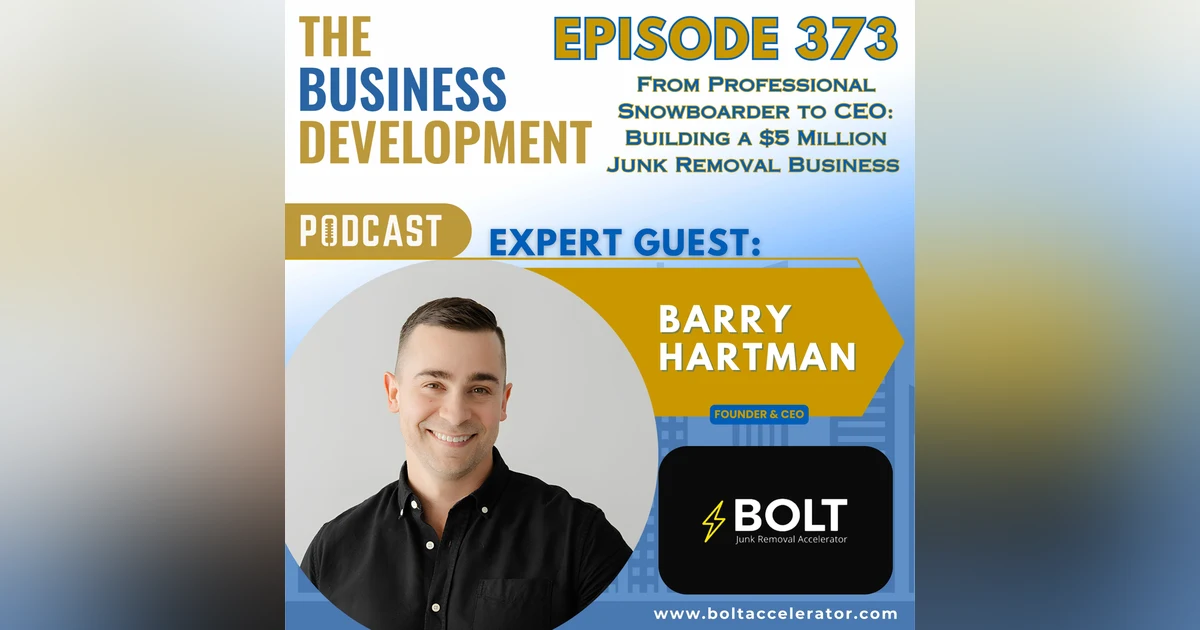
From Professional Snowboarder to CEO: Building a $5 Million Junk Removal Business with Barry Hartman


 Apple Podcasts

 Spotify

 Amazon Music

 RSS Feed
From Professional Snowboarder to CEO: Building a $5 Million Junk Removal Business with Barry Hartman
When Barry Hartman left professional snowboarding to start a junk removal company, a Vancouver newspaper summed up his career change with a headline: “Professional snowboarder drops sponsors to become garbage man.” Barry would have preferred entrepreneur, but the description wasn’t wrong. He was hauling garbage. After earning $200 for a few hours helping with a weekend junk removal job, he had spotted an opportunity. What looked like a side gig could become a business, and the marketing skills he had developed through snowboarding could help him build it.
In this episode of The Business Development Podcast, Kelly Kennedy sits down with Barry Hartman, co-founder and CEO of 505 Junk and founder of Bolt Accelerator, to explore how he helped grow a local service business to $5 million in revenue. Barry shares how early mentorship shaped his approach to hiring and delegation, why developing a pay-by-weight model helped the company stand out, and how a deliberate focus on recurring commercial clients changed its growth trajectory. They discuss competing with an established industry leader, building relationships with both decision makers and people on site, and why winning an account is only the beginning. Barry also explains how he turned his experience into a coaching business and why stepping back from daily tasks can create opportunities for his team to grow.
What You’ll Learn
- How skills developed in one career can transfer into an entirely different industry.
- Why early mentorship, clear processes and hiring can help founders make time to build the business.
- How solving a pricing problem can improve customer trust and operational efficiency.
- Why an established competitor can provide inspiration and evidence of opportunity.
- How a commercial sales process helped 505 Junk grow from $500,000 to $1.5 million in revenue in 24 months.
- Why decision makers and site contacts need different kinds of attention within the same account.
- How consistent service and genuine relationships help turn customers into recurring clients.
- Why stepping away from daily tasks can give employees room to take responsibility and advance.
Chapters
00:00 Professional snowboarder becomes garbage man
01:21 Introducing Barry Hartman
04:17 Selling door to door at twelve
04:58 Growing up around entrepreneurship
06:46 Learning marketing through the family business
08:13 The business lesson Barry’s mother never let him forget
09:47 Helping students discover entrepreneurship
14:09 Becoming a professional snowboarder
18:41 Leaving snowboarding and choosing a new direction
20:26 The weekend job that revealed a business opportunity
21:27 Turning marketing skills into a junk removal business
22:38 Building a company that could scale
25:06 Working on the business and learning to delegate
26:02 Differentiating through pay-by-weight pricing
27:13 Building truck scales and improving efficiency
28:14 Competing with 1-800-GOT-JUNK?
31:09 The commercial sales strategy that changed the business
33:41 Recurring accounts and the path to $5 million
34:16 Building an account management strategy
37:20 Keeping relationships strong after winning the work
39:20 When clients become friends
40:59 The story behind Bolt Accelerator
43:12 Turning experience into systems, coaching and community
44:41 Stepping back without abandoning the business
46:48 Growing Bolt and identifying the right members
49:02 How AI is changing what entrepreneurs can build
50:23 Connecting with Barry
Connect with Barry Hartman
Barry is the co-founder and CEO of 505 Junk and founder of Bolt Accelerator. Through his operating business and coaching community, he helps junk removal entrepreneurs develop the systems, sales processes and leadership skills needed to grow their companies.
LinkedIn: https://www.linkedin.com/in/hartmanbarry/
505 Junk: https://505junk.com/
Bolt Accelerator: https://www.boltaccelerator.com/
Support Foxx and Our Family
Our one year old son Foxx is currently fighting cancer. If you are able to donate or share our GoFundMe, our family would be incredibly grateful.
https://www.gofundme.com/f/support-shelby-kelly-during-foxxs-fight-against-cancer
Thank You to Our Sponsors
Thank you to Colin Harms and our title sponsor, Hypervac Technologies, for your steadfast support of The Business Development Podcast. We are also grateful to Hyperfab for helping us continue to bring these conversations to listeners.
Hypervac Technologies builds professional duct cleaning equipment, including duct trucks, portable vacuums and tools for contractors in the field.
Hyperfab provides custom fabrication and specialized solutions for industrial applications.
Join The Catalyst Club Community
The Catalyst Club brings business development leaders, entrepreneurs, executives and senior professionals together for live sessions, recorded conversations and practical support.
https://www.kellykennedyofficial.com/thecatalystclub
If you know a business owner who is ready to grow but still feels responsible for doing everything themselves, share this episode with them. Follow The Business Development Podcast for more honest conversations about what it takes to build and lead.
Mentioned in this episode:
Hypervac - Revolution Vacuums
There's literally an article in 24 Hour News Vancouver, which at the time was like a big newspaper out here.
Speaker AAnd the COVID page said, professional snowboarder drops sponsors to become Garbage Man.
Speaker BAnd you're like, I resent that.
Speaker AI was like, wow.
Speaker AYou didn't want to use entrepreneur or business person or anything other than garbage Man.
Speaker CThe great Mark Cuban once said, business happens over years and years.
Speaker CValue is measured in the total upside of a business relationship, not by how much you squeezed out in any one deal.
Speaker CAnd we couldn't agree more.
Speaker CThis is the Business Development Podcast, based in Edmonton, Alberta, Canada and broadcasting to the world.
Speaker CYou'll get expert business development advice, tips and experiences.
Speaker CAnd you'll hear interviews with business owners, CEOs and business development reps. You'll get actionable advice on how to grow business.
Speaker DBrought to you by Capital Business Development capitalbd ca.
Speaker CLet's do it.
Speaker CWelcome to the Business Development Podcast.
Speaker CAnd now your expert host, Kelly Kennedy.
Speaker BHello.
Speaker BWelcome back to the Business Development Podcast.
Speaker BAnd today it is my absolute pleasure to welcome to our stage Barry Hartman.
Speaker BBarry is the co founder and CEO of Fiverr 505 Junk, one of Canada's fastest growing junk removal companies and the visionary behind Bolt Accelerator, the premier coaching platform for junk removal entrepreneurs across North America and Australia.
Speaker BFrom his early days as a professional snowboarder to building a $5 million empire in waste management, Barry's journey is anything but conventional.
Speaker BThrough innovations like the pay by weight model and a relentless focus on team culture, he's redefined what it means to scale a service based business with purpose and precision.
Speaker BNow, as the head coach at Bolt Accelerator, Barry is leading a movement helping junk removal owners transform into CEOs, dominate their markets and build empires of their own.
Speaker BHe doesn't just teach business growth, he builds freedom.
Speaker BAnd if you're ready to stop surviving and start scaling, Barry Hartman is the game changer you've been waiting for.
Speaker BThank you for gracing our stage today.
Speaker AWhat an intro.
Speaker AThanks so much for having me, Kelly.
Speaker BYou know, the listeners don't know this, but this has been literally months in the making.
Speaker BWe had technical difficulties the first time around, so it was just, it had, it was not meant to be at the time, but we had a great conversation.
Speaker BI got to know you a little better and that I always find that makes these interviews like a thousand times better.
Speaker AI totally agree.
Speaker AActually it's.
Speaker AI did a podcast recently and there was, it was a full podcast in that case.
Speaker AAnd on the other end that time, this time was my end I was traveling Australia, so Internet tech difficulties, but on that end it was on the, the host side and they lost the whole thing.
Speaker AAnd it was like, I, I, we.
Speaker BKind of.
Speaker AChalked it up as like round two is now we've got a whole hour and a half of prep leading into it.
Speaker ASo it's going to be way better.
Speaker BThat's right.
Speaker BIf there's one thing I've learned on this journey, it's that we're people first, business people second.
Speaker AYeah, that's right.
Speaker BYou can't outrun your humanity no matter how hard.
Speaker ANo, that's a hundred percent true.
Speaker BBarry, I'm super excited for this interview today.
Speaker BWe actually haven't had anybody from the junk removal space before, so I'm very excited that you're the first and I just love your energy and I'm excited to have this chat with you and teach our listeners, who is Barry Hartman.
Speaker BYou're doing incredible things, not just here in Canada with regards to your company, but in teaching the next generation, which is exceptional and something I believe super heavily.
Speaker BAnd so we definitely connect on that front.
Speaker BBut before we kind of dive in deep today, lead us down the journey, man.
Speaker BHow did you end up on this entrepreneurial journey?
Speaker BWere you always this driven?
Speaker AYeah, I mean, I've got the classic sort of entrepreneurial start.
Speaker AWhen I was 12 years old, I was going door to door.
Speaker AI had a three tier sales program, you know that I always joke as a 12 year old.
Speaker AAnd, and the first thing was, I'll wash your car for five bucks and we'll do that on a monthly basis.
Speaker AIf they say no to that, then the second thing was I'll walk your dog once a week at $7 a walk and we'll do it for whatever it was half an hour or something at the time.
Speaker AAnd if all else fails, I asked them if they wanted to buy some chicken strips because everyone needs chicken strips.
Speaker AAnd we bought them from Costco for 20 bucks and we sold them for 30.
Speaker BOh, wow.
Speaker ASo that was the starting point of it all.
Speaker BAmazing, amazing.
Speaker BI always like to ask, like, were your parents entrepreneurs by chance?
Speaker AThey were very entrepreneurial and it was actually until my dad was about 55 years old and he was laid off from his job.
Speaker AHe was in human resources and the company got acquired, they restructured.
Speaker AAnd you know, that's such an interesting age because you're sort of 10 years leading up to sort of retirement if that's the age you're targeting.
Speaker AAnd, and for him, they, they started looking at different options and you know, they landed on purchasing a franchise from a fellow named Mike Drever, and he ended up being our first mentor in business, actually, down the road.
Speaker ABut he bought the seventh franchise off Mike, and it was a retail travel agency specifically for selling cruises.
Speaker ASo it was called Cruise Ship Centers.
Speaker AThey opened up a brick and mortar shop.
Speaker AThey did really well with it, actually, in the.
Speaker AIn the 10 years leading up to selling it.
Speaker ABut I think their biggest claim to fame is they've been on, like, 55 or 60 cruises because they need to product test them.
Speaker BAll,.
Speaker AMake sure they're selling the right thing.
Speaker AAnd so it ended up working really well for them.
Speaker AIt was a good segue into the retirement.
Speaker AAnd, yeah, they.
Speaker AThey've been a big influence on me and very supportive over the years.
Speaker BWow.
Speaker BOkay.
Speaker BOkay.
Speaker BHow old were you when they.
Speaker BWhen they got into that business?
Speaker AI was in high school still, so probably, like, partway through high school.
Speaker AReally had no idea what it was.
Speaker AI remember, like, looking at.
Speaker AAt the retail.
Speaker AAt the actual, like, travel agency and thinking, like, wow, this is a beautiful renovation.
Speaker ALike, this place is perfect.
Speaker ALike, why doesn't our home look like this?
Speaker AJust like a high school kid not knowing anything about business.
Speaker AAnd then.
Speaker ABut I did a bit of work for them over the years.
Speaker AIt started just with, like, filing and stamping their brochures that they would hand out.
Speaker AAnd then.
Speaker BYeah.
Speaker AAnd then later on, you know, when I was taking a break between my stint in professional snowboarding and then, you know, entrepreneurship, I was studying marketing at college at the time, and I asked them.
Speaker AI was like, I don't care what you pay me, but I really think I can help generate some leads for you.
Speaker AAnd of course, you know, as parents, they want to help, but more so, they want the leads.
Speaker AAnd so they took me up on the offer.
Speaker AThey paid me 15 bucks an hour, and I remember getting them ranked number one on Google.
Speaker AMy business.
Speaker AWe created a separate blog post or, like, a blog website for them to sort of start creating, like, their influence in the space outside of the franchise system.
Speaker AWe built at the time a Twitter account for my mom.
Speaker AShe didn't post on it.
Speaker AIt was all me.
Speaker ABut it actually ended up working quite well, particularly the local marketing side of things.
Speaker AUnfortunately for them, I quickly realized if I could do that for them, I could do it for me.
Speaker AAnd started.
Speaker BSomeone else.
Speaker AQuickly afterwards.
Speaker BOkay, okay, I love that.
Speaker BI love that.
Speaker BI always like to ask that question when possible, because I do find that with a lot of incredibly successful people, they come from entrepreneurial families at some level or another, whether it's an uncle or a parent, there was somebody close to them that ultimately modeled the start of it.
Speaker BWhether or not that's exactly what they did is usually negligible.
Speaker BBut I. I really do think being able to see it on some level when you're younger, even in high school, is a massive, massive asset to your kids.
Speaker AYeah, absolutely.
Speaker AAnd I'll never forget one thing my mom said to me when I had decided on 505 junk.
Speaker AI wrote the business plan and was actually ready to drop out of college and go full time on it.
Speaker AWe were on a vacation somewhere.
Speaker ANot a cruise ship, surprisingly, but we were on vacation somewhere.
Speaker AAnd I remember being at the front desk, and she said, what do you see?
Speaker AAnd I looked around, I said, there's a desk, there's a person, and I want to get into the hotel room.
Speaker AAnd she was like, okay, here's what you're going to see in the future.
Speaker ABecause when I stand at the front of a hotel room, I'm wondering, what's the training program for their employees?
Speaker AWhy did they choose this type of flooring?
Speaker AWhy did the customer service rep at the front desk say this thing to me?
Speaker AWhat kind of software are they using to run the hotel?
Speaker AShe's like, once you start your own business, you will never be able to switch that brain off.
Speaker AIt's not a negative thing.
Speaker AIt's not a positive thing.
Speaker AIt's just something for you to be very aware of.
Speaker AAnd just knowing that actually has been really helpful over the years, because it's true.
Speaker AI look at everything through the lens of a business and you can't shut it off.
Speaker AAnd I.
Speaker ATurns out, I love it.
Speaker ASo it's a great thing.
Speaker ABut, yeah, it was a very influential comment that she made at the early days of starting a business.
Speaker BIt's so funny, the interview before you today, we were talking about that how, like, even if you leave entrepreneurship, you never really leave the entrepreneurial thinking.
Speaker AThat's.
Speaker BLike, it literally becomes a part of who you.
Speaker AAre.
Speaker AYeah.
Speaker AI was at a high school yesterday, actually presented to a class about.
Speaker AIt's called Yale Young Entrepreneurs and Leadership Launchpad.
Speaker AIt's sort of like an extracurricular thing that they can sign up for.
Speaker AThey still get credit.
Speaker ASo, you know, the kids in the room are really curious about this because they choose to be there.
Speaker AAnd I remember asking them, I was like, what does entrepreneurship mean to you?
Speaker AAnd someone raised their hand and they were like, solving a problem.
Speaker AI was like, very good answer.
Speaker AThat's great.
Speaker ASomeone else raised A hand and they wrote community.
Speaker ASo you know, community of people, employees, whatever.
Speaker AAnd I remember just showing them around the classroom, like that desk, that paper, that pen, this laptop, the screen.
Speaker AEverything is a business.
Speaker AAnd you, the.
Speaker AThe cool thing about entrepreneurship is you can choose whatever you want to get into.
Speaker AAnd I remember their, their eyes just opened up and, you know, they're focusing on a lot of tech stuff.
Speaker ALike one of them was actually building a.
Speaker AA robot that would go sort of door to door and pick up the trap.
Speaker AI don't know, maybe they did that just for me kind of thing.
Speaker ABut it's, you know, you could see all the, see the wheels turning in these grades, tens, eleven and twelve students.
Speaker AAnd it's.
Speaker AYeah, it's true.
Speaker AOnce you get a taste for it, it's hard to shut it off.
Speaker BWow, that's incredible.
Speaker BTell me a bit more about that initiative that, that you were going to schools and talking to kids.
Speaker AYeah, so it's a not for profit program.
Speaker AI remember that, like when I was in high school, I was very lost.
Speaker AI was kind of hanging out with the wrong crowd and had amazing parents, amazing support, and it still wasn't enough to get me out of my sort of like funk that I was in for a few years.
Speaker AAnd, and so it was, I remember thinking when someone brought this program up to me and asked me to speak at the high school, like, man, I would have loved to find a program like this and be able to like sink my teeth into the idea of launching a business.
Speaker AEven though most of them probably won't pursue the actual model they're building in high school.
Speaker ASome of them might, but just the process of going through it was invaluable, or seemed invaluable.
Speaker AAnd I was thinking like, the first time I joined them actually was pre business coaching.
Speaker ASo now that I'm into business coaching, it makes it even more intriguing to me because that's what I do now.
Speaker ASo coaching these teenagers is, is.
Speaker AIt feels great for me.
Speaker ABut yeah, I just remember thinking, like, I would have loved to have that as a kid.
Speaker AAnd you know, if I can, I always, whenever I'm doing like a speaking engagement or even a high school session or, or college session, if I could just positively impact one person in the room, then it's a hundred percent worth the time to go and do it.
Speaker AAnd yeah, so it's just a program I believe in.
Speaker AWe try and put some time into it every year.
Speaker BSo.
Speaker BAmazing.
Speaker BMan, I look back to being in high school, we had nothing like that.
Speaker BAnd like, I'M in Alberta.
Speaker BSo everyone just thinks we're going into the trades.
Speaker BI think for the most part.
Speaker BBut like the high school had trades programs, but they had nothing in the business space.
Speaker BAnd it's like, I think I knew too, when I was quite a bit younger that I liked the idea of business.
Speaker BI had no idea what the hell that.
Speaker AMeant.
Speaker AYes,.
Speaker BI like the idea of it.
Speaker BRight.
Speaker BIn grade 11, grade 12, I had no clue.
Speaker BBut at the same time, I don't necessarily think you have to have all the clues in the world.
Speaker BI think, you know, I mean, if you know, you know.
Speaker BAnd it was so cool because this year I was hanging out with my nephew and he's like, you know, uncle, I'm in business classes in high school.
Speaker BAnd I'm like, like, for real, like, why did those not exist when I was a kid?
Speaker A100%.
Speaker AYeah.
Speaker BSo schools are doing better.
Speaker BThey're doing much better.
Speaker AThey're evolving for sure.
Speaker AYeah.
Speaker AAnd you know, I was, I was saying to you before, my wife's from Australia and Brisbane, and I know that's a topic that they're starting to explore a lot more is these, like, it's crazy to call entrepreneurship an alternative path because starting a business to me is like, it's a very viable career, especially if you can actually,.
Speaker BIt might be one of the oldest paths ever.
Speaker AIt is, it literally is.
Speaker AAnd like, we spend so much time training and coaching and educating people on how to land this dream job, which is amazing and a really big part.
Speaker ANo business can survive without a great team.
Speaker ASo you need that balance.
Speaker AI just think we forget to bring up the fact that someone needs to start in the first place.
Speaker AAnd that's a whole different set of skills than walking into an existing business and applying the skills that you learn along the way.
Speaker BAbsolutely, absolutely.
Speaker BYou are my very first professional snowboarder.
Speaker BSo I feel like I want to touch on that really quickly.
Speaker BWe've had a former pop star, but we've never had a professional snowboarder.
Speaker BDude, that sounds amazing.
Speaker AIt was a wild experience.
Speaker ASo around those sort of like darker high school days that I was speaking of before, I found snowboarding.
Speaker AAnd holy crap, that I fall in love with it like immediately.
Speaker BYeah,.
Speaker AUnfortunately.
Speaker AI grew up in a small town called Tawasan about, I don't know, and it's about 45 minutes from downtown Vancouver and then about an hour and 15 minute drive to the mountain.
Speaker AAnd if you don't drive, it was about a three hour bus ride.
Speaker ASo.
Speaker BOkay.
Speaker AFortunately for me, my parents decided to open this travel agency that we were speaking of before right near the mountains, because it was a bit of a wealthier community.
Speaker AAnd so a nice sort of silver lining of that was that they had to drive by the mountain and so they would drop me off.
Speaker AI remember starting to get really good because I was going up almost every day.
Speaker AI always joke I fired my high school friends because they were a bad influence on me and it wasn't trending in the right direction.
Speaker AAnd snowboarding was my replacement.
Speaker AAnd, you know, they had all these cool movies coming out, and the professional snowboards were doing all these crazy tricks.
Speaker AAnd I remember just thinking, I want to do that.
Speaker AThat.
Speaker AThat looks awesome.
Speaker AI don't know what it's going to take, but I assume you just have to snowboard every day.
Speaker AAnd so started going up the hill around, like, grade 12.
Speaker AI remember speaking to our high school principal and counselor saying, I'm going to make it into the Olympics for snowboarding, and so I'm going to need time to do this.
Speaker ASnowboarding wasn't even in the Olympics by at that point, but that's okay.
Speaker AAnd the.
Speaker AThe principal, they worked with me.
Speaker AThey were like, okay, we'll give you credit for pe, Physical education, the gym class.
Speaker AWe'll give you two spares and the career and personal planning.
Speaker AIt sounds like you've already made.
Speaker AYou know, you've got that sorted out, Wink.
Speaker ASo we'll give you credit for that, too.
Speaker AAnd so I got every other day off school to pursue snowboarding, and.
Speaker AAnd it started to really take off.
Speaker AI got, you know, as you build up your skill set and you sort of get recognized by different people on the hill.
Speaker AGot some film opportunities, got my first set of sponsors around 17 years old, traveling down to California to do a bit of filming.
Speaker AAnd I remember moving up to Whistler like I was just fresh out of high school, and I saved enough money washing dishes to move up there and move out on my own.
Speaker AAnd I did a full year in Whistler Snowboard every day, night janitor in the evening for the local mountain.
Speaker ASo I got my free pass.
Speaker AAnd.
Speaker AAnd at that point, Whistler is like the pinnacle of professional snowboarding.
Speaker ASo not only does everybody live there, it's such a challenging mountain, especially the terrain park, that if that's your home base, like, inevitably you're just going to start to master the skills over the years.
Speaker AYeah.
Speaker AAnd so I had.
Speaker AI had some sponsorships, but I remember coming home one day or I moved home for the summertime, and I got a call from this random number.
Speaker AAnd the lady on the other line was like, hey, are you Barry Hartman?
Speaker AAnd I was like, I sure am.
Speaker AAnd she's like, oh, I'm calling from Eastern Mountain Sports.
Speaker AWe're out of New Hampshire in the United States.
Speaker ASomeone pass your name along.
Speaker ADo you want to come to Argentina with us in a month?
Speaker AWe're going to film our entire catalog for the year in two weeks.
Speaker AAnd I thought it was a joke.
Speaker AI thought it was a prank, because at this point we're talking dishwasher, janitor.
Speaker A17 Year old snowboarder had no money.
Speaker AAnd I was like, sure, but what do I need to do?
Speaker AShe's like, I'll send you all the details.
Speaker AJust give me your email address.
Speaker AAnd so I made up a proper email address on the spot because my other email address was not good to tell her.
Speaker AWhatever high school when I made,.
Speaker BI remember, I remember the days.
Speaker AAnd, and so, and then, so she sends it over.
Speaker AShe calls me back a couple days or sorry, a couple, like literally 10 minutes later.
Speaker AI hadn't even had time to run downstairs and tell my parents yet.
Speaker AAnd she's like, oh, you're getting paid $350 a day to be there and any expenses you incur will pay you back dollar for dollar.
Speaker AAnd I remember thinking like, they ended up stretching that trip to three weeks.
Speaker ASo it was like, it was like $6,000, which.
Speaker BWas.
Speaker ALike my annual income at the point.
Speaker B17 Is pretty good.
Speaker AIt was a lot of money at the time that allowed me to not only experience that, gained a lot of like good footage and reputation.
Speaker AAnd traveling with these different photographers that flew in from across the world allowed me to buy my first pickup truck and snowmobile.
Speaker AAnd so we, and it just started to take off from there.
Speaker BWow, wow, wow.
Speaker BOkay, so you did that for what, four years?
Speaker BYou were a professional snowboarder.
Speaker BAnd I did notice that the year you stopped being a professional snowboarder was the year that you started 505 junk.
Speaker BAnd so I wanted to understand that.
Speaker BI was like, okay, what, what happened?
Speaker BWhere did that shift happen?
Speaker BAnd then, why Junk?
Speaker AThere's literally an article in 24 Hour News Vancouver, which at the time was like a big newspaper out here.
Speaker AAnd the COVID page said professional snowboarder drop sponsors to become Garbage Man.
Speaker BAnd you're like, I resent that.
Speaker AI was like, wow, you didn't want to use entrepreneur or business person or anything other than Garbage Man.
Speaker ABut they weren't wrong because when we launched 505 junk, I was literally hauling garbage so,.
Speaker BOkay, okay,.
Speaker AYou know what?
Speaker AI got to a point in my sort of snowboarding career where it, the, the writing was on the wall that this was not going to be a forever thing.
Speaker ALike, 98 of the sponsored money goes to 2% of the professional snowboarders in the world.
Speaker AAnd I wasn't part of that 2%.
Speaker AAnd I had done it for so long that I actually kind of fell out of love of snowboarding.
Speaker AThe progression of it was getting insane.
Speaker ALike, you know, not to get too technical, but if back then I could do like a 900 as a trick, kind of going over like a 70 foot jump and spinning two and a half times in the air.
Speaker AThere were kids that were coming out that were 14 years old that were just starting to do tricks that nobody had ever seen before.
Speaker AAnd I remember thinking like, I'm not trending in that direction.
Speaker AI need a plan B here.
Speaker BGotcha, gotcha.
Speaker BYou're like these punk.
Speaker AKids.
Speaker BYeah.
Speaker BThat next generation.
Speaker BHey,.
Speaker AYeah.
Speaker AAnd yeah.
Speaker ASo then I, I enrolled in our local college and started studying marketing.
Speaker AAnd I kind of fell in love with business.
Speaker AI mean, I was just, I knew I wanted to become an entrepreneur.
Speaker AI didn't know what it was going to be.
Speaker AI didn't know if it was going to be a product or a service or what it was going to be.
Speaker AAnd a friend of mine, his older brother, had started sort of a side gig hauling junk on the weekends.
Speaker AAnd he'd go out and we'd go out for two or three hours.
Speaker AHe'd make eight, nine hundred dollars recycling material, pay for a bit of fuel.
Speaker AAnd he gave me 200 bucks at the end of the shift.
Speaker AAnd I was like, I've only been here for three hours.
Speaker AMy time is not worth $70 an hour.
Speaker ATrust me.
Speaker BYeah, yeah.
Speaker AAnd.
Speaker AAnd he was like, no, no, it's all good.
Speaker ALike, it didn't take me that long.
Speaker ALike, just have it.
Speaker AI'll keep the rest.
Speaker ANo big deal.
Speaker AAnd I remember thinking like, no big deal.
Speaker AWhat?
Speaker AWhat do you mean no big deal?
Speaker ALike,.
Speaker BYou don't make.
Speaker AMoney.
Speaker ANo big deal.
Speaker ANot having come from it, like, it's a very big deal.
Speaker BYeah, yeah.
Speaker AAnd so then I got to work.
Speaker AI started writing a business plan.
Speaker AI was like staying up all night studying 1-800-got-JUNK and Brian Scudamore, the founder and researching all the local companies, the American companies.
Speaker AThere's one that just came out on Dragon's Den at the time, which is sort of the Canadian shark tank.
Speaker AAnd I remember seeing like, holy, you could this doesn't need to be a side gig.
Speaker AWe could build, like, a proper legitimate business out of this.
Speaker AAnd you don't need a lot of capital to start, which I didn't have.
Speaker AAnd you don't need really any skill sets to start, which I also didn't really have.
Speaker ABut I did learn a lot on the business side, almost like subconsciously from snowboarding, more so on the marketing side.
Speaker AI didn't know what an invoice was when we started.
Speaker A505 Junk.
Speaker AMy co founder will joke about that still today.
Speaker ABut I did understand marketing.
Speaker AI understand branding.
Speaker AI understand how to work the press.
Speaker AI understand, like, you know, how to kind of be competitive and, like, differentiate yourself from others and the personal branding side of it.
Speaker AAnd so that's when I realized that maybe those skill sets are transferable to junk removal, just not in ways that you might think it would be.
Speaker BSure, sure.
Speaker BBut once again, it's one thing to start a junk removal company.
Speaker BIt's a whole nother thing to scale it to one of the fastest junk removal companies in the whole country.
Speaker BAnd I feel like that takes business savvy, and that's what I'm excited to kind of get into.
Speaker BYou today is like, how did you take an idea, something that essentially you could run with one person and then scale it to such an extent?
Speaker AYeah.
Speaker AThe founder of cruise ship centers, who sold the franchise to my parents.
Speaker AI reached out to him at two weeks into business and was like, here's what we're doing.
Speaker AHere's what I want to build.
Speaker AI don't want it to be just like a small local service with a couple trucks and a couple employees.
Speaker ALike, I. I do want to build, like, a big brand and.
Speaker AAnd long term, have national presence with it.
Speaker AAnd he's like, all right, I'll meet you at the coffee shop.
Speaker AIt was a Sunday afternoon.
Speaker AI'll give you an hour of my time.
Speaker AHe had just sold cruise ship centers for, like, $35 million to Expedia.
Speaker AAnd so he.
Speaker AHe knew what he was doing.
Speaker AFor lack of better words.
Speaker BSure, sure.
Speaker BYeah.
Speaker AAnd he sat me down and he helped me understand how to build a vision.
Speaker AHe understand.
Speaker AHe walked me through building a strategic plan.
Speaker AHe understood.
Speaker AHe taught me how to build, like, standard operating procedures so that we could quickly get off the trucks and delegate the work.
Speaker AHe taught me how to do financial planning.
Speaker AHe gave me three or four books to read.
Speaker AOne was the E Math, which is sort of the go to startup book for entrepreneurs.
Speaker AAnd he just set me off on this, like, Trajectory and met.
Speaker AWe ended up meeting up with him a couple more times after that.
Speaker ASo that was very beneficial.
Speaker AEarly on, something very beneficial as well was my business partner Scott Foran.
Speaker AHe was exceptional at running Google Ads.
Speaker AAnd so we were able to really like really increase our customer acquisition rapidly enough so that we could put our first hire, Alex Elsey, who's now a partner in the company and our VP of sales and operations today.
Speaker AHe was our first sort of hire about six months in.
Speaker AAnd that allowed me to basically get off the truck and dedicate my full time work towards figuring out how to build this business.
Speaker AAnd so I had the time which is like the biggest thing is a business partner and a full time employee allowed me to kind of step back and look at this thing and understand how are we going to scale this thing up.
Speaker BYeah, like instead of you being on the job, you or working in the job, you could work on the job.
Speaker BYou could figure out how to actually grow this thing.
Speaker BLong.
Speaker A100 And that's the classic E myth.
Speaker AIt's like you need to not work in your company, you need to work on it.
Speaker AAnd I just, that was the first book I read.
Speaker ASo that's all I knew.
Speaker AAll I knew was that I shouldn't be working in the business.
Speaker AI need to be constantly working on it.
Speaker AAnd anytime I see myself going back in it, which is working in the trucks or picking up the phones to book jobs or sending invoices, I always had this, and I still do today, this mental cue, this book, just telling me you should not be doing this.
Speaker AYou should find someone else that is happy to do it and go and work on building the business.
Speaker BWell, that's the right, that's the right self talk.
Speaker AYeah,.
Speaker BThat's what, that's what happens when you're wired properly.
Speaker AYes, that's right.
Speaker BWell.
Speaker AAnd that's a very good point because in Bolt, which I'm sure we'll get into in a bit.
Speaker ABut that is one of the biggest limiting beliefs or mental roadblocks that people have is that.
Speaker BThings that no one could do it better than.
Speaker AYou and they can't, they haven't figured out delegating yet and it's just not true.
Speaker BYeah, yeah.
Speaker BOne of the things that you guys are known for in the junk industry is pay by weight.
Speaker BI can't even believe that that wasn't a thing.
Speaker BTalk to me, what was it like before that?
Speaker AStill the same as it is today.
Speaker APeople show up to a job site, they look at it, they give it a ballpark Estimate on how much volume fills the truck, the truck gets filled, and then hopefully everybody was right.
Speaker BYeah, that's hard.
Speaker BThat doesn't work every time.
Speaker AIt doesn't.
Speaker AAnd so we wanted to find something that differentiated us because while it was somewhat easy to get into junk removal, we also happened to really pick a dog fight with an 800 pound gorilla who happened to be in our backyard, which was 1, 800, got junk.
Speaker AAnd so figuring out A, how to differentiate ourselves and B, how to be exceptional at marketing, to me, those were like the top two priorities that we needed to like figure out ASAP in like year one or two.
Speaker AAnd so it started by charging by weight but not having scales in the truck.
Speaker ASo we go to a job site, go to the transfer station, get the weight ticket, drop off the items, scan it, email it to the client, and hope they pay us.
Speaker ANot very efficient.
Speaker BYeah,.
Speaker AYou also can't stack jobs because there's no way of getting the total weight of one job site if we're combining them into two.
Speaker AAnd then, so then we, my business partner Scott and I went on this journey of just figuring out how to put scales on the truck.
Speaker AAnd there's a lot of different ways you can go about it.
Speaker AThe one way that we figured out was a way on how to put an onboard Wayne system on the truck as a sub chassis that allowed us to sort of like measure the components in it.
Speaker AIt had a digital reader on the side.
Speaker AIt had a, a what they call the world's smart smallest printer.
Speaker ASo it could print out these little weight tickets.
Speaker AAnd that allowed us to load material, print the weight, build the client on the spot, go to the next job.
Speaker AOnce the truck's full, then we go to the transfer station.
Speaker AAnd it increased our efficiency, our roi.
Speaker AIt really helped with the commercial clients because they didn't need to be on site.
Speaker AAnd we had proof of purchase through the weight tickets.
Speaker AIt really sent us in the right direction.
Speaker AAnd that was about 2014.
Speaker ASo we were three years in when we first built that truck.
Speaker BWow.
Speaker BWow.
Speaker BOkay, I want to, I want to talk to you about that 800 pound gorilla.
Speaker BBecause he's a big gorilla.
Speaker AYes.
Speaker BThat's a big company.
Speaker BRight?
Speaker BWalk me through that.
Speaker BYou know, were you ever like, I don't know if we can compete with 1, 800 got junk?
Speaker BLike, did that thought ever cross your mind when you were kind of getting started?
Speaker BWhat was it that allowed you to say, you know what, they're big, but I think there's room for us too?
Speaker AYeah.
Speaker ASo they were doing about $150 million at the time, and that was spread out across North America.
Speaker AAnd I kept seeing their trucks everywhere.
Speaker AAnd I always kept thinking, like, every time I saw a truck, it just like, lit me up.
Speaker AWe had our old pickup truck with our crappy trailer and barely any branding on it.
Speaker AAnd I just remember seeing these, like, these blue trucks driving everywhere.
Speaker AAnd they were these Isuzu cabovers with the nice dump body on the back and they always look clean.
Speaker AAnd I just couldn't help but think, like, I want that.
Speaker AI want that.
Speaker AI need.
Speaker AWe need that.
Speaker AWe need the brand, we need the website, we need the.
Speaker AThe customer experience, we need the great employees.
Speaker ALike, we need everything.
Speaker AAnd so I don't think it was ever that we couldn't compete with them.
Speaker AI saw them more of like an inspiration, if anything.
Speaker AAnd I've actually got to know Brian quite a bit over the years and he's been really giving of his time and brought me into his office.
Speaker AAnd, you know, we go back and forth on emails with, like, shared ideas now and stuff like that.
Speaker ABut yeah, he's, he's been great, honestly.
Speaker AHe's one of the nicest entrepreneurs that I've met.
Speaker AAnd at first I was like, are you just sort of like putting up a.
Speaker AA face here?
Speaker ABecause, like, I'm the competitor and you're keeping me at arm's length.
Speaker ABut it turns out he's just a nice guy.
Speaker BYeah.
Speaker BAnd you know what?
Speaker BI see that more often than the, than the alternative.
Speaker BI see so many entrepreneurs who are psyched to give back, who are excited to help the next generation.
Speaker BAnd actually, you know, I've carried that forward too, into my coaching and training.
Speaker BLike, yeah, I have a business development firm.
Speaker BThere's room for hundreds of business development firms in this country.
Speaker BRight.
Speaker BI have no issue training people to be the next competitor because at the end of the day, there's so many businesses.
Speaker BAnd I think in your case, at the end of the day, there's like millions of people who need junk removed.
Speaker AAbsolutely.
Speaker AJust in Vancouver alone.
Speaker AI mean, there's.
Speaker AThere's 25,000 junk removal companies in North America.
Speaker BWow.
Speaker BI had no idea.
Speaker BThat's crazy.
Speaker BAnd.
Speaker AThere's 250 just in our market.
Speaker ASo what's 251 for me at the time it was like, it's not nothing.
Speaker AI just wanted to make sure we could climb to the top because I didn't want to be the 108th best junk removal company.
Speaker ALike, we.
Speaker BWant.
Speaker BWe were in.
Speaker AThis to be the best, however you define it, maybe best in our market.
Speaker ANever the biggest.
Speaker ARight.
Speaker AI don't need.
Speaker AThey're doing 800 million a year now.
Speaker ALike, that's not my goal to do 800 million a year.
Speaker AIt might be for some people, but it was always just that, like steady eddy growth and making sure we could hire great people, build a good brand, have a really strong reputation, the market.
Speaker AAnd if and when all that goes to plan, then we start looking at expansion after that.
Speaker BSure, sure.
Speaker BLike I said, you're like the very first person from the junk industry, or even the garbage industry, we could call it.
Speaker BUltimately, take me into that industry.
Speaker BLike, what is it?
Speaker BLike, what's scaling a business like in, you know, specifically in the junk removal space.
Speaker AYeah, so it's half marketing and half business development.
Speaker ASo we early days, we were about 20% commercial, 80% residential.
Speaker AThe 80% residential are your typical homeowners.
Speaker AThey're looking to get rid of bulk items.
Speaker AThey use us once or twice a year.
Speaker AYou know, we've got to be dialed in with Google Ads, SEO, our referral programs, even, like with AI these days, like having like a good AI voice agent so that if we miss a call, it never actually gets missed.
Speaker AHiring good people, like fighting for reviews, you know, the, the typical service stuff that is like essential in order for a local business to thrive.
Speaker AAnd that got us to about half a million in revenue by 2015.
Speaker ASo from from our perspective, we were growing at a good rate.
Speaker AI mean, still in our twenties, half a million in revenue, we could finally pay not only the bills, but give ourselves a little bit of an income.
Speaker AAnd a friend of mine walked in one day and he's like, those commercial clients, like, tell me about them.
Speaker AAnd I was like, property managers, construction companies, real estate agents, estate managers.
Speaker AThere's lots of different types of.
Speaker AAnd then like our general commercial, which is offices and law firms and anyone that just needs to get rid of anything.
Speaker AAnd he's like, those are all recurring clients.
Speaker AAnd I remember thinking, yeah, I know, it's great.
Speaker AThat's why it makes up 20% of our revenue.
Speaker AAnd he's like, what are you doing to get more of those clients?
Speaker AAnd I said, nothing.
Speaker ASo he, he walks in my office, he grabs a Sharpie, we go to the whiteboard, and he drew out a full pipeline for our future business development plan or commercial sales plan.
Speaker AAnd, And I remember thinking like, that seems pretty straightforward.
Speaker ASo we picked up pipedrive, we got our scripts in place, we.
Speaker AWe adjusted like our B2B marketing and, and Sort of started to prepare for launch, if you will, and we ended up growing from about 500,000 to 1.5 million in 24 months.
Speaker AAnd wow.
Speaker AHonestly, it moved our commercial revenue up to about 50%.
Speaker AAnd of that 50% of commercial revenue, 95% of the clients were all repeat clients booking every week or month.
Speaker BYeah.
Speaker AAnd that's, that's been our scale factor today.
Speaker AI mean, we still, of course, we do a ton, all of the marketing for SEO, meta ads, social media, whatever.
Speaker ABut there's this other side to the commercial where figuring out the process of, of finding and onboarding new recurring commercial accounts and then also figuring out the account management side of keeping them and scaling them and building those relationships even when they move to another company, which is honestly great because you retain the prior account and follow the new one that has what has allowed us to scale to 5 million.
Speaker BAmazing.
Speaker BAnd I love that you touched on the account management space because when I'm working with clients, typically one of the caveats that I have to give them is I can open the door for you, but I'm not the right person to manage that customer.
Speaker BThat needs to be somebody high level in your organization, who you trust, who isn't going anywhere, who's going to treat them like gold and consistently, not just once or twice, but like on a quarterly basis at least.
Speaker BRight.
Speaker BI'd love to better understand your account management strategy because I think that's something that gets super overlooked by a lot of organizations.
Speaker AYeah, so that's a really good question.
Speaker ASo first of all, we look at the different buckets of types of clients.
Speaker ARight.
Speaker ASo for us, that's our construction clients.
Speaker AIt's all within real estate.
Speaker ASo real estate is the main umbrella that we're looking for.
Speaker AAnd then we branch it out into two core segments or verticals.
Speaker AOne is new construction, which is anything from new homes to renovations to commercial tenant improvement projects.
Speaker ALike, my business partner Scott just landed a massive.
Speaker AIt was like a $350,000 job spread out over 18 months.
Speaker AWow.
Speaker AAnd that was one client, one job.
Speaker BWow.
Speaker ASo there's all the new stuff, which is essentially construction, and then there's all the management of the existing buildings, which is our property managers, the estate managers.
Speaker AUnfortunately, people die and, and, but we can really help there as far as like removing the items.
Speaker AHoarding is a huge one for us.
Speaker AYou know, that's another unfortunate situation.
Speaker AWe run into a lot, but the silver lining is that we can really help them.
Speaker AAnd if we are empathetic towards that situation and they can get their house back, man.
Speaker AIt can be transformational for people.
Speaker ASo first we break it down and then we're looking at, okay, who are all the key decision makers in the account?
Speaker ABecause for us there's usually the decision maker and then sort of the site contact.
Speaker AAnd those are two different relationships.
Speaker AFor us, the decision maker is usually more of like a senior manager or sometimes a vp or if it's a small business, it's the business owner.
Speaker AAnd.
Speaker BYeah,.
Speaker AOur goal is not to like bombard them with, hey, you got any work?
Speaker AOr anything like that.
Speaker AIn fact, we're not even really engaging with them on that frequent of a basis.
Speaker AIt's more just to build.
Speaker ATo build the trust with them so that they can deploy our company to multiple construction sites, multiple properties, if they own and operate a real estate office, to all of their agents.
Speaker ASo that's the decision maker that we're really trying to build a relationship with.
Speaker AAnd then for the people on site, which in construction is superintendents or in property management, it would be the actual building manager or the real estate agents.
Speaker AThose people, like, we just have to literally, we do anything for them.
Speaker ALike we've got 10 trucks going out tonight from 6pm till 2am because this client is doing a demolition in downtown Vancouver and they need all the waste removed by Sunday morning.
Speaker BOh, wow.
Speaker ASo account management to me is like the relationship side, but the execution is probably the most important side of it.
Speaker BYeah, absolutely.
Speaker BBut once again, you might do this job right, but if somebody isn't still connecting the dots, making sure that that person is looked after, lunches, meetings, things like that, the relationship can deteriorate and suddenly it does become a.
Speaker BWell, I don't know.
Speaker BI'm going to use your.
Speaker BI'm going to use 1-800-got junk.
Speaker BRight.
Speaker BBut the account management is like the force multiplier for making sure that you do get that next opportunity.
Speaker BAnd so many companies just neglect it and it blows my mind every time.
Speaker BAnd then I see a company like yours, it's like, obviously you're looking after these people or they would not be coming back, you know, year over year over year.
Speaker BRight.
Speaker BBut that is a missing piece in a lot of organizations.
Speaker AYeah, it is.
Speaker AAnd especially in Bolt, right.
Speaker AWhen we're coaching people, like the first thing I say, what's your commercial sales process?
Speaker AAnd usually they just go, sorry, what?
Speaker AWhat is that?
Speaker AAnd that's like literally the first thing that I like to focus on, knowing how much of an impact it had on us that it very well likely will have.
Speaker AThe same impact on them.
Speaker BYeah,.
Speaker ABut you're.
Speaker AI mean, to your point about, like, the lunches and all that kind of stuff, like, that actually is important.
Speaker ALike, we take our clients golfing.
Speaker AMy business partner just went to Mexico with one of our first commercial client who has spent hundreds of thousands of dollars on our company over the years.
Speaker BYep.
Speaker AHe's not looking for, like, a kickback or anything weird like that.
Speaker AHe just wants to know that he's valued.
Speaker AAnd he absolutely is, because it's.
Speaker AOur business wouldn't be the same without that client as well as, like, the very similar ones that are in the same industry using us little things like going to sports games.
Speaker ALike, I. I like all these types of things because it's not just.
Speaker AYou're not just like, giving them the tickets.
Speaker AWe do do that because they don't always want to hang out with us.
Speaker ABut, like,.
Speaker BSure.
Speaker ABut it's more just like it's an opportunity to genuinely get to know someone.
Speaker AAnd I find if you actually like being with each other, then the idea of breaking up doesn't make any sense at all because you actually like the other person.
Speaker BI was gonna say, how many of these people have become friends?
Speaker ALots of them.
Speaker AYeah.
Speaker ANo, it's.
Speaker AYeah, a lot of them are friends.
Speaker AI mean, they come to.
Speaker ASome of them came to my wedding in Australia.
Speaker AI mean, and.
Speaker AAnd so now I don't even look at them as clients.
Speaker AThey're.
Speaker APeople do their thing, and our people do our thing together.
Speaker ABut it's more just like, yeah, they're.
Speaker AWe just became close friends.
Speaker AAside from the actual business relationship,.
Speaker BThe best account management is that it's.
Speaker BIt's when you essentially make friends.
Speaker BRight.
Speaker BAnd at the end of the day, I always say, like, if you're looking to build account accounts, if you're looking to solidify those relationships, do things that you would do with your friends.
Speaker BRight.
Speaker BLike, you didn't.
Speaker BYou did fun things with your friends.
Speaker BThey became friends.
Speaker BThe exact same thing applies to business and people.
Speaker BPeople.
Speaker BLike, what do you mean?
Speaker BWell, why wouldn't it?
Speaker AYeah.
Speaker AIt's so true.
Speaker AAnd yeah, I mean, who.
Speaker AIf someone genuinely likes to golf.
Speaker ANot everyone does, but let's use golf, because I'm talking to the people that do like golfing.
Speaker AAnd I wasn't a big golfer, but I decided to learn the skill of golf knowing that a lot of people in business love golf because it's a nice excuse to spend an afternoon outside.
Speaker AAnd also, I read once, I was like, learn golf because it's four hours.
Speaker BYes.
Speaker BLike.
Speaker AYou're assuming that you're a nice person and enjoyable to be around and know your stuff about business so you can keep up with the talk.
Speaker AWhat a great way to build a relationship with someone than walking around a golf course for four hours and just having fun.
Speaker BI'm a huge advocate of nine holes because by the end of 18, I'm absolutely exhausted and want to go home.
Speaker BBut yeah, I'm right there.
Speaker AI do like the nine hole strategy.
Speaker AThat is solid.
Speaker BOh, man, four hours.
Speaker BYeah, four hours is just a bit too long.
Speaker AI, I, I do agree.
Speaker BYeah, that's amazing.
Speaker BAnd obviously, you know, I want to lead into bolt accelerator because that's something that you're passionate about now and, and it's really awesome.
Speaker BAnd I just, I'd love to learn more about how you got into that.
Speaker AYeah.
Speaker ASo I've had a business coach my entire life.
Speaker AIt started to some degree with my parents, and then it was the mentor Mike.
Speaker AAnd then I realized I had to pay for it because not everyone wants to, you know, help the little kids anymore.
Speaker BYeah.
Speaker AAnd that was one of the best investments I had ever made.
Speaker AAnd I think every time we've hired a business coach since then, it's been the best investment that we've ever made.
Speaker ABecause I like to find business coaches that are either actively living the vision that I see for our business or for my personal life, or they've already done it.
Speaker ABecause that way there's no sort of guru talk or like philosophical type stuff.
Speaker ALike these people have literally done it.
Speaker AAnd so when I go to them with my problems or when they give me positive feedback in return, I know it's true.
Speaker AAnd so, you know, I always look for someone that had.
Speaker AYeah.
Speaker AA, lived out the vision or actively doing it, and B, could provide candid feedback because I didn't need sort of the emotional support.
Speaker AI can get a counselor for that.
Speaker ARight.
Speaker AThis was like a business connection.
Speaker AIt was a business relationship.
Speaker AAnd I really wanted to make sure that they were going to give us like, sound advice.
Speaker AAnd, and so it kind of hit me one day, I was getting all these junk removal entrepreneurs emailing me and calling me and texting me.
Speaker AAnd in one of the business coaching programs that I was in before, you know, they would reach out to me in that there's one or two other junk companies in that.
Speaker AAnd I remember thinking just like, why not just build a business around it?
Speaker AThere's a lot of inspiration, just like junk removal.
Speaker AThere's a ton of good business coaching programs out there, you know, I've done the Tony Robbins stuff currently right now Dan Martell is my business coach and, and he built SaaS Academy, which is one of the largest software coaching programs in the world for software entrepreneurs.
Speaker AAnd so I was like, perfect, I'll align with this guy because he's built a $40 million coaching business.
Speaker AClearly he understands how to run that model.
Speaker BYeah.
Speaker AAnd so I feel like we, this thing is 14 years in the making because we have all of the standard operating procedures, we have all the systems, we have all the coaching and training and resources.
Speaker AWe've built like a bit of a brand presence in the industry, not just for clients, but sort of eyes on us as sort of a fast up and coming junk removal business.
Speaker AAnd so I thought if we can just package all of this together and provide really done for you resources, templates, systems, all that kind of stuff, the coaching so that we can actually help them problem solve issues that we've experienced sometime in the last 14 years.
Speaker ASo never really come across an issue that one of the smaller companies hasn't, we haven't been able to help troubleshoot yet.
Speaker AAnd the third one, and I think the biggest one is the community.
Speaker AAnd so having like minded entrepreneurs in for the most part non competing markets allows them to build that trust and friendships ultimately with each other.
Speaker AAnd so we're building that online but also doing like an in person event every year as well.
Speaker AAnd so it's grown quite quickly.
Speaker AWe started with our first person last year and brought in our second person and I think we're around 30, 35 companies in the program now that are sort of spread out across North America and Australia.
Speaker AAnd yeah, it's, it's, I love it.
Speaker AIt's so fun.
Speaker ALike we're just literally helping people.
Speaker AThat's it, that's what we do.
Speaker BTotally.
Speaker BI was going to say if you could drop everything and just you coaching full time, would you do that?
Speaker AOkay, so I've thought about that and here's, here's what happened for me is I to, to lift up the business coaching program.
Speaker AFirst of all, the answer is like yes, I would do this full time.
Speaker BYeah.
Speaker ANow there's this interesting sort of like dilemma that I've had in my head over the last 12 months as I've seen both companies grow.
Speaker AAnd I almost felt like I was abandoning the operating company to start this new venture.
Speaker AAnd then I would go and reflect on that and go, hold on.
Speaker AThe less I do in the operating company, there's almost 50 people there.
Speaker AEvery time I do an actual task in the company.
Speaker AI'm technically cannibalizing the growth of someone that is either able to and wanting to do it or doesn't know how but willing to learn.
Speaker AAnd then they can add more value to the company, get a promotion, get paid more money.
Speaker AAnd so I, there's things I love about the operating company and I'm finding myself really wanting to make sure that that never gets taken away because my role today is the CEO of both companies.
Speaker AAnd so while I am actively involved in the sort of day to day of Bolt right now because it's a startup, things like we're taking our leadership team on a strategic planning mission to Phoenix in a few weeks.
Speaker AWe're gonna go site tour Tommy Mello, he built a one garage doors to about $300 million.
Speaker ASo we're gonna show them his operation and build the inspiration and build our roadmap for 2026 and the leadership.
Speaker AI, I work closely with a lot of our leadership team and I still love the financial management side of it to make sure that the company's healthy and cash flow positive and we're not, we're balancing growth with profit very well.
Speaker BYeah, yeah.
Speaker AAnd so I don't think that will ever leave me.
Speaker AI love that side of entrepreneurship.
Speaker AI just, I can't get too into the day to day because I feel like every time I do I'm just interrupting.
Speaker BYou've done a lot to make sure that you didn't have to be there.
Speaker BRight.
Speaker BAnd on a certain level it's like, of course, if you can get yourself to that stage that makes the most sense.
Speaker BAnd then now what are you going to do with that time?
Speaker BAnd I think if the passion is coaching, which I, you know, I haven't met a coach yet who isn't like, I friggin love this.
Speaker AYeah.
Speaker BIt's just figure out how the heck you scale that.
Speaker BHow do you get Bolt Accelerator to not just a hundred, but thousands?
Speaker AYes.
Speaker AYeah, that's exactly it.
Speaker AYeah.
Speaker AOur vision is, is, is helping 500 members.
Speaker AThat's the target.
Speaker BAmazing.
Speaker AAnd you know, there's 25,000 companies in North America and frankly we probably don't want to work with 24,500 of them.
Speaker AI don't think coaching's for everybody.
Speaker AI think, I think there's probably 95% of the companies out there are just wanting to make a quick buck.
Speaker AThey're doing it off of Craigslist or Marketplace and they don't want to actually build like a proper structured business that has a leadership team.
Speaker AAnd a strong brand and a good local presence and maybe an expansion plan at some point.
Speaker AI like working more with the companies that are all in on their business because I find that they can get the most value out of Bolt versus the companies that are sort of like half in, half out.
Speaker AMaybe I'll keep my full time job but kind of do this part time.
Speaker AYeah, it's so both.
Speaker ANot for everybody, but you know, there's, I'm sure there's tons of other coaching programs out there that could really help those types of entrepreneurs.
Speaker BWell, and there's different, you know, I mean there's different stages.
Speaker BRight.
Speaker BLike, sure, that Craigslist junk removal company today might be feeling like, yeah, we're good, but in a year they might change their mind.
Speaker BAnd I would say like at any given time without a much capacity, you could maybe work with 1 to 2% at a time anyway.
Speaker BAnd any company that makes it past, you know, four or five, six years, they're probably going to be thinking about how do we do this better?
Speaker AYes, absolutely.
Speaker AYeah.
Speaker BMost people don't do the same thing for five years.
Speaker BAnd I was like, yeah, we're good.
Speaker ANo, it's, it's a really good point to bring up.
Speaker AIt's, it's such a good, a good point to bring up.
Speaker AI mean most of, the, most of the companies are somewhere between three and 20 years in.
Speaker AI would say the average is probably five to seven years.
Speaker ARight.
Speaker ASo they've like, they've made it as far as they've made it, but they hit a roadblock and they want to figure out what's next.
Speaker BYeah,.
Speaker ABut, yeah, no, you're, it's, it's so true.
Speaker AI mean nobody, you know, stands still for five years straight.
Speaker AIt's not going to light too many people up.
Speaker BNo.
Speaker BAnd, and not to mention things change so rapidly, especially these days.
Speaker AYeah.
Speaker BThat you have to be on your feet.
Speaker BYou have to be thinking, what's next?
Speaker BLike you can't make five year plans because five years from now we might have flying cars.
Speaker BLike that's just literally the world we live in.
Speaker AIt's so true.
Speaker AI was, we were talking to, we were, I was talking to the kids yesterday and, and the teacher was having them brain create their businesses on a blank sheet of paper.
Speaker AAnd I was like, I don't, don't want to be rude here or anything but you know, if you go ask your parents for $30 a month and go to lovable.com l o v A B L E, it's basically chatgpt for coding, in a sense that you can type what you want it to make and on the back end, it creates all of the code to engineer it and then it actually designs it on the front as well.
Speaker ASo literally anything is possible at this point.
Speaker AWhen it comes to Internet technology, with the most recent advancements in AI, like, it's mind blowing.
Speaker BAnd that's amazing because that's today.
Speaker BAnd we are like, we're like at iPhone one of what AI is going to be.
Speaker AI have not heard that yet.
Speaker AAnd I'm going to use that.
Speaker AIt is so true.
Speaker AIt is so true.
Speaker AWe are at the iPhone One of AI at the moment and the iPhone One was like, wow,.
Speaker BI have an ipod and a phone.
Speaker BYay.
Speaker AYes.
Speaker AIt's so true.
Speaker BBarry, this has been absolutely incredible.
Speaker BI enjoyed every minute of it with you.
Speaker BThank you for sharing your insights with us.
Speaker BFor the people listening who want to get in touch with you, either want to get on the Bolt accelerator or just want to learn more about 505 Junk or just want to hang out with you, what's the best way for them to get a hold of you?
Speaker AYeah, I'm most active on Instagram, so it's just Barry Hartman.
Speaker AB A R R Y H A R T M A N. Very active on LinkedIn as well.
Speaker AThose are kind of my big two.
Speaker AAnd bolt accelerator is probably a quick Google search and it'll pop up all over.
Speaker ASame with 505 junk.
Speaker AWe're active on all the social channels.
Speaker ABut if you guys, you know, if anybody wants to check out like our marketing or website or anything like that, quick Google search should pop everything up.
Speaker BAmazing.
Speaker BAnd I'll make sure all the links are in the show notes both for the accelerator and for 505 junk and your LinkedIn as well.
Speaker BSo we'll make it real easy for them.
Speaker BDude, what a pleasure.
Speaker BThank you so much for spending time with me today.
Speaker AThanks for having me.
Speaker AThis has been great.
Speaker BUntil next time.
Speaker BYou've been listening to the business development podcast and we'll catch you on the flip side.
Speaker CThis has been the Business Development Podcast with Kelly Kennedy.
Speaker CKelly has 15 years in sales and business development experience within the Alberta oil and gas industry and founded his own business development firm in 2020.
Speaker CHis passion and his specialization is in customer relationship generation and business development.
Speaker CThe show is brought to you by Capital Business Development, your business development specialists.
Speaker CFor more, we invite you to the website at www.capitalbd.ca.
Speaker CSee you next time on the business development podcast.