
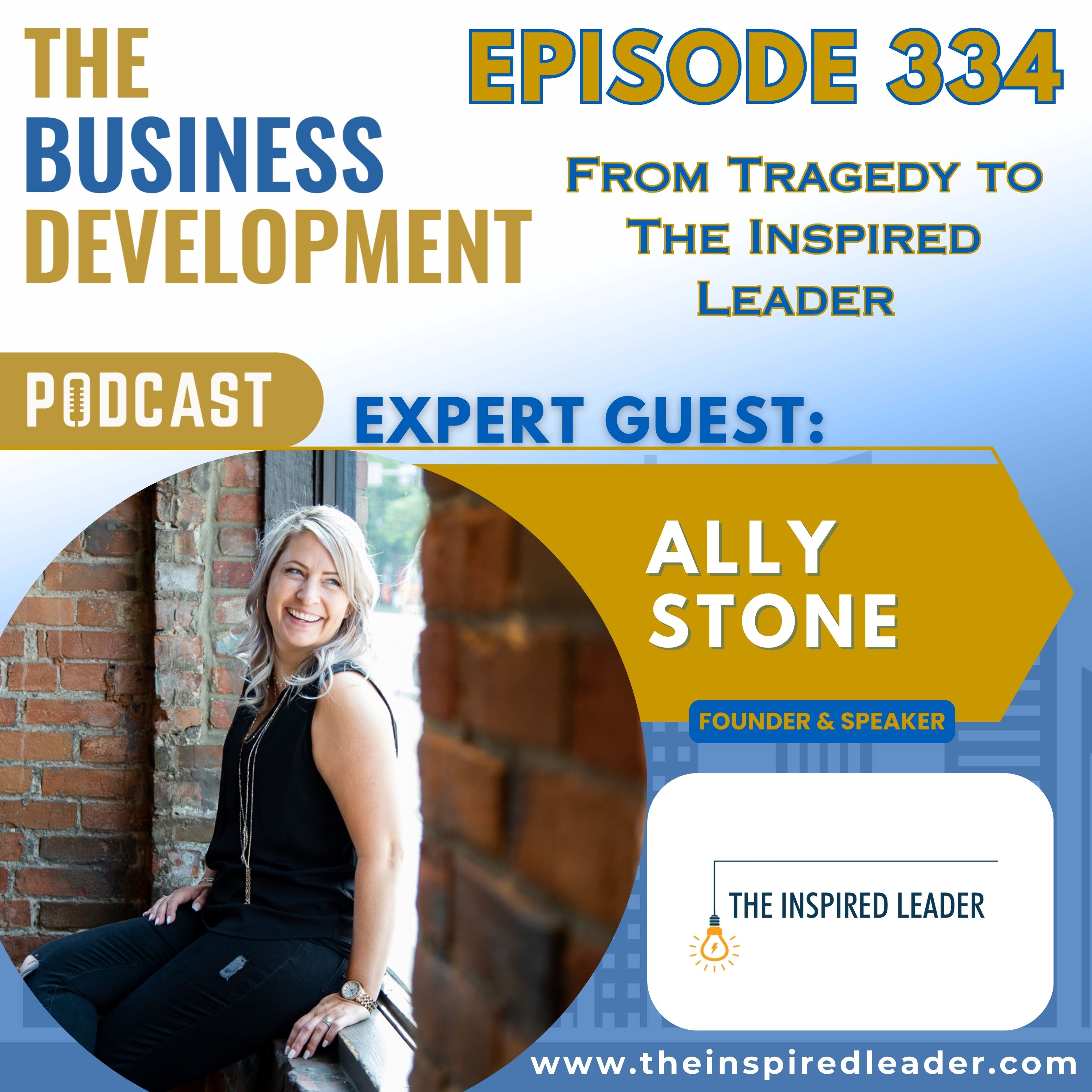
From Tragedy to The Inspired Leader with Ally Stone


 Apple Podcasts
 Spotify
 Amazon Music
 RSS Feed
 Episode 334 with Ally Stone is a powerful journey through leadership, resilience, and what it truly means to put people first when everything is on the line. From building and scaling a multi-million-dollar restaurant group to leading through one of the most emotionally intense moments in business during COVID, Ally shares how real leadership shows up in action, not words. Her decision to feed hundreds of employees when the business shut down, instead of protecting margins, is a defining moment that reflects the culture she built and the values she stands for.
But this episode goes far deeper than business. Ally opens up about the life-altering moment in Tokyo that changed everything for her and her husband, leading to a complete shift in identity, priorities, and purpose. What follows is a raw and honest conversation about burnout, pressure, and rebuilding from the ground up, not just as a leader, but as a human being. This is an episode about becoming, about learning to lead yourself before you lead others, and about finding strength in the moments that break you.
🌐 theinspiredleader.com
Key Takeaways:
- Leadership is revealed in crisis, not comfort, and the decisions you make under pressure define your legacy.
- People-first cultures are not a strategy, they are a commitment that shows up when it’s hardest to follow through.
- Your team is the true engine of your business, not your product, pricing, or location.
- Success in business is built on human connection, and when you invest in people, they invest back in you.
- Burnout does not happen overnight, it builds quietly through ignored signals until your body forces you to stop.
- You cannot lead others effectively if you are running on empty, self-leadership comes first.
- Life can change instantly, and resilience is built through how you respond, not what happens to you.
- Letting go of control and identity tied to your role can open the door to a more meaningful purpose.
- Authentic leadership requires vulnerability, even when it feels uncomfortable or unfamiliar.
- Growth is not about doing more, it is about becoming more, both as a leader and as a person.
🎸 Sponsor Shoutouts:
A huge thank you to Colin Harms and Jamie Crozier for your continued support of The Business Development Podcast. Your partnership helps make these conversations possible. 🫶
The Business Development Podcast is proudly sponsored by Hypervac Technologies, Hyperfab, Thunder Bay Hydraulics Inc., and Atlas Elite Lifts. 🎸⭐
Hypervac Technologies is North America’s leader in hydrovac excavation, delivering safe, non-destructive solutions for critical infrastructure and utility work.
Hyperfab, the fabrication division of Hypervac, builds custom industrial solutions designed to perform in the toughest field conditions.
Thunder Bay Hydraulics Inc. is a trusted leader in hydraulic cylinder repair, manufacturing, and system support for industries like mining, construction, and forestry.
🌐 www.thunderbayhydraulics.com
Atlas Elite Lifts provides premium automotive lift solutions built for safety, performance, and long-term reliability.
Join The Catalyst Club Community: www.kellykennedyofficial.com
If you are serious about growth, leadership, and surrounding yourself with people who are actually moving the needle, The Catalyst Club is where that continues. Weekly live sessions, real conversations, and a community built to help you grow.
Mentioned in this episode:
Hyperfab Midroll
From Tragedy to The Inspired Leader with Ally Stone
Ally Stone: I had to stop everything. Everything had to stop. I was so deep in I had burnt out so bad. My nervous system was completely fried. I was living in high fight or flight for months and months on end.
Intro: The Great Mark Cuban once said, business happens over years and years. Value is measured in the total upside of a business relationship, not by how much you squeezed out in any one deal, and we couldn't agree more.
This is the Business of Development podcast. Based in Edmonton, Alberta, Canada. In broadcasting to the world, you'll get expert business development advice, tips and experiences, and you'll hear interviews with business owners, CEOs. And business development reps. You'll get actionable advice on how to grow business.
Brought to you by Capital Business Development CapitalBD.ca.
Let's do it. Welcome to the Business Development Podcast, and now your expert host, Kelly Kennedy.
Kelly Kennedy: Hello, welcome to episode 334 of the Business Development Podcast, and on today's expert guest interview, I bring you Ally Stone. Ally is a transformative force in leadership and culture.
With over 17 years of experience building powerhouse teams and scaling businesses from the ground up. As the former Director of leadership development for Original Joe's, she helped grow the franchise to over 90 locations and 40 million in annual revenue, all while staying fiercely committed to human connection as the heartbeat of long-term success.
Today as the founder of the Inspired leader, Ally speaks on stages across Canada, runs sold out leadership summits and develops world-class programs designed to bring heart presence and purpose back to business. Her journey is one of resilience, reinvention, and radical authenticity. From the boardroom to the stage, Ally helps leaders unlock their highest potential, not just by doing more, but by becoming more.
If you're ready to lead with impact, build cultures that thrive and reclaim what truly matters, Ally Stone is the voice you've been waiting for. Ally, it's an honor to have you on our stage.
Ally Stone: Thanks, Kelly. What an intro. Wow. You're a real wordsmith. Thank you so much. I was like, wow, you're making me sound so amazing.
Kelly Kennedy: Honestly, I, uh, I left our first conversation. I, I just left our first conversation and like, uh, I didn't even know what to think, honestly. It was so impactful.
Yeah.
I, I was sur like, you know what I mean? There, there's probably a handful of stories, like introduction stories that I've had on this show that left me like that.
I, I mean like three. And you were absolutely one of them. And I remember thinking, holy cow, there's so much here. I'm so excited to have this interview.
Ally Stone: Yeah. So here we are, I felt like we could talk for an hour too. Like there's so much to unpack, so
Kelly Kennedy: Yeah, absolutely. So
Ally Stone: I'm open to where we go, so,
Kelly Kennedy: absolutely.
Our listeners are in for a treat today. Please start off with the journey. You know, you started out as an entrepreneur at 22, pretty incredible. Take us all the way back, take us back maybe even a little bit before that. Who is Ally Stone? How did you end up on this path?
Ally Stone: I don't know.
It was, it was, it was one of those things that, um, ending up in the restaurant industry and hospitality. So I ended up in hospitality after high school. I didn't know what I wanted to do. So my parents, I didn't come from a lot of money, so like I didn't have the option just to like hop into school and have that paid for.
And so the thought of paying whatever 40 grand for an education at that time was paralyzing to me. So I was like, I'm just gonna go to work and I'm gonna figure out what I wanna do along the way. And always had this intention that I would go to school, I would get some sort of degree, a master's, something along the way.
But
Kelly Kennedy: yeah,
Ally Stone: Obviously this opportunity with original Joes came up at 22. And so this was a really interesting experience for us. So my husband and I ended up being, uh, getting partnered in it together. Not married at this time. We actually didn't get married until we were like 30, so we're still another eight years of this.
So really kind of, maybe. Questionable decisions at 22 years old. Sure. Um, but we went on this incredible journey building these restaurants and it was I remember saying to my husband Chris at the time, I'm like, I don't really wanna own restaurants. Like restaurants don't really traditionally treat people well.
It's not a great industry to work in. Like we haven't, we've had substandard experiences. We had some great ones, we had lots of substandard ones. And you know, we were like, I was like, I just dunno if this is what I wanna lay my name to. Right, sure. And he had had this dream, like when I met him and I remember we were dating, he is like, one day I'm gonna own a restaurant.
And I was like, yeah, whatever. Let's have another beer, right?
Kelly Kennedy: Yeah.
Ally Stone: And then two years later he is like, we're gonna own a restaurant. I was like, oh my God. So it all happened. And so the crazy thing with Original Joe's was I kind of thought when. We got this opportunity to buy in that you know, it would be this, this one restaurant, this one thing, and, and that would be it.
And
Kelly Kennedy: yeah,
Ally Stone: Unknown to us at the time, but Original Joe's was gonna go through explosive growth over the next decade. There would be 98 locations by the end of that. And we would have 17 units in our partnership group altogether. And so we would go from, you know, 20 team members to 550. And so
Kelly Kennedy: Wow.
Ally Stone: That journey for me and for my husband Chris, was very impactful for us. And I would say now that I have like an MBA in business, but just through the hard knock school of like yeah. Learning to run a business. 'cause there was no other option. Like I remember saying to Chris through that adventure being like, one of us needs to go to school.
Like somebody needs to get an MBA who's gonna run all these businesses, right? Yeah. But there was no time 'cause the growth was so fast and expansive and so. Just one of those really interesting things that life throws at you. And now I look back and I think, oh my gosh, I'm so grateful for that experience because it has allowed me to become the type of leader I am today.
Right? Without that, I wouldn't have learned those lessons. So
Kelly Kennedy: yeah, I just, I think back to myself at 22, I was an idiot, Ally. I was no way. Like there's no way that at 22, I would've had the responsibility within myself or frankly anybody that I was dating at that point, either to be able to go out and launch a business, let alone commit to be a business partner.
Let, holy cow I, talk to me about that a little bit, because on one hand, your friends are out there partying, they're in college, like sure they work, but it's not a career, it's a job, right? Like for you to walk into business ownership at that point. How for our younger entrepreneurs listening. 'cause we do have younger entrepreneurs listening.
I didn't get into entrepreneurship till I was 32. I was 32 when I launched Capital Business Development. And that was the moment I was ready to do it. Any moment before that would've been too soon. How for, for the younger entrepreneurs out there, how
Ally Stone: well it was messy. It was disaster. I still ed with my friends and then went and led my restaurants hung over and like all the things.
So there was a clear division, there was a clear division between the friends that were committed to a career and the ones that were just kind of trying to figure it out. And I think it actually cleared out some of my friend circles in that time. Yeah. Because I had a different trajectory like immediately in life that other people didn't.
Right. And the investment for us. It was everything. Like it, it was any, and it was everything we had, right? So like in the beginning, I remember Chris and I were so broke to make this investment, we had to like eat craft dinner and sit on the floor. And at one point we didn't have a coffee table and like all, all the things, right?
Like the car breaks down and it's like, I don't know how we're gonna fix this. And yeah. And, and that experience in life was pretty humbling for us because we were working in hospitality, we were making really good money. You know, you're making tips every night. You got hundreds of dollars in your drawer and whatever, and then all of a sudden we didn't have that, right?
And so, it was a really humbling experience to really think like, what does it actually mean to run a business? And what kind of commitment does that actually take from the owners to make it successful? And truthfully, that Original Joe's that we invested in in the start was not successful off the start, right?
And so there was a pretty scary time for about a year and a half where we were like, is this gonna actually make it, is our investment actually going to. Pay off. So
Kelly Kennedy: Yeah, yeah, yeah. You're actually our first restaurateur on this show. Oh, cool. In over 300 episodes. I know it's a little bit surprising, isn't it?
But actually it's pretty cool because, you know, you had so much experience in that space, and I know that I have listeners right now who are interested in the restaurant business. I, you know, I worked at Mr. Mike's Steakhouse in college, in West Ed. Right? Like, I knew that world well, I was a bartender, I was a server.
How I, that's how I got my way through, and I remember how hard that was. Like a restaurant is a hard business to choose. I think for any, anybody, they don't necessarily realize it. But my gosh, I. I like to say I don't think I've ever worked harder for less money. But the funny thing is, is that I actually made pretty good money when you factored in the tips.
But I always like to say like, you know, your paycheck could come in and be like 400 bucks. You'd be like, oh my gosh, I worked two weeks for this. But I always have, oh
Ally Stone: wait a minute, I have thousands of dollars in tips in my pocket.
Kelly Kennedy: Right? Yeah. I always had, I always had at least a hundred bucks in my pocket leaving a night of of work.
So yeah, it's a different world for sure. Uh, it was a great experience. I actually really liked it. I liked the people and I think that is what makes a restaurant is the people. The people are absolutely incredible. And I wanna kind of chat with you about that because that seems to be one of the things that you really focused on.
And, you know, you helped grow a $40 million business with 17 locations. That scale was kind of on you. You were working on that scale, and I wanted to know what did that teach you about culture, connection and leadership?
Ally Stone: Yeah. Oh my gosh, so much. So in that first year and a half, I'll start back where that restaurant was not thriving.
I was so focused on like figuring out how to make numbers work, to get sales in, to get people through the door. And I was not focusing on people and team. And so truthfully, I think like as a leader in that time, I wasn't really present, right? I wasn't there with people. I wasn't making those connections.
And it wasn't until I started getting really curious about what it meant to actually lead a team. And so at this point, I didn't even know it was gonna scale, but I just started to get really curious. I started reading books like. Simon Sinek. Start with Why. Yeah. You know, books like that. It started to get really connected to this idea of what it meant to take care of people.
And it started to really inspire me. And so it was actually like in those early years that I started to see the potential of creating connection, of creating an environment and a space to work in that was meaningful, that felt like they had impact, that they could, they, they could have a say in what went on.
Like all of these things that people started to stay longer, they started to seem happier at work. I was happier because I was having great connections with people and that thing that happens in restaurants where people, it is all about the people started to happen, but then it started to bleed through the entire company, which was a really cool feeling.
And I remember when we started it, I said to Chris, like, I don't want to be. Like other restaurants, like, I wanna do this different. If we're gonna do this, I wanna do this different. And he was like, yes, I totally agree. And so, you know, we talked a lot about like, what does it look like to build a culture?
How do we create a people first organization? And that became like our dinner table talk as the married couple owning a business. Yeah. Uh, which sometimes would end in screaming across the table and sometimes high fives. You know, it would depend on the day.
Kelly Kennedy: I know. I know the drill. I know the drill. Been there, done that.
Ally Stone: So many people are like, how do you work with your partner? I'm like, you know what? I actually think it was amazing. Like, I loved it, but it was challenging. But I think our relationship was better because of it. 'cause we had to talk about everything, right? Yeah. Like there was no, if we didn't process things in the business, then we were failing, which then forced us to process things in our relationships.
We had, we had a great connection that way. Right? Yeah. Yeah. So as the organization grew, we just kind of got to a place where it was too big for either of us to be, working individually in one store. And so as we started to create what maybe was this umbrella of like a corporate kind of structure, we talked about like, what does this look and how do we continue this, this people-centric, people-focused organization in this growth?
And so what ended up happening was my husband Chris kind of became director of operations, if you will. And
Kelly Kennedy: yeah,
Ally Stone: he was, you know, in there leading the teams, leading the senior level leaders. And I became the director of leadership development and culture. And so my job just became to help identify people, help people identify their skills, their talents, help them grow.
And one of my things about it that I think was really unique was like. I always said to people, I was like, I'm here. I can help you develop leadership skills. I can help coach you. I can help you, you know, in your life if that's what you need. We got a lot of your kids when they're 20 years old and they needed things, right?
Kelly Kennedy: Yep, yep.
Ally Stone: Um, and I always said, I don't care if you stay at original Joe. I'd just like to help you develop in this chapter of your life so that when you get to the next chapter of your life, you have some skills that you can take with you. And I think that attitude allowed more people to kind of come in and learn with me and be more open to it, rather than being like, oh, okay, well they, I have to make this commitment to restaurants forever and that's not right.
That's not what I wanna do.
Kelly Kennedy: Sure. Yeah.
Ally Stone: And so lots of people kind of step outta that. And so we had this really cool culture of learning, of growth, of development and people supporting people and mentorship and, I really just think that attitude, that feeling, that energy just, just catapulted us to the next level.
And turned it into a restaurant organization that, kind of near the end of my tenure, we weren't even really posting ads for jobs. Everything was coming through referral. Everybody wanted to work with their friends. Like it was just this beautiful like synergy that was happening. And it was such a great place to work.
And so I feel like I'm a, I'm a walking billboard for the effect that this people centered, people for focused heart-centered leadership can have on an organization. And granted, I know this was hospitality, but now through the inspired leader, I work with different organizations all the time and I see it and it's possible and it shifts everything for people.
And so I love that I was able to have this experience young and then. Be able to take this experience out into like the greater business world now and help people see what's possible. So
Kelly Kennedy: you were like, you were so early on the people first culture focus, right? Like, you know, when I think back to when you got into this, you know, between 2006 and let's call it twenty ten, twenty twelve.
It was not that the, the workplace was still not people first at all. It was revenue first, profits first come hell or high water, you're gonna be at work. Right. Um, yeah, it's been, it's been interesting and I think, you know, I think COVID was a big shifter in, in switching the whole world, maybe more towards the people first workplace.
You're definitely seeing that pick up. I think if you look at the success of LinkedIn post COVID True. That's what it is. It's the shift from, from an employer first, a profit, first driven workplace to a people focused workplace. But the fact that you were in this a full decade ahead plus is absolutely, absolutely incredible.
And you know, you said that you owe that to just reading books like, uh, like Simon Sinek, correct?
Ally Stone: Yeah. I spent a ton, like I. If you can't see around me right now, but there, I have hundreds of books. I've kept all my books. They all have notes in them. Like
Kelly Kennedy: yeah,
Ally Stone: it's just been, it's been, that is my MBA, that is how I did it and I learned, absolutely learned at night before I went to bed and Right.
And so all of those things. And so, yeah, I'm, I'm super inspired by people who challenge the status quo and I'm always looking for that next edge, uh, in business and especially when it comes to people and how we can better take care of them.
Kelly Kennedy: I know that I have a lot of listeners right now who, since you are a restaurateur, since you did have multiple, multiple restaurants, they're asking.
What is it like, what is it like to run your own restaurant? I think many of them have a service company. Maybe they provide electrical services. Heck, maybe they sell products, whatever. Um, maybe they're huge, but I think running a restaurant is a different beast. Can you maybe just give us some insights into what it's like to run a restaurant and then maybe even to scale that into a chain of restaurants?
Ally Stone: Yeah. It, you know what, I think it's a lot of people's dream. Like a lot of people came to me over the years and was like, oh, I've always thought about owning a restaurant. And I was like, yeah. Careful because it's intense. I get it. There's some sort of, um, shiny right piece to it. Yeah. That's really cool.
You can walk into this restaurant anytime you get food, you can take your friends, right? Like it's pretty cool.
Kelly Kennedy: Well, it's social, right? Like when you picture going to a restaurant, it's always fun, right? It's always fun. Yes. I never think about going to a restaurant and it be crappy.
Ally Stone: Yeah.
Kelly Kennedy: It's always kind of an exciting moment.
Right? Unless you have little boys who fight all the time, then it's like, okay, you dread it a little bit. But but most experiences of heading to a restaurant put a smile on my face and I think put a smile on other people's face. So I think the image we paint to a restaurant to owning a restaurant is, wow, it must be so cool to be that person.
Ally Stone: Yeah. And so there are, there are times where it is like that. And then there are times where you're like, holy God, what have I gotten myself into? So what I'll tell you that I have learned, like since leaving restaurants is restaurants to me are one of the most complex. Business models in the world, the amount of inventory, the amount of intricate intricacies, the amount of moving parts.
Like when I look at other businesses now, I'm like, oh my gosh, this is actually so easy. I can see this all for you after everything going through everything in restaurants, right? So there are so many pieces, below the iceberg. Yeah. That people just don't see. And then where we're talking to with this team piece, right?
This team piece is everything. Because if you can't get that they're basically your people that are working in your restaurant. They're basically, and, and I know this is true in other businesses, but they're basically running your business. They're basically running, and you know, they probably told you this at Mr. Mike's, your section is your own business, right? That's right. You go to make your money.
Kelly Kennedy: Absolutely.
Ally Stone: But the truth of the matter is that has to be a real, a real feeling, a real thought, a real action. Because if that's not happening, your business is failing. And I see restaurants fail a lot in. In that lack of connection and that lack of belief in what people are doing.
So
Kelly Kennedy: what, okay, so now that you touched on the failure aspect and the success aspect, for our listeners listening who maybe are aspiring restaurateurs, two questions. First, what makes a restaurant business successful? Like, are there some tips that you could give them that could just give them that slight edge in launching the restaurant and, and having it become successful fairly quickly?
And then what are maybe, let's call it the three things that you see that lead to a restaurant's downturn?
Ally Stone: Mm-hmm. Um, well, I definitely think what makes a restaurant successful is not the food, not the location. Not the beer. I think it's the people. And I also think that leads to the downturn too. Mm.
So I think it's so incredibly important. We used to sit around in our area team, and we used to talk about how the food, the building, the environment was just the ante into the game. That's the base level. We all have to get that. Anybody can serve a burger. Anybody could make our dil dip, right? Like,
Kelly Kennedy: yeah.
Ally Stone: Those things could happen anytime, anywhere. The real, the real thing that makes hospitality, and truthfully, Kelly, any business successful is its people.
And so, yeah, again, this is just why this became so incre incredibly important to me.
Kelly Kennedy: Yeah.
Ally Stone: So the people can be your biggest downfall, I think if we're not having leadership that truly believes in that and believes in making that connection, I think.
When you get to levels like where Chris and I were in that organization, it could be really easy to sit in an office and shut a door, right? And be like, okay, I've got lots to work on today. But every day for us it was connection, call, training, whatever, whatever we were doing, right? We were always with people.
And I think that changed the game. I think the other things that can hurt a restaurant truthfully are a little bit more global since pandemic, but restaurants just truly haven't recovered, uh, yeah. Since the global pandemic and people aren't dining out as much. And so there's actually a danger in a culture shift right now where people just, it's just not the same.
Yeah. I, I see it actually coming back more now, this year. But how many years are we out of a pandemic? Right?
Kelly Kennedy: Yeah, it's a lot. Yeah, it's a lot.
Ally Stone: It's been a long shift. And so I'm always really, uh, cautious of people who are thinking of opening a restaurant right now. It's a tough industry to be in. The margins are raised thin as far as food goes and all of those things.
And then we have this whole piece of how people are showing up in the world, uh, differently. And so I keep saying restaurants need to change. We need to evolve. We need to start to figure out a new way to serve people, to take care of them, and to create that experience, not anchored in this old way. I don't know what that is yet.
I play around it with my head a lot. Yeah.
Kelly Kennedy: But
Ally Stone: something is ready for a shift. I think so.
Kelly Kennedy: Well, it's really hard to do restaurants remotely.
Ally Stone: Yes.
Kelly Kennedy: Just doesn't work. The virtual restaurant just isn't really made it yet. Oh my goodness. Okay. Okay. Yeah. My, it's completely slipped my mind how crappy COVID was for restaurants, and now I feel like we have to go there.
I have to know. Yeah. What was it like to be, to own multiple restaurants going into COVID? What were your thoughts? Like, were you thinking it was over?
Ally Stone: It was so stressful. I'm like, I'm already touching my face thinking about it. I, so effectively that the world that year 2020, shut down March 20th.
March 21st. Yeah. And so, I had been in Hawaii actually with my husband, um, and we got back on like March 10th and there was rumors in Hawaii, this virus, and, but nobody was really talking about it.
Kelly Kennedy: Yeah.
Ally Stone: And then it came time for us to fly home and people were messaging us and be like, are you gonna be able to get on a plane?
We're like, whatcha talking about? Like, and so we kind of we're kind of like outta the loop because we were on holidays and then we came back and we were like, oh shit. What is going on in the world? And so I started having conversations with my partner and so, you know, we haven't really touched on this, but my husband's actually not working at this time because he actually got sick.
And so it's just my other partner and I running the restaurants and I started having conversations with him and you know, we're having a lot of back and forth, but like, what does this actually mean? It's pretty imperative to our industry 'cause we're bringing people together and people are talking about six feet and masking and like all of these things.
And so, it got to the point where it started to get pretty severe. There was talk of Canada shutting down all of the things. And so the actual franchise that owns Original Joe's decided to mandate that they would shut down all restaurants effectively on March 18th. Wow. 2020 mandate shut down. And so of course uproar from franchisees, all the things.
Kelly Kennedy: Mm-hmm.
Ally Stone: Um, and we got off that call and I remember going to my partner and saying, I don't know if we can do this. And he was like, well, we kind of have to, it's mandated. And I was like, no, I don't think we can open on the 17th, which is St. Patrick's Day.
Which is our highest sales day across the board.
Oh wow. Like thousands of people coming in, drinking, spitting, drunk over each other, all the things. Right.
Kelly Kennedy: But it's a good day.
Ally Stone: I was like, I don't. Yeah. Oh my goodness. And I think the franchise, I understand they were probably like, yeah, this one last day of sales outta it. Sure. It's not that bad, whatever. I get it all.
It's a business decision. But morally, I was like, I don't think we can bring all these people together. And so that was a big thing. And so that was the morning of the 16th. And so that day we effectively decided to shut everything down for us on the 17th. And we didn't open. And in a matter of eight hours we had to lay off, oh, I don't know.
At that time, our initial layoff was like 350 team members. And I remember going to our senior level leadership team and saying, this is big. Like I never in my life started this to think that this is something that would be happening and we're going to take this seriously. So no layoff happens through an email.
Kelly Kennedy: Mm-hmm.
Ally Stone: I hope it's through a one-on-one conversation or through a phone call, no texts. And so by the end of eight hours, we had actually effectively. Talked to all of these people and tried to ease some of their concerns. But truthfully, none of us knew No. What was happening.
Kelly Kennedy: Yeah.
Ally Stone: And that was when I started to convert this office in my house.
I remember at the end of the day, and I just laid down on the floor in here and cried. I cried. Yeah.
Kelly Kennedy: Yeah. And
Ally Stone: I remember Chris came up and he was like, are you okay? And I was like, no. Like I am not. I am not. Okay. I don't know what to do. And my phone was just, it was just like this, right? Yeah. Everybody texting me being like, what do we do?
Kelly Kennedy: Yeah. Looking for leadership because they're scared. Yeah.
Ally Stone: It was so scary. And so, you know, people in hospitality traditionally live plate paycheck to paycheck, right? Yes. They rely on those tips that was paying their rent. That was paying their car payments, like,
Kelly Kennedy: yeah.
Ally Stone: And so, yeah, it was so scary. And so then the conversation shifted to, well, like, how can we take care of these people?
How can we take care of these people in this time? What does this look like? Do we have finances to pay some paychecks? For a while we didn't.
Kelly Kennedy: Yeah.
Ally Stone: And so what actually ended up coming out of it was like. We were like, we, we can't pay your paychecks. We don't have that kind of money in the bank, but what we can do is feed you because we actually get food quite cheap.
Kelly Kennedy: Yeah.
Ally Stone: And so we kept food coming into our restaurants and this was a way to actually keep some of our team employed. Um, and we would hire some of our chefs to come back in for hours and they would actually create meals and put them in boxes. And then our team would take turns, they would book times to come in and effectively like fill their fridge.
Wow. And so we were like, if you live alone, take enough food for you. If you have a family of four, take enough food for your family of four, we wanna feed you so that you can save the money you have left to make sure you still have a roof over your head. Or you can make that car payment so it doesn't go into repo or like whatever.
Kelly Kennedy: Oh my gosh.
Ally Stone: And that was really,
Kelly Kennedy: it's not very often that I get teary on the business development podcast. Wow. Um, you know what? That one hits me hard because I've been there. I've been that person. Yeah. I've been that bartender. I've been that server. And I couldn't imagine at that time what it would've been like.
Yeah. That's amazing, Kelly. Yeah. Yeah. We called it Thanks for doing full bellies. You know, I mean, on behalf of, on behalf of X servers and servers everywhere. That's lot. That means a lot. Yeah.
Ally Stone: I feel like it was the least we could do. Like I feel like Yeah. The way you're crying, I was crying every day.
Right. That's brutal. Yeah. And then I would get these messages from people that would, they would pick up their first round of food and they would be crying and they would send me pictures of them holding this big bag of food and being like, I don't even know what to say. Like, I didn't even know how I was gonna eat this week.
And
Kelly Kennedy: yeah,
Ally Stone: like I just kept thinking, frick, I am so lucky that I have a sharehold and like, I don't even know if I'm getting money out of this, but at least I have some money in the bank and I'm gonna be okay and I can pay my mortgage. Like, like there are so many people who are going to be struggling right now.
Kelly Kennedy: Yeah.
Ally Stone: And that was part Kelly of. The whole people first, like leadership in Original Joe's, it was about taking care of our people, like inside our four walls, but also outside of our four walls. Like we did so many things to take care of our community, to take care of people in need. You know, there was a few years pre pandemic where we did something called, uh, delivering Compassion, where through the cold months of the year, our whole team would come together.
We would make soup and sandwiches and bake cookies, and then we would go out and feed people on the streets, and then people started donating clothes and we, like, they turned into this whole thing. And so we've done some pretty amazing things and they've given so much of their time. I just thought, oh my gosh, like this.
I, I hope that this shows some of the gratitude that I have for all of the things that they have done. Yeah. And so it, not that it worked, that's not the right way to say this, but it. It helped. Our turnover rate was, I think, less than 12% at the end of the pandemic. Wow. Lots of restaurants weren't even able to open their doors or open for regular hours.
Kelly Kennedy: Yeah.
Ally Stone: Um, and we were able to get back to it quite quickly. But a lot of people left. A lot of people left holiday, hospitality, holidays, hospitality through the pandemic, of course.
Kelly Kennedy: Yeah. It was,
Ally Stone: yeah. A really interesting time.
Kelly Kennedy: Yeah. It's, um, yeah, and it's, it's, it's experienced so differently by everybody, right?
Like everybody has a different experience. The funny thing about the pandemic was it was the kick in the butt. I needed to start Capital Business Development, which eventually led to the show and everything else that we do, right? Like, it, it would've never happened. Likely. I was comfortable. I had a great job.
Like I got paid well, everything was good and cushy, like the idea of leaving, and I, and I helped found that company. So I'd been there a really long time, 10 years at that point. And so. I wasn't going anywhere without the kick in the butt. And it's funny 'cause we talk about it all the time on the show, it's like entrepreneurship really requires the rug to be pulled out from under you for a lot of people in order to take that leap, it's been one of the greatest experiences and one of the hardest experiences of my life.
It continues to be that. I was actually having a really hard week this week, and we'll get into that a little bit later. After following one of the best weeks I've ever had. I'm kind of experiencing like a little bit of like depression or like, like the downturn of the rollercoaster, right?
Yeah.
But before we get into that, I wanna get into that with you, but before we do that, I wanna talk about Tokyo. Now, your husband Chris, he's a marathon runner and he's been doing stuff like that for a really long time and it's incredible. You were telling me the distances he ran and it it's unreal. And you mentioned that, uh, he was running a race in Tokyo, one of the hardest races on earth, if I remember you correctly telling me.
And something crazy happened.
Ally Stone: Yeah. Yeah. So Chris is a competitive marathon runner. He still, wow. He still is quite competitive. Okay. In his times, even for his age. He's an old man now in marathon.
Kelly Kennedy: I know, I know the feeling. I got gray beard. I was looking at pictures of myself, I'm like four years ago with a fully black beard.
And I'm like, oh my gosh.
Ally Stone: Mar always says that too. He's like, I'll just embrace the salt and pepper. I'm like, it's just for man. It's up to you. So,
Kelly Kennedy: that's right.
Ally Stone: Um, yeah, so basically it, it was one of those things that, you know, happen in your life that changes. Changes everything. So we went to Tokyo 2018 pre pandemic.
Chris wanted to run, there's six or seven world major marathons. And when you do that, you get this like crazy marathon medal. He want very few people like achieve this, right?
Kelly Kennedy: Yeah.
Ally Stone: Especially at like an elite status and. So he wanted to run this Tokyo marathon. And I remember, uh, when we got out there, I remember feeling like something wasn't quite right with Chris.
Mm-hmm. And, and asking him about it. But also we just traveled like halfway around the world and jet lag and tired and, all the things.
Kelly Kennedy: Yeah.
Ally Stone: And, um, so he goes out, he runs this Tokyo Marathon. He trained to run a sub two 30, which is getting pretty close to an Olympic time. Other countries would actually send him at two 30.
Canada requires a faster time, but he runs this marathon in two hours and 32 minutes. And so, wow. For anybody listening that knows about marathons, this is like sprinting with the Kenyans to run a entire marathon in Japan. It's crazy to watch. Like it's just a whole thing. Uh, I've seen him do it over and over and so, the night after the marathon I wake up in in bed and I am, I'm freezing cold. I'm soaking wet. And I remember like touching my body and being like, what's going on? And I turn on the lights. I realized it wasn't me, it was him. And he was in a coma. He was profusely sweating. The bed was completely soaked, like drenched Kelly.
Yeah. And I was like, so that was a crazy moment. Um, by the time we got to a hospital, he was conscious, which was good.
Kelly Kennedy: Mm-hmm.
Ally Stone: Um, they ran every test they could think of on him in Tokyo and couldn't find anything wrong with him. So he tested positive for the flu. 2018, nobody cares.
Kelly Kennedy: Yeah.
Ally Stone: And they were just like, you have a couple options here.
We don't really know what's gonna happen. We don't think he's gonna have an aneurysm or anything like that. We've done all the tests. So you like. Take him home to Canada and you can get him to a hospital there and see what's going on. Or you can stay here if you feel safer doing that, but at some point your insurance is gonna run out.
And that one day in the hospital was probably like 25 grand. Like it was crazy. I remember when we got into the ER to see a doctor in Japan, you have to put a credit card into a machine. And so Chris is like, on a stretcher and like is this emergency situation, nobody will see him. Nobody will look at him until I put my credit card into this machine and it's all in Japanese and I can't read it.
Oh wow. And I'm having this panic attack in the middle of this hospital. So I actually had to find a nurse who had gone to school in Vancouver who could speak English. And I had to pair to be my translator for the entire day. Like it was just a crazy experience.
And so I made the decision to take him home, but by the time I got him home, he was worse.
And so it was very neurological. What could happen, what was happening to him. Like he could walk and, you know, all the things just fine, but he had no idea. We were in Tokyo. He had no idea he'd run a marathon. Oh, wow. He had everything was just like a blackout for him. Yeah. And then in that blackout he was getting really, because he was aware, he was getting really anxious about it, right?
Yeah. Like he wouldn't, and so he was like, of course all these questions and what's going on? Why are we on this plane? He would wake up, right? All of these things.
Kelly Kennedy: Mm-hmm.
Ally Stone: And so when I got back, I took him to the U of A, they ran tests again, couldn't find anything wrong with him, said he wasn't in life-threatening danger and refused to admit him.
And so it took me three visits to the hospital before they would actually get a neurologist to look at him. So this took another like 72 hours. And by this point it was just like out of control. And so we saw a neurologist and he was like, it was actually, he was pretty relaxed about it. And he was like, yeah, I think he's, he's gotten a, an encephalopathy.
He's like, he probably got a bite from a mosquito. It happens in Japan. He is like, it is an illness and like, but it will clear out four to six weeks he'll be better. So no treatment, no hospitalization, no nothing. They just send us home and everything just spirals from there. And so, Chris never recovers, he never recovers from whatever happened in Japan.
The memory centers are gone in his brain, so he has no short-term memory and a pretty spotty long-term memory and all of the, quite frankly, shitty things that go along with that. So his life has been a real challenge, um, since that happened. And of course, he was never able to return to work and so. It changed everything for us.
Right. It changed, it changed our lives, it changed our marriage. It changed the way the organization was run. Yeah. And I remember I had to stay home and care for him for like three, four months after we got back from Japan. So there was this timeframe where we were supposed to be gone for like 14 days.
Yeah. And then neither of us just ever came back. Right? Mm-hmm. Mm-hmm. And so the people in the organization, this goes back to this people piece. And this is like, just such an interesting, and we never would've expected this and never would've asked for it, but it's such an interesting point to make around taking care of people, was that they were so, concerned.
Like people wanted to know they were reaching out, you know, asking. And we didn't have any answers. Of course. Like, I was like, I honestly dunno what's going on. Yeah. I dunno when I'll be back. I don't know when he'll be back. But they cared, right? Because we cared about them. And so. It was like about three weeks after I got home, one day I was just kind of like in the house with Chris and I heard a knock at the door and I went to open the door.
Nobody was there, but there was this like fa, fresh baked loaf of bread.
Kelly Kennedy: Mm-hmm.
Ally Stone: And a card on top of it. And it was signed from all the people in a store. And they were like, Hey, just thinking about you. And then it went on for like days, like a day after day after day, people with like flowers wine. Until one day somebody dropped three months of freezer meals on our doorstep.
Kelly Kennedy: Wow.
Ally Stone: Um, like individually packed. Wow. So that we could just like eat. And I remember opening the door and just standing there and like sobbing my eyes out. Mm-hmm. Because I was like, I wasn't eating. Yeah. I wasn't taking care of myself and I didn't know what to do. And then all of these people that we write their paycheck for shouldn't be doing this kind of stuff for us.
Kelly Kennedy: Yeah.
Ally Stone: Are showing up and taking care of us. And these really. Emotional about these really, like profound ways that, yeah, it just, it makes it all worthwhile running a business when you have this real human connection in it,
Kelly Kennedy: and community is so much bigger than your peers. I think maybe that's the lesson here, right?
Is that like, as a business owner, as a leader, as just another human, there's, you know, we we're compassionate for other people regardless of their status in life, regardless of where they come from, where they're at. And, and I think if you're good and you're a good leader and you're out there helping people, at some point it might be your turn to need that reciprocation.
And I kind of feel like if you've gone out of your way like you did, there's gonna be people who step up to help you. That's, it's an incredible story. Wow. Uh, yeah. That, that was, that was the moment, that was the moment people that left me thinking, wow, how, how does somebody even recover from that? Not just recover.
You've gone in a completely different direction from, from that moment. I like, I, I feel like for you there was everything before there was the moment, and now there's a clear line into everything after. Yes. Talk to me a little bit about, about, actually, I guess when we get married, we don't think about the in in sickness or in health vow, do we?
No. I think for maybe a lot of people it's just like, yeah, of course. Whatever. Right? Yeah. But for you, it became a real thing. And I want to talk a little bit about what was it like for you having to step away from your career, which I, which is incredible at this point and you're having to essentially take all of your focus from business, which I know for any business owner, it's their baby too, right?
It's like, it's like I have to step away from my baby to look after my baby. And this could be your husband, your wife, your kid, whatever. It's Right. Yeah. It's hard. It's hard. Hard because you focused everything into the business and it becomes a part of you. It becomes a part of your identity. Talk to me a little bit about that, because I know this whole thing for you led into a pretty severe burnout.
Ally Stone: Yes. I think looking back now, I just I just did, you know? Mm-hmm. Like I just ground through. I just kept moving. I felt like there was no, no opportunity to reflect, to think about what this might look like. Like everything was like a 9 1 1 emergency in my life for months. Right?
Yeah. Like it would be. Like as an example in, in the real acute phase, the first couple months when Chris was sick, I would be worried that he would walk out the front door and get lost. Like
Kelly Kennedy: mm-hmm.
Ally Stone: It was a lot, right? All the time. And so there was no, you know, as business owners, we obviously get really busy, but really good entrepreneurs know the power of taking time to reflect, to integrate, to like really think about what their next path is.
Like that those are really good entrepreneurs and people who do that in their life are actually really often quite successful in their lives too. And there was none of that at that point in my life. And so I was just kind of like going through the motions every day, grinding it out, trying to hold myself together, and truthfully, not really letting myself feel any of it.
Looking back now, there was so much grief. Mm-hmm. And loss and change, like massive impact change that nobody had asked for. Yeah. I was just like, yeah, I'm okay. I'm okay. I'm okay. Right. Rolling up the window, putting the armor on, and eventually getting to the point where I'm saying to myself, I have to go back and lead this organization because and Chris still wasn't even in the best place.
Like, I had to get his parents to come take care of him during the day so that I go to work, and then I would still have to take care of him at night. So now it became double time.
Kelly Kennedy: Yeah.
Ally Stone: But I was like, somebody needs to get back to these people, we love them. We care about 'em. We bet everything on this.
Yeah. We can't, like, right. Yeah. And so, I went back and it was about two weeks.
Kelly Kennedy: Mm-hmm.
Ally Stone: It was not long. Mm-hmm. Um, and I was walking into our leadership team meeting. I was walking to run it and the past, Chris always run it, ran it, and I would support him with it. We kind of bebo back and forth, and this was the second one.
And I remember the first one walking out and feeling so sad that he wasn't there and that I was doing it myself. And so I'm walking the second week and I'm driving up to work and I go to get outta my car. I put my hand on the door of my car and I just freeze. I'm like paralyzed. And I'm like, and I remember sitting there being like, what the hell is going on?
Like, I was really hard on myself at that time too. Right, sure. Like everything was
Kelly Kennedy: Yeah.
Ally Stone: Yeah. Push
Kelly Kennedy: it through. Right. It was on you. It was on, you were taking it all on.
Ally Stone: Yes. And if I couldn't do it, our life was going to be in shambles, so there was so much. Pressure around it all. Lot of pressure, right?
Kelly Kennedy: A lot of, yeah.
Ally Stone: Which I have this whole perspective now about men who take care of women and women stay home and take, and I'm like, man, that's a lot of pressure. That men will go through like, holy, I did not, I did not realize Anyway, so I go to get out of my car, I freeze and all of a sudden I just, I'm overcome with emotion and not just like, you know, sitting there crying, like heaving sno ugly crying in my car.
And I'm like, oh my God. Like what is going on?
Kelly Kennedy: Yeah.
Ally Stone: For this like, perception of this super strong woman, right? And I'm actually really pissed off at myself in this moment that this is happening. And so I remember calling into one of my coworkers, one of my peers that I really trusted, and I was like, Hey, mind just coming out to my car and talking to me for a second?
And he was like, yeah, for sure. And he came out and I remember he opened the. The driver's side door and he was a little like, holy shit.
Kelly Kennedy: Mm-hmm.
Ally Stone: What did I walk into but he was so kind and I remember he just kind of like kneeled down and he put his hand on my leg and he just kind of waited. And then eventually through ugly snot here crying.
I said, I just, I just don't think I can do this. And he was like, that's okay. Like you don't have to do this. Mm-hmm. He's like, I don't know why you think you have to do this. Nobody expects you to do this right now. And that was really profound for me. And he was able to give me the opportunity to allow myself to see through my blinders and start to think differently.
And that day I didn't go to work.
Kelly Kennedy: Yeah.
Ally Stone: He covered for me. And I remember I started driving home and then I thought in my brain, I can't go home because if I go home, I have to take care of Chris and I need to take care of myself right now.
Kelly Kennedy: Yeah.
Ally Stone: And so. I went to my sister's, I broke in, I know her door code.
It's actually break in. I went to my sister's and I went to her basement and I just crawled on her couch and I remember I grabbed a bunch of blankets and I cried and I fell asleep and woke up like four and a half hours later, like I don't think I'd actually even like slept. And I remember sitting up in her basement and kind of like sitting and like waking up and being like, whoa.
That was a day like what happened today?
Kelly Kennedy: Yeah.
Ally Stone: And then thinking, holy shit, if I don't figure this out, I'm not gonna make it. I'm not gonna be able to take care of Chris. This organization's gonna falter something major is gonna have to change, like I am now the number one priority. Mm-hmm. And that was like a big awakening for me.
And that shifted everything for me. That shifted the way I saw leadership, that shifted the way I saw teams. That shifted the way I saw myself as a wife, like everything. And it was powerful. And so that sent me on a crazy journey. A crazy journey of learning what it meant to actually care for me in a way that filled my battery or fills my battery so that I can show up in the world the way I want to, the way I feel called, to the way that's bringing purpose and meaning to the world, right?
Like I think we all absolutely came here to do something. We all came here to contribute something to the world, but if we're running on empty, we're gonna miss the whole point of that. And so that's become a big part of my message.
Kelly Kennedy: Yeah. Oh my goodness. And I would like to say that I was like insightful and, and saw burnout and believed it was a thing until I experienced it myself.
And I think a lot of entrepreneurs feel that way. They're like, ah, whatever. Like, that won't happen to me. And, and it's not, it's not in your control. I think that that's like the surprising thing. And you kind of talked about like that breaking point. Like you didn't wake up that day thinking you were hitting your breaking point.
It just happens. It's just like, holy shit, I'm in some serious trouble. Right? And your response can be everything from a full on panic attack to depression, to whatever. You don't know what's coming for you. Uh, whenever you go through burnout, it's pretty crazy. And I, you know, mean I've gotten to the point where now I can start to recognize the signs.
Like I'm a high performer. I'm very similar to you in that, in that aspect. I, I wanna do a lot of things. I do a lot of things, but I regularly feel like I push up against that wall and I'm like, okay, I need to like, I need to get outta here. I need a vacation. I need to get away for a week or whatever. Two a week is a lot right now, but let's call it a weekend and just reset.
Right.
Ally Stone: Yeah.
Kelly Kennedy: But I think, I thought it was bullshit when I first got into, heck when I started the show, I thought it was bullshit. I talked to a lot of people who were like, oh yeah, you gotta watch out for burnout. Burnout, whatever. Right? But it's, but it's a real deal thing. People, it's a real deal thing.
And if you end up in it, you can be in a world of hurt. And I think maybe one of the valuable things that you could offer our listenership today, Ali, how the heck did you pull yourself out?
Ally Stone: I had to stop everything. Everything had to stop. I was so deep in, I had burnt out so bad. My nervous system was completely fried.
I was living in high fight or flight for months and months on end.
And my body was just like, no. It's like the Gabor book. When the body says no, it's just like, Nope.
Kelly Kennedy: Yeah.
Ally Stone: No more. My mind couldn't even fight through it. There was nothing. And so, I think, so I talk a lot about this with leaders.
Now this is a big part of what I offer because I actually, I believe we miss out on an opportunity when we hit that burnout and also recovery. I can easily start to burn out again now. Yeah. That I've burnt out a couple times in my life. Yeah. And so you have to be even more careful once that's happened once or twice.
'cause now your, your, your body can tip back into that experience quite easily.
Kelly Kennedy: Mm-hmm.
Ally Stone: And the recovery time I think just becomes longer and longer until at some point you just can't do it anymore.
Kelly Kennedy: I guess it's different for everybody how they pull themselves out, but I think yeah, you can end up in this position and you can be like, my world is over.
Right. Like if you're an entrepreneur Yes. And you're a high performer and you hit a burnout like this, you could think it's all over and you're never gonna bounce back because in the moment it feels like there's no hope.
Ally Stone: Also, if you're a solopreneur, you could lose your business.
Kelly Kennedy: Yes.
Ally Stone: If your business thrives and not thrives with you.
Kelly Kennedy: Yep.
Ally Stone: This is more important than ever this conversation, right? You need to be your top priority if you want to have a thriving, successful business. And that is the inspired leader now that the business does, it generates revenue on me, right? And so if I can't show up, if I can't go to these keynotes, if I can't speak at these conferences and handle this travel and do all these things, it's not happening.
Right? And we're right back to square one. And so that's super, uh, important. And I think coming out of burnout is one thing, but one thing, Kelly, that I think actually maybe is even more important or people are starting to feel it, is to recognize the signs.
Kelly Kennedy: Mm mm-hmm.
Ally Stone: Before you get to burnout, are you starting to feel like annoyed tired, frustrated, at the end of days?
Are you having a hard time staying up past like seven o'clock at night? Are you short with your family? Do you have a short fuse when you get home? These are all signs. Your battery is running low, your internal like energy, cylinder. And if that's running low. Yeah. If you don't have the capacity to show up in your life in these ways, those are science, that those things are coming for you.
Kelly Kennedy: Isn't that just entrepreneurship?
Ally Stone: S pretty intense.
Kelly Kennedy: Wait a sec.
Ally Stone: I actually think, because now I'm experiencing it in a whole different way, and for sure I have weeks. Like I have weeks. I'm like, oh God. Like that was awful.
Kelly Kennedy: Yeah.
Ally Stone: Um, this is actually one of those weeks. It's been a little intense for me. Me too. But I have many, many weeks now where I'm like, Nope, that was awesome.
It was super balanced. I felt energized after my calls. Everything was like great, right? Mm. Mm-hmm. And so we're never gonna find that harmony if we don't focus on it, if we don't think about it. If we don't start to ask ourselves how we're feeling at the end of each day, or when we start a day or after an interaction, right?
Like. This is an energizing conversation right now. We're both kind of giggling and laughing and getting lots out of it. We're both gonna leave it and feel good. Yes. But if you're having those conversations that aren't filling your Bowery, you really need to ask yourself why you're doing them right?
Kelly Kennedy: Mm-hmm. Mm-hmm. Mm-hmm. I think a lot of things, especially as entrepreneurs, we don't let go of things fast enough that aren't serving us right. And I know I'm guilty for that. I know many people that are guilty for that because we get used to doing all these things and instead of taking things away, we just add one more, add one more.
Add one more. Until one day you're doing so much, you can't add one more and your body just snaps.
Ally Stone: Yeah, totally. Totally. It's in my MSBR training, I think it might be Cabim, but he talks about overwhelm and how when we start to use that word, that's the first sign. So as an entrepreneur, if you're starting to say, oh, I was really overwhelmed this week, or I'm overwhelmed today.
Kelly Kennedy: Yeah,
Ally Stone: that's a sign. You're on a track to burnout and you need to pay attention to that. 'cause that is the first stage.
Kelly Kennedy: Interesting,
Ally Stone: you know, we're starting to contract our view. We're starting to be like, oh, this is too much. We're not expansive anymore. And as entrepreneurs, when we are not expansive, we're not growing.
We're not building our businesses, we're not taking care of our people. So
Kelly Kennedy: yeah,
Ally Stone: this mindset stuff is so incredibly important.
Kelly Kennedy: My gosh, I wanted to talk to you, and this is the thing that I was getting to earlier last week. I had probably one of the craziest, most incredible weeks that I've had in podcasting, entrepreneurship, you name it.
We actually got nominated for Podcast of the Year and for Best Business Podcast 2025 on the Quill Podcast Awards. So we were top three. So we'll Judging Fingers still crossed, I don't know, till Tuesday. I got nominated for Edify Top 40 under 40, like, uh, past the judging round, I guess, or no, heading into the judging round.
So that happened same day on Tuesday. We sold out the accelerator cohort of our first group coaching program for Business Development Mastery, which was incredible. And then I launched the Catalyst Club all in the same week. And it was just like win after win after win after win. I was like on, you know, I was in the sky, right?
And then Monday hit and I had like the worst crash alley. Like I, this whole week has just been a struggle to get through. Like, just like emotionally depleted, you know what I mean? And we don't talk about that. We don't talk. I've talked to so many leaders at this point. Like I, I think at this point we're at like 162 interviews where like, they've had incredible things happen.
They sold their business for $400 million and then experienced the worst depression right? They'd ever went through in their life. We don't talk about like the crash after high, that high achievers experience. And I think, I think it's on a regular basis. Like at this point, I've had things like this happen, I think probably three or four times where I had a crazy good week followed by, just feeling depleted, sad, unable to keep up with life.
Like a struggle, like a true struggle, struggle, family, just everything. It's like it all comes crashing down. I'm not sure if there's a word for it yet. Maybe I've heard like the entrepreneurial rollercoaster being one of them.
Mm-hmm.
But have you experienced that?
Ally Stone: Oh yeah. I experience it every time I leave a keynote.
So, uh, when I do a keynote at a conference and there's like 500 people in the room and there's this energy and this vibe and people are vibing with me and they're laughing and crying and then I'm talking to everybody in there, and then I walk out and the next day I am alone. I'm like,
Kelly Kennedy: yeah.
Ally Stone: Right. It's the weirdest thing.
Yes.
Kelly Kennedy: Yeah.
Ally Stone: And so I actually think it's really natural. I think it's normal. I think actually our, it's probably part of our nervous system too, and it probably has to come back down. Mm-hmm. And it has to reregulate and it's kind of like the swing of the pendulum. So it's those things.
Kelly Kennedy: Talking about it.
Ally Stone: Oh,
Kelly Kennedy: Like, because it's like, let's like, shut up. Like I can already hear people.
Ally Stone: Everything's so good.
Kelly Kennedy: You just have such an incredible week. Like you're on top of the world. Shut up. Stop complaining about how hard your week is. Right? Oh, and it's funny 'cause I actually, this was one of my very first posts in the Catalyst Club because it just was so relevant to this week that I had to go in there and talk about it, where it's like, Hey, have you experienced this?
Because I should be feeling great and I'm feeling kind of crappy right now. And, uh,
you know, on the one hand, I, it's one of those things, and we talked about this and I wanna get into it with you where. You have, you can be authentic to a point, right? I feel like you can be authentic to a point, especially on a thing like LinkedIn.
I always preach authenticity like everybody is doing it makes sense. But still, like you said, there's like a confidence level and a leader that you must have. So there's always still barriers. There's still a point at which you can hit your, uh, what do you call it? Your authenticity peak, right? Where you, you can't, you can't push it a little further.
You can't talk about that crappy feeling. For instance, I shared that, I shared that in the Catalyst Club and I wouldn't have shared that same thing on LinkedIn, I don't think. 'cause it just feels like on a certain level, what do you have to be complaining about Kelly? Right?
Ally Stone: We crack jokes about our first world problems.
But here's the thing, Kelly, I think like we all have our own experience of life and I. There's something that's coming up for me in that about like not honoring your experience of life too. Mm-hmm. And maybe we need to normalize talking about these things like maybe that needs to be okay that you're having a shitty week this week and like that's Yeah.
You know what I mean? Like
Kelly Kennedy: Yeah.
Ally Stone: Take the thing with Chris and I, like we were in Tokyo and everything was amazing. It was on fi. He is running this Olympic time marathon and then the next day life is completely changed. And that's maybe an extreme example, but I think we go through these things all of the time and we were talking about this before we got on and this authenticity piece and how authentic, we
Kelly Kennedy: need authentic can you be?
Yeah, exactly.
Ally Stone: Yeah. And, and so I think that's up to each of us. You're really challenging me on this right now and so I'm like just putting this out. But I do think this is up to each of us.
Kelly Kennedy: Yeah.
Ally Stone: And I think the more real we are, the more. Real. We help other people be.
Kelly Kennedy: Absolutely.
Ally Stone: That's something I notice, like, and I've been looking at like my Instagram lately and stuff, and a lot of it, like we plan ahead and it's all kind of like mm-hmm.
Built out and whatever, and they're all my ideas and it's all good. But then sometimes some of this stuff comes up and I'm like, I don't feel that way right now. Or like, I don't Yeah. Like I actually don't resonate with that. And, and I actually said yesterday, I was like, maybe I should just start pulling it down when it doesn't feel authentic to me right now.
Yeah. And that's okay. Right? And some things we have to plan and we have to do these things and that's okay. But there is a piece of us, people like you and me, who want to have these conversations in the world, in a world that has pushed vulnerability, pushed authenticity out, pushed this all out, and it's all been about like creating this persona, being this type of leader, building this business, generating this revenue.
But the truth of the matter is, we have such a better experience if we're authentic, genuine, and real with each other. And so. I don't know. I might encourage you to post it.
Kelly Kennedy: I, I, you know what? I work on it.
Ally Stone: Oh, I get,
Kelly Kennedy: yeah. Excellent. I, well, I work on it a lot, right? I do, I do. I push myself pretty hard and the reason that I created the Catalyst Club was to support my coaching community and my business development podcast community initially.
But what I realized was, was that we also need a space where that's judgment free, that's peer-driven. That, you know, if I was to post this, someone could be like, you know what, me too, and the whole world isn't gonna see it, right? It's only gonna be a, call it our thousand members or whatever we have at the point that is airing, that's going to see that and be able to connect with it.
Because I do think as much as we love to be public, as much as we have to kind of put ourselves out there, and LinkedIn is really that, right? Like, if I put something out there, a hundred thousand people are gonna see it, right? If like, that's great, but at the same time it does not everybody I want to see it is going to see it.
Does that make sense?
Ally Stone: Yeah. Yeah.
Kelly Kennedy: So it's I feel like everybody needs that space and you know, whether it's the Catalyst Club, you know, whether it's Ally's community, as this starts to grow, whatever it is for you, I think we still, we all need that safe space for ourselves.
Ally Stone: Yeah, for sure. And that's part of, you know, if you think back to like Brene Brown's work and her talks around vulnerability and her ideas is like, you can't just be vulnerable with everybody.
Kelly Kennedy: That's right.
Ally Stone: I think what we're talking about too, like in this idea of sharing some of these things we're going through is maybe setting a new precedent though. Yeah. Like maybe starting to right at starting to touch the edges of what seems to be out of the, the social norm right now. Yeah. Of what we share.
Right. And there could be some power in that because they really feel like the world of business entrepreneurial leadership is shifting to, it's a more conscious way, a more. Collaborative way of thinking, but that's only gonna happen if we all, tiptoe out of the box once in a while and try different things and share different things and
Kelly Kennedy: yeah.
Ally Stone: Expand our point of view. Right? We all have to carve a new path too. But you have to have your circle.
Kelly Kennedy: Yes, you do. Yes you do. And it's interesting too, because it's funny, I was, I was talking with Colin Harms, one of my, he's actually a sponsor of the show, but he's been a long time friend as well. And we were talking about the idea that, um, authenticity is a privilege too, right?
Yeah. Like on a certain level it is a bit of a status if you are able to come out and, and speak to your truth, right? Like, I think for a lot of employees that's not on the table. Why? Because it makes them look weak in front of, you know, their peers, their, their employers, their managers maybe their fellow coworkers, right?
No one wants to be ridiculed or criticized, and you have to put yourself out there in order to be authentic, right? Like there is a cost to being authentic. And I think unfortunately we are still not quite there. We're still like, I like to think that like really entrepreneurs, leaders, people have already kind of accomplished a status.
I think the ones that are really out there sharing it and try and encourage people to do so, but I think we forget that not everybody has that same ability to do so. Or if they do, there may be repercussions that me and you don't have.
Ally Stone: Absolutely. Yes. And truthfully I know it as a woman. Yeah.
Right. And so it's a different experience and I think about women in other countries and women who can't share their voice and women who don't have the same rights or, and so, um, yeah, 100% I agree with you. And so I think there is it's important for like people like us that are more comfortable like stepping into and sharing our authenticity to keep doing it because I think we're.
We're carving a path, we're highlighting a way for other people to get there, but also to be kind and gracious.
Kelly Kennedy: Yes.
Ally Stone: And, uh, caring to people who are learning that journey. I actually was on with a client right before this, and we were talking about it and I said the authentic journey is not the easy journey.
It's, it actually probably be easier to roll up the window, be like, I'm not gonna be sure who I am. Yeah. I'm not gonna be vulnerable. I'm not gonna risk it. But here's the thing, here's what I think, and you can tell me what you think. I think when you are 90 years old and you're looking back on your life, if you rolled up the window your whole life, you're gonna be like, holy shit, I missed something.
Kelly Kennedy: Absolutely. Yeah. No, I agree completely. I think about that push in entrepreneurship and how much it's changed my life too, right? Like my life was very different. Was I a business developer still? Yeah. But my life is way different now that it's my company, my community, my podcast, my business, my coaching.
Yeah, I, if I wouldn't have taken that leap as scary as it was in that moment. And it's still scary today. There's still plenty of moments in entrepreneurship where I'm like, oh shit, here we go. But every time I push that boundary and I achieve a new personal level for myself, yeah. I couldn't imagine not going that far and doing it.
So I agree completely. It's like, you got one life, what are you gonna do with it?
Ally Stone: And fear is big, right? It, I mean, like you talked about the mindset stuff and coaching and in entrepreneurialism and fear is huge. And so. To move out of that fear state where we're afraid to be vulnerable or authentic or whatever that is.
That happens in baby steps. That happens in micro steps. Yes. Like I didn't learn to be authentic and share my voice overnight. That took a lot of Yeah. Baby steps. Courage. Growth. Setbacks. Yes. Failures,
Kelly Kennedy: yes.
Ally Stone: Saying things that were stupid and then being like, oh dude, I didn't even resonate. That's why
Kelly Kennedy: I do that.
I do that every day.
Ally Stone: I'm just okay with it now. I think we become more accepting of ourselves. Yeah. Like I might listen to the data and be like, oh, I totally even mean that. You know, like we just kind of gotta be who we are and Yeah. And, and just show up as authentically as we can. Right. So,
Kelly Kennedy: absolutely.
Absolutely. Yeah. Well, we've been talking about it. What the heck is The Inspired Leader?
Ally Stone: Uh, that was the transition out of the major life change. I recognized, you know, after a year or two of being back at the restaurants that who I was as a person had changed and my heart truly just wasn't in running the restaurants without Chris.
And so I ended up mentoring and training a new director. I, I mentored her for almost two years, so quite a while. And slowly at the same time, built the inspired leader and transitioned out. And my initial idea was that it would be a executive coaching company for women executives and leaders, maybe entrepreneurs.
Definitely had that to bring to the table too. Um, and, and, and really like, I dunno if I had much vision beyond that at that point, Kelly, which was super interesting, but I think I was super busy, like transitioning out of Joe's. There was a pandemic, there was like, right. And so I didn't really have a capacity to think beyond.
And then once I was out. I realized that there was so much potential for this company. And so it's really expanded, uh, over the years. I spend a lot of time inside of organizations, so I'll do a lot of leadership development team training, I'll say really high ei connective people first stuff like we've been talking about, help leaders and teams make those connections and, and forge those new pathways to create that type of environment in their organization.
And then one of the kind of unforeseen things in my life, uh, was that I actually became a keynote speaker. So if you would've asked me like six or seven years ago, if I would've been on stage standing on stages Wow. All over Canada and the US and speaking to people, I would've. Well, I, number one, I would've laughed and number two, I would've screamed and ran away.
So
Kelly Kennedy: I know the feeling. Can you hear me? Scare's the bejesus out of me.
Ally Stone: Woo.
Kelly Kennedy: Yeah.
Ally Stone: So that's been really interesting and I actually like really resisted that off the hop. But the more times they went in and shared stories about original Joe stories about building culture stories about me and Chris, I recognized that every time I walked out of those rooms, there was a profound impact in the audience.
Mm-hmm. And people were genuinely moved and not just moved in the moment, like inspired, but moved to shift. Like people would reach out to me after and be like, such and such is going on in my life. How do you think I can handle this? I'm not happy. I need to. And just like all of these things, or this is happening in my organization, or we had this tragedy in our organization and I just don't know what to do with it.
Mm-hmm.
We need change. Right. And so. It's been really powerful, realizing that, number one, I'm not alone in my stories that we all share is some sort of collective, I don't know, energy. Yeah. Something in our stories that's really magical when we share them. And so that's been a really beautiful experience.
I think I spoke on 36 stages across Canada last year. Wow. Working with Talent Bureau of Canada. So like lots of really cool things. Um, so I'm really just trying to stay open to where that takes me right now too, uh, and what that looks like. Yeah. So it's been, it's been quite the journey for sure. Yeah.
Kelly Kennedy: That's absolutely incredible. Um, so for the people listening, if they want an incredible keynote speaker, I, you know, I'm pretty sure they've, they've, they've listened from the caliber of this conversation. There's a lot there. So if people do wanna book you for a speaking gig, what's the best way to do so?
Ally Stone: I could just visit my website, the inspired leader.com, or find me on LinkedIn at Ally Stone. And yeah, I'm always happy to connect. I try to stay, I try to stay very real in all of this and connect and have conversations. And so even if something came up that somebody heard, like, feel free to reach out.
I'm super happy to even just converse. So
Kelly Kennedy: amazing.
Ally Stone: Yeah.
Kelly Kennedy: And we were talking like a while ago. You're an incredibly successful coach, frankly. You're, you're booked solid, so they're hearing this, you're probably busy, um, but you also do workshops on top of the coaching. Can you speak to your workshops?
Ally Stone: Yeah, sure.
So I mean, that really came out of that kind of last decade at Original Joe's when I was doing a lot of leadership development there. And I had built a suite of training modules that I was using in the restaurants. Things like accountability, but the idea of accountability through partnerships, how to create an extraordinary team culture creating creativity and creative organizations and teams.
And so I have this kind of suite of, I would call it a masterclass in high EI leadership.
Kelly Kennedy: Yep.
Ally Stone: Um, that organizations generally, so when I have a conversation with them, I'm like, here are the 15 offerings. They're like half day workshops. We can come in and we have ways to kind of, um. Keeps the progression going forward after, but it's an opportunity to inspire, motivate, and engage your team to think differently so that you can shift into a new way, uh, of being, if you're looking for change in your company.
And so it's really fun for me because I like, love that stuff and I love working with teams obviously. So, um, I get a lot of joy out of it. Um, and I think the organizations that I work with get a lot out of it too. So it's a really neat experience for them as well if they're looking for growth.
Kelly Kennedy: Yeah.
That's amazing. I honestly, I didn't know how much I'd love teaching until I started doing it. Like teaching and coaching is a ton of fun. Yeah. And it's really rewarding. It's so fun. I would say to any of my experts out there, if you haven't taken that leap, if you're an expert in something, start sharing that information, start getting into teaching it, because if you're an expert in it, the odds are pretty good.
You're passionate about it and teaching it is like the whole next level.
Ally Stone: Yeah, it's awesome.
Kelly Kennedy: I see that. I see that your, your dog partner is also in the room. Yes. Mine. Mine was snoring and coughing.
Ally Stone: That's good. Before we got on, I was like, okay. Memphis, you be good around.
Kelly Kennedy: Yeah. Mine's usually pretty quiet today for whatever reason.
Sneezing and coughing and snoring. Yeah. Ally, this has been incredible.
Ally Stone: Can I just say, isn't it great that, that we live in a world where we can do this now too? Oh my goodness. And it's actually acceptable.
Kelly Kennedy: It's, it's hard to believe that this is a thing. Yeah,
Ally Stone: yeah, yeah.
Kelly Kennedy: Yeah.
Ally Stone: And our dogs are so much happier and our That's right.
You know, it's so nice to be, it's so nice to have the choice now. And I know not everybody has the choice, but I love that sometimes I'm working in organizations and some days I get to spend the day at home Yeah. Coaching on Zoom. Right. And that's, I love that. I think there's so much potential in the way that we can craft and build our businesses now.
And I love totally that about being an entrepreneur. And that we get to create that reality.
Kelly Kennedy: Well, and for me, my partner works at home, so Shelby works here, and then we have a one and a half year old as well. So he's here a lot of the time. We have a nanny that kind of comes in and watches him, but like if I wanna take a break from work and just go and hang out with my boy, I can.
Right. Like it's pretty incredible life. It's, yeah, it's pretty lucky. Yeah.
Ally Stone: Yeah. There's some really good things that came out of the big changes in the
Kelly Kennedy: world. Absolutely. Absolutely. Yeah. Anyways, ally, this has been absolutely incredible. Um, once again, if people wanna get ahold of you, what is the best way to do so?
Ally Stone: www.Inspiredleader.com. Find me on LinkedIn, uh, ally Stone. Love to connect, and yeah, this has been so much fun. Thanks, Kelly.
Kelly Kennedy: It's been incredible. Thank you, ally. Until next time, you've been listening to the Business Development Podcast and we will catch you on. The flip side.
Outro: This has been the Business Development Podcast with Kelly Kennedy.
Kelly has 15 years in sales and business development experience within the Alberta oil and gas industry, and founded his own business development firm in 2020. His passion and his specialization is in customer relationship generation and business development. The show is brought to you by Capital Business Development, your Business Development specialists.
For more, we invite you to the website @ www.capitalbd.ca. See you next time on the Business Development Podcast.


Founder/CEO
Ally Stone is a transformative force in leadership and culture, with over 17 years of experience building powerhouse teams and scaling businesses from the ground up. As the former Director of Leadership Development for Original Joe’s, she helped grow the franchise to over 90 locations and $40M in annual revenue—all while staying fiercely committed to human connection as the heartbeat of long-term success. Today, as the founder of The Inspired Leader, Ally speaks on stages across Canada, runs sold-out leadership summits, and develops world-class programs designed to bring heart, presence, and purpose back into business.
Her journey is one of resilience, reinvention, and radical authenticity. From the boardroom to the stage, Ally helps leaders unlock their highest potential—not just by doing more, but by becoming more. If you’re ready to lead with impact, build cultures that thrive, and reclaim what truly matters, Ally Stone is the voice you’ve been waiting for.