
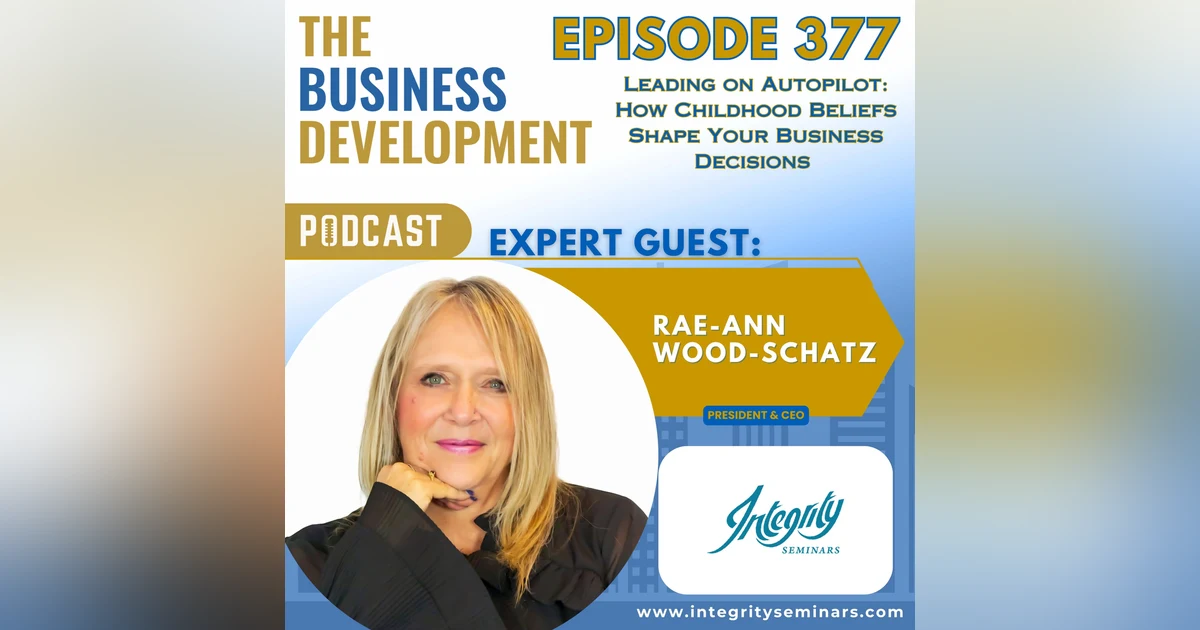
Leading on Autopilot: How Childhood Beliefs Shape Your Business Decisions with Rae-ann Wood-Schatz


 Apple Podcasts

 Spotify

 Amazon Music

 RSS Feed
Leading on Autopilot: How Childhood Beliefs Shape Your Business Decisions with Rae-ann Wood-Schatz
Rae-ann Wood-Schatz was eight years old when she met her dad at the door in her sweatpants and running shoes. He ran five kilometres a day. She wanted to go with him. When she couldn’t keep up, he sent her home. The next morning, she met him at the door again. This time, she brought her bike. Years later, what Rae-ann remembers is how badly she wanted that time with him. In her words, “Maybe if I do this, he’ll love me and approve of me.” She can look back now and name the belief she was forming. At eight, all she knew was that she could go faster on a bike.
In Episode 377 of The Business Development Podcast, Kelly Kennedy sits down with Rae-ann Wood-Schatz, executive coach and founder of Integrity Seminars, to explore how beliefs formed in childhood can shape the way we lead, earn a living and respond under pressure. Rae-ann remembers a sixth-grade teacher telling her to stick to sports when she struggled with a sewing project, and how readily she accepted the idea that she wasn’t creative. Kelly and Rae-ann bring that same question into business. If you set out to earn $150,000 and finish the year at $75,000, what did you believe about earning more, and where might that belief have influenced a decision? Rae-ann also shares a simple Positive Intelligence exercise listeners can try the next time they feel themselves reacting before they’ve decided what they want to say.
What You’ll Learn
- How to trace something you believe about yourself back to a specific experience, as Rae-ann did with her teacher’s advice to stick to sports.
- Why two people can grow up in the same household and come away with different beliefs about themselves.
- How to spot the evidence you keep collecting for a conclusion you reached years ago.
- What to ask yourself when there’s a gap between the income you set out to earn and the amount you actually earned.
- How to test a belief by trying a different response and paying attention to what happens next.
- How a strength like speaking directly can become a liability when you turn it up under pressure.
- How to use a few breaths and the simple act of rubbing your fingertips together to pause before you respond.
- What opening a wellness centre at 61 taught Rae-ann about the difference between believing in a service and getting people through the door.
Chapters
00:00 “Maybe if I do this, he’ll love me and approve of me”
01:18 Introducing Rae-ann Wood-Schatz
02:28 The chance meeting that led to 15 years in crisis work
04:01 Why Rae-ann began looking for a different career
05:53 Leaving an executive director role and moving her family to Edmonton
09:37 The origins of the program that changed Rae-ann’s life
12:16 Why wanting a different result doesn’t always change what you do
16:42 How we learn what we’re capable of as children
20:22 Recognizing the beliefs behind an automatic reaction
23:52 What Rae-ann came to believe about earning her father’s approval
25:05 Trying to keep up with her dad and coming back with a bike
27:02 How to identify a belief that keeps showing up in your decisions
28:23 When a $150,000 income goal becomes a $75,000 year
30:55 Testing a belief by doing something differently
31:23 What is Positive Intelligence?
33:09 When being direct crosses the line into bullying
34:24 A simple exercise to pause before you react
35:42 How your focus changes what you notice
37:18 How to access Positive Intelligence coaching
37:56 Inside Integrity Seminars and the Samurai Game
41:46 Opening Soultuary Wellness Center at 61
42:30 What Rae-ann experienced in a float tank
46:12 Why it’s easy to put off taking care of yourself
46:48 Connecting with Rae-ann
47:49 Closing thoughts
Connect with Rae-ann Wood-Schatz
Rae-ann Wood-Schatz is an Edmonton entrepreneur, author and executive coach. Through Integrity Seminars, she helps people examine the beliefs and habits they bring to their work and relationships. She also co-founded Soultuary Wellness Center with Shawna MacNeil. Integrity Seminars
Connect with Rae-ann on LinkedIn
Explore Rae-ann’s programs at Integrity Seminars
Visit Soultuary Wellness Center
Support Foxx and Our Family
Our one year old son Foxx is currently fighting cancer. If you are able to donate or share our GoFundMe, our family would be incredibly grateful.
Support Shelby and Kelly During Foxx’s Fight Against Cancer
Thank You to Our Sponsors
Thank you to Colin Harms and our title sponsor, Hypervac Technologies, for your steadfast support of The Business Development Podcast. We are also grateful to Hyperfab for helping us continue to bring these conversations to listeners.
Hypervac Technologies builds professional duct cleaning equipment, including duct trucks, portable vacuums and tools for contractors in the field. Visit Hypervac Technologies
Hyperfab provides custom fabrication and specialized solutions for industrial applications. Visit Hyperfab
Join The Catalyst Club Community
The Catalyst Club brings business development leaders, entrepreneurs, executives and senior professionals together for live sessions, recorded conversations and practical support.
If someone came to mind when Rae-ann talked about being told to stick to sports, share this episode with them. Ask each other one question: What did someone tell you as a kid that you still assume is true? Follow The Business Development Podcast for more honest conversations about what it takes to build and lead.
How do I create connection?
Speaker AHow do I build relationship with my dad?
Speaker AMaybe if I do this, he'll love me and approve of me and all of those pieces.
Speaker AAnd I remember we start out running.
Speaker AI'm 8, he's 38, he runs 5k a day.
Speaker AI don't run much, so obviously I can't keep up.
Speaker ASee the irritation, see the annoyance, see him being upset.
Speaker BThe great Mark Cuban once said, business happens over years and years.
Speaker BValue is measured in the total upside of a business relationship, not by how much you squeezed out in any one deal.
Speaker BAnd we couldn't agree more.
Speaker BThis is the business development podcast based in Edmonton, Alberta, Canada and broadcasting to the world.
Speaker BYou'll get expert business development advice, tips and experiences and you'll hear interviews with business owners, CEOs and business development reps. You'll get actionable advice on how to grow business.
Speaker CTo you by capital Business development capitalbd CA.
Speaker BLet's do it.
Speaker BWelcome to the business development podcast.
Speaker BAnd now your expert host, Kelly Kennedy.
Speaker DHello.
Speaker DWelcome back to the business development podcast.
Speaker DToday it is my absolute pleasure to introduce Raeanne Wood Schatz.
Speaker DRayan is an entrepreneur, author and executive coach who began her career in Calgary supporting women leaving abusive situations.
Speaker DWhen a personal development course changed the direction of her life, she asked the owner for a job.
Speaker DHe turned her down.
Speaker DShe kept showing up, finished the programs and volunteered.
Speaker DEventually that same owner asked her to run programs in Edmonton.
Speaker DSo she packed up her three boys, two dogs and three cats and took the chance.
Speaker DRayanne is the founder of Integrity seminars and co founder of Edmonton's Soltuary Wellness center which she opened at 61.
Speaker DThrough her work in positive intelligence, she helps leaders recognize the habits that take over under pressure.
Speaker DRaeanne is here today to show us that the most important person we'll ever learn to lead is ourselves.
Speaker DRayanne, it is an honor and a privilege to have you on the show today.
Speaker AThank you for having me.
Speaker DTake us back to the beginning, Raeanne, were you always this entrepreneurial, driven?
Speaker DWhat.
Speaker DWhat led you down this path?
Speaker AI would say definitely not.
Speaker AMy origins or the roots of my career started in the nonprofit sector.
Speaker ASo I graduated from university with a degree in psychology and felt like I wanted to move into.
Speaker AWhether it was programmed from my parents or what I felt like society said would make me a success is I thought I would eventually want to be a lawyer because then I would be rich and famous.
Speaker AI had gone straight into university out of high school and post undergrad.
Speaker AFelt like I needed to give myself a little bit of A rest.
Speaker AAnd so I was working in a, in a nightclub and I met a woman sitting at the bar waiting for a blind date who happened to be the volunteer coordinator at a crisis center or women's shelter.
Speaker DYeah.
Speaker AAnd so she had suggested that if I was taking a year off, why not use at least put some energy towards the degree that I spent all the money and time getting and invited me to come and volunteer at the shelter.
Speaker AAnd I think very quickly realized that I had an aptitude towards helping people in crisis.
Speaker AAnd I thought was going to be a year hiatus turned into a 15 year career.
Speaker DWow.
Speaker AWorking inside of that, that space.
Speaker AAnd also realized after a 15 year career that I couldn't imagine being in that level or that grade of energy for the rest of my life.
Speaker AI was 33 or 34 and I knew I had another 30 plus years probably to invest into my career.
Speaker AAnd I just didn't see having capacity or a desire to stay in crisis work.
Speaker ASo that was my drive towards going and taking the course that I took.
Speaker ANot because I felt like there was anything horrible or wrong, but that I wanted to just really create a space for clarity and perhaps of redirection and focus and had no idea of that.
Speaker AI would then decide that the content of that program was not only life changing, but that I felt really inspired thinking that if all people did this work, what a different world it could be.
Speaker AAnd so I made the leap of faith when the opportunity to buy the franchise and move to Edmonton, what it would look like to move from not for profit where I wrote grants and I mean I was managing a $3 million a year program that I was responsible for.
Speaker AI wasn't just a crisis worker, I was the executive director.
Speaker ASo I did a lot of leadership and I had a lot of staff.
Speaker ASo I feel like I had some of those skills but I didn't have all of the exposure or the risk.
Speaker ANow at the end of the day, the worst that could happen is the board of directors would decide I wasn't doing a good job and I would lose my job.
Speaker ABut being an entrepreneur was a whole new space.
Speaker ABeing in the for profit world was unknown and to be honest, very scary for me.
Speaker DAt.
Speaker AThe beginning.
Speaker DOh, of course, of course.
Speaker DAnd I want to speak to that for a second because obviously you've jumped from an executive director position, a great position, you've worked your way up, you've earned your way there, you probably have a nice salary, a nice life.
Speaker DWhat kind of personal development course makes you uplift and uproot your whole life and change a completely different direction and choose to even pursue purchasing that, that company, that.
Speaker DThat seems like a hell of a jump.
Speaker AIt was a significant leap.
Speaker AAnd it wasn't even just that.
Speaker AIt was.
Speaker AI had three small children and part of my evolution was to really examine my choice to stay in a relationship that as a teenager felt like it made sense as an adult.
Speaker AMy person was.
Speaker AHe was fun as a partier and those sorts of things when we were teens, not so fun raising a family.
Speaker AAnd so part of my decision in that personal development process was to make the transition out of my marriage.
Speaker AAnd so it meant having to enroll him in a dream and a desire to want to go from Calgary to Edmonton.
Speaker AAnd that meant moving our kids as well.
Speaker ASo I was not only disrupting my stability and my security in the safety of the job I had, it was convincing him to invest in me and believe enough in me and my purpose and my passion to agree to let me bring the kids to Edmonton as well.
Speaker ASo he eventually followed and moved up here and continued to co parent with me.
Speaker ABut it also meant that then not only his agreements, but I'd be basically on my own.
Speaker ASo I'd be launching a new business.
Speaker AAnd I think that probably what I took away from the program that inspired that was just the whole concept of I think of Simon Sinek and start with your why, you know, like that whole piece of my why for being and existing and purpose and mission.
Speaker AAnd I felt like even though I had always known my father when I was seven and some listeners may not even know who Ann Landers was, but is that there was a advice column in the newspaper called Ann Landers and I don't believe she was an actual person.
Speaker AI think there were probably a collective of people, but people could write in to the newspaper and ask Ann for advice.
Speaker AAnd so when I was seven years old, my dad used to call me Ann Landers because I was always coaching and counseling all my friends.
Speaker AYou know, I was in grade two, I was in grade two and I was the go to person.
Speaker AAnd so I feel like I'd always known being in service to humans and supporting people was probably my incarnated calling.
Speaker AAnd I think I hit that point where getting people from zero to five, you know, just moving them out of crisis and into some version of less of a way of being inside of trauma.
Speaker AI saw in the program people can not only survive, but they can absolutely thrive with the right skills, the right training, the right tools, the right support and that there's an Opportunity for people to become much more powerful than they ever imagined they could be.
Speaker AAnd so to teach that and then to embody it was the courage to take risks, the courage to drive yourself towards what you never imagined could be possible.
Speaker ASo it wasn't just teach it to others.
Speaker AIt's live it and embody it.
Speaker AYeah.
Speaker DTell me about the program that absolutely changed your life.
Speaker AYeah, so it's a.
Speaker AIt's a. I'd love to take credit for the development.
Speaker AI do a lot of program design.
Speaker AAnd this one was created its origins and its roots are in the 70s.
Speaker AAnd I would have said, you know, probably back in the 70s, the content would have been revolutionary.
Speaker AAnd, you know, very, very left of center, large group awareness training was just starting to get some traction.
Speaker AI think that's changed a lot.
Speaker AAnd it's probably back then would have been the University of personal Growth.
Speaker ANow I would say it's, you know, sort of the late elementary junior high of personal growth.
Speaker AA lot of people have watched the Secret.
Speaker AThey've read books.
Speaker AThey've learned a lot about manifestation and how our beliefs create our thoughts and our thoughts create our feelings, and our feelings drive our behavior.
Speaker ABut the original program was developed by a man named Werner Erhart, and it was called Seminars Training.
Speaker AAnd so it began there.
Speaker AAnd then over time, some things shifted and he disbanded or dismantled his program.
Speaker ABut a lot of his staff and the people that worked with him and trainers said, you know, we can't lose this content.
Speaker AIt's rich and it's rewarding.
Speaker ASo they split it up and went out into the world.
Speaker ASo it's out there under many, many different umbrellas.
Speaker ASo if you've ever heard of landmark seminars, Birth from the Same Mother, the program out of Texas called Choices, Birth from the Same Mother, the Pursuit of Excellence, has been in Canada, PSI seminars.
Speaker ASo there are a lot of different people teaching the content all over the world.
Speaker AAnd so I know I've even done some training and support for a company in Mexico that they got the original content from a trainer in Argentina.
Speaker ASo I have a colleague who teaches the same programs in Kazakhstan.
Speaker ASo,.
Speaker DWow,.
Speaker AIt's everywhere in the world.
Speaker AWhen it came to Western Canada, it came in actually as a not for profit and didn't really do well in that space.
Speaker AAnd so the person that I ended up working with had bought the content and rebranded it.
Speaker AAnd then he and I worked together for a period of time and then started to change direction or vision or focus for what we wanted to do.
Speaker AAnd I rebranded on my own in 2016.
Speaker ASo.
Speaker DWow.
Speaker DWow.
Speaker DSo bring us into the program itself.
Speaker DWhat are the key teachings?
Speaker AWell, I think the core of it is that many of us desire better or different results.
Speaker AWhether that's the money we generate, the health that we have, the quality of our relationships that so often we have a desire to have things be better and that we don't always understand fully that, you know, like I, so I, because my background is in psychology, I often tell the story of, you know, in a four year degree usually you would take a course on human motivation or say culture and psychopathology.
Speaker AAnd in a four year journey you would take a half a semester on a concept, you would learn a semester on something.
Speaker ABut behavior modification back in the 80s was a significant part of psychology and working with humans.
Speaker ASo I would take not just a half a semester, but year long programs for four years on behavior modification.
Speaker AI'd spend time in a laboratory teaching rats and guinea pigs to be able to push a leverage walk through a space to either avoid pain or to get to a reward.
Speaker AAnd at one point I had a guinea pig that was programmed to do 13 different things to get to a reward at the end, could remember 13 different steps to get to the reward.
Speaker ASo we were being guided towards the idea that people's lives will improve when they modify what they're doing that isn't working.
Speaker AOr if they feel like they can get a reward at the end of it, they'll do whatever needs to be done.
Speaker AAnd so I often use the example of health.
Speaker AYou know, so you're not feeling great, you're not, you know, maybe not feeling good about yourself, your energy is low.
Speaker ASo you decide, you make the decision.
Speaker AI'm going to be healthier.
Speaker AAnd so the first thing people generally do then is immediately go to, I'll start using my gym membership that I've been paying for and not using.
Speaker AI'll go to the produce aisle and make sure that I pick up vegetables, not go to the pop and chip aisle.
Speaker ASo a lot of energy and attention goes into changing what you're doing.
Speaker AAnd in concept, usually people start to see results so they feel better, they have more energy, they start to look better, they're feeling better about themselves.
Speaker AAnd so in concept, if we were as, you know, smart as guinea pigs and rats, we'd be healthy forever.
Speaker ABut most people can easily identify with the concept of, you know, it was became somewhere along the way unsustainable.
Speaker AAnd I was back into some of those old patterns and those old habits.
Speaker AAnd so, so if you then imagine what we've been brought to in the form of what works better is attitude.
Speaker AYou know, then somewhere along the way we've been collectively scripted into, you know, you just need to be a cup half full person.
Speaker AYour life will be better when you look through the lens of positivity.
Speaker AAnd science has allowed us to see that of the thousands of thoughts you have a day because you're constantly, even when you're sleeping as a dreamer, you're still thinking on some level is that we 76% of our thoughts are negative, you know, and it doesn't even have to be like super doom and gloom negative.
Speaker ABut you know, you wake up in the morning now and it's like, God, it's still dark.
Speaker AThat's not a, oh, look at how beautiful the sky is.
Speaker AYou know, the darkness of it.
Speaker AThat or the whole piece around.
Speaker AI didn't really have a good sleep.
Speaker AI don't feel good.
Speaker AThat, you know, I feel tired is that would be on the side of what we would call negative.
Speaker ASo if I use the health example, I mean, I don't know if you remember in the 90s, you might have been a bit young, but the government sponsored ads, the participation ads,.
Speaker DI still remember a body break.
Speaker AHal and Joanne.
Speaker ASo, so we weren't being invited to focus on as much the behavior as the attitude towards health, you know, and so how many people watch those ads and you know, leapt off the couch and went for a run?
Speaker AYou know, most people maybe got off the couch and went and got a snack, you know, so.
Speaker DYeah,.
Speaker ASo not that attitude.
Speaker ADoesn't matter.
Speaker AI'm a big advocate for do your best.
Speaker AYou know, we were just having the conversation about seeing through the lens of gifts and lessons and being as positive as we possibly can be.
Speaker AAnd the human experience is not in reality something that is we can create better lives by just looking for the positive because we know the other leaks in.
Speaker ASo the missing link oftentimes for people is it's not just what you're doing or even how you're feeling.
Speaker AWhat matters more than anything is your pre programmed ways of looking at yourself, looking at the world and how you approach things.
Speaker AAnd again, science tells us that about 10% of our programming is available to us at a conscious level.
Speaker ASo Dr. Bruce Lipton, he wrote a book called the Biology of Belief and he uses the metaphor of if you were to imagine that you as a person are a supercomputer, is that in the last trimester of your mom's pregnancy, everything that computer needed to be a supercomputer was in play, hard drive, keyboard, monitor, all of those pieces.
Speaker AProblem became that computer was absolutely useless without programs.
Speaker ASo the impact of life is that we have the struggle or the challenge of we need programs to be able to be a supercomputer.
Speaker AThe bigger challenge is that who are our primary programmers or what was programming us, our parents, our culture, our society, our schools, our our peers.
Speaker AYou know, there are so many different programmers that were responsible for what we were uploading.
Speaker AAnd you know, if you ever had a parent unknowingly, lovingly say, you can't do that, you might have started to pick up that program of I'm not capable.
Speaker AMy art teacher in grade six was really struggling to.
Speaker AI was trying to make a sew a thing and I wasn't very good at sewing.
Speaker AAnd she literally looked at me and said, stick to sports.
Speaker ASo I began to pick up the program of, oh, I can do things physical, but I can't do things creative.
Speaker ASo I don't think she meant to give me a program of I'm not capable of something or I'm good at something.
Speaker ABut it's that whole piece of we start to then operate subconsciously from those programs, not from anything other than what it was that we were being taught or told and that we embed that into our thinking and then that drives how we feel, our attitude, and then that drives our behavior.
Speaker ASo the course itself is predominantly, let's spend hours exploring the subconscious and the programs that exist at the level of our subconscious and then really start to understand our sabotage programs, our limiting programs, the things that will forever get us into a spin or a cycle or a loop of what's not serving.
Speaker AAnd so the gift and the is less about do better, do different is self awareness and understand yourself better.
Speaker AAnd it's not an opportunity to blame your parents or to blame your childhood or to blame anyone in your life.
Speaker AIt's to have full awareness and full accountability for I am the creator of my life now.
Speaker AI am the one who gets to be the source and cause, not my programs.
Speaker DI want to spend a little bit of time here because you mentioned only about 10% of our subconscious programming is available to us.
Speaker DI imagine that that means that we're conscious of it.
Speaker DCorrect me if I'm wrong.
Speaker DThe other side of that is if we have 90% of our, of our programming that is completely not available to us.
Speaker DWe don't even know these programs are running.
Speaker DThey might have been introduced to us as kids.
Speaker DYou mentioned, like young children, maybe even in school.
Speaker DHow do we even re like, how do we even know what those programs are?
Speaker DAnd then it kind of sounds like if we don't understand what those.
Speaker DWhat those programs are, we're doomed to repeat them forever.
Speaker AIndeed.
Speaker AThat's exactly.
Speaker AYou absolutely have nailed it from the perspective of then we become pre programmed automatic reactors to things in life versus conscious and aware responders.
Speaker ASo how we start to.
Speaker AAnd again, that's part of a big part of what the program is designed to do is to look for those moments where we feel triggered or we emotionally recognize that our nervous system is dysregulated and we take a moment and we zoom out and we do our best to look at it through the lens of I'm probably reacting and responding or resisting what is simply because something in my belief system has been activated or triggered.
Speaker AYou know, we talk a lot about not only 90% of what drives us is sitting at the less than consciousness is that we make choices all the time as to how we want to respond to situations.
Speaker ABut if you notice that you're perpetually in reaction to something versus consciously able to say.
Speaker AA better choice for me would be is we start to really understand that we have this.
Speaker AThis way of looking at ourselves and looking at the world that isn't always accurate.
Speaker AYou know, that we.
Speaker ASomething happens and we lose sight of the truth or we lose sight of the facts because we can't see it clearly.
Speaker AEverything that we experience has to go through that filtering process.
Speaker AAnd so when we, when we start to see patterns and we start to see loops, you know, I often use the example of so I have a older sister and a younger brother.
Speaker AAnd so I'm a middle child.
Speaker AAnd so when I was born, my dad wasn't at the hospital.
Speaker AYou know, back in those days, it wasn't usually, you know, the whole family was in the birthing room.
Speaker AHe was at work.
Speaker AAnd when my mom called him and said, yay, we have a, we have a baby girl, he was angry.
Speaker AHe was upset.
Speaker DOh no.
Speaker AAnd I think he was upset mostly because he had in, in his mind, anticipated had a daughter already.
Speaker ASo naturally I would be a son and they would have the perfect family and all would be well in the world.
Speaker ANobody anticipated that he was gonna be that upset that I was born a girl.
Speaker AAnd so I remember my mom often telling the story to people that not only was he so upset that I was born a girl, the day we were released from hospital, he made the neighbor come and pick her up.
Speaker ASo he wouldn't even come to the Hospital to pick us up.
Speaker AOh, my gosh.
Speaker AAnd so I.
Speaker DI can't imagine how that would have affected you over your life.
Speaker AAnd that's my point exactly, is that I wouldn't have said, I consciously started to believe that there was something wrong with my gender or something.
Speaker DYou.
Speaker AKnow, my father didn't love me.
Speaker AI wouldn't have said that.
Speaker AI consciously decided that was true.
Speaker ABut at a less than conscious level, I'd heard that story enough times.
Speaker AThat.
Speaker AAnd how I now know in retrospect that I did start to think that or believe that was.
Speaker AIf you look at photographs of me as a child, I was the proverbial classic tomboy.
Speaker ASo I looked like a boy, I dressed like a boy.
Speaker AAll my friends were boys.
Speaker AAnd so I remember as a young child, my dad was an athlete.
Speaker ASo that may also explain a little bit of why I became athletic.
Speaker ABut I remember being like 8 years old, and he was going for his traditional 5k run, and I met him at the door with my sweatpants on and my running shoes.
Speaker AAnd, you know, and I vividly remember him looking at me with the, what are you doing?
Speaker AAnd I'm like, well, I'm gonna run with you again, probably at a less than conscious level.
Speaker AHow do I create connection?
Speaker AHow do I build relationship with my dad?
Speaker AMaybe if I do this, he'll love me and approve of me and all of those pieces.
Speaker AAnd I remember we start out running.
Speaker AI'm 8, he's 38.
Speaker AHe runs 5k a day.
Speaker AI don't run much, so obviously I can't keep up.
Speaker ASee the irritation, see the annoyance, see him being upset.
Speaker ASo he sends me home.
Speaker AAnd I remember the next day getting up with the, okay, well, if I can't run fast enough to keep up with him, maybe I'll ride my bike.
Speaker AYou know, I can ride my bike faster.
Speaker AAnd so again, meeting him at the door ready to go, and him being frustrated and annoyed.
Speaker AAnd so somewhere along the way, I started to believe that not only did I not have the love, care, and attention of my father is that I started to.
Speaker AAnd the boys that I used to hang out with and be friends with were also starting to be irritated and annoyed.
Speaker ALike, why don't you go play with the girls?
Speaker AWhy are you always trying to play with us?
Speaker AAnd so I think my.
Speaker AMy programming started to shift from I need to be a boy to boys aren't really awesome.
Speaker AAnd so I could see how that unconscious programming was shifting and evolving, but not to something beautiful and meaningful.
Speaker AAnd then fast forward my early Career.
Speaker AI already mentioned that.
Speaker AWhat I then found myself inside of was intimate partner violence.
Speaker AI worked in women's shelters, so.
Speaker ASo it's the recognition that we don't always know what our beliefs are, but we're magnetizing and attracting things and people and situations.
Speaker ABecause now I had all the proof and the evidence that, you know, boys aren't awesome.
Speaker AAnd.
Speaker DYeah,.
Speaker AAnd we, so we look for the, we look for the evidence, but we're not consciously sitting down and going, this is what I decided about me.
Speaker AThis is what I decided about the world.
Speaker ALet me tell you all the ways that I get to be right about that.
Speaker AIt happens at a very sub and natural level, but it's affecting everything.
Speaker DAnd actually the progression you just gave, you know, I think brings a lot of clarity to people how it, how something that happens early in life can translate into things that happen later.
Speaker DBring me into things that we can do to start to identify some of these deep subconscious programs.
Speaker AGenerally speaking, I would say one of the most important things to be willing to self evaluate and be in an energy of self honesty is what are the things that are present in my life that aren't serving me, that I don't love, that I struggle with?
Speaker AAnd if I wasn't looking to existentially blame something or someone outside, but I start to really believe that I am a manifester and I am the designer and I am the main actor and I am the producer of my life, is that whatever's coming towards me is a direct mirror of what I must believe about me or the world around me.
Speaker AAnd so I call it the based on results is that if I look at what I'm creating and I believe that there's probably something sitting below the tip of the iceberg.
Speaker AThink the metaphor of, you know, so you set a goal and you say, I'm going to generate $150,000 personally this year.
Speaker AYou've declared it at a conscious level.
Speaker AYou probably have beliefs that'll support that.
Speaker ALots of people make that kind of money.
Speaker AI'm a good person, I deserve to have that kind of money.
Speaker AOr what?
Speaker AYou'll have beliefs that are supporting you.
Speaker ABut as the year is passing and you know you're at 50,000, you're at 60,000, you're at 70,000, you get to the end of the year, you think your goal or Your intention was 150, but based on results and the reality is that it was 75,000.
Speaker AAnd you know that's true because that's what you created.
Speaker AAnd so then the invitation is not to look for an excuse to fabricate or justify why you didn't make the 150,000.
Speaker AYou, you ask yourself this.
Speaker AThe honest question of, well, based on results, I must have probably some money beliefs that kept me from that 150,000.
Speaker AMy actual intention was 75,000.
Speaker AAnd it would be my programming sitting below the tip of the iceberg that took me off that, you know, maybe the belief is it's too hard or the belief that I don't really deserve it, or the belief that if I have that kind of money, people won't love me or care about me.
Speaker AYou don't automatically get the answer, but you're at least willing to look.
Speaker AYou're telling yourself the truth.
Speaker DSo the secret is basically to just start to look.
Speaker DYou don't have to have the answers.
Speaker DThey're probably not going to come immediately.
Speaker DBut simply recognizing, recognizing there might be something there is enough to get started.
Speaker AYeah.
Speaker AThe based on results.
Speaker ASo if I say I want something, I want, I want more of something, or I want something to be better and it's not manifesting, I'm probably carrying some programming, some thoughts about myself or the world around me that's blocking me or stopping me.
Speaker ASo I start with that truth telling.
Speaker AAnd then when I can be honest about that and tell the truth about then that, you know, I say get curious, not furious.
Speaker ADon't be mad at what you're creating in your life.
Speaker ADon't be upset with what's there.
Speaker AGet curious as to, you know, what could it be that I must think or feel or believe about myself that would be creating this result or this outcome, not whose fault is it, including my own.
Speaker DI always used to tell my students when I was teaching business development that if you believe you can do something or you believe you can't, you're right.
Speaker AEither way.
Speaker AEither way.
Speaker AEither way, you're right.
Speaker DEither way, you're.
Speaker ARight.
Speaker AYeah.
Speaker DBelieving is half the battle.
Speaker AYeah.
Speaker AWell, and then just the piece around from that place of recognizing that there's something there and being in the curious space is, Is then experimenting with different ways of thinking or different ways of being, and then watching and observing what the shifts are in the.
Speaker AIn the results or in the outside world, then you'll know you're starting to tap some of those less than conscious beliefs because you start to see a different result.
Speaker DYeah.
Speaker DYeah.
Speaker DOne of the things that you talked about when we first chatted was something called positive intelligence.
Speaker DWhat is positive intelligence?
Speaker AYeah.
Speaker ASo again, I would love to say that I am the creator.
Speaker ABut remember my art teacher told me I wasn't creative is that there's a man by the name of Shirzad who worked inside of corporations, multimillion dollar businesses and realized that one of the things that most often was getting in his way or in the way of the people that worked with him and for him were arc the archetypes of our saboteurs.
Speaker AThere's the controller saboteur, there's the hyper vigilant saboteur.
Speaker ASo he would go beyond just the what I'm pre programmed.
Speaker ABut not only am I pre programmed from life experience, it's created a way of being that is my default.
Speaker ASo there's a self protection piece, you know, like so for the controller, one of the gifts of the controller is being driven and determined and very focused on creating results and getting things done.
Speaker AThe controller turned up too loud can become very rigid, unmovable, not coachable.
Speaker AAnd so it's the concept of our weaknesses are generally when our strengths get turned up too loud, we often think that this is my strength, that's my weakness.
Speaker AThey're not, they're two sides of the same coin in concept.
Speaker ASo even if you think about, you know, someone who's very kind and generous and giving, that's a gift turned up too loud becomes a people pleaser.
Speaker ASomebody who's very direct and honest and like speaks their truth turned up too loud can become a bully.
Speaker ASo.
Speaker DYeah,.
Speaker ASo the mental fitness aspect of positive, you know, we have eq which is we're very self aware in our emotions and we have good ability to regulate how we're feeling.
Speaker AIQ of course, is how you're able to mentally absorb information and learn and all of those pieces.
Speaker APositive intelligence is mental fitness designed to support us in learning about our saboteurs, learning how to interrupt the patterns that we've created, rewire ourselves literally.
Speaker AThere's science behind the rewiring of our brains to a different type of neural pathway that allows us to be more in that place of positive or what he calls the sage mind.
Speaker ASo instead of being in the saboteur path and in the saboteur mind, we can move to the sage mind, which is where we innovate, we explore, we activate, we just show up differently from a, from a grounded regulated space versus that reactive belief driven programmed space.
Speaker DNow what are some examples on how we could use positive intelligence in our day to day?
Speaker ASo, so the program itself, it's an app based program.
Speaker ASo it's seven weeks of learning and taking time three times a day.
Speaker AThe app notifies you to basically hit the pause button.
Speaker ASo it would be like micro or mini meditations.
Speaker DOkay.
Speaker ALike, in concept, I. I just take a minute out of my day and I do something to regulate how I'm feeling or what I'm experiencing.
Speaker AI just slow everything down.
Speaker ASo he would say things like, you know, just pause and take a couple of deep breaths and then run your fingers together.
Speaker ALike, just rub your fingers together.
Speaker AAnd as you're rubbing your fingers together, put all of your attention on the tactile experience of what it feels like.
Speaker ASo that I'm pausing the hamster wheel of my patterns of thinking, and I'm just slowing everything down.
Speaker AAnd then from that place of slowed down is putting my attention and my focus on my intention for the day or something that I want to create.
Speaker AOr just give ourselves that little mini micro pause and then direct our focus.
Speaker AYou know, we talk a lot about in our work.
Speaker AThe reticular activating system is that that whole piece of what I focus on expands.
Speaker AYou know, I often use the metaphor of there's so much coming in in any given moment, we can't possibly attend to everything.
Speaker ASo how do we focus?
Speaker AWell, we don't usually consciously direct our focus.
Speaker AIt just happens like.
Speaker ASo it's like I used to say that it's like, if you are thinking about buying a Jeep, now, everywhere you go, you see Jeeps.
Speaker AIt's not that there's more jeeps in the world.
Speaker AIt's just you're focused on it.
Speaker AOr when I was pregnant, it was like, oh, my God, everybody in the world is pregnant.
Speaker AAnd, you know, I haven't seen a pregnant person in the last 31 years since my youngest was born.
Speaker AIt's not that there's not pregnant.
Speaker AI'm just not focused there.
Speaker DYou're not looking for it.
Speaker DYeah.
Speaker AAnd so the reticular activating system's job is to help us decide what we're gonna focus on.
Speaker AAnd again, if we're programmed towards focusing on something distressing or not serving or.
Speaker AAnd it's not conscious, it's not like I'm consciously making that decision, then we need to find ways to regulate better.
Speaker AWe need to find ways to focus on the things that really matter and that create the life and the results that we say we want.
Speaker AAnd the only way we can do that is manage those subconscious pieces and then direct the attention of our conscious mind.
Speaker DAmazing.
Speaker DIs that app something that people can just download?
Speaker AThey could, but I.
Speaker ASo if they went onto the positive intelligence site, they would spend A lot of money and they would spend it in US Dollars.
Speaker AI am a certified coach and I am happy to.
Speaker AIf people wanted to take a look at it and didn't want to go through the mainframe and the app itself is.
Speaker AThey would just get a hold of me and I would have a conversation about how to support them inside of that for in a.
Speaker AAnd then, you know, I do a bit of coaching and supporting people while they're in the program as well.
Speaker ASo.
Speaker DAmazing.
Speaker DOkay.
Speaker DAnd I think that's a great segue into integrity seminars.
Speaker DSo bring us into your company.
Speaker DIntegrity seminars.
Speaker DWhat do you guys do?
Speaker ASo again, that program that I mentioned, the EST program, that was from the 70s, that is the core of what I do ad integrity is it's a four level program.
Speaker APeople often take about a year to go through.
Speaker ASo there's a three day program and then a five day program and then a four weekend program and then.
Speaker ASo that's the essence of.
Speaker AOr the core of what I would say we do.
Speaker ABut we also.
Speaker APositive intelligence is part of it.
Speaker AWe actually have a program where for companies and corporations that want to do team building and staff development, we have a.
Speaker AIt's built around a lot of cubbies, the effective, highly effective people.
Speaker ABut we have a, a quine therapist.
Speaker ASo we bring people into arena where the leadership.
Speaker AYou're tested on your leadership skills as to how you can get a horse to do.
Speaker AWhether you're a horse person or not a horse person.
Speaker AIf you can regulate yourself in a way that you can lead the horse.
Speaker AYou know, horse therapy is what.
Speaker AIt's a fascinating process.
Speaker AThe, the body language that you carry and the impact that has on a thousand pound animal.
Speaker ASo we get to do that.
Speaker AI also teach a program.
Speaker AI'm the only Canadian facilitator of a team building professional development program called the Samurai Game.
Speaker ASo it was a.
Speaker AThere was a.
Speaker AHe's dead now.
Speaker AHis name is George Leonard.
Speaker AHe was a World War II veteran who was a Aikido black belt in the keto, but also a big, big lover of the concept of Bushido or the warrior's code that the samurai carried.
Speaker AAnd so when he came back from war, he's sitting around with his buddies and kind of said, you know, there's something about being in a situation where you're facing death and the reality is there that today could be your last day on the planet that changes how you look at the world.
Speaker AAnd so he said, I'd like to be able to simulate that or create an opportunity for people to feel into what that might be like without the actual risk.
Speaker AAnd so he developed the samurai game from the concept of that together with.
Speaker AIf you understand aikido as a martial art is it's learning to move with the energy of what's coming at you, not create force against force.
Speaker AAnd then the concept of the code of bushido.
Speaker AAnd so he put those three kind of concepts together and created the samurai game.
Speaker ASo it's quite a beautiful, fascinating look at life through that lens.
Speaker AAnd so I get to bring that to the world as well here in Canada.
Speaker ASo.
Speaker DVery cool.
Speaker DVery cool.
Speaker DAnd then, is that program only run here in Canada, or do you take international students as well?
Speaker AWell, there are definitely.
Speaker AAnd there are.
Speaker AI think there's 147 certified trainers around the world, so people that are interested in experiencing the samurai game would easily be able to access.
Speaker AAre there programs being offered in their geographic area?
Speaker AOf course.
Speaker ABecause I'm the only Canadian facilitator, people would naturally make their way to come here if they wanted to participate in a game I'm offering.
Speaker ABut I do it inside of companies.
Speaker AIf somebody.
Speaker AI did one for a jewelry company in New Jersey, so they invited me to come and train their leaders in the samurai process.
Speaker ASo I got to go to New York and.
Speaker AYeah,.
Speaker DRight on.
Speaker DRight on.
Speaker DYou also have a wellness center.
Speaker DLet's talk about Soultuary.
Speaker AYeah.
Speaker ASo funny.
Speaker ANot funny story.
Speaker AI've always sort of said that my purpose in life is to support people in the trinity of mind, body, and spirit.
Speaker ASo I'm also a certified shamanic coach.
Speaker AIn fact, I'm pouring a sweat lodge tonight for a group of our people.
Speaker AAnd so I felt like the integrity side of things was the mind really helping people in the reprogramming and all of those pieces.
Speaker AThe shamanic work is a way to support people in their spiritual growth and evolution.
Speaker ASo the only thing I felt like was missing was the body aspect.
Speaker AAnd so I got this download that I don't know if you.
Speaker AHave you ever been in a sensory deprivation tank?
Speaker DI haven't, but I imagine it's very strange.
Speaker AIt absolutely is, because I'm one of those people that my brain goes.
Speaker AMeditation has been a struggle for me.
Speaker AIt's very difficult for me to slow everything down.
Speaker AI remember listening to a CD of Wayne Dyer getting in the gap, where he kept talking about the gap between your thoughts, and I'm like, what gap, dude?
Speaker AThere's no gap.
Speaker AIt never stops, but it never stops.
Speaker ASo.
Speaker ASo I was really like, I guess I'm Not a meditator.
Speaker AAnd then I got introduced to floating.
Speaker AAnd I remember having a moment inside the tank where it was like, there's nothing, you know?
Speaker AAnd it wasn't just because there's no light, no sound, and you're weightless.
Speaker AI felt like I just hit this point of it was time to get out.
Speaker AAnd I hadn't fallen asleep, and I hadn't.
Speaker ASo it was like.
Speaker AI don't know where I went, but I just had a.
Speaker AWhat I would call a transcendent experience.
Speaker ASo I decided that I wanted to bring floating to people.
Speaker AAnd my business at the time was doing fairly well, so I was gonna.
Speaker AAnd I wanted to create passive income.
Speaker AYou know, I had a business coach who was really encouraging me to look at other ways to create financial freedom.
Speaker ASo I thought, okay, I'm going to invest in these tanks.
Speaker AI'm going to find somebody that has a wellness center or a spa that wants to.
Speaker AI'll bring the capital, they'll bring the infrastructure.
Speaker AAnd so I bought these tanks seven or eight, nine years ago, put them into a client's massage studio.
Speaker ABut the condensation and the.
Speaker AThere's a thousand pounds of epsom salts inside of them.
Speaker AAnd so they create a lot of humidity, and they emit into the world some pretty intense, well, salt that eats drywall.
Speaker AAnd anyway, long story.
Speaker ALong story short, we had an agreement that they would be there for a year, and we'd revisit the partnership.
Speaker AThere would have needed to be a $60,000 upgrade on the H Vac.
Speaker AThe massage therapists were saying, like, our clients are sliding off the tables.
Speaker ALike, so she just basically said it was a nice idea, but you're going to need to take your tanks out.
Speaker ASo I didn't know what to do with them, so I put them in a friend's warehouse, and he had them for about seven years.
Speaker AAnd then he called me about a year and a half, two years ago, and said, I've sold my warehouse.
Speaker AWhat do you want to do with these tanks?
Speaker AAnd I'm like, oh, yeah, those tanks.
Speaker ASo I thought, well, maybe I'll just like, do the final part of.
Speaker AAt 61.
Speaker AI'll do the final part of the Trinity and build a wellness studio that isn't just going to be the float tanks, but we've got, like, red light therapy.
Speaker AWe've got cold plunge.
Speaker AWe've got infrared.
Speaker AWe've got.
Speaker ASo Soltuary was.
Speaker AWas birthed.
Speaker AAnd it's built just below where the seminars are.
Speaker ASo we're kind of physically located in the same general area.
Speaker AAnd it's been.
Speaker AIt's been a bit of a struggle.
Speaker AI think I had mentioned to you earlier that I. I honestly believe that if I built it people would just come naturally.
Speaker AThat we're all very committed to our wellness and that includes our physical wellness.
Speaker AIt hasn't exactly turned out that way.
Speaker AI've been a bit surprised at how, you know, this shouldn't be a pampering experience.
Speaker AThis should be a regular part of your self care practice and people aren't that good at it.
Speaker AI'm discovering.
Speaker DYes.
Speaker DAnd I think a lot of people struggle with wellness in general.
Speaker DRight.
Speaker DI think we live in a time where, you know, we're so busy doing other things that to focus on ourselves sometimes feels selfish.
Speaker DAnd I get that.
Speaker DLike.
Speaker AI.
Speaker DGet that it is and we need to be a little bit selfish.
Speaker DBut I do think a lot of people feel that way.
Speaker DRight.
Speaker DIt's like it's hard to get away from the family sometimes to do these things, especially in your 30s, I think is an example.
Speaker DBut.
Speaker AOr we wait until we're in struggle until it becomes a have to.
Speaker AA have to instead of I get to or I want to.
Speaker DYeah.
Speaker DYeah.
Speaker DWow.
Speaker DThat's.
Speaker DWe went pretty deep on this today, Rayanne.
Speaker DThere's obviously a lot deeper that we can go.
Speaker DIf people do want to get a hold of you, they want to take.
Speaker DTake part in integrity seminars or they want to do a zero g float, what is the best way for them to do so.
Speaker ASo definitely integrity seminars.com is.
Speaker AOur website has pretty much everything and anything anyone would need to explore.
Speaker AAnd then sultuary ca is our.
Speaker AIf people are in Edmonton or visiting Edmonton and want to come and have an experience, there's again all sorts of cool, interesting things that we have.
Speaker ANot just the tanks, there's lots of other things there as well.
Speaker DAmazing.
Speaker DYou know, it's almost the new year.
Speaker DLet's try some new things.
Speaker DGive it a go.
Speaker AWho.
Speaker DDoesn't need a transcendent experience these days, hey, Rayanne?
Speaker AIndeed.
Speaker AAbsolutely.
Speaker AYeah.
Speaker AYou're.
Speaker AYou're more than welcome.
Speaker AIf you end up coming up.
Speaker AI would love for you to come and have an experience.
Speaker DAmazing.
Speaker DThank you, Rhianne.
Speaker DThis has been incredible.
Speaker DAnd until next time, you've been listening to the business development podcast and we'll catch you on the flip side.
Speaker BThis has been the business development podcast with Kelly Kennedy.
Speaker BKelly has 15 years in sales and business development experience within the Alberta oil and gas industry and founded his own business development firm in 2020.
Speaker BHis passion and his specialization is in custom customer relationship generation and business development.
Speaker BThe show is brought to you by Capital Business Development, your business development specialists.
Speaker BFor more, we invite you to the website at www.capitalbd.ca.
Speaker BSee you next time on the Business Development podcast.