
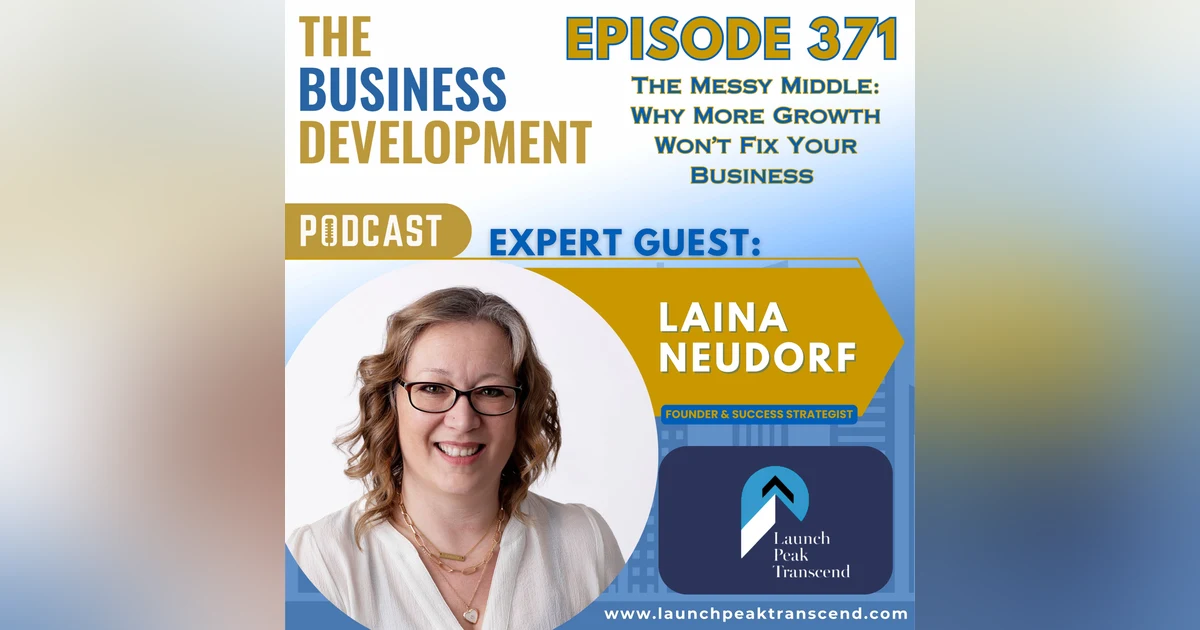
The Messy Middle: Why More Growth Won’t Fix Your Business with Laina Neudorf


 Apple Podcasts
 Spotify
 Amazon Music
 RSS Feed
 A family construction company tripled its revenue in one year. Behind the growth, the owners were still carrying the business themselves. He was leading in the field. She was handling payroll, scheduling and the administrative work. They hired Laina Neudorf to help, but when they understood the work required to change how the business operated, they walked away from the engagement. They had become so busy running the business that they couldn’t make room to improve it.
In Episode 371 of The Business Development Podcast, Kelly Kennedy speaks with Laina Neudorf, Founder and Success Strategist at LPT Success Solutions, about navigating the messy middle of business ownership. Drawing on nearly two decades of experience across industrial construction, oil and gas, and software operations, Laina explains why more revenue, another hire or a new system may not solve the problem an owner is facing. They discuss recognizing bottlenecks, questioning familiar habits, making room for change and understanding what success looks like beyond the numbers. Kelly also shares how Foxx’s cancer diagnosis forced him to reassess his business activities, revealing that some things he thought were essential could stop while the business kept moving.
What You’ll Learn
- How to recognize the messy middle, when an established business still depends too heavily on its owner.
- Why understanding the root cause of a problem matters before hiring, expanding or spending more on marketing.
- How a not-to-do list can help you identify activities that no longer deserve your time.
- What asking “What would break if I stepped away for two weeks?” can reveal about your business.
- How to introduce changes in stages, measure their impact and transfer decision responsibility to your team.
- Why your next business decision should reflect both the company’s needs and the life you want to build.
Chapters
00:00 Will more growth solve your problems?
01:08 Introducing Laina Neudorf
04:10 From industrial construction to software operations
05:22 Why projects succeed and how to navigate change
07:23 Understanding problems versus symptoms
07:53 Making the leap into entrepreneurship
10:07 Family, ambition and redefining success
12:17 Kelly’s experience balancing business and Foxx’s treatment
13:50 Rethinking work-life balance
15:22 What is the messy middle?
17:18 Can you build a business and the life you want?
18:29 Burnout and the value of a not-to-do list
19:53 Questioning the habits that keep you busy
21:08 Affording help and exploring fractional support
22:43 What happens when you stop doing everything?
24:25 The two-week absence test
25:57 Why growth isn’t always the answer
26:59 A construction company’s cautionary growth story
28:36 Understanding your business before the next big decision
30:45 Making changes without disrupting everything
32:22 Recognizing the owner as the bottleneck
33:15 Sharing responsibility and deciding what to delegate
33:51 The Business Diagnostic and a 90-day plan
35:22 Getting support to implement change
36:05 Who Laina works with
36:43 Profit, pressure and knowing when to ask for help
37:40 Connecting with Laina
Connect with Laina Neudorf
Laina helps owner-operators understand their business before deciding what comes next. Through LPT Success Solutions, her Business Diagnostic examines business performance alongside the owner’s goals, helping establish priorities and a practical 90-day plan. She also offers fractional and contract support for owners who want help implementing those changes.
Website: https://launchpeaktranscend.com/
Business Diagnostic: https://go.launchpeaktranscend.com/diagnostic-info
LinkedIn: https://www.linkedin.com/in/laina-neudorf/
Explore Laina’s three ebooks: Where the Hell Is My Profit?, Shouldn’t This Be Easier By Now? and Where Do I Go From Here?
https://go.launchpeaktranscend.com/book-trilogy-2
Support Foxx and Our Family
Our one year old son Foxx is currently fighting cancer. If you are able to donate or share our GoFundMe, our family would be incredibly grateful.
https://www.gofundme.com/f/support-shelby-kelly-during-foxxs-fight-against-cancer
Thank You to Our Sponsors
Thank you to Colin Harms and our title sponsor, Hypervac Technologies, for your steadfast support of The Business Development Podcast. We are also grateful to Hyperfab for helping us continue to bring these conversations to listeners.
Hypervac Technologies builds professional duct cleaning equipment, including duct trucks, portable vacuums and tools for contractors in the field.
Hyperfab provides custom fabrication and specialized solutions for industrial applications.
Join The Catalyst Club Community
The Catalyst Club brings business development leaders, entrepreneurs, executives and senior professionals together for live sessions, recorded conversations and practical support.
https://www.kellykennedyofficial.com/thecatalystclub
If you know a business owner who is busier than ever but wondering why things aren’t getting easier, share this episode with them. Follow The Business Development Podcast for more honest conversations about what it takes to build and lead.
Mentioned in this episode:
Hypervac - Revolution Vacuums
Is the answer always growth?
Speaker AI know that if you look at a company, most of them are thinking, grow.
Speaker AIf I grow big enough, all my problems will go away.
Speaker AIs that, is that actually true?
Speaker BThe great Mark Cuban once said, business happens over years and years.
Speaker BValue is measured in the total upside of a business relationship, not by how much you squeezed out in any one deal.
Speaker BAnd we couldn't agree more.
Speaker BThis.
Speaker BThis is the Business Development Podcast, based in Edmonton, Alberta, Canada, and broadcasting to the world.
Speaker BYou'll get expert business development advice, tips and experiences and you'll hear interviews with business owners, CEOs and business development reps. You'll get actionable advice on how to grow business.
Speaker BBrought to you by Capital Business Development, CapitalBD CA.
Speaker BLet's do it.
Speaker BWelcome to to the Business Development Podcast.
Speaker BAnd now your expert host, Kelly Kennedy.
Speaker BHello.
Speaker AWelcome back to the Business Development Podcast.
Speaker AAnd today it is my absolute pleasure to welcome to our stage Lena Neudorf.
Speaker AEvery business decision has consequences.
Speaker AWith nearly two decades of experience across industrial construction, oil and gas and global software operations, she has helped teams navigate complex projects, improve processes, and make decisions where time, money and execution mattered.
Speaker AToday, as the founder and success strategist behind LPT Success Solutions, she brings experience to owner operators facing a question that success alone doesn't answer.
Speaker AWhat comes next?
Speaker ALaina works with business owners in the messy middle.
Speaker AThey have customers, revenue and a team.
Speaker ABut choosing their next move isn't getting any easier.
Speaker AThrough her business diagnostic, she helps them understand what deserves their attention before they commit to another hire, another system, or another expansion.
Speaker AToday, we're exploring how to move forward with purpose, because building a business that works is only one achievement.
Speaker ABuilding a business that works for you is the next.
Speaker ALaina, it's an honor and a privilege to have you on our stage today.
Speaker COh, thank you so much, Kelly.
Speaker CYeah, I mean, it's great to be here.
Speaker AIt's great to have you.
Speaker AThis is something that I have absolutely experienced.
Speaker AYou know, I'm, I'm very early on my business journey.
Speaker AI like to say that, you know, I guess now we're closing in on six years, but it still feels real early.
Speaker ABut there's been a lot of change that has happened in my business in the last six years.
Speaker CYou know, I, you know, there's that, there's that ongoing adage that death and taxes are the two things that you can count on in life.
Speaker CAnd I do think that they need to add change to the third as a third, third piece to that list, because everything is always changing, right?
Speaker CLife, business, family, Everything is constantly moving and evolving.
Speaker AIt is, it is.
Speaker AAnd you know, you find too, and we're going to talk about this later on Today, you hit on it before the show started, that people change.
Speaker ARight.
Speaker AI think that's the thing that you're not really taking into consideration when you launch your business, even if it's something that you absolutely love.
Speaker AYou might find six, eight years down the line that you want to do something different, that your passions have changed or that your circumstances have changed.
Speaker AMaybe you got married, maybe you had five kids, whatever.
Speaker AMaybe you started podcasts, who knows?
Speaker ARight.
Speaker ABut things have absolutely changed and you change with them.
Speaker CAbsolutely.
Speaker CAnd you know, and sometimes, you know, like, those things change, your family changes, your business changes, and you don't necessarily even realize the impact of that or how to address those things in the moment.
Speaker CRight.
Speaker CSo before you know it, there's this huge misalignment between, you know, what you want and where you are.
Speaker CRight?
Speaker AAbsolutely, absolutely.
Speaker AYou know, before we get into it, you have lived an exceptional career.
Speaker ABring us into this, you know.
Speaker AHow did you end up on this path?
Speaker COh, wow, I did.
Speaker CI spent about 12 years of my life in industrial construction on oil and gas sites here in the industrial heartland of Alberta and Port Saskatchewan.
Speaker CSo I was here for construction of a couple of really huge projects out here.
Speaker CYou know, expansion of Scotford Upgrader and Northwest Redwater.
Speaker CHuge projects out here.
Speaker CAnd then after that I went into software.
Speaker CI was working in a software company for several years because unfortunately, when it comes to oil and gas and industrial construction, it's one of those sort of boom and bust type of industries where, you know, you don't always have that stability for employment.
Speaker CSo, you know, it was just one of the casualties of one of the bus cycles.
Speaker CSo I had to find somewhere else to go.
Speaker CAnd I ended up at a company that did software development.
Speaker CSo, yeah, I mean, it's kind of like a 180 from where I was.
Speaker ASounds like you had to manage a little change, Lena.
Speaker CReally?
Speaker CYeah, you definitely could say that.
Speaker AWell, obviously you've been part of some incredible, incredibly successful projects.
Speaker AYou've had, you know, a large variety of projects from software to large scale engineering projects.
Speaker AWhat would you say makes the difference between projects that go very successfully and ones that maybe fall off the rails?
Speaker CWell, I think project planning is a large portion of that, but expectation management is also super, super important in that.
Speaker ARight.
Speaker CBecause there is not a project that I don't think has ever existed in the history of the universe where something hasn't Changed from the plan.
Speaker CYeah.
Speaker CSo we all have these best laid intentions, but it's just understanding that just because you intend for something to go a certain way doesn't mean that that's the way it's going to go.
Speaker CAnd rolling with that.
Speaker CRight.
Speaker CLike understanding how, how to be a little bit flexible and respond to changes is really, really important in the, in still navigating what, what success could look like.
Speaker ALet's talk about change really quickly.
Speaker AWhat makes change management successful?
Speaker ARight.
Speaker ABecause we know we're going to be navigating change.
Speaker AWe know that change is going to be a part of this.
Speaker AWe know that no project is going to go to plan.
Speaker ABut how do you navigate it when things go out of plan?
Speaker ABecause I know that particular situation or when you run into a roadblock or a challenge, that's when things can mentally go off the rails too.
Speaker CI know in the projects I've worked on that really understanding the end go.
Speaker CYou know, sometimes there's ways to get to that end goal when things go off the rails that maybe you hadn't considered.
Speaker CLike sometimes you just, you have to be really nimble and willing to sink on your toes when things are changing really quickly.
Speaker CBecause I think as long as you have the end in mind and you understand exactly where you're wanting to go, sometimes you don't have to follow the plan.
Speaker CEspecially if the plan falls apart.
Speaker CRight.
Speaker CSo just kind of understanding how the circumstances are changing, like that's kind of the most important part.
Speaker CHardest.
Speaker CWell, what is it that actually changed and how does that affect where we're going and what we're trying to accomplish?
Speaker CRight.
Speaker ATruly understanding the problem.
Speaker AI like that because I think a lot of times we see the result of the problem and we try to fix that maybe before we even understand truly what went wrong.
Speaker CAnd the other thing is sometimes we're responding to symptoms and not necessarily the problem either.
Speaker CSo really ensuring that our understanding and our comprehension of where we're at is truly a problem and not just a symptom of a different problem.
Speaker AYeah, yeah.
Speaker ALead me into LPT's success solutions.
Speaker AObviously your company, but what made you decide to start this company?
Speaker ATalk to me about the jump, because we have a lot of people who listen to this show who are maybe just like you.
Speaker AThey've had incredibly successful careers, they've worked at plenty different projects, different companies, different industries and they have something that they want to bring to life.
Speaker ABut making that jump from employee to entrepreneur can sometimes be pretty damn scary.
Speaker ARight.
Speaker AEspecially for people like you who had Built incredible careers, who had great positions at these big companies, who had nice paychecks that you have to walk away from and walk on your own two feet, maybe for the first time in your life.
Speaker ATalk to me about that jump.
Speaker CWell, it's not for the faint of heart, I can tell you that.
Speaker CBecause with entrepreneurship comes a hundred different challenges.
Speaker CAnd a lot of those, everybody talks about the struggles, but you don't truly understand what they are until you're there.
Speaker CAnd they're not the same for everybody either.
Speaker CRight.
Speaker CI've decided that I wanted to make an impact, and even though I had these fantastic roles in the past, I felt I wasn't giving my gift to the best of my capacity.
Speaker CLike, I just.
Speaker CYou know, you kind of always feel like there's.
Speaker CWell, not always, but sometimes you kind of just feel like there's something missing and you can't quite put your finger on what it is.
Speaker CAnd for me, it was not feeling like I'm.
Speaker CI'm making enough of an impact.
Speaker CAnd I just.
Speaker CI really wanted to make sure that I was actually providing the level of value to people that I could.
Speaker CThat was really important to me, and it was terrifying.
Speaker CIt was absolutely terrifying.
Speaker CAnd we talk about change.
Speaker CThe.
Speaker CI'm going into my third year of business now.
Speaker CMy first year was pretty much a wash because it was just a learning curve.
Speaker AYeah.
Speaker CAnd when I talk about learning curves, like, I've.
Speaker CI learned software systems that have a stated learning curve like this.
Speaker CRight.
Speaker CAnd it's just, like, super, super steep.
Speaker AYeah.
Speaker CAnd that is nothing compared to the learning curve in entrepreneurship, because there are just so many moving pieces and then family dynamics and just so many things to consider.
Speaker CSo it's certainly not for the faint of heart.
Speaker AYeah.
Speaker AI love that you talked about the moving pieces, because I think when a lot of people think about entrepreneurship, the only thing they're thinking about is the business or, you know, the product or service they want to sell.
Speaker CRight.
Speaker ABut you touched on something that's really critical to running your own business.
Speaker AHow does it impact your family dynamic?
Speaker AAnd that is something that has come up so many times on this show.
Speaker AI have seen way too many divorces, way too many, you know, separations from children, and you name it, for people that were chasing broad ambitions but were just not able to manage that.
Speaker CAnd it's interesting that you say that, because the reason I specifically struck out into entrepreneurship was because I wanted to have more control over my schedule and over my time with my kids, because I'm a single mom, and it's important for me.
Speaker CIt's funny, I. I never considered.
Speaker CI was always a really ambitious person when I was in.
Speaker CIn the career path, and I had never considered being a stay at home mom.
Speaker CI. I had always focused so much on my career.
Speaker CBut then, you know, March 2020 happened, and of course, Covid changed the entire landscape of the world in multiple ways.
Speaker CAnd, you know, there was a lot of terrible pieces.
Speaker CI don't need.
Speaker CThis isn't a Covid podcast, and I don't need to get into that.
Speaker CBut it certainly reassessed my priorities because at that time, I was an employee and I was working from home, and I. I ended up developing a relationship with my kids that I didn't even know I was missing.
Speaker CAnd so I was still ambitious.
Speaker CBut my definition of success changed when I realized I could spend more time with my kids, but also make money and design that around my family instead of the other way around.
Speaker CInstead of forcing my family to fit into my career life, I was gonna.
Speaker CI was able to do that the other way around.
Speaker AYeah.
Speaker AYeah.
Speaker AIt is kind of funny that you mentioned this isn't a Covid podcast, but I'll tell you, I have interviewed so many people on this show who started businesses in Covid, me included.
Speaker CYeah, well, and when you're working from home, you are.
Speaker CYou're able to.
Speaker CRight.
Speaker CBecause you're dropping the commute, which is a huge part of the frustration that people have when they're working.
Speaker AThis show might be more of a Covid podcast than we might think.
Speaker CFair enough.
Speaker CFair enough.
Speaker AOh, goodness.
Speaker AYeah, it's.
Speaker AIt's something that hits me really close to home because obviously I've run into all of these challenges trying to start my business right.
Speaker ALike, I. I had a.
Speaker AA big family when I started this.
Speaker AYou know, me and.
Speaker AMe and my girlfriend at the time, she had three little boys when we met.
Speaker ASo I launched my company, you know, with the.
Speaker AThe oldest at the time was five and the youngest was two.
Speaker AAnd then we had two more little boys of my own during this journey, during my podcasting journey, I found podcasting two years into my business, launched this very show, launched another show just this year.
Speaker AI used to work there, having a ton of fun with those, but it's just a constant evolution and balance.
Speaker AAnd obviously things got thrown really out of balance, you know, for.
Speaker AI haven't talked about it a lot for a lot of listeners on the show, but, you know, my son, we've been fighting a cancer journey with my youngest son, he's 14 months old, fighting stage four cancer.
Speaker AAnd I've had to try to figure out, how in the world do you balance a business, a family, and still provide the care that is just demanded of you when you're trying to fight for your kid's life?
Speaker AAnd it's not easy.
Speaker AIt's not easy, especially for ambitious people who are trying to build something who had already invested lots of time into businesses and podcasts and whatever else you're working on.
Speaker ACatalyst Club for me, too.
Speaker AAnd yeah, there's a lot to balance, and I think maybe we can't understate how critical it is to try to find some level of cohesion between all of it.
Speaker CAnd I think work life balance as we've known it in the past is sort of a myth, right?
Speaker ATotally.
Speaker CIt's because it's a juggling act constantly.
Speaker CAnd if you're never going to find the right balance, so to speak, it's just managing your expectations and your priorities for each of those things and making sure that they.
Speaker CThey mutually can coexist.
Speaker AI would like to meet the person who coined the term work life balance.
Speaker AAnd I want to know what corporation they work, because I feel like this was definitely leaning towards, we want better performance from you at work.
Speaker CWell, or conversely, it could have been an entrepreneur that was able to have the freedom over their calendar and also a family at the same time.
Speaker AThat's right.
Speaker AThat's right.
Speaker AIt's so funny, Lena, because if you look at, like, just how everything has changed in the last five years, I truly think business has changed.
Speaker AAnd the way that we think about business has to change too.
Speaker ALike, you can't look at the way we did things pre Covid and the way we do things today in 2026 and say they're the same.
Speaker AThey're not even close to the same.
Speaker CNo, no, absolutely not.
Speaker CAnd you know, like, that's a.
Speaker CAnd that's the other thing.
Speaker CNot only did business change and the landscape of business change, but politics have changed things and people have changed.
Speaker CLike, I don't think I'm the only person that redefined what they wanted their life to look like after having that experience of COVID Right.
Speaker CAgain, your definitions of success and your definitions of what you want your life to look like would have changed significantly in some cases.
Speaker AAlso, let's talk about that.
Speaker AYou work with a lot of business owners right now who are, in a term you coined the messy middle.
Speaker AFirst explain what the messy middle is, and then let's talk about the challenges that those owners are facing right now.
Speaker CThe messy middle Is somebody who's established, generally speaking, a relatively successful business, successful from any outside standards.
Speaker CThey've got consistent revenue coming in.
Speaker CThey're, they're, you know, they're, they've got business.
Speaker CThere's things are going well.
Speaker CLike I said, from any outside definition, they've kind of established themselves.
Speaker CThey're kind of past that startup stage, right, where you're still trying to figure everything out.
Speaker CAnd, you know, there's always all these decisions that they're facing and do we want to grow the business?
Speaker CDo we want to hire somebody?
Speaker CShould we automate things and do we bring in more AI?
Speaker CYou know, there's all kinds of questions that these business owners are asking themselves.
Speaker CAnd then in tandem with even just the business pieces, it's, is this business still doing what I want it?
Speaker CLike, as an owner, am I still getting what I want to out of this business?
Speaker CAnd is it still operating in a way that's sustainable for me?
Speaker CBecause again, like you said, your, your business can change as you do, as you build it, as you grow.
Speaker CSo, you know, you might build a business and you're in that Messy middle, say, 10 years later, but your life has changed significantly.
Speaker CYou've gotten married, you've had kids, like even you were talking about.
Speaker CAnd so maybe somebody wants to grow their business, but maybe somebody who has the same stats on paper just wants to have Fridays off or stop working 16 hours a day or put more effort into attending more hockey practices or dance recitals.
Speaker CRight.
Speaker CLike it's, it's about not just the business success, but what does success look like for the business owner as well?
Speaker CBecause we have to take those whole, that those two things holistically when we're designing a path forward if you really want to be truly happy.
Speaker ASo I've had this big problem with running businesses.
Speaker AIt's that I want both.
Speaker CYeah.
Speaker CAnd you can have both.
Speaker CIt just has to be intentionally designed.
Speaker AI hate compromising on either side, Lena, but I don't know how to do it.
Speaker APut it this way, I've interviewed probably 200 people in my, in my lifetime of interviews, and it's something that comes up almost all the time is how do you get better work, life balance.
Speaker AEven after all of that, Lena, I still feel like I don't have the answer.
Speaker AI just, I feel like there's always compromise required.
Speaker ARight.
Speaker AAnd maybe, maybe there is.
Speaker AMaybe that's just the answer.
Speaker AThere's no way to get both.
Speaker AYou have to give a little on one side or the other.
Speaker CI mean, so every decision you make means that you're deciding not to do something else.
Speaker CAnd that's something that people forget constantly.
Speaker CRight.
Speaker CLike you sometimes you just can't do it all.
Speaker CSo, again, that intention is so important because if you, if you, if you try to do everything, you're just going to burn yourself out.
Speaker CRight.
Speaker CSo, I mean, and a lot of business owners in the messy middle, the problem is they're in their own way too, because they have to still be the.
Speaker CThey're the bottleneck for a lot of things that are happening.
Speaker AAnd you talked about the burnout.
Speaker ARight.
Speaker AAnd burnout is something that on this show, I don't think I was not prepared for how many of these conversations would end in.
Speaker AI burned out and ended up sick or in the hospital or giving up.
Speaker ASo many of the conversations end up there because I feel like the burnout is almost an inevitability if that's the path you're on.
Speaker CExactly.
Speaker CBut so.
Speaker CAnd that's why I like to holistically look at things, because understanding.
Speaker CUnderstanding, first of all, what you're capable of and your capabilities are going to be different from this person and this person and this person.
Speaker CBut also just understanding that you as an owner don't have to do everything.
Speaker CYou've designed it that way, but that doesn't mean it has to be that way.
Speaker CSo, you know, kind of the first step is figuring out.
Speaker CAnd another thing I really like to draw from is, oh, what the heck was his name?
Speaker CHe did.
Speaker CI can't remember his name.
Speaker CI'll have to come back to that later.
Speaker CBut I wrote.
Speaker CI read a book.
Speaker CI read a lot of books.
Speaker CAnd he was talking about specifically having a what not to do list.
Speaker CBecause sometimes we really struggle again with all the things and understanding what makes sense to pay attention to and what to actually ignore.
Speaker CBecause guess what?
Speaker CThat's consuming a lot of time and it's not doing anything for you.
Speaker COr in some cases, having a negative impact.
Speaker CJust as important as a to do list is a not to do list.
Speaker ASo let's talk about that a little bit.
Speaker ACause I think what we're actually talking about is the daily habits.
Speaker AAnd I, you know, I mean, for instance, I've been podcasting for a few years now, and the way I did podcasting in the beginning is very different than I do podcasting today.
Speaker ABut there were points along that way where I really had to question.
Speaker AI'm doing all of these things.
Speaker AI used to do a lot of group sharing on LinkedIn and things like that.
Speaker AAnd I had to Ask myself at one point, does this still make sense for what I want to do?
Speaker AIs it actually doing anything or is it just me doing shit because I'm doing stuff?
Speaker CExactly.
Speaker AAnd I think a lot of business owners do find themselves in that place where they did this thing and maybe there was a good reason behind it when they started, but they've never sat back five years later and asked themselves, is there still a good reason to do this?
Speaker AIs this even working?
Speaker AHow, how often are our habits holding.
Speaker CUs back and, or does it still make sense for me to be doing this thing?
Speaker CBecause maybe that activity still needs to happen, but doesn't mean that you as the owner, as your business has grown, it doesn't make sense for you to be doing it.
Speaker AYeah.
Speaker CBecause you have to look at how much your time is worth versus what you, what you're getting back from that time.
Speaker CRight.
Speaker AI think one of the problems that people have too is that, yeah, you might know that you need help, but how do you justify that help?
Speaker ALike we talked about this in the beginning, obviously we're in Canada.
Speaker AThings in Canada are tough right now.
Speaker ALike, you know, I mean, we're not going to, we're not going to sugarcoat it.
Speaker AIt's not, it's not been easy, you know, since the trade war with the US and all of the issues going on in politics.
Speaker AThere's inter provincial challenges, tariffs, you name it, stack it on.
Speaker ABusiness owners in Canada are facing a slew of challenges right now.
Speaker AAnd cost is the big thing everywhere.
Speaker ARight.
Speaker AYou can't run a business without profit.
Speaker AMargins were already thin and now we're dealing with this kind of thing.
Speaker ABusiness owners are taking on more than ever out of necessity, or at least the feeling of it has to be out of necessity.
Speaker CWell, no, I mean that's definitely a concern that people are dealing with, but it's just, it's almost like, like we were talking about the daily habits and, and, but there's also, I think, an opportunity to look at efficiencies in your business as well.
Speaker CAnd, and the other part, I would say, when it comes to cost is just because you need help with a particular task doesn't mean you have to hire somebody full time.
Speaker CI mean, there are so many opportunities now especially, there's so many more people starting businesses.
Speaker CThere are so many more opportunities to bring in fractional or contract help.
Speaker CSo, you know, hiring somebody to do social media management for five hours a week is totally different than hiring somebody full time.
Speaker CRight.
Speaker CThere's, there's never been a better Time, in one sense, to own a business because of the options available to you to cut those costs.
Speaker ALet's talk about the efficiencies, because I actually, I think you're right.
Speaker AAnd I've had to make a lot of very hard choices I never thought I'd have to make over the past couple months.
Speaker ASo I'm really happy that you chatted about that because there were things in my business that when Fox got sick, I had to just say, I can't do that anymore.
Speaker AIt just was what it was.
Speaker AThings had to pause.
Speaker AThings had to stop.
Speaker AThe ways that I did things or the additional things I maybe had to do had to be cut out.
Speaker AAnd it just was what it was.
Speaker ABut here's what I found, Lena.
Speaker AThings kept going well, and that's what.
Speaker CI was gonna ask you.
Speaker CSo have you missed those things?
Speaker CHas it made a meaningful impact to your business to not have those things?
Speaker CThat's what I'm saying.
Speaker CSo.
Speaker CSo it's.
Speaker CIt's understanding the.
Speaker CSo that's why it's so important to understand the activities that are needed in the business versus the activities that you're doing.
Speaker CJust because at one time you needed to do it and it made sense.
Speaker ABut I guess the question is, how do you evaluate?
Speaker AIs there a safe way to do this?
Speaker ABecause obviously I just had to blanket cut a bunch of stuff and live with the consequences.
Speaker AI just accepted there are probably going to be negative consequences to this.
Speaker AI. I can't control that right now.
Speaker AI have to make a choice on behalf of my kid, and that's who I'm choosing.
Speaker AAnd when I did that, I made blanket cuts.
Speaker AWhat I'm saying maybe is that probably still is a very harsh way of doing it.
Speaker AI do not recommend that for every business owner.
Speaker ABy the way, that is not good business advice.
Speaker AThat is pull the emergency ripcord business adv.
Speaker ABut there's gotta be a safe way to test it.
Speaker AAnd I think for me, it's a challenge because I'm not sure I could have done it without those circumstances.
Speaker AAnd it just being I need to cut a whole bunch of stuff, what is going to happen?
Speaker AIs there a safe way to test these cuts?
Speaker CAbsolutely.
Speaker CWell, it's all about, again, being proactive and intentional.
Speaker CSo if you were to just go through a hypothetical situation in your mind, as any other business owner but you, Kelly, because you had already to do this.
Speaker CBut if you were to go.
Speaker CTo go in your mind and say, if I were to step away from this business for two weeks, whether it was Planned or unplanned, what would break first?
Speaker CWhat would be the impact?
Speaker CAnd really, again, designing your business in a way that doesn't require you to be involved in the day to day operations.
Speaker CBecause once you're in the messy middle, like I talk about, you should not have to be involved in the day to day operations.
Speaker AHow many employees would you say is an average messy middle?
Speaker COh, I mean it's, it varies really by sector and by, you know, different.
Speaker CYou know, there's just, I, I can't give you an answer to that.
Speaker CBut I would say you would have at least five, we'll say, just as an arbitrary number.
Speaker CI mean, you need to have a staff.
Speaker AThere needs to be.
Speaker CYes, yes.
Speaker CYou can't be a solopreneur because if that, obviously if I'm telling you to delegate it to somebo, who are you going to delegate it to?
Speaker AThat's right.
Speaker AThat's right.
Speaker AYeah.
Speaker AOr a solo podcaster.
Speaker CRight, right.
Speaker CBut again, we could talk about how you could potentially offload some of those smaller pieces on an hourly basis.
Speaker CRight.
Speaker CWhat's the highest leverage activities that you specifically Kelly, as a business owner, need to be focusing on?
Speaker CWhat things need to be done by you versus could be done by others?
Speaker AYes, absolutely.
Speaker AIs the answer always growth?
Speaker AYou know, when you're working with a lot of these companies, I know that if you look at a company, most of them are thinking grow.
Speaker AIf I grow big enough, all my problems will go away.
Speaker AIs that, is that actually true?
Speaker CNot unless you're, you're being intentional and building that growth in.
Speaker CLet me ask you something.
Speaker CCan you build a single family home and the Eiffel Tower on the same foundation?
Speaker AProbably not.
Speaker CAbsolutely not.
Speaker CRight.
Speaker CSo structuring what that bottom layer looks like is important for growth or for people who, like I said, I maybe just want to be able to take more time away and not worry about things being on fire.
Speaker ASo let's, let's elaborate on that a little bit.
Speaker ASo if companies are growing and growing, do you find that sometimes they're trying to grow an Eiffel Tower sized business on a family home structure?
Speaker CYes.
Speaker CLet me tell you an interesting story, if I may.
Speaker CI worked with a company a couple years ago, it was a small family based construction company and they grew three times their revenue in one year.
Speaker AWow.
Speaker CAnd they were still at.
Speaker CBut so they hired me to come in and help them because they were still involved in the day to day operations.
Speaker CHe was involved in the day to day operations.
Speaker CShe was still doing all of the administrative work.
Speaker CEverything from ap, Arkansas, payroll, scheduling, everything.
Speaker CShe was doing everything behind the desk, and he was doing a lot of the leadership still out in the field.
Speaker CSo they hired me to come in and help them.
Speaker CAnd this is a cautionary tale, by the way.
Speaker CThis is not a success story, and there's a reason I'm getting to this.
Speaker CSo they hired me to come in and help them.
Speaker CI had some sessions with them.
Speaker CWe started having some conversations so I could understand where they were at, so we could work together to build some changes in for them, and they disappeared.
Speaker CThey literally, as soon as they understood how much effort was required to fix things so that they could move forward in a healthy way, they decided to abandon the engagement altogether.
Speaker BWow.
Speaker CSo they.
Speaker CThey had built so much, so little capacity in their business.
Speaker CThey were so maxed out, they couldn't even address the.
Speaker CTo make the changes to make their business more functional.
Speaker CAnd that happens so many more times than we think about.
Speaker CYou are just literally balls to the wall all the time.
Speaker CSo you do have to understand that if you want things to change and you want things to be different in your business, you have to have an appetite for that change.
Speaker CYou can't accomplish the things that you want by doing the same things that you're doing now.
Speaker AOh, goodness.
Speaker AOkay.
Speaker AWell, now I have a bit of a tough question.
Speaker AI think, because we're talking to a lot of businesses that are in that messy middle right now, and now they might be thinking, oh, crap, are we too far down this path?
Speaker AThat the road to fix it or the road to the growth we want is now going to be incredibly challenging.
Speaker ATalk to me a little bit about the things or the preparation that a company maybe should be taking if the goal is significant growth.
Speaker CWell, I mean, ideally, the first thing would be understanding where you're at.
Speaker CUnderstand exactly where you're at from like a data perspective, like, where's your mar.
Speaker CWhat are your margins at?
Speaker CYou know, what is your utilization?
Speaker CLike what.
Speaker CHow busy are the people that you're working that are working?
Speaker CThere's a whole bunch of factors that I go through in the work that I do that would really establish, like I said, that baseline.
Speaker CSo a really good understanding of where am I at right now.
Speaker CBecause the other thing that is interesting, one of the ways that people come to me is because they're on the edge of a decision, right?
Speaker CThey're thinking, I need to hire somebody.
Speaker CI need to get more marketing.
Speaker CI need to, you know, do all of these things.
Speaker CAnd I challenge that because you can't.
Speaker CYou.
Speaker CThat Might be a reasonable hypothesis, but you can't actually make a decision without having all of the information and understanding that even while your gut feel is to hire somebody because everybody's always busy, that doesn't necessarily mean that that's the right answer right now.
Speaker CThere are some.
Speaker CSo many things that you need to do internally or think about before you even get there.
Speaker CBecause if the problem is that you are the bottleneck, then hiring another person isn't going to solve that.
Speaker AYeah, yeah, yeah.
Speaker CIt's just going to cause another layer and it's going to make things harder for you.
Speaker CRight.
Speaker CSo really understanding, not just, not just like you said we were talking about earlier, not just understanding the symptoms, but the actual problem that you're trying to solve or the not necessarily problem, but the situation that you're in and the root causes of that before you make any decisions, whether it's buying leads or marketing or hiring or any of those things.
Speaker AYeah, yeah.
Speaker AOne of the questions that I have for you because you come in as an external consultant and you help owners navigate these challenges, right?
Speaker AYou're working with already very established teams, very established company cultures.
Speaker AHow do you, and we're talking about in some cases, probably significant change.
Speaker ALike in the, in the, in the case of that construction company, there needed to be a lot of change enacted, right?
Speaker AHow do you enact a level of change like that and still keep the business operations moving forward?
Speaker ABecause I could see that being a very dis.
Speaker AA disruptor to day to day operations on a significant level.
Speaker CYou also don't want to go in with a bomb and just blow everything up, right.
Speaker CIf there are multi stage changes required, they have to be phased in and depending again on the size and complexity of the organization would determine how you would do those things.
Speaker CSo I mean, I'm not talking about enterprise level corporations here.
Speaker CI'm still talking about small medium businesses.
Speaker CRight.
Speaker CSo you can generally address those things in stages.
Speaker CAnd again, it's a pointed list of what's going to be the most impactful thing to your business that you can change right away and then you just work down from there.
Speaker CBut it's also understanding that as you're making changes to pay attention to what that change does to the business and watch and iterate because this change might affect this thing, might affect this thing, might affect this thing.
Speaker CSo if you go and blow it all up and just change everything all at once, it is very disruptive.
Speaker CBut you're also not going to know which changes made meaningful difference to your business either because you're just, you're introducing too many variables.
Speaker CRight?
Speaker AYeah.
Speaker AIn your experience with the companies that you've worked with since you started your business, what are the changes required that you see on a regular basis?
Speaker CThe number one challenge almost every single business that I work with has is some variation of the owner being in their own way and being the bottleneck and just being, having to be involved into too many things.
Speaker CAnd that really does affect so many different pieces of your business.
Speaker CYou have to transfer that ownership to the people that are working for you.
Speaker CBecause again, we, everybody hears it all the time.
Speaker CIf you are a business owner, you should be working on the business, not in the business.
Speaker CRight.
Speaker CSo getting you out of there as quickly as possible in a responsible and sustainable way is the goal.
Speaker AHow should a business owner decide what they should tackle versus what they should offload?
Speaker CIt's all based on decision responsibility.
Speaker CRight.
Speaker CLike accountabilities between the roles, what makes sense for this particular role or this.
Speaker CBut like this function, it's not necessarily person, it could be more function related.
Speaker CRight.
Speaker CSo there could be situations where a decision that needs to be made is too important for your staff to do alone, but perhaps there's a combination of two people that need to agree before that decision is made or like, like there's a multitude of creative ways that you can solve those things.
Speaker ASo for somebody listening right now who recognizes their business in our conversation, which is probably a lot of business owners, talk to me a little bit about your product, the business diagnostic.
Speaker COh, I love it.
Speaker COkay.
Speaker CSo I have a really analytical mind and I'm also a people person, which is kind of a cool combination for me anyway.
Speaker CSo I go through this process where I send them a, like a, an intake questionnaire and it's a, it's a relatively detailed questionnaire to get a basic understanding of where are you at data wise in your business and where are you wanting to go person wise in your business as well.
Speaker CRight.
Speaker CAs the owner.
Speaker CSo they go ahead and fill all that out and I get that, I analyze it and I, I come, I put together a few potential hypotheses based on the information that I've gotten and really just get a, an understanding of the business and then I book a 90 minute follow up with them.
Speaker CAnd that follow up is all about building the solutions.
Speaker CFirst of all, understanding, okay, here's where you're at and here's where, here's where you said you wanted to go and here's your 90 day plan on how to get going in that Direction what to do first and in what order and what not to do.
Speaker CSo yeah, understanding what to do and what not to do and really just starting to implement the things that make the most sense for your business from an impact cost and you know, disruption standpoint.
Speaker CLike there's a whole, a whole host of, of facets of things that we look at to really help them getting going in the right direction.
Speaker AAnd then obviously a lot of these, even when you have the plan, enacting the plan is a whole nother ball game.
Speaker ATalk to us a little bit about those services.
Speaker CWell, I mean if somebody wanted help implementing that plan, I definitely offer those services as well on like a fractional or contractual obligation.
Speaker CLike in this, you know, three, six, nine month, whatever.
Speaker CLike those are all ad hoc.
Speaker CThe whole point is here's your plan.
Speaker CYou can take it or you can hire me to help you take it or you can, you know, like there's different layers.
Speaker CIt depends on how much hand holding.
Speaker CBecause every business owner wants a different level of support after they get that information.
Speaker CRight.
Speaker CSome of them want to just go away and do it themselves.
Speaker CAnd some of them would like a little bit of help.
Speaker AYeah, absolutely.
Speaker AWho is your ideal customer?
Speaker CSmall, medium businesses, like I said, in that messy middle, I generally find that they would fall within the half a million to 2 million revenue range.
Speaker CThat's generally where they don't yet have somebody in place to do specifically what I do.
Speaker CAnd, and they still, you know, so they still require that level of help and usually like service based businesses.
Speaker CSo anybody who's either an accountant or even construction or you know, any of those type of service based business, that would be who I could help the best, I would say.
Speaker AAmazing.
Speaker AAnd what problems, speak to them directly.
Speaker AWhat problems might they be seeing in their business right now?
Speaker AWe're giving you a call.
Speaker AWould make sense.
Speaker CWell, again, sometimes it's not even just problems, it's change.
Speaker CIt's any kind of change.
Speaker CIt's, you know, I'm concerned about this thing and how is it potentially going to affect me or you know, anything like that?
Speaker CYou know, some of the struggles might be, you know, having, having people having a high turnover or wanting to hire somebody or not feeling like they're making enough money or the business has grown, but my revenue, where's my, where's the rest?
Speaker CWhere's my profit?
Speaker CHow come, how come we've gotten busier and we're charging more but our margins haven't changed?
Speaker CYou know, like any, you know, I actually, I wrote three ebooks that would help them determine whether or not they could benefit from working with me.
Speaker CAnd they're aptly titled where the Hell is My Profit?
Speaker CShouldn't this Be Easier by Now?
Speaker CAnd Where Do I Go From Here?
Speaker AThat sounds like a very fitting progression.
Speaker ALena.
Speaker AIf people want to check out those ebooks or they want to learn more about LPT success solutions or heck, they just want to chat with you, what's the best way for them to get a hold of you?
Speaker CThey can, you know, the easiest way is they can email me or any of my socials and my website as well so I can, I can share those with you.
Speaker AAmazing.
Speaker AOkay, anything like that will be in the show notes if you want to get ahold of Lena Laina, thank you so much for the chat today.
Speaker COh, thank you so much Kelly.
Speaker CIt's been great.
Speaker AUntil next time, you've been listening to the Business Development Podcast and we'll catch you on the flip side.
Speaker BThis has been the Business Development Podcast with Kelly Kennedy.
Speaker BKelly has 15 years in sales and business development experience within the Alberta oil and gas industry and founded his own business development firm in 2020.
Speaker BHis passion and his specialization is in customer relationship generation and business development.
Speaker BThe show is brought to you by Capital Business Development, your business development specialists from.
Speaker BMore we invite you to the website at www.capitalbd.ca.
Speaker BSee you next time on the Business Development Podcast.