
Why You Can’t Outwork Burnout Anymore with Maureen Codispodi
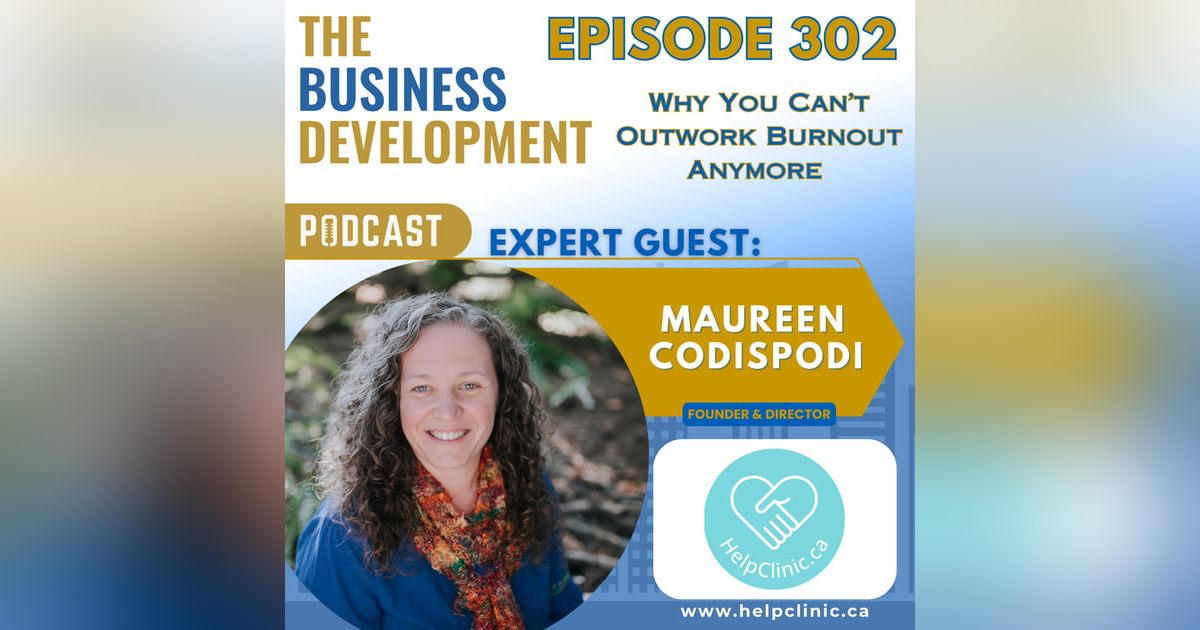







Episode 302 is a grounded and necessary conversation about the unseen cost of entrepreneurship. After nearly 200 interviews with founders, leaders, and high performers, a clear pattern has emerged: burnout, health scares, and identity collapse are no longer edge cases, they’re becoming normal. This episode explores how the current culture of nonstop pressure and hustle is quietly breaking people, and why so many entrepreneurs feel unable to slow down even when the warning signs are impossible to ignore.
In this episode, Kelly sits down with Maureen Codispodi to talk honestly about burnout, mental health, and what sustainable success actually looks like. The conversation challenges the idea that pushing harder is always the answer, unpacking how to recognize limits, rebuild balance, and redefine ambition in a way that protects both the business and the person behind it. This episode is for anyone who wants to keep building without sacrificing their health, relationships, or sense of self along the way.
Key Takeaways:
1. Burnout is not a personal failure, it’s often a predictable outcome of building without boundaries.
2. If your body is sending signals you can’t ignore, that’s not inconvenience, it’s information.
3. Hustle culture makes overwork feel normal, but normal doesn’t mean healthy or sustainable.
4. The cost of success should never be your health, your family, or your sense of self.
5. Your business can grow faster than your capacity, and that gap is where burnout begins.
6. Rest is not a reward you earn after the work is done, it’s a requirement to keep doing the work well.
7. If you can’t slow down without feeling guilty, that’s a warning sign that needs attention.
8. You need systems that protect you, not just strategies that push you.
9. Real resilience isn’t enduring more, it’s learning when to pause, adjust, and ask for support.
10. Sustainable entrepreneurship is built on consistency over intensity, and long game thinking over short term adrenaline.
Links referenced in this episode:
If Episode 302 hit you in the chest, it’s because you can feel it too. This isn’t just another episode, it’s a signal that something needs to change. Episode 300 marked the start of the next phase, and 2026 is our year. The Catalyst Club exists for that exact moment when you stop waiting for the “right time” and decide to build anyway, in the in between moments, with real life happening all around you. This is the room for founders, business developers, and next generation leaders who want real connection, real support, and real momentum in the year they finally make the leap.
Inside Catalyst Club there’s no hierarchy, no posturing, and no competition for power. It’s leaders supporting leaders, showing up as humans, leaving ego at the door, and actually talking about what’s real. The community is fully virtual and active daily, bringing together perspectives from around the world that you simply can’t get in a local only box. If you’re ready to step into the new era we’re talking about and stop circling the runway in 2026, you’re welcome here.
Join us at: www.kellykennedyofficial.com/thecatalystclub
The Business Development Podcast is proudly supported by our 2026 Title Sponsor partners.
🚛 Hypervac Technologies is North America’s leading vac truck manufacturer, trusted by contractors across the continent for performance, safety, and innovation. Learn more at www.hypervac.com.
🏗️ Hyperfab is a leader in custom fabrication and industrial manufacturing, supporting critical infrastructure and industrial projects across North America.
Their partnership helps make it possible to continue delivering high-value, experience-driven business development conversations throughout 2026.
00:00 - Untitled
01:06 - Untitled
01:06 - The Affordability Crisis of Therapy
08:24 - Mental Health Awareness Post-COVID
13:24 - The Affordability Crisis of Mental Health Care
17:47 - The Importance of Mental Health in Physical Wellbeing
30:31 - The Challenges of Parenthood
35:11 - Navigating Parenting and Entrepreneurship in the Digital Age
38:08 - The Shift in Entrepreneurship
44:07 - Coping with Entrepreneurial Burnout
53:17 - Challenges Faced by Female Entrepreneurs
01:00:35 - The Importance of Asking for Help
01:01:59 - Introduction to Help Clinic Canada
Why You Can’t Outwork Burnout Anymore with Maureen Codispodi
Kelly Kennedy: And you know what, I'm just gonna like, I'm just gonna talk about like, the affordability crisis of it. Just 'cause I think it's really important, right? Like if, yeah, if us at a, at a higher end, at a, at a upper middle class are struggling to pay for something like therapy, right? Like, not just for us, for our kids, like if our kids need therapy, right?
It's like we're gonna pay it, but like, it's gonna put a major dent in our month to month income. I, I'm gonna just gonna throw a number out there, because the last time that I went to therapy, I paid I think somewhere around $220 an hour. And I'm not gonna say that it wasn't worth every penny because first thing it absolutely was, but $220 Canadian an hour.
Starts to add up very, very quickly if you're doing therapy once a week.
Maureen Codispodi: Sure does it sure does. Yeah. And you're in Alberta, and so Alberta has the highest standard rate of therapy costs. I don't know why that is. Um, and that's one of the things you know, with Withheld Clinic Canada, we do offer, um, support in every province with licensed professionals.
And we have tried to kind of make it a unified pricing based on all of that research and all of the sort of recommended costs in bc uh, where our headquarters is. And where I live and work, uh, the, I think standard pricing for therapy is, uh, somewhere between one 40 and one 60 an hour. Okay. Um. And our clinic, uh, for our full fee is, uh, we range from one 30 to one 50 an hour.
For like a standard one hour. Yeah. With one-to-one therapy. So it is on that slightly lower rate, which is, you know, it just, it helps money go further. It helps you be able to see it. Therapist more often, more regularly and with less stress because yeah, five sessions at two 20, that's a huge bill, right?
Kelly Kennedy: Yeah. And you know, like I, I, shoot, you're not, you have to be rich to have mental health problems in Alberta. You better. You better be making that oil money to pay for your mental health. Yep.
Outro: The Great Mark Cuban once said, business happens over years and years. Value is measured in the total upside of a business relationship, not by how much you squeezed out in any one deal, and we couldn't agree more.
This is the Business Development podcast based in Edmonton, Alberta, Canada, and broadcasting to the world. You'll get expert business development advice, tips, and experiences, and you'll hear interviews with business owners, CEOs, and business development reps. You'll get actionable advice on how to grow business, brought to you by Capital Business Development CapitalBD.ca.
Let's do it. Welcome to the The Business Development Podcast, and now your expert host. Kelly Kennedy.
Kelly Kennedy: Hello. Welcome to episode 302 of the Business Development Podcast. Today it is my absolute pleasure to bring you Maureen Codispodi. Maureen is a registered clinical counselor with 25 years of experience in mental health education and counseling.
She is known for her ability to create calm, welcoming, and safe spaces where her clients feel heard and supported. Her work is rooted in a deep commitment to meeting people where they are empowering them to heal and grow at their own pace with a centered and integrative approach. Maureen has dedicated her career to helping individuals navigate challenges such as immigration and acculturation issues, neurodiversity and mental health concerns like stress, anxiety, depression, and trauma.
As the founder and director of Help Clinic Canada, she is breaking down barriers to therapy, ensuring mental health support is accessible to all, regardless of location or financial status, more than just a counselor. Maureen is a visionary in the mental health space, reshaping how Canadians access care.
With a passion for equity and inclusion, she leads with purpose ensuring therapy is not just a service, but a movement towards real change. Through Help Clinic Canada, she's building a legacy, one that makes quality mental health support affordable. Available and impactful for people nationwide. Maureen, it's an honor to have you on the show.
Maureen Codispodi: I'm so glad to be here, Kelly. Thank you.
Kelly Kennedy: My gosh, I struggled with that one. See, 302 episodes. I still make a ton of mistakes. I am human. Yeah, aren't we? I know people like to think, they're like, oh, well by the time you're at like hundreds of episodes, you just got it. You got it all figured out. It's like, no.
I still word mush mouth. I still misread things. I still have like errors. All the flipping time guys. I still struggle from day to day with podcasting and I doubt that's ever gonna change because you know what? I'm human.
Maureen Codispodi: Yes. Yeah, you did well, Kelly. I, I was impressed. That was a mouthful. So
Kelly Kennedy: Yes it was.
But honestly, congratulations. You have done a ton in your career and I'm really excited to have you on the show today. I'm really excited about the timing of this show right before Christmas, which as we know, my gosh, a lot of people are struggling right now. Kennedy family included at this point. We have actually done, I believe, four back to back.
No, one, two, three, four, five back to back birthdays. Wow. At this time it's just, it's absolutely bonkers in our household. The birthday mess that is December
Maureen Codispodi: Uhhuh and our family's very similar. Kelly. Very interesting. So, uh, yeah.
Kelly Kennedy: Oh goodness. It's a blessing. It's a blessing and a curse. Sometimes me and my son actually share the same birthday, which is super, super cool.
Um, I That is cool. I love it. I love it. But it just added another birthday to an already very struggling birthday mix.
Maureen Codispodi: Yep. Yeah. Both my daughters are, I, I, we just had their birthday, so, uh, yeah, it's, uh, it's an interesting time. And then add Christmas and, yeah, it's a lot.
Kelly Kennedy: Yes, it's, it is, you know, last, you know, last year, I guess we're gonna be speaking at this point, last year we moved into a new home in October and it was like, it was cash tight, let's just call it cash tight.
Yeah. And then you kind of ran into that, like back to back birthday mix and then Christmas and me and Shelby were just like, oh my gosh. Like, how are we supposed to figure this out? Like, we're only human, we're not, you know, loaded, we're not rolling in it. We're just like, uhhuh trying to figure out how to balance life.
And I know, you know, I just saying to my people out there who struggle at Christmas time, who struggle with the new year. We're right there with you. We're right there with you. And, you know, I hope Maureen to be able to like, shed some light and provide some like, hope and inspiration for these people today on our show.
Um, I love mental health topics. They ended up becoming one of the, like, highlights of the show that I never saw coming. I never realized how important mental health was going to be in business operations, in business development, and just being able to stick with anything, the mental health aspect is, um, it's absolutely critical.
And it seems really crazy. And, you know, one of the things I wanna talk to you about today is that weird roll off that that happened during COVID because it's like, we took mental health really, really seriously. Right? It's like COVID came and we're all sitting in our basements, losing our minds. I started a podcast and a business figuring out life.
Mm-hmm. Um, feeling, feeling the pressures of life. And then COVID ended. Yeah. And it's like people just forgot about mental health again. We're right back in like the, oh, don't worry about it. Just keep on crushing on, like, we forget that happened.
Maureen Codispodi: Yeah. Yeah. It's, uh, it's in, uh, people's memories somewhere, but they've just moved on and, um, we haven't taken all the lessons with us for sure with, I think, um, I think my family did for sure.
We made some big changes during COVID and, uh, I didn't start my business during COVID exactly, but the idea of my business started during COVID for sure. Um, but the actuation, um, you know, we've only been, had our doors open for just over a year and a half. Yeah. And so, but building up to being open also took quite a long time.
So the idea was there and it was because of COVID that I realized how important, reaching people and getting support to where people needed in Canada was. And so, yep. The idea was kind of born.
Kelly Kennedy: The reason that I was immediately interested in what you had to say when we first got together was the fact that you were doing reasonably priced mental health care, right?
Like mm-hmm. Yeah. Here's the thing. Here's the thing, and it's funny 'cause me and Shelby, you know, we do okay, like we do okay for Canadians. We question sometimes why it's so hard to actually get ahead. Because as Canadians, I think, you know, we're in the, we're in the upper 10% for sure of being able to like, make money.
But being able to get ahead is a larger family, has been almost impossible. Like just the cost of everything. Mm-hmm. The cost of, so the funny thing about mental health care, and me and Shelby have both gone for counseling. We both taken therapy, but my God, we do okay. And it is prohibitive. It is so flippant, expensive that I think it's truly for the rich.
Which to me doesn't make any sense. It's like you have to be wealthy enough to get mental healthcare in a time that we are prioritizing mental healthcare. It seems absolutely crazy. Talk to me about that.
Maureen Codispodi: Yeah. Yeah. Well, and it's those gaps in, in our Canadian culture, right? So we do have a, you know, we do have medical.
That's, but usually that doesn't include mental health supports. And if there are publicly funded mental health supports, meaning they're free or accessible, there's huge wait lists. And those people on those wait lists are usually people that are really, really struggling. And then if anybody wants to be, getting some help with some normal stuff or be proactive about their mental health, it's either, you know, you're paying huge sums of money out of pocket, or you need a job with really good benefit packages.
And, you know, there are really good jobs with benefit packages, but a lot of like human based professions teaching paramedics, nurses, their packages are quite low. Which, when you look at all the data, it's just, it's kind of shocking because these are the people on the front line helping. And as well.
Business owners mostly don't have mostly don't have extended health benefit packages unless, you know you have a spouse that has something or you buy into something but you generally are paying out of pocket. And so, um, one of the, one of the best parts of our organization is that our regular fees for our clients, so our full fee that go to our fully licensed therapists, we set them at a slightly lower rate.
And the splits for the therapist are higher than with other organizations. So most of that money is going into the hands of the therapist. Yeah. Um, to try to support, um, preventing burnout for the therapist and preventing, you know, them from having to. Overtake caseload. And then we've also launched our low fee therapy program, which is all, um, master student interns.
And so that program offers therapy with amazing, amazingly, um, experienced students for $25 a session. Um, wow. And, and I have to say that we do have quite a few, um, early startup phase entrepreneurs in that program. And they're just so grateful to have access to affordable support, whether they're trying to grow their businesses.
And some of the best feedback that we've has been from, people that are either, you know, have their own businesses or growing businesses or whatever, they have just been so grateful to be able to access support and as well access support with dignity at a low cost, right? Because. You know, there is a little bit of shame around saying, Hey, like, I can't afford it.
Yeah. And I'm growing my business and I, you know, we've created this application form where it's very non-invasive and people just feel supported in the journey as opposed to having approved their income or you know, sort of justify why they can only afford the $25. We try to, you know, make sure that process is, is done well for clients.
And, yeah, so far it's been really successful.
Kelly Kennedy: Um, definitely. I I love that. I love that. And you know what, I'm just gonna, like, I'm just gonna talk about like, the affordability crisis of it, just 'cause I think it's really important, right? Like, if, if s at a, at a higher end, at a, at a upper middle class are struggling to pay for something like therapy, right?
Especially like, not just for us, for our kids. Like if our kids need therapy, right? It's like we're gonna pay it, but like, it's gonna put a major dent in our month to month income. I, I'm gonna just gonna throw a number out there because the last time that I went to therapy. I paid, I think somewhere around $220 an hour, and I'm not gonna say that it wasn't worth every penny because first thing it absolutely was, but Canadian an hour.
Starts to add up very, very quickly if you're doing therapy once a week.
Maureen Codispodi: It sure does. It sure
does. Yeah. And you're in Alberta and so Alberta has the highest standard rate of therapy costs. I don't know why that is. Um, and that's one of the things you know, with with Help Clinic Canada, we do offer, um, support in every province with licensed professionals.
And we have tried to kind of make a unified pricing based on all of that research and all of the sort of recommended costs in bc uh, where our headquarters is. And where I live and work, uh, I think standard pricing for therapy is, uh, somewhere between $140 and $160 an hour. Okay. Um. And our clinic, uh, for our full fee is, uh, we range from $130 to $150 an hour.
For like a standard one hour. Yeah. With one-to-one therapy. So it is on that slightly lower rate, which is, you know, it just, it helps money go further. It helps you be able to see it. Therapist more often, more regularly, and with less stress because yeah, five sessions at $220, that's a huge bill, right?
Kelly Kennedy: Yeah. And like, I'm, I shit you not, you have to be rich to have mental health problems in Alberta. You better be making that oil money to pay for your mental health.
Maureen Codispodi: Mm-hmm. Yeah. It's very interesting. It's very interesting. The landscape like Canada, I don't know, there's just all these different, um, factors involved and, and with, uh, regulations for therapists, it's all very different as well.
So yeah, there's a lot to navigate operating this company for sure. And just doing that research, you come to know like how different provinces operate and sort of where and why there's those gaps. It's, it's really interesting. Yeah.
Kelly Kennedy: In a country where apparently we prioritize health, right? Like, oh, we're gonna give you, you know, subsidized healthcare, right?
Like, I can go to the doctor, I can get my arm fixed. If it's broken, I can get a surgery. Mm-hmm. For free. But if I'm dealing with like anxiety or mental health challenges or like I'm at the end of my rope, it's crazy. Yeah. That there's like not more government help in that space. And actually I'm not an advocate for bigger government, but I am an advocate for government helping the people with health.
Maureen Codispodi: Well, and and I think that you bring up a really important point, right? The, I think, you know, I'm not our public healthcare is amazing. I've lived in countries where there's no public healthcare, right? And I am really grateful for it. However, there's gaps and one of the gaps is in how they conceptualize mental health care.
So is it something that's part of healthcare? And so that's the issue. It's like the separate thing that doesn't belong there. Mm-hmm. Even though the research says it does, and everyone kind of knows it does, the government systems haven't caught up to that philosophy or that belief that. That mental healthcare is healthcare.
Yeah.
And so there's this basically systemic gap in recognizing, you know, how and why people need help. And, you know, forget being proactive. So the only way you get into a free or subsidized program is on a huge wait list. And probably when things, you know, when you probably should have got help long before then, right?
Yeah. And so, um, being proactive about mental health becomes almost impossible. And so we, we really strive to change the conversation about mental health and being proactive and like talking about it when. When it's just a rumbling or talking about it when it's just something normal. And, I've had some pretty good conversations about this, but I like to say the analogy of like, mental health care should be just like going to the gym, right?
Yeah. So like you're working on your, your brain, you're working on your mental health, just the same as you'd go to the gym to, you know, work on your physical health.
Kelly Kennedy: My argument would be that your physical health is directly impacted by your mental health. And if we want healthier people, we need to worry about the mental health aspect first, because if more people were looked after.
I think there'd be less physical a ailments. I really do.
Maureen Codispodi: A hundred percent agree. And I, they, I, there would be literature to back that up, Kelly. It's, that's just not a speculation. We know there's a direct correlation, right? So taking care of our mental health makes sure means that we have healthier bodies in general and we're healthier people in all ways.
Right? You know, it also impacts like how we parent and other, you know, there's just so many ripple effects of taking care of your own personal mental health that are sort of not quite part of the conversation or we're not quite caught up to that. As a, as a country.
Kelly Kennedy: Yeah, absolutely.
Absolutely. Well, we kind of got a little bit ahead of ourselves, you know, before we ended up on this journey. I know you've done an absolute ton in your career. You, you've been a teacher around the world. It's super, super cool. Yeah. Lead us into, you know, who is Maureen Codispodi?
Maureen Codispodi: Yeah. Um, I'd love to share, I'll try to give you the, the Kohl's notes version, but I, um, yeah, I started my career in mental health like 25 years ago, so I worked a lot of community-based mental health and I realized that I couldn't do it sustainably and that I was gonna burn out.
Quite honestly. I realized that quite early, about five years into doing it. So I thought, no, I've always wanted to be a teacher. So I moved to Australia, became a teacher, and then started working in international schools around the world and absolutely loved my life. Traveled the world, did some amazing things.
Um, I work in inclusive education as well, so that's one of my passions. And you know, I have always sort of followed my. My heart as opposed to like trying to like do the, I'm gonna be in this one career forever. I've just kind of let you know my, my gut and my heart lead me where I wanted to go.
And I think that it's allowed me to have some amazing successes in my career. But. You know, the main, the main thing that I know is that I always wanna support people no matter what I've been doing. And I'm kind of a lifelong learner. Like, I just, I remember finishing my undergrad and thinking, oh, I didn't ever wanna do that again.
And mm-hmm. You know, a few more degrees later and a few more credentials later, I am, uh, still, I'm still on that track. And so, going back to school as an older person to become a therapist. Yeah. You know, when I got into the profession, I realized, oh, this is where I needed to be. Right. And I, you know, truth be told, I don't know that, um, you know, the 23-year-old me.
I would've been, been as successful. Right. I'm really grateful for my life experience and my journey because it really informs how I support people. And and I think that, you know, I'm just, I'm just really grateful to be able to do what I do. Um, and you know, I mean, truth be told, I have a lot of professional experience where if I, if my business was, was not successful, I could be working tomorrow.
Right? Sure. And, and that's you know, it's a good feeling right? To know that I wouldn't be without work, right. And I have always kind of followed my heart and just let everything drive me. And I think, I don't know if I told you this when we met, but, uh, one of the reasons that I also started to Help Clinic Canada was because about 15 years ago, I actually, um.
Uh, fundraised and cycled across Canada solo. Wow. And it was during that, that cycling trip that I just, I got to talk to so many men. Actually it was quite interesting, who shared their journeys of losing their wives, losing their daughters to breast cancer with me. And it was quite, wow. It was quite amazing because I just realized like, how, how.
Open people could be, and sharing their journeys with me. And it made me realize too, that, I have traveled this beautiful country in many ways, but there's just so many remote communities and there's so many populations where people don't get the services that they need. And Yeah. You know, as I started to build this company, you know, thinking about mental health at that time, I was like, we've gotta figure out a way to make this accessible to everyone.
And quite honestly, COVID COVID decided for me that, you know, my vision of creating this online therapy company that I'd had was actually, you know, it was almost like perfect timing. But I already had this, like, I need, I know that online therapy will work. Yeah. Um, and then COVID came along and gave my company a nice big shove.
So then, all the stars aligned. But I, I know that my. Path and my journey has led me here, you know, to be able to support as many people as possible. And you know, one of the things that I think that our company is doing really well is actually, it's sort of unsaid, but because we do have this low fee program where we have a master student interns is, for me, one of my passions is creating safe spaces for learners.
And because I come from a background of education, I absolutely love having practicum students and love being able to create spaces for them to learn and to grow as therapists and to nurture them as professionals. It's such a honor, quite honestly. And so, you know, I know that no, everything I've done has led me right here.
Kelly Kennedy: Yeah. That's so amazing. It's so amazing that you kind of get to like inspire and help lift up the next generation, you know? Um, the older that I get, the more I realize how important it is for people to just get that first opportunity, it's amazing how powerful and how important that first opportunity is.
And yet for some people, how out of reach it can be for them.
Maureen Codispodi: Hundred percent. Yep. Oh no. And when you say that, I just think too about like if you did a parallel with that idea with the low fee therapy, right? Like some people just think it's outta reach, but by providing that opportunity, people get a taste to be like, oh.
I can see why this can work.
Yeah.
You know, and, and ideally 10 years from now, I'm sure that the conversation around getting mental health support and getting therapy is gonna be a very different one. Having that first time to be able to do it is great. Right?
Kelly Kennedy: Yeah. Yeah. Absolutely. And I, you know, I wanna talk about it.
I wanna talk about, you know, the challenges specifically for us men admitting, admitting we need help, we suck at that. Mm-hmm. And it's not our fault, let me tell you that right now. I grew up in the nineties and, you know what mm-hmm. To really, frankly, forward thinking parents, very progressive parents.
But I still grew up in a time where you didn't cry when you got hurt. You know, you, you held it in. You didn't deal with that. Yep. Um, you didn't talk about your challenges. You were tough. Right. Grew up Alberta oil and gas, boy right here. Mm-hmm. We grew up as tough, as tough as nails, right? Mm-hmm. Um, you didn't show the pain, you ate it.
You maybe you drank it away. Take your picks. Right. Take your picks. So whatever you were gonna do to douse that, that challenge uhhuh, but we did it all. And I look back now at that time and I just think like, how was that the right way to handle it? Right. And you know what? Honestly, I'm pretty okay.
I'm gonna tell you that right now. I came out pretty okay. I did have like bouts of anxiety for a while that kind of just struggling with things that were bubbling to the surface, right? I actually lived a pretty great childhood. I really don't have a lot to complain about. I don't have a lot of large trauma.
But I still had to deal with some shit from being a teenager, um, as many of us have to deal with. And I realize now that like I should have been more open. And I've definitely, when I launched the podcast, one of the very first things, I say it right in the trailer, I'm gonna tell you it in an honest, authentic way because I'm done hiding.
I'm done hiding. I'm done hiding anything. Like if I have something that needs to be said, I'm gonna say it because eating that causes more pain and more challenge long term. I would rather live in a, in an authentic way as I move forward. But my gosh, yeah, like there was a long time where. The motto is just be tough.
And I know I'm not alone in that. There's a lot of men out there who are still living that way, who grew up in the exact same way, who are maybe dealing with a lot of inner challenge. Maybe they didn't have it as good as I did growing up, and they're dealing with that stuff and they're pushing it down.
And I don't think they realize maybe how much those things are affecting every choice and every decision they make throughout their day.
Maureen Codispodi: You know, I really, when you said just living that authentic life, like there's two pieces here. As a, like as I said, what, what led me here? Um, and I can tell you that being able to just lead authentically and build a company in a way that feels good to me.
Is such a gift because as I said 20 years ago, I wouldn't have been able to do this. And, you know, I've grown into this spot where I feel like I can provide this space. But, you know, talking about men and therapy you know, I do, I do support a lot of men in my own private practice or when with my clients happen to be men.
And I do really, you know, that piece about self-medicating is definitely an issue. Right. And, and people people have opportunities to use alcohol or marijuana to, to medicate. And you know, realizing that they're using it as a form of medication can be quite eyeopening, right?
Mm-hmm. And just like opening those channels of. Of saying like, it's okay and how can I get support so that I'm not having to use it as a medication. Right. And you know, there's lots of reasons. It could be like ADHD or anxiety or lots of things going on and for generations that's how it was handled.
So, you know, you said you grew up in the nineties, but imagine, you know, growing up as a man like in the fifties or sixties. Sure. Right. Yeah. And so I think, you know, things are progressing and changing and as you said, you had quite progressive parents who are probably more open to hearing about your, you know, emotional states.
Absolutely. And understanding who you were. But you know, I think the conversation is definitely shifting and I think that, there is. More opportunity for men to share how they're really feeling. And, and I think I told this story on another podcast, but they, you know, I spent a lot of time teaching in early years and, um, one of my passions is, you know, working with, with really small kids.
And it's really interesting to me, um, because it starts really young, you know, this gender role, socialization. And my experience tells me that actually, like those little boys are really sensitive, really emotional creatures. And it's actually the girls that sort of have the, you know, intuitive regulation strategies and are able to adapt emotionally more quickly and show more maturity in that way.
And so, you know, it's not surprising to me, when kids and little boys are not given the opportunity to learn about it, how they end up. So, and I have to say, education is shifting right? In almost every classroom you'll hear teacher talk, teachers talk about regulation and zones and, you know, feeling happy.
And it's definitely not a gendered conversation. It's more about like identifying how you're feeling and acknowledging how you're feeling. And, you know, there's probably not many earlier classrooms or, or classrooms at all that are not talking about this now. So I think, you know, our children are gonna be, um, having very different conversations in their adult lives and being a lot more willing to like open up and share and take care of themselves, quite frankly.
Kelly Kennedy: Yeah. Yeah. It's, uh, it's, I have four boys. Uhhuh, I can tell you right now that, uh, the emotions run hot in the Kennedy household. My gosh. Just to give you an idea, one of our boys this morning didn't get his, his turn on PlayStation. Mm-hmm. And decided to just hit the other one with a chair. Yeah. Yeah. So that was the level of like mm-hmm.
Oh my gosh. Like, I needed some self-regulation in that moment because I'm like, my God. Oh, you do? Yeah. I could spank him right now, but you know what? It's not gonna help.
Maureen Codispodi: It's not gonna help. Yeah. No. Being a parent to young children of any gender, honestly, I think, you know, it's it is like that self-regulation piece Yes.
Is so tricky in those moments of, of Yeah. When they challenge you. I have two daughters and they are pretty calm actually. And I, I say that from experience, but there is sometimes where it's just like, wait, I've gotta like, take a step back here. Yeah. And just breathe Right.
Kelly Kennedy: Yeah. Well, you know, me and Shelby both take that.
We don't, we don't have any like discipline, like that we don't spank or anything like that. We, you know what I mean? We try to just like walk through it. But man, like, I guess my view on it is this, is that if I'm trying to stop them from hitting each other, how is me hitting them, teaching them anything good?
It never will. It's just not gonna will. But I do find myself regularly as a parent trying to reach for like, what can I do? Like at the end of the day, you know, we typically take the PlayStation away. That's the thing they love the most. That's the, that's the best possible recourse, right?
But it's flipping hard.
Like people don't talk, don't talk about how challenging it is to be a parent. You know, we're on here to talk about entrepreneurship and we're gonna get there, but we gotta talk about parenting too, because for me it's obviously, it's a big deal. I have four kids. I love being a dad. Being a dad is one of the greatest things that's ever happened in my life.
But being a parent. You are never prepared for it. No, you're never prepared for it, and you're definitely not prepared for it when you're dealing with silly things like, oh, I hit my brother with a chair, he's hurting in the basement now. And then I was justified to do so, you know, because he didn't gimme my turn or whatever.
It's, it's, uh, absolutely. Oh goodness, my gosh. It's like I never would've thought Entrepreneurship is hard, but honestly, I just come to the conclusion that life is hard.
Maureen Codispodi: Yep. Yes. Yeah. And I honestly like. An analogy for entrepreneurship is parenthood. You know, like you have a goal, you have a plan, you have this idea of what's gonna happen, and then the reality hits, and then you're like, oh wait, I have to deal with like these million things simultaneously while keeping my cool and, you know, um.
And, and looking at the sort of the long game, right? Yes. And, and with kids it's so unpredictable and you don't know who they're gonna be as human beings, and like, we can't, we can't decide their personalities or their temperaments or how they're gonna act, interact with each other or any of that.
And all of that is out of our control. And, you know, being an entrepreneur, there's so much that's out of our control. Yeah. And so I think, um, being a parent has probably helped me a lot more than, um, I realized until you were just talking about it now, you know, to become an entrepreneur, it's like, oh wait, I do have these skills.
Hold on.
Kelly Kennedy: Yes. You know, and honestly, I'm, I'm actually asking for your parenting advice on this one. Yeah. As a parent in 2025, it's flipping hard, right? Like, we're trying to contend with what do we do about the internet, what do we do about social media? Just to give you an idea, right now, I'm keeping 'em off social media as long as humanly possible.
If I can keep them off of it till they're 18, dammit, I'm gonna do it. Because I just don't see that being good for kids at all. And it's funny because I'm very active on social media. I'm a presence on social media. I'm an influence on social media. I, yeah, social media's incredible for what I've used it for, but I also see the incredible dark side to it and the use cases that can go very, very wrong.
And, uh, man, I, I definitely struggle with that on one side, because on the one side, I see the massive benefits that have happened to me from my use of social media. Yeah. But I've been using it as a tool to reach people in a way that is beneficial. I like to think for humanity. Yeah. And the ways that I see social media being used towards kids, not so much.
Maureen Codispodi: Yeah. Yeah. It's, uh, I think this is a battle that a lot of parents are, are dealing with, and it's, there's so many different ways to deal with it, right? And it really depends on philosophically like who you are as a parent and how you wanna be as a parent. But I think ultimately putting your head in the sand is not gonna help your kids.
Being proactive, having a strategy, having a plan, like sharing that plan with your co-parent making sure your kids understand the plan and that it's intentional, right? That it's not, you're not saying you can't go on social media because I say so, but these are the reasons and teaching them the reasons is gonna skill them to be able to use the internet use.
Whatever devices they want, but using it safely. And so there, there is a dark side. There's lots of, links between addiction on social media you know, and addiction to other things. Mm-hmm. Because it can be a quite an addictive thing. And when you think about like a young developing brain
Yeah.
Being on a screen, it's like they're getting, you know, they're hit constantly of this endorphins. And so like, they want the good feelings. They want all of that to happen. And so, you as the parent are essentially acting as their like frontal lobe and helping them with the things that they can't control.
And so like. Unfiltered, unattended use of any type of, you know, technological thing is never gonna be good for a kid. Like, as the adults having a plan and being clear about what the boundaries are and why. Right? So as they're ready to learn about certain things, like making sure that we're teaching them why, because that's what's gonna have them, pause and think, oh yeah, I remember I had that conversation with my dad about X, Y, Z and this is dangerous.
And so I'm supposed to proceed with caution, right?
Kelly Kennedy: Yeah.
Yeah.
My gosh. Yeah. I like to think I'm a good dad. I definitely try. I definitely try. It's on my, it's on my list of things to do that. I really want to be a good parent. And man, Maureen, I'm struggling with it and I'll tell you why I'm struggling with it, because I want to be a good parent.
I want be an exceptional entrepreneur. I want bring great shows to people twice a week. I want grow a business and I want to be a good partner. And I feel like in that mix of things, the pie, that is what Kelly wants to have happen with his life. I think I, I do great in some areas and other areas. I struggle, and I'll tell you right now, I'm not afraid to say it.
The parenting aspect is something that I want to get better at and that I'm struggling to balance great parenting with being a great entrepreneur.
Maureen Codispodi: Yeah. There's never a perfect balance to anyone's lives, entrepreneur or not. And I think I, I have to be honest, like one of the simplest things to recognize is that like people that are sort of just going through the motions and not being an intentional parent.
Are the people that we need to worry about. But when people are actually thinking, Hey, how do I do this? How do I get better at it? What do I need to do? Weight? The balance is off. You know, you're already kind of ahead of the curve because you're actually trying to do it intentionally and give it thought.
And you know what? Recognizing that it's not always going, the balance isn't always gonna be correct. And so right now there's probably just like that lack of balance, right? Just like, you know, being an entrepreneur is gonna affect many parts of our lives. Um, being an entrepreneur and being a parent is a struggle.
I'm dealing with the same struggle, right? You know, I have a spouse that works a lot of hours and then I'm working a lot of hours. Yeah. And then I have kids and we're trying to, you know, balance healthy things. And, oddly enough, I work online all the time. Yeah. And yet I say to my kids, oh, no more screen time.
But you're always on the computer. I know that. Right. I know, I know that. I know that battle. So it's a really hard thing to explain.
Kelly Kennedy: Yes, it really is. Oh my gosh, my, yeah, my kids call me out on that all the time. They're like, dad, you're always on the computer. It's like, I know I'm working though. Yes. Trust me, this is work.
And like, they're like, well, it just looks like you're on LinkedIn. I'm like, I know it looks that way. That's part of my work now. Yeah, absolutely. Absolutely. Yeah. Oh my goodness. Okay. Yes. And here's the thing, and I, we're just gonna get into it because obviously I'm a podcaster, I'm a content creator, I'm a business development expert.
I'm a coach, and I do retainer contracts for business development still. And I'm a partner and a dad. So I'm like, honestly, people ask like, why don't you get out more? It's like, that's why I don't, I don't leave the house if I don't have to, just because my life will fall behind the moment. I do. It's not uncommon for me, Maureen, to work 16, 18.
Yeah. 20 hours a day sometimes. And I hate to admit that. And, uh, the fact that like. You have to stick with it. And the demands of an entrepreneur now have changed. And I've really recognized it in the past a little bit. And I really don't think it's just me. I know that I'm probably not helping the problem because I'm out there doing the same things, but it's not enough to just run a business anymore.
And me and you were talking about this before, something has shifted and I would say, I don't know, I dunno what year it happened, I wanna say like 2024 seemed to be a big eye opener into this shift, right? I, I like to call it the, your personal branding. But it is no longer enough for a business owner to just run their business, use word of mouth to grow their business.
Like maybe it's still works in a small town, small town. But something shifted. And the requirement for a business owner to not just run their business and run it, well do the things that they were supposed to do before uhhuh. Now they have to be live on social media. They have to be findable, they have to be leaders in their space.
They have to be providing value and content for people to find them. The need to become a content creator and essentially an influencer for all business owners is a lot to ask. When they were already working, let's call it 12 hour days, Uhhuh. Now those days, I'm right there. I'm working 16 hours most days that I'm working because why?
Because the workday ends. There's still stuff that I gotta do. There's still comments I gotta respond to. There's still social media stuff I gotta schedule. There's still content I gotta create. There's still shows I gotta plan. And these are all over and above my business. And here I volunteered for this, by the way.
I'm totally cool with it. I, this is the stage of my life I'm in, that I'm in that growth stage. I'm the right age, I'm the right, right person to do this. So I'm doing it. But it is a lot to ask of entrepreneurs and I am very aware of the ask and of the shift. And I just wanted to like, I wanted to better understand from you when you're dealing with entrepreneurs, are you seeing that shift with them too?
Maureen Codispodi: Yeah, a hundred percent. I have to say, I was a mental health professional, and then I became a business owner and an entrepreneur. So my perspective is, is really different. And you know, I said to someone the other day that it's not like I work full time, it's just like I work all the time. Yeah, and it's that thing you're talking about, like you're always on and there's always something to do. And any entrepreneurs that I'm working with or speaking with you know, because I talk about mental health with people we're talking about this like. Burnout. And the thing is, is like we signed up for it, we wanna do it.
And as you joked earlier, like, I wouldn't do this for anyone else. Like, I would not work this hard for anyone else. That's right. Right. And like, so brilliant because n neither would I, right? Yeah. And so now I'm seeing it from all sides of the issue. And it's really easy as a mental health professional to say, okay, like, we need to reprioritize, we need to create better balance so that all the areas of your life are working together.
You need to set boundaries, right? And like, you know, those are catchphrases, but boundaries are basically the crux of the issue. And it's, and it's about protecting yourself, right? Because as you and I both know, going nonstop, you know, a hundred miles an hour every day. There has to be, there's, there has to be a consequence, a break wall.
Yes, exactly. And you know, I, I shifted out of working in education, right? So the shift for me is like, I was working education, so I would get holidays and breaks, and then I transitioned into a profession where it doesn't quite work the same. Yeah. And then I first transitioned into business owner, which is completely different, and so that shift for me has become more and more apparent as more time goes on. And I realized, wait a second. Hey. And you know, I know you and I were just talking about this earlier, but I've reached a point where I've went, wait a second. Like, how long is this sustainable? And I think that as an entrepreneur, you do need to stop and assess, right?
And yes, there is pressure to continue and to grow and to do all the things as you mentioned, right? And, and yet. If you get there and you're successful, probably you'll burn out at some point. Oh yeah. Because it's just too much, right? Mm-hmm. Mm-hmm. So, learning how to set a sustainable business in terms of sustainable for your own self and your own mental health and your own family, not sustainable in terms of financial bits.
Like, that's great. But the other piece is like, if you are the operator, if you're the owner, you are the founder. If you are the, the thing that makes the engine run Yeah. And you're going a million miles an hour, eventually you won't be able to do that anymore. So how do you prioritize, how do you put boundaries in place?
And that, and some of that work is hard, right? And uncomfortable because you're sort of always in this place where you have to, something has to lose or you, and, and so you feel like, well, if I don't do that, then this bad thing's gonna happen.
Yeah.
But here's the thing. And I say this from com, a most compassionate place possible because I am also a parent and I also have a partner.
But it's the people in our lives and how we make them feel and the the time that we spend with them. Yeah. And, and you know, it's not the amount of time, but the quality of time and just like being a present person in people's lives and creating space and boundaries so that you can be present, right?
And otherwise, like, what the heck are we doing this for anyways?
Kelly Kennedy: Yeah, Yeah. I guess for me, I've always looked at it as this is just the time that I have to work really hard. And I've talked with lots of entrepreneurs that kind of, they realize, right? Like, if you've been in entrepreneurship any length of time, if you've been in podcast during length of time or content creator, what you realize is the long survive, the strong survive.
It's not a, it's not an Insta win. It's how long can you keep up at that pace. And the people that can keep up for the longest tend to win the day. It's just the way it works. And it's, it's a hard ask because what we are really saying is what I'm saying here is, is that every one of them experiences burnout.
Yeah. Like we're all running ourselves into a brick wall at a hundred miles an hour, and we're hoping we survive the car crash. That's it. That's it. And every, I've talked with so many entrepreneurs, like at this point we're well over 150 interviews, probably approaching 200. And so many of them, so many of them talk about burnout or hitting the wall.
We're getting so close or ending up in a hospital. Like it's, it's actually an epidemic for entrepreneurship. The way we're doing it is hurting people.
Maureen Codispodi: Yeah. Well, and it, the other thing too, right? And like we, we are succumbing to like what's out there in the media, right? Like we have to up our game because we see the example of everybody else upping their game and being in the spotlight and doing all the things that you were talking about.
And, maybe five years ago it was. Social media was a thing, but now there was some time where something shifted, as you said. Yeah. And so we are also being influenced, right. And feeling like, oh, I have to perform, we have to be better. We have to grow, you know, I have to reach a certain number by a certain time, and if I don't, I'm a failure.
And sort of shifting your own thinking is the best way forward, right? Like you said, the mentally strong survive. But that mental strength if you don't take care of your boundaries and you don't take care of your mental health, you will burnout. It will get hard. And you know, like the analogy that I use is like, it's a marathon, not a sprint.
And so you gotta have enough fuel in the tank and you gotta take moments where you can get them. And the reality is it's really, really hard. Yeah. You know, I, I have so much compassion for people that are doing something similar, right? Building businesses is not easy and. And yet, here I am, right? So like, I'm, I'm like the living dichotomy.
I'm going, Hey, like I'm a mental health professional. Get some balance, do all the things right? Set some boundaries, and then yet, I'm working all the time.
Kelly Kennedy: So you re you realize that you have no choice if you wanna make it right. Like, and I, I hate to say that because I wish there was a different way, because honestly, I'm okay and I'll, I'll, I'll tell you my, like safeguards.
I'll tell you what happens to me when I'm, when I know I'm hitting a wall. And maybe this helps other people. Maybe it's a horrible thing to do. Maybe I really am just doing it wrong. You can, you can bring me up to speed on this, but for instance, I think I've realized that I, if I wanna keep competing, if I wanna play this game, if I wanna become one of the best, I have to play the game.
I have to play the game the way the rules are today. That's right. The rules today, they're stacked against me. They're stacked against me physically, mentally, and in my business in success, right? Like. Everything is out here to kill me. Everything is out here to stop me from being successful, and I gotta grit through and do it.
However, I also realized that at the pace that I go, at some point I'm going to run up against that wall, and I've hit it multiple times. I'll tell you that right now. I've never actually experienced full blown, I need to be hospitalized. Burnout uhhuh. But I've hit the wall where I'm like, I'm losing it.
I'm, I'm dealing with like, I'm not motivated. I'm feeling anxiety. I'm stressed out. I'm thinking about everything. How do I make it, how do I not die here? Right? Yeah. And when I hit that moment, sometimes I'll go over it to my partner, Shelby, and I'll just say, babe, we need to get out of here. And for me, and, and maybe you experienced this as well, because everything is at home.
My business is at home. Yes. My podcast studio's at home, like when I'm at home, there is no getting away from work. I live work. I'm there every single day when I get out of bed, the only room I don't work in is my bedroom. Right. Like, it's just, that's it. But I'll look at her and I'll just be like, look, I need to leave.
I need to get outta here. Mm-hmm. And for me taking a, a complete reset break, like I'm talking like, you know, I'm not looking at social media. Mm-hmm. I'm at a hotel with my boys playing on water slides, being a dad, living, living a dream. For those two days, that's, and when I get back, I feel fresh, I feel repaired.
I'm not saying that this is gonna work for me long term. What I'm saying is the handful of times that I've found myself there, that has helped me in the short term. But yeah, I, like for me, I just don't see a way forward. In the current business paradigm without me ending up at that wall over and over again.
And so just finding ways to like not hit the wall and die mm-hmm. Seems to be my avenue of choice, at least at the moment.
Maureen Codispodi: Yeah. Well, and I, I, I think one thing I can say is like, like I said at the beginning of our conversation, like being proactive about your mental health. Right. And like talking to someone, right.
Not just your partner, but talking to an unbiased person who is just there to listen to you and support you with what's next. Yeah. I think that's an important piece, right? And it's, and I say that obviously like that's my business, but I believe that, right? And so, I don't I do practice what I preach, right?
I, I get support in that too. And I think, yes, taking breaks is really important. And I think Bo both you and I are of the mindset. It's like now this is the time to work hard and then, right. And so for me, I have sort of. Some timelines on, on, on years of like, buy x then this. Yeah. And if not, then that.
Right. So that I am the priority and my family's the priority. So there has to be like, well, if it's, if we haven't reached this point by this date, I'm gonna re reassess because Okay. I can't sustainably do what I am doing forever. Yeah. And, and the way that I've built my business is like I am trying to build a business so that it's a place I'd wanna work.
Yeah. Um, and eventually, you know, there may be a shift in who is operating my company. And that Sure. For me would be a perfect scenario. Right. And so I always think about that and I think, yeah. And I just gotta get up and move my body. And one of the things that you do, like you said, you take these breaks.
I said that is absolutely one of the best things you can do for a reset. Right. It's like, you know, simple cognitive behavioral therapy. If we change our setting and move our bodies. It can cause a shift in our mental health and our thinking, just getting outta your space and doing something different and, uh, of course, like being active and having fun with your boys is a perfect, is a perfect thing to do.
Yeah.
But I, what I would say is like, doing it, not in reaction, but, and being proactive. And proactive.
Kelly Kennedy: Yeah. Yeah. Like trying to do that more before the burnout. I, yeah. I totally get it. Yes, I totally get it. Maureen. I've been able to take like, let's call it two weeks real vacation in the last three years.
Like, it's just, that's just where we're at. And uh, you know what? I get it. I understand that, like you have to prioritize it, but I think the reality for most entrepreneurs is like the, unfortunately, the way that our businesses are running, at least in the beginning, we're it, right? Yep. And so even taking that time can be almost impossible.
Like, I, I think a lot of people are not like acknowledging that most entrepreneurs, it's not that they don't want vacation. It's that when you're building a business, there's not a lot of time for vacation in the very beginning. Right? Yeah. And I think we, we gloss over that. We forget that's typically just not available to them.
Maureen Codispodi: Yeah. And, and, and it comes at a cost, right? So like taking any breaks comes at some cost, right. But I'm just gonna just put this out there for, for you to chew on as like, at what cost, right? Yeah. So like, what, what is the priority? Right? And as I said before, like if there's no you, there's no business.
Yeah. And so keeping that in mind as you're sort of like driving down the road checking your mirrors. Like, Hey, am I resourced? Do I have what I need? Am I about to burn out? Did I schedule time away before I felt I had to take the time away? Right? And so trying to be conscious of it. And it's really hard and acknowledging that.
And, one of the simplest ways of feeling like, oh, wait, I'm not alone, is by talking to other entrepreneurs. Yes. And being like, yeah. And not to have like a pity party, like, oh, this is so miserable. But to have a, a shared conversation, a shared understanding, and that shared experience, like just this conversation with you right now has sort of like, acknowledged me and made me feel validated Right.
In what I am doing. Right? Yeah. And it's like, yeah, I hear you. I see you Kelly. Like what you're doing is amazing and there's other options out there. Let's open the conversation, but let's support each other and say, yeah. It's hard.
Kelly Kennedy: Yeah. I, one of the big blessings that I've had from this show was connecting with so many entrepreneurs and being able to have that level set conversation where it's like, oh, you too.
Okay. You, well, you're doing really good. So if you're struggling. Then I must be okay as well. Yeah. It's been really eye-opening, um, with all these conversations with entrepreneurs, just how much the shared struggle is, no matter whether your company makes $400 million or you're making your first 40 bucks, you know, it's crazy.
We're all experiencing a lot of the same problems.
Maureen Codispodi: Yep, absolutely. Absolutely. You must have so much insight. Sorry, I'm just amazed I, the nuggets that you must have from all the entrepreneurs. I, I would love to, I would love to see those like collated in one spot. Who knows, maybe you should write a book, Kelly.
Kelly Kennedy: We have it. We have all the audio. Maybe one day, uh, when we make enough money, I can hire somebody to put all of the best nuggets into one really great video. That would be pretty cool. Yeah, there's been a lot. There's been a lot. It's been incredible actually. It's been one of the coolest experiences my whole life.
And I would, I, like I said, it's been a hard work, but I wouldn't have trade it for anything. Like it's changed my life. I'm a better person for doing this, so it's been pretty cool. One of the questions that I really had for you was you work with a lot of entrepreneurs and you work with a lot of women and men, and I guess one of the questions is, do you see a difference in challenges that female entrepreneurs seem to be facing, um, that are quite a bit different from male entrepreneurs and maybe vice versa.
I was just wondering if there was maybe a bit of a some information mm-hmm. On, you know, entrepreneurship, male versus female.
Maureen Codispodi: Yeah, I think you bring up something really important. Female entrepreneurs in Canada, I don't know the number off the top of my head, but are way underrepresented. So there isn't as many female entrepreneurs in this country because of the barriers, the systemic barriers that exist to building businesses.
And so the ones that sort of get in the ring and do it anyways I think they have a lot of expectations on them. So females, feel like I can't fail.
Mm-hmm.
Um, and I'm sure men experience this too, but it's like, the, it's just the situation isn't set up for them to succeed.
And then they're like, well, I don't care. I'm gonna climb that obstacle. I'm gonna climb that barrier. I'm gonna do that. And so what you see is. Women are burning out. Men are too, but it's, it's because of a different issue. And, I don't know. I don't know that there's any, you know, system to it.
I don't know the numbers, but you might know better. It's like, I don't know, a female of founders are more successful than men, or men are more successful than women. I don't know that. But what I see in the counseling room is that, women are feeling a lot of like, not good enough. And I am, I don't deserve to be in this space.
Yeah. And if I speak up, if I'm loud, if I'm clear, if I'm whatever I'm perceived as something bad. And so like, being a strong voice, being a, being a model for what you want in the world, you know, we sort of have to like fit into the shoes or fit into the thing that. That society wants us to. And so being a female entrepreneur has its own unique challenges.
But there's a lot of internal self turmoil that happens and a lot of, just trying to do it anyways. In the face of that, those internal struggles, I think with men what you see is, you know, there's more confidence for sure in building the businesses, but that burnout that happens is, is quite harsh.
Right. So it's like how you describe it, hitting that brick wall.
Yeah.
I think somehow intuitively women know sooner to take care of certain things or are, you know, more open about how they're feeling and so they're getting support in different ways, whatever that is. As they navigate those challenges, I do have to say like, I belong to several, um, different.
Entrepreneurial women's groups or tech in women's groups. And honestly, women supporting women is one of the most amazing parts of being an entrepreneur for me because I, women don't, nat weren't naturally sort of socialize to, to support each other to win. And so it's amazing being part of this like evolution where women are just like championing each other and building each other up.
And so I get the privilege of also being part of those groups. You know, there is good things happening I think on both sides, but I think regardless of gender it's hard. Being an entrepreneur is hard. Yeah. And I think one of the best things that we can do is. Speak our truth and be honest and be vulnerable and share what's really going on instead of pretending everything is fine.
Yeah. And so we do it because we're like, well, we're the face of the company and people are looking at us. But if you're honest, right? Like it's hard. And so saying to my team, yeah, I had a hard week. I had some challenges, this is what's going on for me. Can anyone gimme some support with this?
Right. And and it's amazing, right? When, when you show that level of vulnerability, people, people step up.
Kelly Kennedy: Yeah. So, yeah. I, I love what you said about women aren't afraid to ask for help. I, I really love that aspect of it. 'cause I genuinely think that that's a big differentiator between men and women in general, is that.
I think as a guy, people look at us like we have to have all the answers. And because we feel like we have to have all the answers, we have to look like we do, and we have to act like we do even when we don't. And it's not the right choice, but I feel like it's a bit of a systemic choice that's been thrown upon us.
Right. And we're far less likely to ask for help until we're already in some serious trouble. Yes, yes. Like, we're already, we're already a hundred meters from the brick wall going a hundred miles an hour before we're like, oh crap. Now I need to talk.
Maureen Codispodi: Yes. You're, you're, you're exactly right. You're exactly right.
And, and, and, you know, facts will, facts will support that, you know, um, on a sad note, like men, uh, are much more successful at the completion of suicide, right? Yeah. And there's a reason for that, right? There's a reason that, we get to the brick wall or you get to the brick wall as a man, right?
And it's like, oh wait. You know, and we're, and that thing we were talking about earlier, right? Like, suck it up. Boys are told to suck it up and don't show their emotions and don't tell anyone how you're actually feeling. And then, you know, you end up in these roles as an entrepreneur and it's like, oh no wonder.
And no wonder I can't share how I'm feeling or thinking. Um, you know, I have a partner who works in a female dominated profession and, uh. You know, it's really interesting to have a partnership with a person like that who has a different perspective on, on something. Like he doesn't work as an entrepreneur as such.
Um, he does have a little bit of a side hustle, but he's, works full-time in education and he, he has some interesting perspectives to share and it always helps inform how I support men in my company too. And I think, you know, people like you showing an example of vulnerability, showing an example of like being really honest about what's really going on, like challenges in life and parenting and business and whatever.
You are. Representing what is possible. Right. And so like not being afraid to say like, Hey, this is hard. Hey, I had some anxiety. Hey, I needed to talk to somebody. Yeah. And that's okay. You know, the more men like you who are in the spotlight saying those things, the more people are gonna say, I can ask for help too.
And it's okay. Right?
Kelly Kennedy: Yeah. I've been, like I said, blessed to have known a lot of people who gave me their ear, right? And so I could have that conversation with trusted men who were in similar entrepreneurial experiences to me, where I could be like, Hey, did this ever happen to you because I'm freaking out.
And they were like, oh yeah, that happened to me last Wednesday. And I could have that conversation, right? But it took me being vulnerable, and I'm gonna say this right now to my men listening. You have to take the step. You have to talk to somebody and say, Hey. You have some time to chat and I think you're gonna find most entrepreneurs, especially, they're gonna give you their time because they were you or they are you right where you are.
And they're willing, they've been there and they recognize how powerful that five or 10 minute conversation can be to helping you on your path. And so, you know, don't be afraid to ask for help. Um, I know it's not always common for us. We wanna hit that wall. We don't wanna ask, but I think you'll find if you ask for directions.
It's not gonna kill you. It's gonna, it's actually gonna make you stronger.
Maureen Codispodi: Hundred percent. I can't, such good advice, Kelly. I can't agree with that more. It's, you know, and, and I, and as a female, I experience the same thing. And it's not, you know, I might go to a male entrepreneur or I might go to a female entrepreneur, but I'm gonna feel just like that much safer going to somebody who I know maybe had a more similar experience to me.
Yeah. And have those conversations. And even me, it's hard for me to be vulnerable of and do those things sometimes too, because I'm worried like, am I a good enough entrepreneur? Are they gonna think I'm a failure? Like mm-hmm. I have all these things running in my head too, because I'm just a human being at the end of the day.
And I do have to be brave sometimes and say, Hey, I need support. And that was part of the reason I joined a lot of these networking groups for women. Yeah. And supporting groups for women because, you just need to have people that understand and can help you through the challenges and can normalize it and validate you and say, yep, I totally hear you.
I totally see you and it's okay. Yeah, I've been there too, right? Yeah.
Kelly Kennedy: Yeah, absolutely. Maureen, this has been absolutely incredible. Thank you so much for your time today. I feel like I got a little bit of a session here, which has been pretty good. Uh, I feel better. So it must've been a win.
Maureen Codispodi: Yeah, I love it. I'm glad.
Kelly Kennedy: Take us into Help Clinic Canada. Who are you for? What are your services and how can people get ahold of you?
Maureen Codispodi: Yeah, so Help Clinic Canada. It's, uh, our website is helpclinic.ca and if you go on our website, you'll find, um, you can book, uh, sessions, either consultations, which are free, 15 minutes, or you can book right in with a therapist of your choice.
Um, we have lots of, um, dropdown menus to help make that choice easier for you. But if you need help, you can email us or call us and we can match you with a therapist. We offer, um, full fee therapy, which is, you can claim it back on your extended health benefits if you have it. And if you are a new entrepreneur or you don't have enough funds, that's okay.
We've got you covered too. So we do offer $25 therapy. You just have to fill in a really simple application. Um, but our whole mission is to break down barriers to mental health support across this country. You know, whatever you need, we've got your back. We also have a massive data bank of resources available online to support you in your local community.
So check us out, check it out. Reach out if you need support, if you wanna talk. If you're not sure, reach out anyways and, um, you know, I'd love to support you. So whatever you need, um, we've got you.
Kelly Kennedy: Amazing. Amazing. And I will have the links in the show notes to the show plus in all social posts, just so that you're aware.
However, you're also active on LinkedIn. Are you in, are you having more people come and follow you?
Maureen Codispodi: Yeah. Um, I am active on LinkedIn. I have just started using that platform and I absolutely love it, like I've been on it for years, but I absolutely love it. And one of the things I love about LinkedIn is that support and that shared, um, entrepreneurial spirit you find on there.
Yeah. And so, yeah, come find me on LinkedIn. Um, Maureen Codispodi. We also have Help Clinic Canada on there as well. So come and find us and reach out on there please.
Kelly Kennedy: Amazing. And we're getting people right before Christmas and heading into the new year of 2026. Do you have just any pieces of, of wisdom and advice, um, to starting a new year strong?
Maureen Codispodi: Yeah, and I, you know, the cliche of, of a re what are they called? Resolution, you know. Yeah. I think be honest with yourself and set some priorities for yourself. Check out what's important in your life and, you know, make a commitment, commitment to prioritize some growth in one of those areas, right?
And don't view it as like an all or nothing dichotomy. Like, oh, I'm gonna go on this diet and lose 25 pounds because you're setting yourself up to lose, right? So what you wanna do is you wanna set some goals that are sustainable, that are attainable and that are realistic, right? And so you're not saying I can't do it, and if you didn't get to it one day, okay, who cares?
Move on and do it the next day anyways. And so just set yourself up to win in the new year and, don't be afraid to be a little bit selfish. And, I see that as a, I see selfish as a good word, because that means you're taking care of yourself and prioritizing your own needs. And you know, as Kelly and I have been chatting about today, like.
Without you, there is no parents to your kids. And without you, there is no business. And without you, your partner doesn't have a partner. And so you gotta take care of yourself so that you can take care of the other people first. And you know, my favorite analogy is, you know, if I can leave you with one, is like put your oxygen mask on first.
Right? And so that's an easy idea to get in your head and, and so anytime you think, am I being selfish? No, you're just putting your oxygen mask on.
Kelly Kennedy: Yeah. Amazing. That's some great advice for the new year. Well. Merry Christmas, everybody. I hope you all have an absolutely incredible holiday season.
Until next time, you've been listening to the Business Development Podcast, and we'll catch you on the flip side.
Outro: This has been the Business Development Podcast with Kelly Kennedy. Kelly has 15 years in sales and business development experience within the Alberta oil and gas industry, and founded his own business development firm in 2020.
His passion and his specialization is in customer relationship generation and business development. The show is brought to you by Capital Business Development, your Business Development Specialists. For more, we invite you to the website @ www.capitalbd.ca. See you next time on the Business Development Podcast.


Founder | Director | Therapist
Maureen Codispodi is a Registered Clinical Counsellor with 25 years of experience in mental health, education, and counselling. She is known for her ability to create calm, welcoming, and safe spaces where clients feel heard and supported. Her work is rooted in a deep commitment to meeting people where they are, empowering them to heal and grow at their own pace. With a client-centred and integrative approach, Maureen has dedicated her career to helping individuals navigate challenges such as immigration and acculturation issues, neurodiversity, and mental health concerns like stress, anxiety, depression, and trauma. As the founder and director of Help Clinic Canada, she is breaking down barriers to therapy, ensuring mental health support is accessible to all, regardless of location or financial status.
More than just a counsellor, Maureen is a visionary in the mental health space, reshaping how Canadians access care. With a passion for equity and inclusion, she leads with purpose, ensuring therapy is not just a service but a movement toward real change. Through Help Clinic Canada, she is building a legacy—one that makes quality mental health support affordable, available, and impactful for people nationwide.