
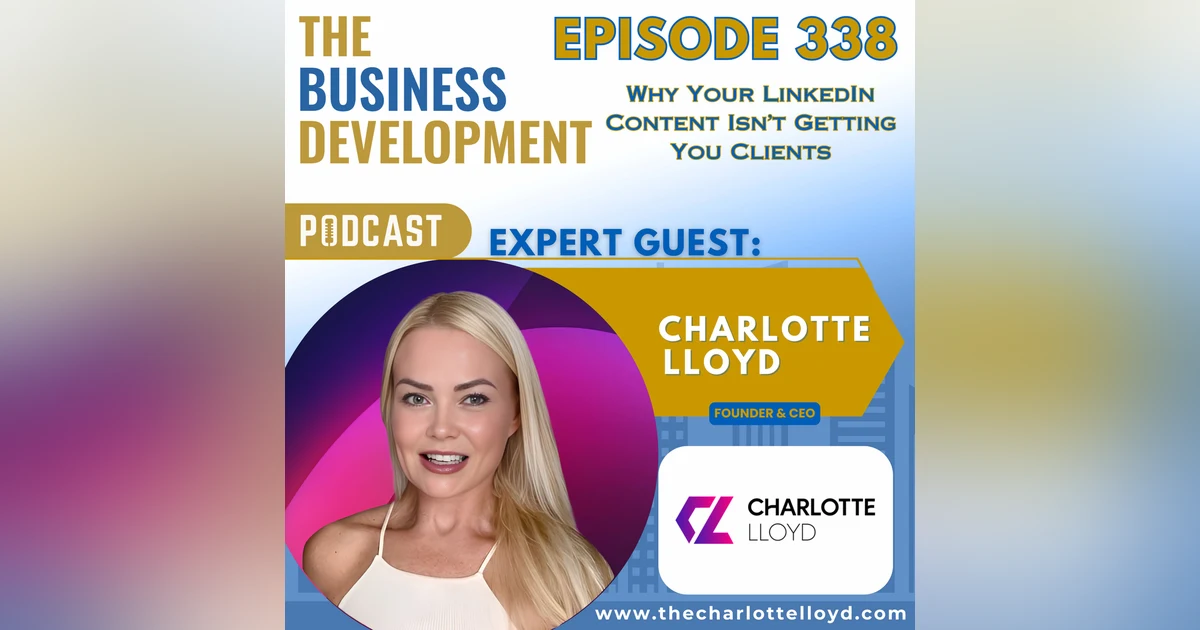
Why Your LinkedIn Content Isn’t Getting You Clients with Charlotte Lloyd

 Apple Podcasts
 Spotify
 Amazon Music
 RSS Feed
 In Episode 338 of The Business Development Podcast, Kelly Kennedy sits down with Charlotte Lloyd to break down one of the biggest misconceptions in modern business development: that content alone will bring you clients. With over 20 years in B2B sales and millions in closed revenue, Charlotte shares how LinkedIn is often misunderstood as a content platform when in reality, it’s a conversation platform. She explains why most entrepreneurs struggle to convert attention into revenue, and how the real opportunity lies in starting meaningful, intentional conversations with the people already engaging with your brand.
This episode dives deep into practical client acquisition strategies, including how to structure your LinkedIn profile for conversion, how to identify warm prospects, and how to use direct messaging without sounding salesy. Charlotte introduces her SPICE framework for building authentic, high-converting conversations and emphasizes the importance of prioritizing sales activity over perfectionism. If you’ve been posting consistently but not seeing results, this conversation will shift your perspective and give you a clear path to turning visibility into real business growth.
Connect with Charlotte Lloyd on LinkedIn:
https://www.linkedin.com/in/charlottelloydsales/
If you’re ready to take action on what you heard in this episode, check out the Client Acquisition Club:
https://www.thecharlottelloyd.com/clientacquisitionclub
Key Takeaways:
- Content builds awareness, but conversations are what actually turn attention into paying clients.
- Most entrepreneurs don’t have a content problem, they have a lack of consistent, intentional outreach.
- The people most likely to buy are already watching you, they’re just not engaging publicly.
- Rejection is part of the game, and learning to handle it is a requirement for building a real business.
- Your LinkedIn profile should clearly show who you help, how you help them, and the outcome they can expect.
- You don’t need a website to start, you need clients first, because clients define your real business.
- Generic, copy and paste messaging kills trust, while personalized conversations create real opportunities.
- You only need a small number of high quality conversations each day to consistently win new business.
- Most business owners ignore the warmest opportunities sitting in their existing network.
- Sales is not about pressure, it’s about understanding the problem, guiding the conversation, and helping the right people move forward.
🎸 Sponsor Shoutouts: Thank you Colin Harms and Jamie Crozier for your steadfast support of The Business Development Podcast! 🫶
The Business Development Podcast is proudly supported by Hypervac Technologies, Hyperfab, Thunder Bay Hydraulics Inc, and Atlas Elite Autolifts Inc. 🎸⭐
Hypervac Technologies: North America’s leader in vacuum truck manufacturing.
Hyperfab: The custom fabrication division of Hypervac.
Thunder Bay Hydraulics Inc: Hydraulic cylinder repair and manufacturing for mining, forestry, and construction.
Atlas Elite Autolifts Inc.: Premium automotive lift systems for shops and garages.
Join The Catalyst Club Community:
www.kellykennedyofficial.com/thecatalystclub
Mentioned in this episode:
Hyperfab Midroll
Why Your LinkedIn Content Isn’t Getting You Clients with Charlotte Lloyd
Charlotte Lloyd: The biggest thing about selling is you are the athlete of the business. Sellers are athletes. You have to treat your sales process like you would as an athlete, showing up to training, doing the hard things, getting up early, staying disciplined, knowing that. You're gonna fail more times first than you actually win.
Intro: The Great Mark Cuban once said, business happens over years and years. Value is measured in the total upside of a business relationship, not by how much you squeezed out in any one deal. And we couldn't agree more. This is the Business Development podcast based in Edmonton, Alberta, Canada. In broadcasting to the world, you'll get expert business development advice, tips, and experiences, and you'll hear interviews with business owners, CEOs. And business development reps. You'll get actionable advice on how to grow business, brought to you by Capital Business Development CapitalBD.ca.
Let's do it. Welcome to The Business Development Podcast, and now your expert host. Kelly Kennedy.
Kelly Kennedy: Hello. Welcome to episode 338 of the Business Development Podcast, and today it is my absolute pleasure to bring you Charlotte Lloyd.
Charlotte is a powerhouse in the world of client acquisition. After building a thriving six figure side business from her LinkedIn content while still in corporate, she stepped into her true calling, helping coaches, consultants, and service-based entrepreneurs. Grow profitable businesses without burnout.
As the founder of the Client Acquisition Club, she equips her clients with proven sales systems, non sleazy outreach and content strategies that drive real results. Charlotte's no fluff real world approach has helped business owners close high ticket deals and build sustainable revenue engines.
She doesn't just teach sales. She transforms the way entrepreneurs think about client growth. If you've been feeling stuck, invisible, or overwhelmed by the noise, Charlotte is the voice that cuts through with clarity and direction. Her message is simple but powerful. You don't need to hustle harder. You need a smarter system.
With the right strategy, mindset, and support, you can build a business that delivers freedom, fulfillment, and the impact you were meant to make. Charlotte, it's an honor and a pleasure to have you on the show today.
Charlotte Lloyd: Thank you so much for the intro, and it's a pleasure to be here. Kelly, thank you very much for having me.
Kelly Kennedy: I have been awaiting this interview for quite some time. Um, as you we're both, you know, pretty big on LinkedIn, you're, you're much bigger than me, but, you know, we're kind of, we both leverage that space and now I can't even teach business development. I feel, without teaching how to build a personal brand on LinkedIn, because in my mind, at this point.
They are linked and we're gonna talk a little bit about that today. Yes. But I just feel like you said it's such a massive advantage to leverage LinkedIn that it's like, why not? Why not? We have to all kind of take that leap and, um, you know, you've spent a lot of time teaching people not just how to use LinkedIn, but also how to close business on LinkedIn, which I feel like.
They go hand in hand. But they're also something that almost every entrepreneur is struggling with is that game plan. How do we do it? How do we utilize LinkedIn to grow our businesses? And so I'm really psyched to talk to you about that today. That is your space, that is what you coach on. And, uh, before we do that, I would love for you, maybe just to take us back to the beginning, who is Charlotte Lloyd?
How did you end up on this entrepreneurial path?
Charlotte Lloyd: Yeah, so that's a great question. So. I started, uh, a long time ago in B2B sales, cold calling, selling to big FMCG brands like PepsiCo, Danon, um, this was back in like 2001. The phone was normal. Telesales was normal, and you would send emails, but you'd just be, you wouldn't be using emails or anything online at all.
Uh, you might meet people in person. Yeah. But my very first role was not meeting people in person, I had to, obviously I had, I had a really low salary but I was incentivized with commission. Mm-hmm. So I wanted to more than double that. I was living in central London, not cheap. And I learned the basics of sales there.
Now cold calling is the, like original training ground for a lot of sales reps. Most sales reps hate it. Yeah. So being an individual computer doing that basically set me up, accept on thing that's really important when you're an entrepreneur's rejection, you're gonna come across rejection. The biggest thing about selling is you are the athlete of the business, right?
Without you, if you're running your own business or if you are part of a bigger, if there isn't a sales department, there's no business. Even if people say product like growth and marketing, all this bring business in, but really the engine of the business is the sales team. Sellers are athletes. You have to treat your sales process like you would as an athlete, showing up to training, doing the hard things, getting up early, staying disciplined, knowing that you're gonna fail more times first than you actually win.
So having that mindset, being able to eat rejection for breakfast is one of the things that you've gotta learn. You've often gotta learn that the hard way, because we mentioned before I came on separating you from the service. Yeah, when you're selling a company service, it's different because the rejection isn't the same.
When you're selling your business, it's another thing. It's your baby, so you are attached to that. Yeah, so, so there's an adjustment there. I wanna talk about it now. Then I moved into face-to-face selling. I sold for big brand financial times for years. And I sold to governments. Very difficult, very long sales cycles, lots of bureaucracy, uh, lots of procurement.
So
Kelly Kennedy: yeah.
Charlotte Lloyd: Lots of follow up. Lots of ghosting.
Kelly Kennedy: Yeah.
Charlotte Lloyd: So, which is totally normal. Yes. And it really galvanized me for what I'm doing today. So I've done a lot of the hard things and some of the hardest clients sold to globally across different cultures, speaking different languages, Spanish, Portuguese. So yes, I could say that that set me up perfectly for where I'm today.
How did I get then to LinkedIn? Before that? Go back to 2011, I decided to move to Spain and my boss at the time in financial, I was based in London. I was in a, uh, senior role and I said, Hey, I wanna move to Madrid. And there was no office there. So he said to me, look, you're gonna have to go commission only because I can't pay you.
I can't have you as a salaried staff, so we don't have a company there. I was like, okay, I'll do it. Everybody thought I was crazy. You are going commission only, like you're not gonna make any money until you actually sell. So I thought, yeah, I'm up for the challenge. Why not? I'm good at sales, I'll do it. So I, I, I moved to Madrid.
I'm in my apartment and I'm working from home because there was no office. Yeah. So way before it got trendy with COVID. Um, yeah, it was a really weird thing. I thought, God, how am I gonna say to people that I worked in, in, in from home? Because nobody did. They probably think I'm slacking when actual fact, twice as hard as anyone else was in the beginning.
'cause it was concern.
Kelly Kennedy: That's right. Yeah.
Charlotte Lloyd: But if I didn't sell anything at the end of the month, I wasn't gonna make money. Pure, plain and simple. And I've always been the breadwinner in the family. That set me up perfectly for, I'm not an entrepreneur. For, I'm an entrepreneur of necessity. I don't have generational wealth.
You know, I had a nice upbringing, middle class, but I've made this happen myself, and I'm proud of myself for doing that because it's a route that. Nine out 10 people are like, you're gonna go Commissioner only. Why would you Yeah. Stick with a safe salary.
Kelly Kennedy: Yeah.
Charlotte Lloyd: But the thing is today, salaries are far less safe than they were.
Kelly Kennedy: That's right.
Charlotte Lloyd: Companies are not a guarantee that you're gonna have a stable job for a long time because everything's changing quite rapidly. This segues nicely into sales whenever a crisis comes along. So along came the, the financial crisis.
Everything was like, we get contracts, people phoning up saying, Hey, wanna do this? Just send me the contract. Send me the invoice. And suddenly after that, the phones were dead. So we had to do, we had to call, we had to make more of an effort. Yeah. People have always said, oh no everything's under scrutiny.
We need to sign this off because the financial crisis happened. And guess what? It's like we're really careful about how we're spending money. So we had to change how we sold. We had to. So every time a big change comes along. So COVID came in 2020. And I actually switched into a salary draw for a different company, but selling a product, a service that didn't even exist.
So it was an A oh wow solution for this new company for global data. And I was like, yeah, I'm up for that challenge. Obviously with COVID, we couldn't travel and I used to be traveling twice a month doing face-to-face meetings, doing networking events.
Kelly Kennedy: Yeah,
Charlotte Lloyd: so overnight. What do we do? We're all on Zoom.
How do we get meetings? We're gonna have to use email more. We're gonna have to pick up the phone more.
Kelly Kennedy: Yeah.
Charlotte Lloyd: Hey, there's this thing called LinkedIn.
Kelly Kennedy: Mm-hmm.
Charlotte Lloyd: Which I wasn't using at all. I think back of the time, I had 3000 followers in 2020 and it was literally, I would never post on there. And people were sharing all these awful posts.
Anyway, it wasn't anything like, it's today. So I thought, I'm gonna have to find people on here. And it turned out a lot of my clients that I was selling to in that role weren't active on LinkedIn. So getting their attention was hard. So I decided, well, hang on a minute. I'm seeing a lot of other sales reps create content, and I was a sales rep, then why don't I do this?
And maybe if I tag some of the companies and I will get their attention that way, not just with me reaching out to them. So it started off like that. I've got. Over 20 years experience. I just wanna share my knowledge, started sharing my knowledge. All of a sudden it's, I just started to get a lot of momentum, a lot of followers, mainly from sales teams and sales reps say, ah, show this to my boss.
I would get on calls with ideal clients, so booking meetings with prospects, the company I worked, and they'd be like Hey, yeah, I've been seeing your content. Who are you? You've never engaged, you never even liked, I dunno who you are. Yeah. But you're seeing my content. So the power of lurkers. Right.
So this That's right. Really made me think, wow, there's are so many people that are seeing this. But I took for granted what that actually meant. And I'd actually built a brand on Instagram, which was more relate to the fashion industry. And I did affiliate things and I didn't really make anything of it because I thought, well, it's not, it just didn't work.
You know, a lot of people are afraid to post online. A lot of people are afraid to show up online. I wasn't afraid to show up on LinkedIn because it also represented me in a different way to what I was doing in Instagram. So, hang on a minute, I've got a lot of knowledge about sales. Sales is something that most people, even sales reps struggle with.
Yeah. And I started out coaching sales reps and sales teams, and I still coach sales teams and consult B2B businesses, but I then made a pivot. So. 2023. I built my side hustle started 2023 and I started to build clients. So get people one-on-one, started testing what worked, what didn't work. And then I did a couple of team trainings, but there's one big one, which took me to Dubai.
So it was in person and it was online. And I would remember being in my role in corporate, obviously remote. Yeah. I said to my then boss, I went away four times, so it was um, June, July, August, September. I said, oh, I've gotta go away. I've gotta take some, I've gotta take some time off for a week each month, which seemed a bit suspicious. Off I went and trained in person and then trained online eventually then said, okay, I've in my side hustle. Starting my own business.
Kelly Kennedy: Yes.
Charlotte Lloyd: But the transition, yeah. Obviously I had to win clients first before I moved into business. A jump in time.
Kelly Kennedy: Yeah.
Charlotte Lloyd: What did I do? Yes, I create content first, but because I was in corporate and because I didn't have an intention to start the business, at first it was just like, I'll create content, I'll see what happens.
It then started to spiral and it became something that helped a lot because suddenly I had a personal brand. I didn't really know back then what the personal brand was.
Kelly Kennedy: No, I don't think any of us did.
Charlotte Lloyd: Yeah. And I think having that experience of at least dabbling with social media and Instagram before gave me the confidence and I thought, hang on a minute, I'm good at this.
I've got some knowledge here. Yeah. That other people have who has sold to the president of Brazil, who's been in a room with like, dignitaries in Canada who's been in. So all of these kind of different experiences as well. So I've gotta share this on LinkedIn. I wanna share my knowledge. I also though got into the dms, and this is the thing, is that I started to reach out to the people who were engaging with my content.
So people that don't step forward but are showing some kind of intent. If they're viewing your profile, they're following you, connecting, you engage with your content. And this is where a lot of people that run a business fall down and that they think, oh, well, if people aren't sending me leads and coming inbound.
Then it means they're not interested. And that is the number one cardinal thing to, to really not believe, right? So you've gotta shift your beliefs with this to be good at sales. This so now I, I'm running my own business and I decide that I wanna pivot to consultants, coaches, people that service business owners, solopreneurs.
I have quite a wide, I don't have a, however. I'm niche on the problem in that I help with lead gen, I help with the sales part as well as people so they can grow their business and get more clients and yeah, the pivot was a big thing as well because that's so been used, so used to creating content for sales reps and for sales teams.
And the slight difference when you are selling and it's your own business and obviously coaches can, people that run their own business, they need a different kind of sales help to what sales reps need.
Kelly Kennedy: Yeah.
Charlotte Lloyd: So. I made the pivot, the Client Acquisition Club was born, which is my group coaching program.
I also coach people one-on-one as well, and now we're almost at a hundred members. Wow. And it's, yeah, so people are in there and they're learning how to use LinkedIn to get more leads and how those leads into actual clients. And also, yeah.
The most important thing is prioritizing what needs to be done in the business. Every single day I see people who, they're not getting wins, they're not getting clients because they're not usually doing the right things, right? Or companies say, Hey, we're not getting any leads, so why don't we just outsource all the lead gen and see what happens?
You might get some leads that way, but they usually aren't qualify. So the thing here is, is that yes, if you show up on LinkedIn, it makes that process easier because people know you from your content, so they trust you. So the conversations flow much better, even if they're not directly inbound. You need to be sending dms each day.
And I'm not even talking about volume here, because a volume approach usually means you're copy and pasting.
Kelly Kennedy: Yeah.
Charlotte Lloyd: You're not actually making the outreach about them. The buyer, they feel it. They sense it salesy and they check out.
Kelly Kennedy: Yeah. Yeah.
Charlotte Lloyd: So that happens a lot. Usually people are not sending enough of the right type of messaging to get a response.
Again, it depends on who you are targeting, but usually businesses will need, if it's a small business, depends on if you're making 5, 10, 15, 20, 30, 40, 50 k month. There's a certain amount of clients that you need each month to be able to do that. You need to be able to focus on the right inputs. What do I need to do to close a client this week?
It's actually, when you break it down, it's very simple. I might need to start five, 10, maybe 20 conversations a day, but they have to be good conversations. Yeah. Right. I'm not gonna stick them through the slammer of automation and just hope that somebody responds. Right. Because we usually have to do a lot of that to get response and provided that we do that content, even if we don't create content for a week, we can still start conversations with our existing connections.
I think what a lot of business owners don't realize is that in the pool of connections they have on LinkedIn.
Several potential buyers there that they could be messaging. So that's another thing. The low hanging fruit, I don't see people leveraging referrals. Asking for referrals is what I mean here. And then the warmer outreach from content if they're not coming inbound. But if they're actually on your profile and actually engaging with your content, connecting and following, then they're showing some kind of intent.
Right? Yeah. They might not be ready to buy right now, but we need be starting conversations and nurturing them so that. When they are ready to buy. It's, we're gonna have, we're, we're lining up that conversation to see if we can help.
Kelly Kennedy: Yes. Yes. And you know, I talk to so many people who are struggling to close new clients over LinkedIn, not just struggling to close new clients.
Let's talk about, we haven't even gotten there yet. Let's talk about the people that are just maybe just becoming entrepreneurs, like you said. I think there's a difference in mindset shift between an entrepreneur using LinkedIn. An executive using LinkedIn, right? Yes. They're, they're very different use cases for LinkedIn and I think some of them struggle with that.
How do I make that difference? And, you know, you know, your profile is a incredible example for anybody listening. Check out Charlotte Lloyd's profile on LinkedIn. She has meticulously crafted that profile to convert for her and it's done incredibly well by the way. And I just wanted to suggest that it's a very different use case, like I said, from an executive using LinkedIn to that transition to an entrepreneur.
And, and I'm hoping today, Charlotte, with your level of expertise. That we can't give a small masterclass for our entrepreneurs listening on the steps. Like if you were to work with an entrepreneur and it's day one, and their profile's a mess, they're still executives, right? They're still, you know, CEO at X, Y, Z company, but they're not really sure how to transition that into their own consulting business or whatever.
Where do you start with them? Can you maybe walk us down the path of how do we change our LinkedIn from an employee to an entrepreneur?
Charlotte Lloyd: Yeah. The first thing is make sure that your headline is clear, right? Several different formulas for writing a headline. My favorite one is who I help. I help coaches and consultants, small service based business owners get clients on and beyond LinkedIn with sales and content strategies.
So who do you help? How do you help them? What's the outcome that they get? Again, you don't have to be overly specific. A lot of people say you must be really, really specific. You, you do have to address who it's that you're helping. Right. So we need to have an idea of that. Uh, but the simplest one, because when people like, make sure that it's mobile optimized.
Right. So you've got your banner I wanna see on your banner as well. Either that same thing or it's exactly the same because it's a mobile laptop. When people open it on a mobile device, they can see ah, right. This is really clear who I help and who I don't help. I offer some B2B training as well.
So I put in a LinkedIn trainer top funnel, um, that kind of thing. I help businesses actually get leads, right? It's that part of the sales process. So make sure that you, a lot of people have a lot of unnecessary wording and verb mm-hmm. In their headline. Simpler, the better. If there's anything about you that might be different.
I have one of my clients who's like, she's into wildlife, so she wants to put that on her headline at the end because it's memorable. Right. And it's also a good conversation starter.
Kelly Kennedy: Yeah.
Charlotte Lloyd: You have to be very clear who you help, how you help them. What's the outcome? Is there a certain pain point that they wanna avoid?
You might wanna put, I help X do Y without pain point. What's the pain point that you're helping them? I help coaching consultants get clients on LinkedIn. Or burnout without hustle. Mm-hmm. No hustle. No bro marketing or bro sales, for example. That's another thing I could add on. That's the first thing, right?
The first thing, make sure you've got a good headshot. Make sure that actually spend, you know what it is, $300 to get somebody to do your banner. Right? To make it look professional, more professional, right. It depends on what your service is, but I would seriously considering doing that.
Kelly Kennedy: Yeah.
Charlotte Lloyd: Because. When I optimize my banner, so many people reached out to me just about that.
Started a lot of conversations like, oh, where did you get that done? And then, then we're into a conversation. Potentially I can help them.
Kelly Kennedy: Mm-hmm. Yeah.
Charlotte Lloyd: The next thing your about section does not need to be about you in the third person. She does this and that. I'm guilty of having that like years ago.
Right. The third person. Focus on address the people that you help. What's the problem that you help them solve? What are you helping them do? Be very specific. Talk about the pain points first, right? Are you a service-based business owner and you are facing this issue in your business? What is it?
Spell it out.
Kelly Kennedy: Yeah.
Charlotte Lloyd: Tell them how you solve it, but keep it concise. Maybe four to five bullet points. Share some proof of who you've helped. That just needs to be one or two lines. But let's see some of those testimonials there, you don't, obviously you don't have to. Some people put them in the featured section.
I don't recommend doing that.
Kelly Kennedy: Yeah. '
Charlotte Lloyd: cause remember you're trying to capture people's attention.
Kelly Kennedy: Sure. And they might not even get to the featured section. They might only read your about
Charlotte Lloyd: Yeah. Some people. Don't, most people don't read the about right. It's one of these things. So the most important first is the headline, the banner.
Then the about section. The about section has to be about them so they can clearly see themselves and how you help solve their, their problem or problems. Right now we've done the about section, the featured section is the next most important thing. What do we need in the featured section? We need to have.
I used to have a link to have to book a call with me, but I just found that a lot of people would waste my time. And most people, if you say in your post, Hey, go and book a call with me in the feature section, they won't do it because you're asking them to do something is too much, right? They're just not gonna make that effort.
So I prefer to have, again, you can have two to three different things. But I have a link to my newsletter so people can capture people's emails. So that's one of my lead magnets, a link to a DM course that I have. How to do the dms using my SPICE framework. There, and then I have a link to my website.
Right? But you probably don't even need a link to your website because if you, it depends where you're on your business. More experienced businesses will have a website, but businesses are starting out, don't need it. How can you capture them? With a lead magnet? You need to capture their email address.
Good. Because then you can email them and not just reach out to them on
LinkedIn. Too many times I see people with posts or with documents or even testimonials, it's like, I can't, I dunno how to reach you. Mm-hmm. If you're a business owner, I need to know how to reach you. I need to experience you in some way. Ali Manga is a great way to give them a little bit of medicine for one of the many problems that you solve so that when they actually sign up to that, you start a conversation with them.
But they also experience you on a deeper level and they're, they're experiencing help. They're getting help, their problems being solved. Or they're experiencing you via the newsletter. Right. So we're nurturing those people so they come top of funnel. It's like middle of funnel and then bottom of funnel.
Very simple. Those are the main things that, that obviously then you have your posts and how you order my order. Wanna order your posts or your videos? I prefer people see my posts.
Kelly Kennedy: Yeah.
Charlotte Lloyd: And then your experience section. I've taken out a lot of my experiences. You only really need three to four recent experiences.
Kelly Kennedy: Mm mm-hmm.
Charlotte Lloyd: Nobody's really interested in what you did in 2001.
Kelly Kennedy: They don't care what you're doing in 2005?
Charlotte Lloyd: Yeah.
Yeah. The most important thing in the experience section is. Really, what did you achieve? Were there any results or metrics that you achieved? So yeah, if you're a sales rep, you 200% of quota in 2024, which, which quarters were, they give us some results. Did you help drive a certain amount of revenue?
The more you can attach some of the problems you solve as well to outcomes. Hey, it stands out. Not just, I work, this is, so I worked at this company and I, these were my, my responsibility and I did this and that. Nobody cares. Yeah. They wanna see what the outcome was, what the result was.
Kelly Kennedy: Charlotte, you had mentioned that there were companies that you could pay to help you create a unified brand image.
Do, can you name any companies that you would recommend to do that for the people listening?
Charlotte Lloyd: Oh, I have a designer you mean that did my banner?
Kelly Kennedy: Yeah. Yeah,
Charlotte Lloyd: I did the wording around it. I see there's plenty of people that can, that offer these kind of services. Uh, but yeah, I said, look, you know, once I. I didn't, when I started the business, my branding was different.
My business name was different. It's only until I started getting more and more clients that it actually, ah, okay. So now it's very rarely do people start out and they know exactly who they serve. Right. So this is another thing is, yeah, if you've not got clients, the, the thing that you need to be doing is the, and nothing, you don't need a website.
Yes, you've got a LinkedIn presence, but you need to be starting conversations that are gonna make you money.
Kelly Kennedy: Yeah,
Charlotte Lloyd: you need to be selling because that's the most important thing. Too many people end up getting a website way before they need one, and they don't, the website isn't very clear on what they do and who they help.
So until you're maybe a year into the business, I wouldn't recommend having a website. It's have a me, a social media presence. Start getting clients in, and then when you've got more, some more clients, you then are like, Hey, I'm actually solving these problems now. Okay, now it makes sense. My branding is will come next.
Right. You can't brand yourself perfectly before you get clients. Right?
The thing is that you need to get the clients first.
Kelly Kennedy: Mm-hmm.
Charlotte Lloyd: Most of the time you need the sales skills to be able to do that. Then comes the other things like the marketing. The branding is a distraction. Certainly the beginning.
That's my opinion.
Kelly Kennedy: Well, it's so funny because I think about like the evolution of my business Capital Business Development and we're, we're completely different. We're like 180 degrees in a different direction than the company we started out as. And so I kind of like to say like, you don't have all the answers.
Sometimes the opportunities are gonna present themselves as you come along and you'll make that pivot like you did, like I did. And you know, we started out being that like, essentially that that support in the business development side, that consultant that you hire to help you. And now, you know, we do coaching, we do teaching, we just started our own community.
We have the podcast like it's a completely different animal than it was way back in 2020. And so, like I say to people now. Yeah, you're better off just to get started and keep going one foot after the other. And yes, something's gonna present itself. Opportunities are gonna come and you might be completely different.
We've probably updated our website four or five times in the last five years.
Charlotte Lloyd: Yeah, totally normal. Totally normal. Because as you might, you might wanna niche down on something that services that you offer, you're only gonna know that when you get clients in, problems change. So there might be elements that you wanna add to your service as you grow.
Like you're not gonna stay doing the exact same thing.
Kelly Kennedy: Yeah, yeah.
Charlotte Lloyd: Especially not in today's world with everything changing so quickly. So you've gotta be really open to that. And you know, some, you've gotta really focus on what's gonna move the needle, what's gonna get me. The fastest results or next level results that I need to grow and scale my business.
Where do I need to invest? So too many people think they can do it alone, right? You skilling up is one of the most important things a lot of people think they don't need to invest in Coaching. Coaching is a big thing when you're starting a business because you need that help from somebody who's a few steps ahead who can say, Hey, you're not gonna make these mistakes.
This is what you're gonna do. Too many times people think I'll figure it out, and that's where the pain comes. They don't, they could be making way more money than what they do. They've got the expertise and the knowledge, but it's just not, they're not getting it out there so they can think, I'll just carry on and figure it out.
And you know, so many, 65% of businesses, well 90% of businesses fail the first year. This I, I've seen that statistical, I'm not quite sure where it's from, but because they don't prioritize getting clients. So they might rely on one client as well. When you don't own that relationship, you don't own the revenue.
So you think, oh, I'm just relying on this one client. And they get complacent. It's like, no, you've gotta look for the next one and the next one.
Kelly Kennedy: Yeah. Yeah.
Charlotte Lloyd: Uh, that's another issue that I see. The other issue is, like I said, people. Don't want to send, people have got bad sales messages. Right. Sales have still got, there's a stigma unfortunately when it, there's, there's pressurized sales, there's still some people doing that, and that messaging isn't gonna resonate with most people.
Most businesses, very salesy messaging, you know, that we've got the proof. There's various tools that analyze outreach and types of messaging. And ones that get responses versus ones that don't. So I think a lot of times people think, well, I haven't got time, so I'll just send this message and see what happens.
I'll blast and blast and that's where they fall down. Doesn't work like that. Mm-hmm. And if you want to be getting high ticket clients and a good handful of high ticket clients, you really need to focus on, less is more, but you still need to be contacting new people, starting conversations. So many people, there's a mindset issue in that I'm frightened to do this because I'm not gonna, I'm gonna get a no.
But hell, what if you got a yes? Yes. You know your service without change somebody's life.
Kelly Kennedy: Yeah.
Charlotte Lloyd: You might have to send 10 messages at first and you get nine nos. Obviously, when you have a coach who knows what they're doing, you're gonna minimize this, but still there are gonna be some people that will say no for whatever reason.
And at the end of the day, we wanna leave them with the best kind of outreach message where they're like, aha, this person is talking my language. I like them. Even if I'm not ready to work with them now, we'll be in the future. So there's a nuance to messaging. You know, everyone thinks if we just script it out and template it out and, you know, I've got so many different templates, but none of my conversations are exactly the same.
No, they follow a framework, but they're never, ever gonna be worded the same. And now we're in this online space, right? People are, yes. People are partly fed up with online as well. I think we want real connection. Yeah. We want in-person connection, but we want, we want, we crave human connection even more.
Kelly Kennedy: Yes.
Charlotte Lloyd: And the thing is, is that when people get online, they think that automatically means that they can say what they like and just throw it out there and see if they get a response. And that's what, that's what causes a problem.
Kelly Kennedy: You mentioned earlier you have a framework, you call it, is it the SPICE framework?
Do I got it right? The
Charlotte Lloyd: SPICE Framework in the dms. So, yeah. Um, I need to trademark it.
Kelly Kennedy: Yes,
Charlotte Lloyd: you do. Spice framework. Here's how it goes. So I start a conversation with, um, a person by. Identifying a struggle. So the s is start with a struggle or a compliment. And a struggle might be, so, a compliment might be they see, they saw your con they came from your content.
You say, Hey, thanks for engaging with my content and my post. And they say, Hey, I lo oh, I really loved it. Um, it stood out to, okay, what stood out to you? What do you like about it? What do you love about it? So we're asking them a question of what, what, and why questions at the beginning of the dm. They might hit on a struggle if you've been talking about that and doing your posting in the correct way.
Like, oh, you're describing my, when you talked about that post about you know, like really scaling to 50 K months or whatever. I, I felt what you were saying in that post. So problem symptom focused content gets you inside your prospect, your buyer's head, and they're kind of like in the dms going, yeah, that.
Okay. So when you say that, somebody said to me today, oh, um, I said, why did you connect me? I really like your vibe and I think I need to work on my sales, right? Mm-hmm. Potential pain point, potential struggle here. Yeah. Now we need to dive deeper on that. And this is the part that so when the, when somebody comes this way, this is not cold, right?
So I'm talking about when they've come from content, right? So we reach out to them and say, Hey, what made you connect to me? Or what did you like my posts the other day, it was about X topic. You know, what stood out to you? Most people don't do this. So I'm starting the conversation. I'm not waiting for this person to just eventually DM me.
Kelly Kennedy: Yeah. Um,
Charlotte Lloyd: because I could probably need that. This is one thing to mention. Most people don't like to admit that they need help. No matter what that is, right? It doesn't matter what the service is, but they often don't like to admit that they need help. They might wait and see your content for a while before they eventually, some of them might step forward, but they're stepping forward in a way by engaging or by viewing your profile, connecting or following you.
They want more of you.
Kelly Kennedy: Can I pause you just for a sec, Charlotte?
Charlotte Lloyd: Yeah.
Kelly Kennedy: So are you saying that you're reaching out to people ahead of the like just because they've liked the content?
Charlotte Lloyd: Yes.
Kelly Kennedy: Okay. Because I think a lot of people aren't doing that.
Charlotte Lloyd: Of people. So that's what I call lower hanging fruit.
That's the easiest thing to do. So first thing in the morning, eat the do the hardest task. This is the hardest task for most people. It's sending dms, it's doing the sales things, identify even the night before, just spend some time. It's a tool like condo where you can put people in and they, so you've got that list already.
Identify who they're reach out to them the next day so that you know exactly, okay, I'm read this person, like my post, they followed me, they connected, I'm gonna send them. Usually people don't send personalized connection requests, right?
Kelly Kennedy: Yeah.
Charlotte Lloyd: They send back one because they're like, Hey, whatever. So that's another thing.
So that makes you stand out. So I'm just talking about people that show intent Right now. I'm not even talking about call the leads. That's whole the different thing. So this personally said, yeah, I'm struggling with selling. So I might send, usually I'd send a voice note, right? Sometimes it depends on, when I look at their profile, I feel what their energy is.
You can feel their energy sometimes.
Kelly Kennedy: Yeah.
Charlotte Lloyd: If they're like a corporate who's a C-level who's never used LinkedIn, I might not send a voice note straight away. I'd be saying, okay. When you say that you are wanting to improve your selling yeah. You know, it's, it's, it's a really important thing. See, I might pick out things about her profile.
See that, so this, this girl had, um, some really life-changing experiences that got her to, and she, she got voted the top transformational coach for 2024. So I congratulated her on that. I'd done a little bit of my homework and obviously was interested in the things that she was, that she'd done. So I said, and then eventually at the end I asked the question, so I built some rapport, was like, Hey, I've seen you on this, you know that.
And that's, you know, amazing. When you say that you want to improve your selling, what have you tried already? Right? So we're asking what they've done already. We wanna see and test, is this a problem that they've prioritized? Is it something that they really wanna do? Sorry, that they really wanna do?
Or is it just that, have they done anything? And they might come back and say, well, I have or I haven't. So you get a little bit more context. It's like, oh, I've been sending dms or I've been doing this. Okay, great. So, and they might hit more, a little bit, a bit more on the pain. So how's that been going for you with the dms?
What have you found? Oh, so we're going deeper into pain now. They might say, I'm not getting responses, or I feel that I could be getting more business and I'm just not getting enough, the business that I deserve. Great. Um. Why do you feel that this is an issue? Sometimes they might tell you why. So you don't need to ask why.
So what, why question. So we've now gone on to the first part of the spice. Identify a struggle or a compliment, start the conversation. The p is the pain. We want to be able to extract some kind of pain or problem that they might be having that we might be able to help them with the i I. Um, so we asked them what and why questions.
At this point, we've stayed on the topic. Really important here is that. Either people pivot to being too businesslike too soon. I'm gonna give you an example of that in a minute. Or they literally just go off on a tangent and ask all loads of unrelated questions, oh, whatcha most excited about in your, you know, it's like if somebody's telling you that they wanna improve their sales or the thing that you specialize in, you're not gonna then keep asking all the questions, or they ask them too many questions and get friends zoned.
Part of the people struggle with the most is, there's two things in the dms. Is this part of shifting to business related question? But we've gotta earn the right to ask that. And the other part is closing for the meeting, right? So an example of somebody who connected to me sent me a blank connection request, didn't say anything, didn't say anything.
As soon as I accepted, I got a message. Thanks for accepting Charlotte. How's your video performing? They're a video strategist, right? What do I think? You are trying to sell me. Yeah. Boom. There's nothing wrong with that question, but the context in which it was used is completely wrong. Yeah. So right now we've got hang on a minute.
You're sending, you wanted to connect to me, but you haven't even picked out anything from my profile. That could be, you could have built a little bit of rapport with me first.
Kelly Kennedy: Yeah.
Charlotte Lloyd: Before you shift to business. So that, so that's one thing.
Kelly Kennedy: Well, and, and I find it kind of funny because you know, you're talking specifically about high level coaches.
Yes. And I feel like on a certain level, high level coaches we're able to spot the crap a lot sooner. So you're kind of talking about maybe even a harder demographic of people to build connection with because I think we're a little bit skeptical.
Charlotte Lloyd: Yeah, exactly. I'm.
I think all the good dms I've received in the last six months, um, it's two. That's what I've got. Wow. Of people selling me their services, but doing it in the right way. It's two. That's it.
Kelly Kennedy: That's incredible.
Charlotte Lloyd: So, yeah. The next thing of the spies identify any blockers. So what's been preventing them from kind of, so what's, you know, out of interest, what's been preventing you from solving this problem on your own?
Wanna test if they've actually done anything. Have they worked with a coach, for example? Have they, have they outsource their lead gen services or some, whatever it is that you're specializing in? Have they actually sought help for, um, the next thing, spice So on sea, confirm the ideal state. Where do they wanna get to?
Sometimes you can miss this step because if they're giving you a lot of information and context, you might wanna pivot to a call asking them for a meeting sooner. I qualify in the dms. And the way that I ask for the meeting is a way of hinting that, you know, we're gonna get on a call and explore what it looks like if we work together.
So it's very clear. It's not like we're not having a coffee chat. The C is confirm the ideal state. So if you didn't have this problem. What would success look like? What's good for you? Yeah. You know, if we could, we can get you selling more. Is it, is it, where do you wanna get to with scaling? Is it, is it 20 k month or third?
Is it more than that? So get the, again, you can also do this on the call, but you can also do it in the dms as well, depending on how much context they've given you beforehand. The final thing is E engage them for a meeting.
I'm happy to share some insights with you or recommendations on the problem and the solution.
Kelly Kennedy: Yeah. Um,
Charlotte Lloyd: why don't we do this? It'd be good to connect with you properly. Let's hop on a call and explore what it would look like if we work together. Different ways to ask this.
Why don't we hop on a call and we get to meet and I'll share with you some insights into what I've been doing with other, other business owners like you.
Kelly Kennedy: Yeah.
Charlotte Lloyd: Great. Yeah. Then at that point, when you've had that good conversation, you then wanna send them some questions to answer on the calendar invite to get a little bit deeper into the pain where they wanna get to.
So when you start that call, you already have a lot of information and you are asking just a few more questions, learn more about them, how the business might be performing, and explore if we're a fit to work together. So starting off that way, but you've gone through a DM there. It's not this wham bam, thank you mam approach.
Kelly Kennedy: Yes,
Charlotte Lloyd: it's okay. Now I've got some, I'm getting on a call with somebody that actually needs my help versus somebody that doesn't need my help.
Kelly Kennedy: Okay. Wow. I, I can tell you right now, this is the first time we've ever had somebody go this in depth in over 300 and some episodes on how to do this messaging. So thank you for that.
I can already hear, you know, some of the listeners wondering here, is this specifically just for, just for speaking with like, like coaches or selling coaching services, or does this work across all areas of B2B business?
Charlotte Lloyd: Yeah, so good question. Again, yes, it works across all areas of business. If the person, if, if the person you're reaching out to isn't so active on LinkedIn, then I would, and if you're reaching out to a colder lead where there's less intent, then I would be sending different type of messaging.
So I'd be getting perhaps a bit to the point sooner with them. Maybe one or two messages before I, I segue into something like, um. Message here, but typically what I'm seeing with C levels like you is that they're let's say they're VP of sales. They're what are they typically struggling with?
So if we can't find anything that we, you know, any kind of commonality and you know, that, that they really don't have a, there's not much information on them. And today we can find a lot anyway with chat gpt. So I would first ref, before I even get to that point, I would be referencing. Some kind of trigger looking for a trigger in their business.
What's been happening? Are they expanding? Are they, is there ever hit a certain milestone? They're selling bigger B2B. You wanna be finding this stuff out and you wanna be mentioning it when you connect to them and notice this saw this is happening in the business. Typically what happens is problem A or problem B.
It was either of this on your radar or is something, or you're focusing on something else. So what we've done there, I've just asked a question around a problem. Before we've actually gone in and said, Hey, we're, we've got a solution for it. We wanna know is it something that they're facing? Typically what?
So we're maintaining our authority here in that we know what's happening in the industry. We've done some research on the business and we're being a bit up, we're being upfront with them and saying, this is, this is typically what I'm seeing is it is. And we're making it easy for them to respond.
Right. Because if they're not really on LinkedIn, we wanna give them, we wanna make it as easy as possible for 'em to say, oh, we're seeing this, or we're seeing that. But before you do that, I would try to find something else personal about them. Is there anything on the profile or anything commonality, you know, are they in Seattle, for example?
Have you been there? Yeah. Is there something there that stood out to you if you see that they're living there? So anything, if, you know, if that message can be copied and sent to a bunch of other people, then why would this person reply? Mm-hmm. Is the question should be asking, so has it earned the right to a response?
Then if I still don't get a response from them, I might say something at the end, like, odd message here. But what I've this, here's some more insights that I'm seeing with businesses like yours with corporates like yours. Are you open to sharing are you open to sharing some notes on how I'm solving this for um, are you're open to comparing notes on how I'm solving this for other corporates like you?
Right. So it's a very soft ask for a meeting.
Kelly Kennedy: Yeah.
Charlotte Lloyd: Potentially we might wanna share some. They're like, okay, so, so, so we're inviting them first before we actually ask them. We're not saying, Hey you know, the really direct juggler approaches, we've helped businesses grow by 20% in the last quarter using X technique.
You know, and this is, might be very direct. Do you want to see how Right. It's a little bit, it's a bit more of a harder sell, right? So I'm a softer approach there. Am I say something like odd message because it's, I'm kind of saying, Hey, this is a bit weird, but I thought I'd just ask you anyway. Yeah,
Kelly Kennedy: yeah.
Charlotte Lloyd: I find that people that are less active on it, some people like, like that direct approach right up front. Most people don't, but if they're not active and they're a busy exec, it's, it, it makes sense perhaps to get to the point sooner.
Kelly Kennedy: It's really curious because I think about the way that I approach dms, I approach them very differently than Than a, than a formal email, right?
So when I'm doing business development and I'm trying to get companies to that meeting stage, I tend to do a more formal, direct email. I just straight up ask for what I want, which is the meeting, right? And I kind of see maybe with the LinkedIn strategy. The warmer, softer approach because it's not quite as formal.
It's not quite the same way that people wanna be connected to. I think people expect to be a direct through email. Like, what do you want? Tell me what you want. Get to the point, get to it quick. Right? Yes. Whereas like through LinkedIn, you're showing us that ultimately a softer strategy, taking the time that direct approach is just gonna get kicked out the door on LinkedIn.
Whereas on email it's great. So I think maybe that's where we're struggling is that. People are using those skills that they've created, that they've learned from email and trying to make them happen on LinkedIn. And it's just not happening. And, you know, I'm the same way. I get that, I get that direct hit on LinkedIn, I'm just like, Nope.
Out the door. So I love the fact that's,
Charlotte Lloyd: how do you feel? How is that person gonna feel when they read that message? Yeah. That's the most important thing.
Kelly Kennedy: Yeah. I
Charlotte Lloyd: specifically love, even if you're sharing a lead magnet, you know, it could be you've got an event, you can, you still don't. Send the direct message first.
You might wanna connect with them on something first before you send that. So you invite, you never send the link automatically to them either. We wanna first see, is this something of interest you, you've gotta invite. But if you nurture the conversation, right, we're talking about if you haven't booked the meeting within a few days, then you, you know, you move on to the next one.
That's the thing. But you'll, if you wanna take the time and really build the relationship, a lot of my businesses. It's built on relationships. It's helping people solve a problem, but it's that human to human contact that they need with that, you know, they need help with their self. They need access to me.
Kelly Kennedy: Yeah.
Charlotte Lloyd: It's not like they, they work with me and then they get forgotten. There's lots of learning, but it's the long-term relationships that people don't prioritize. And that's the thing is that when you're approaching people in the dms, when you're selling a high ticket offer. You have to put them at the heart of it, them what they need to achieve, how you can help them get there.
But also being interested in them. If you were an in-person networking event, you come up and say, Hey, do you wanna get my um, I help people make 30 a month using, you want it? It's like you be, yeah, exactly.
Kelly Kennedy: Oh my goodness. Yeah. I'm still waiting to find that person, but that would be hilarious.
Charlotte Lloyd: It just wouldn't happen in real life,
Kelly Kennedy: would it?
No, it wouldn't happen. No. Why
Charlotte Lloyd: would you treat people online any differently?
Kelly Kennedy: That's, oh my goodness, that's I've n you just like, I've never heard it put that way before, but that is super, super powerful, Charlotte.
Charlotte Lloyd: So running an online business, you can do so much with it. I mean, you can reach, you know, I'm a.
I agree with Daniel Priestley on a lot of things, and he's saying, you know, we've got access to 8 billion people. Well, there's 8 billion people in the world. About 6 billion have access to high speed internet. It's limitless who you can reach on social media. Like it absolutely is limitless. There's so much that you can do.
Before, we couldn't do this. We couldn't sell to people in different regions. We'd have to go there, yes, meet them, or there'd be some kind of in-person element, which is, it still is with a lot of things, but you're now able to literally start any business that you want. There's almost too much opportunity, but it's knowing, okay, what's the opportunity that's right for me?
How am I gonna leverage? A lot of people are uncomfortable online, like they haven't quite, remember when online dating came, everyone was like. Because I, I, I remember it. I did some of it, not very much because I met my husband before, but I met him on Facebook. But I would say, did you meet him online?
Everyone would say to me like, did you meet them online at the time? I was like, oh my God, you met online?
Kelly Kennedy: Yeah.
Charlotte Lloyd: Oh, that's horrible. That was the reaction back in like, 2001, 2000 different time. Yeah. There was no Bumble or whatever. And people be like, yeah, I met on this site. And they were just really embarrassed to admit it.
And if we look back now and think, God, like you really are, you've got, and there's problems when you have so much choice as well. And this is where people kind of get into the trap of, oh, it's like a Pandora's box. And the paradox of choice. Sorry. But yeah you can do so much with an online business that you can't, because you're in person, you're limited, you've got more limitations.
People are still not as comfortable with the online world Yeah. As they are with the in person. And this was, you know, one of the industries I was selling to was government and they just did not like the whole marketing and lead gen. Sales online at all. It was educating them on how to do it. They'd much rather go to networking events in a nice country and meet people face to face because they just found it easier.
But really when you think about that, you've gotta deploy yourself to those places. I know. 'cause I did it. And you would spend a whole, a week or more meeting lots of people. Yeah. And really you, you can now do, your bandwidth was limited.
Kelly Kennedy: You're super inefficient. Yeah.
Charlotte Lloyd: So if you're in a business isn't online, you need to think about getting it online.
And even if you don't build a presence on LinkedIn and you haven't got a big presence, there's still so much that you can do just by reaching out to people and you know, be that sending them your lead magnet, but doing it in an elegant way, starting conversations with them to book meetings with them building a newsletter, using that to market your services.
These are all things that, you know, you've got so much at your fingertips and you outsource as well.
There's no limits.
Kelly Kennedy: I love it. I love it. I know one of the questions that might be coming up right now is, um, okay, so we're doing this, we're spending the time, we're getting really personal. We're not just going straight for the jugular on the, on the cold call. How many of these people should we be managing at a time?
And, and how do you manage this? Because I know that, for instance, LinkedIn messages can get super unruly. What's the best way to track your efforts week over
Charlotte Lloyd: week? There's a, there's a really good tool here who, um. They're not sponsoring this podcast, but they're called Condo. So you basically clean out all the crap in your closet.
Uh, kondo trycondo.com is a tool which is safe to use with LinkedIn. It works off LinkedIn, so it's like a little app. Uh, you use it on your desktop. Yeah. You then have conversations. It's so you can basically tag people. Did they view my profile? Did they follow me connect? Did they download my lead magnet for example?
Are they, am I booking? Did I book a meeting? Are they dad? Where are, so you can put on whatever. Do I need to follow up with them? You have a timer. So let's say I send a message to you, Kelly, today, and you've just connected with me and I'm asking you, you know, sending a message. What made you connect me?
For example, what corner of LinkedIn? Several ways of asking it as well. And then I'm gonna be putting a timer, so if you don't respond to me in two days, I'm then gonna put that timer to respond to you in 48 hours and the inbox will remind me. Okay? So I'll have a little inbox, which is with a timer on it.
And I'll click on that and I'll see all the people I need to respond to in two days, in three days, in four days. And, but I set the timer.
Kelly Kennedy: I see.
Charlotte Lloyd: So once you start to use it, it's incredible because, yeah.
Kelly Kennedy: Yeah. Because it, because if you're trying to do this just on your own, you're not gonna do it. Like you need tools to help you.
Charlotte Lloyd: Exactly.
Kelly Kennedy: Yeah.
Charlotte Lloyd: Exactly.
Kelly Kennedy: I love it. I love it. You know, this has been incredible. This has been incredible. Charlotte. Thank you so much for your time and your insights. And I would really, really love. To dive into the client acquisition club, you know, take us into it. We, we've kind of touched on what you do, but like, let's dive deep.
Who is the client acquisition club for?
Charlotte Lloyd: Okay, so the Client Acquisition Club is for you if you are perhaps at the start of your business journey and more and also very more experienced to advance. So, the way that it works is it's a learning platform. It's an evergreen platform and. There's several elements to it in it.
I coach on a weekly group coaching that's every Wednesday, and people come in, they might be at different stages in their journey. They might need help building their offer or finalizing their offer or refining it. They've got a few clients and they wanna get some more already. But they know that they can do better.
They wanna scale or they wanna launch a program themselves or. They're selling B2B, so they might be losing business to the status quo. They're not involving the right decision makers. They're not saying the right things on the calls. You know, there's more scrutiny now with budget. So it's knowing how to approach those conversations in the right way as well.
So what they're doing when they're on the call and their, and how to build their authority. So it involve also using LinkedIn.
Kelly Kennedy: Okay.
Charlotte Lloyd: And lead gen. So it's sales, content, lead gen. Those are the three things that you need. Lead gen and, and selling, of course, the most important one. And when people join, it's like they, they work their way through. There's a course in there they can do that. It's really short because I know people don't have time and that helps to prepare them for what they need to do, both on LinkedIn, but also how am I gonna get clients in the fastest way possible?
Okay. I need to go through these certain steps. So I guide them to what they need to do and then give them that ongoing support and accountability, which is the part that they need, that often need the most is,
Kelly Kennedy: yeah,
Charlotte Lloyd: okay. I know I've gotta do this, but I've gotta keep doing this.
Kelly Kennedy: Yes.
And
Charlotte Lloyd: keep showing up.
And the great thing about it is, is that I'm using these techniques all the time myself. So everything that I teach is what I've already done and tried and tested. And they get feedback. We workshop what they do. I also show them what I'm doing as well, like with real life examples. So they get to, yes, build their LinkedIn, build a brand, build a presence.
But it's the main, the focus is on where's my next client coming from? How am I gonna scale it? I've got this.
Kelly Kennedy: And I was, I was, uh, I was browsing your website earlier as well. It's absolutely beautiful. By the way, if anyone else is looking for a template on how to build a beautiful website, Charlotte's got that too.
So
Charlotte Lloyd: tell my designer you did it,
Kelly Kennedy: but your reviews are incredible and I just wanted to shout that out. I was looking at some of the wins from your clients and they are huge. They are big. Um, this is. This is incredible. And yeah, if you guys are looking for some lead gen support, some sales support, Charlotte is your person.
Uh, that is the client acquisition club. Charlotte, it's been an absolute pleasure having you on with us today.
Charlotte Lloyd: Thank you so much for having me, Kelly, and I look forward to speaking with you again soon.
Kelly Kennedy: Likewise. Until next time you've been listening to the Business Development Podcast, and we'll catch you on the flip side.
Outro: This has been the Business Development Podcast with Kelly Kennedy. Kelly has 15 years in sales and business development experience within the Alberta oil and gas industry, and founded his own business development firm in 2020. His passion and his specialization is in customer relationship generation.
And business development. The show is brought to you by Capital Business Development, your Business Development Specialists. For more, we invite you to the website @ www.capitalbd.ca. See you next time on the Business Development Podcast.


CEO/Founder The Client Acquisition Club
Charlotte Lloyd is a powerhouse in the world of client acquisition, with over two decades of B2B sales experience and $20M+ in revenue closed across global brands like the Financial Times, GlobalData, and Investment Monitor. After building a thriving six-figure side business from her LinkedIn content while still in corporate, she stepped into her true calling—helping coaches, consultants, and service-based entrepreneurs grow profitable businesses without burnout. As the Founder of The Client Acquisition Club, she equips her clients with proven sales systems, non-salesy outreach, and content strategies that drive real results.
Charlotte’s no-fluff, real-world approach has helped over 300 business owners close high-ticket deals and build sustainable revenue engines. She doesn’t just teach sales—she transforms the way entrepreneurs think about client growth. If you’ve been feeling stuck, invisible, or overwhelmed by the noise, Charlotte is the voice that cuts through with clarity and direction. Her message is simple but powerful: you don’t need to hustle harder—you need a smarter system. With the right strategy, mindset, and support, you can build a business that delivers freedom, fulfillment, and the impact you were meant to make.