
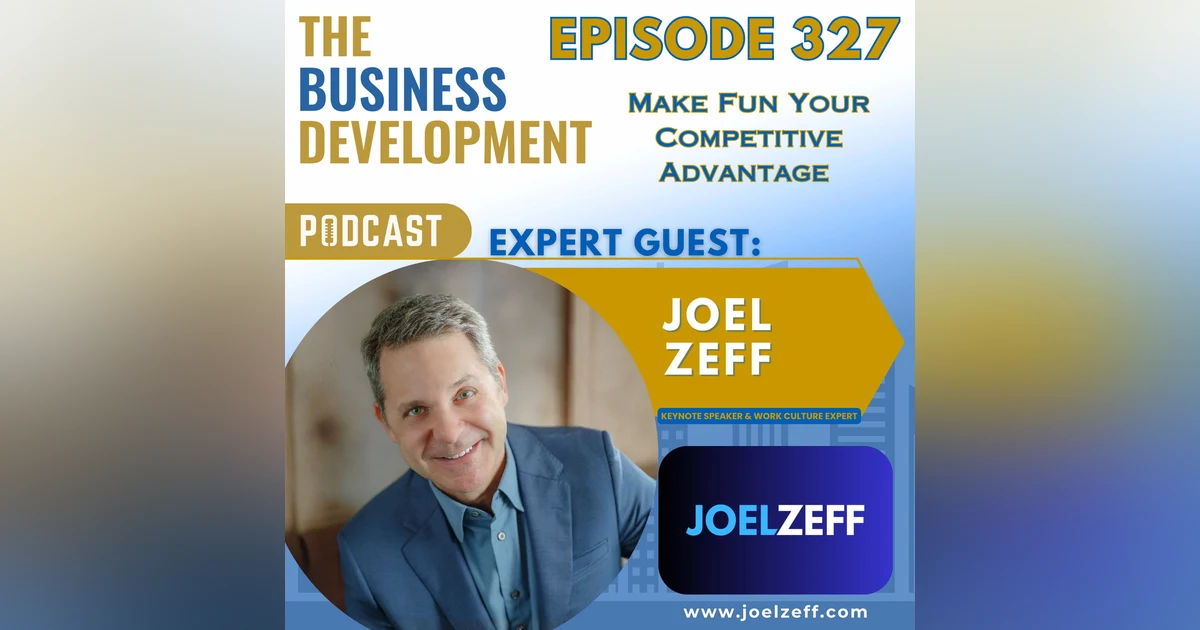
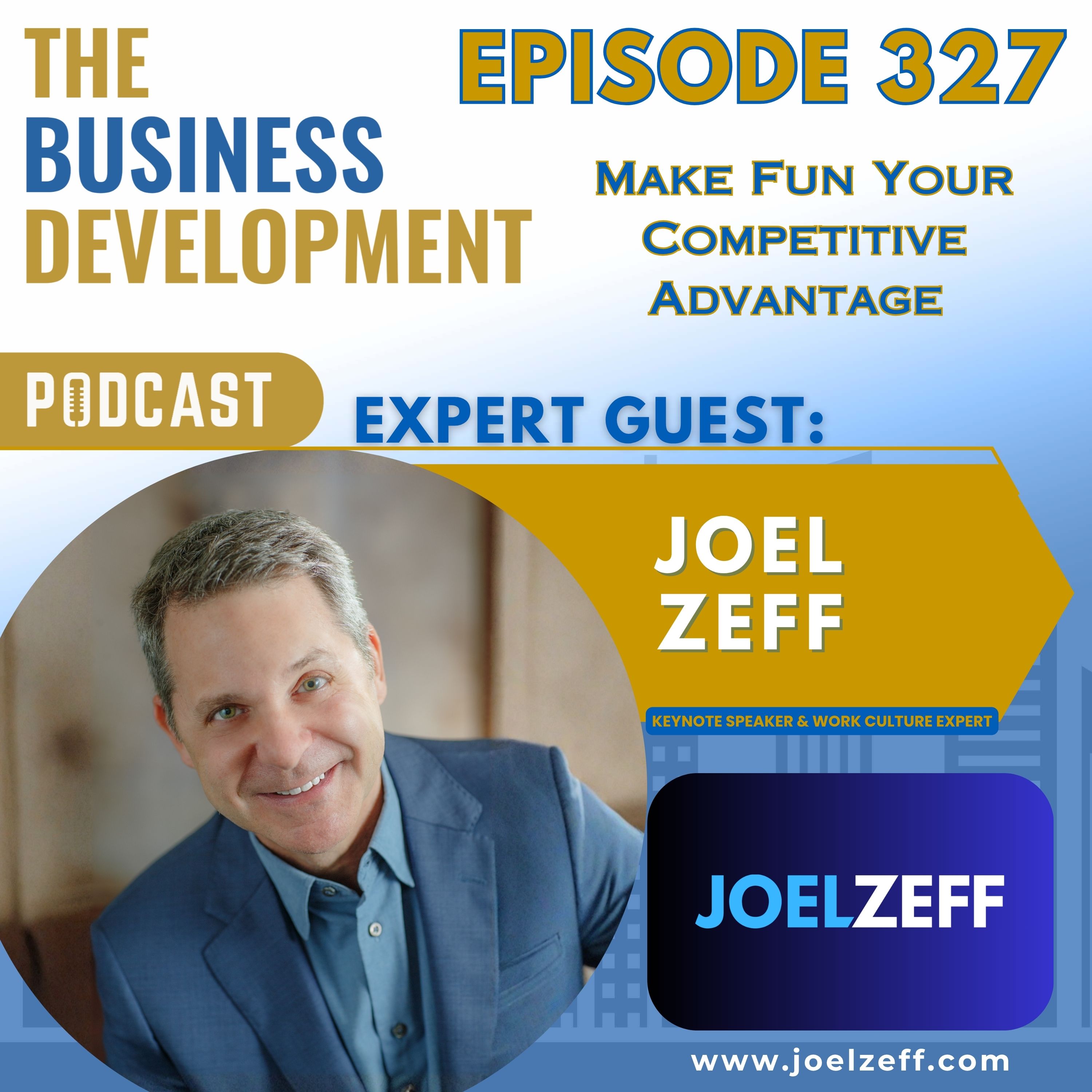
Make Fun Your Competitive Advantage with Joel Zeff

 Apple Podcasts
 Spotify
 Amazon Music
 RSS Feed
 Episode 327 of The Business Development Podcast features Joel Zeff, a nationally recognized speaker, humorist, and work culture expert who has spent more than 25 years helping organizations build stronger teams and better leaders. In this conversation, Joel shares how losing his job became one of the most defining moments of his life when he walked out with a harmonica he did not even know how to play and used that moment to choose energy, humor, and resilience over defeat. That story becomes the gateway into a much bigger conversation about leadership, mindset, and why fun is not something extra at work, it is often the very thing that helps people stay engaged, adaptable, and ready to perform at a higher level.
Throughout the episode, Joel breaks down why celebrating small wins matters more than most leaders realize, how positive support creates momentum, and why staying in the game is one of the most important choices any professional can make. We also explore public speaking, confidence, workplace culture, embracing change, and how leaders can create environments where people feel energized instead of drained.
Learn more about Joel Zeff:
https://www.linkedin.com/in/joelzeff/
Get Joel’s book, Make the Right Choice:
https://www.amazon.ca/Make-Right-Choice-Passion-Elevate/dp/1394278950
Business Development Podcast listeners can also access Joel’s special offer, a free chapter on change, directly through his website.
Just Mention the Show.
Key Takeaways:
- Fun is not a distraction, it is a competitive advantage that drives energy, engagement, and performance.
- Celebrating small wins consistently builds momentum and fuels long-term success more than waiting for big milestones.
- Staying in the game is the most important decision you can make, because quitting guarantees failure while persistence keeps opportunity alive.
- Confidence does not come from perfect outcomes, it comes from choosing how you show up in difficult moments.
- Leaders create culture by giving people ownership and supporting them, not by demanding passion without building the foundation for it.
- Positive support multiplies performance, when people feel encouraged they take more risks, produce more, and grow faster.
- Most people do not fear public speaking, they fear making mistakes, and learning to embrace imperfection unlocks confidence.
- Fun looks different for everyone, the key is identifying what energizes you and leaning into it consistently.
- Your response to setbacks defines your trajectory more than the setback itself, mindset is the difference between collapse and growth.
- The best leaders bring humanity into their work by creating environments where people feel safe, valued, and motivated to contribute.
Sponsor Highlights
This episode of The Business Development Podcast is proudly supported by our 2026 Title Sponsor, Hypervac Technologies. Hypervac designs and manufactures industry-leading hydro excavation equipment used across North America to help contractors excavate safer, faster, and more efficiently.
Alongside Hypervac Technologies, Hyperfab delivers custom-built fabrication solutions designed for performance, durability, and real-world industrial application.
This episode is also proudly supported by our 2026 Roadblock Sponsor, Thunder Bay Hydraulics Inc. Thunder Bay Hydraulics specializes in hydraulic manufacturing, repair, and systems integration supporting industries across Canada.
Alongside Thunder Bay Hydraulics, Atlas Elite Lifts delivers premium automotive lift solutions for high-end homes, luxury condos, dealerships, and elite garage spaces, with lift systems so cool they are Bat Cave Ready.
🌐 www.thunderbayhydraulics.com
If you enjoy the show, please take a moment to give these leaders and their companies some love for supporting the podcast and helping us continue bringing powerful conversations like this to the business community. 🎸⭐
Join The Catalyst Club Community
If you enjoy conversations like this and want to connect with other entrepreneurs, leaders, and business builders who are focused on real growth, I invite you to join us inside The Catalyst Club Community.
🌐 www.kellykennedyofficial.com/thecatalystclub
Mentioned in this episode:
Pre-Show Ad #1 - Atlas Elite Lifts
Hyperfab Midroll
Thunder Bay Hydraulics - Post Show - Ad #1
Make Fun Your Competitive Advantage with Joel Zeff
Joel Zeff: Anybody can play the harmonica for a few seconds, and it sounds like you know what you're doing. And so I can do a blues note. And so what I did was I started, and I don't know why I don't know why Kelly, but this is my attitude. I just lost my job. Let's find some fun. I just lost my job. I got no money.
They told me to come clean out my desk, so I stole a three hole punch. I got the newspaper blues.
Intro: The Great Mark Cuban once said, business happens over years and years. Value is measured in the total upside of a business relationship, not by how much you squeezed out in any one deal, and we couldn't agree more.
This is the Business Development Podcast based in Edmonton, Alberta, Canada. In broadcasting to the world, you'll get expert business development advice, tips and experiences, and you'll hear interviews with business owners, CEOs. And business development reps. You'll get actionable advice on how to grow business,
brought to you by Capital Business Development Capitalbd.ca
Let's do it. Welcome to the The Business Development Podcast, and now your expert host, Kelly Kennedy.
Kelly Kennedy: Hello, welcome to episode 327 of the Business Development Podcast, and today it is my absolute pleasure to welcome to our stage Joel Zeff. Joel is a nationally recognized speaker, work culture expert, author, and humorist who has spent more than 25 years energizing audiences around the world, known for his spontaneous humor and unforgettable stage presence.
Joel blends improvisational comedy with powerful insights on leadership, collaboration, communication. Innovation and navigating change. He has shared his message at more than 2,500 events. Yes, 2,500 events, helping organizations build stronger teams, create culture of support, and bring more passion and engagement into the workplace.
He is also the author of Make The Right Choice, lead With Passion, elevate Your Team and Unleash The Fun At Work. A book constantly recognized as one of Amazon's top work and life balance titles At the Heart of Jewel's Work is his signature philosophy, the Tadda moment. It is the simple but powerful act of celebrating progress, recognizing the small wins, and supporting the people around you as they succeed Through humor, storytelling, and real world insight, Joel reminds leaders and teams that success is not just about results, it's about energy, trust, collaboration, and showing up ready to support one another, because when people feel supported, appreciated, and empowered, incredible things happen.
Ta-da.
Joel Zeff: Wow.
Kelly Kennedy: Joel, it's an honor and a privilege to have you on my stage today. Thank you for coming.
Joel Zeff: I just wanna know that there were 326 people before me.
It took 3 26 people to get to you. Like, well, there can't be anybody else.
Kelly Kennedy: Well, you know, we'll just, we'll add it to one of your 2,500 plus performances.
Joel Zeff: I feel like I'm the last person picked for kickball, like 326 people were chosen for your kickball team before you got to me.
Kelly Kennedy: You know, you could really look at it as like a level up you know, when I started this thing Yeah. I just wasn't ready to talk to Joel Zeff and
Joel Zeff: no.
Kelly Kennedy: Now we are. I, I have, I've elevated to a level where I can talk to someone such as yourself.
Joel Zeff: Perspective. Yeah. That first hundred,
I don't even, I don't even be near that first hundred.
Kelly Kennedy: Yeah. And then you'll, you'll feel bad when we get to 500. You'll be like, oh yeah, wish we were 500.
Joel Zeff: Wow. You're really you 327.
Kelly Kennedy: Well, you know, before we, before we kick this off, I have to give a big shout out to Wayne Lee for making this connection.
Uh, you know, obviously met with Wayne Lee, the, uh, the world famous hypnotist from Edmonton here. Uh, love him. Such an incredible individual. And, uh, after interviewing him, he is like, you know, I know someone that you gotta know.
Joel Zeff: Perhaps he's hypnotized both of us,
Kelly Kennedy: perhaps, right? Like, who knows?
Joel Zeff: We might, who knows?
We right? We could both be, every time I talk to Wayne, I feel like he's, he may be hypnotizing me. How would I know I wouldn't?
Kelly Kennedy: Those dangerous handshakes and snaps. You're just, you're done. I
Joel Zeff: don't know. For some reason I send him like a thousand dollars every month. I don't know why.
Kelly Kennedy: Because you love him that much. Yeah.
Joel Zeff: Yeah. I'm like, I don't remember why I'm doing this. I think, oh, he's anite, but it's, he's fantastic. He's a legend and it's an honor to be here on your podcast. I love, uh, once I discovered your podcast I just love. The energy and how authentic you are and how much you love to learn about people's stories and, uh, engage with them to help your listeners in what they do as leaders, as communicators, as innovators.
It's just, um, it's a, it's an honor and I'm excited to be here.
Kelly Kennedy: The honor is mine. I, you know, the further I go down this path, the more I realize how much I don't know.
Joel Zeff: Yeah. Dunno, anything.
Kelly Kennedy: There's nothing like interviewing hundreds of experts to realize that. Yeah. You have a lot left to learn.
Joel Zeff: We'll see. We'll see what 327 does.
Kelly Kennedy: Oh my goodness. Well, you know, for our listeners, I already know Joel's story a little bit, so, uh, I think we're gonna have a little bit of fun today. Obviously you come from the comedy background, which is a lot of fun. I love funny people, and you do a great job. Yeah. You know, Joel, for our listeners meeting you for the very first time.
You've had an incredible 30 year career at what you've done so far, over 2,500 speaking engagements. I think I asked you at the beginning of the show, like you and what Tony Robbins like, who gets That's incredible.
Joel Zeff: He probably, I think he's made a little more money than me.
Kelly Kennedy: We'll see. You know, maybe this is a big, I think he
Joel Zeff: a little
Kelly Kennedy: more 20, 2600 is your moment, Joel.
Joel Zeff: Yeah. He garden a little more. Uh, yeah. I've been very lucky and I never planned on being a speaker. I didn't even know, I didn't even know speakers existed. I didn't even know there were, that people had conferences and they hired people and it was, uh, I was working at a PR agency. I started as a journalist.
I was a newspaper reporter. That's my degree. And I loved it. And, uh, and we could talk about the day I lost my job at a newspaper, which is a, a fun story. And I, I started working at a PR agency and then an adding agency. And when I lost my job, I had a lot of free time. A severance check, which is the best combination ever.
If you ever have that opportunity, you have to have no debt, you have to be single. It's a lot, lot less. It's a lot less stress. And so that was my circumstance. And so I started doing standup. I started going up on open mics and, uh, because I just wanted to explore this what I loved in comedy.
And I, and I, I just wanted to see what would happen. And and I also started taking workshops with an improv group and I auditioned, and that was really a moment of true love when I first went to an improv show and I started, uh, going to the workshops, I auditioned, got in the improv troupe. They had a theater in downtown Dallas.
It was amazing. Some very talented people. And one of my clients was Texas Instruments, and they said. I know you do improv comedy on the weekends. We're having this executive retreat. Why don't you come up, play some of that improv with us before dinner, which, how about that invite?
Kelly Kennedy: No kidding.
Joel Zeff: And so I said, okay.
I guess, it wasn't like I jump in. It wasn't like this is the beginning of something exciting. This was, no, someone's gonna pay me a few hundred bucks and, um, I'm gonna talk to a, they were all men, all VP level, all engineers. So you're like, oh, well this is the perfect audience for comedy and, uh, I could, if I could find this audience every weekend.
Wow. And, uh, so they, something crazy happened. They had fun, and more importantly, I had fun. And that's when the light bulb started kind of flickering on. Maybe I could offer this to other clients. And that's what happened. And just like anything, if you're passionate about something, if you love something, you put the time and effort and work into it.
Then people take notice and they like to refer you and they like to pass your name on. If you make them feel good, if you take care of them and you're a great partner, they pass your name around and, um, because everybody wants to work with a great partner. And now 2,500 events later, here I am, number 327 on the business development podcast.
I peaked. I'm peaked, baby Kelly. I peaked.
Kelly Kennedy: Wow. Okay. Okay. Congratulations.
Joel Zeff: Thank you.
Kelly Kennedy: Thank you.
Joel Zeff: And it's, uh, you don't know when that door opens, that's going to create something that you're going to love to do and it's gonna be rewarding and fulfilling. You're gonna meet all these amazing companies and you're get to travel and meet all these amazing people.
And it's incredibly rewarding. And I always say it chose me. Because I didn't ever sit down and say, I wanna be a speaker now. People today, do they're like you know, they're like influencers. They, they pop up constantly. And you know, I never said, this is my career. This is my path. This is what I wanna do.
And it chose me, and I'm glad it did because I love it. It's very fulfilling and it's energizing and inspiring and it's great. I'm just, all I'm doing is sharing what improv taught me. And because I love improv and what I've learned watching thousands of managers and entry level and executives and every industry, people from every industry play these improv games and what choices they've made.
Kind of, when everybody makes the same choice, you kind of notice these things. And that's what I'm sharing with my audiences. And it's very powerful because we're laughing, we're having fun, but we're also talking about really important messages about embracing change, being more present, helping the people around us be successful, creating opportunity, being accountable, being adaptable.
And so these are really powerful messages that help us be better leaders, better teammates, better communicators. Better innovators.
Kelly Kennedy: Okay. I, that's amazing. And I wanna better understand the bridge. Okay. So you, you know, you obviously did a workshop basically with, with some executives on improv, right? And then you turn that into a incredible career in workplace culture and leadership.
How does that happen? Bring me into that, because I know my listeners are like, how do I do that? That's amazing.
Joel Zeff: Yeah. I, I, I'm very lucky. I'm very fortunate. You know, I was sharing something that I loved and I think that's a big part of it. And when I first started, someone would say Hey, we have this conference and we need somebody to talk about teamwork.
Kelly Kennedy: Yeah.
Joel Zeff: I'm like, well, improv is all about teamwork. And I would just go and I, it, and it just evolved. It was very organic. I wish I could tell you I sat in a cabin for two weeks and wrote a keynote. That's not how it happened. It was, I got up on stage and I shared what improv taught me and what I loved about it and what it what I think it can teach the audience.
And it evolved. And if I said something I really liked, I said, well, I'm. I'm gonna say that again. That was really good. And it continues to evolve. You know, I want it to be organic because my keynotes, I think audiences really, when they're engaged, when it's authentic, when they believe that it's happening for the first time, there's a connection that's very powerful when it's, you know, when speakers get up there and just kind do the same thing over and over and over.
It just, it's a record that's played too much. Mm-hmm. I just dated myself. What's a record? I don't know. Gen Z just went, I don't understand the reference for
Kelly Kennedy: a record. They're, we're still figuring out tape.
Joel Zeff: Yeah. What, what this record he's talking about. It's ridiculous.
Kelly Kennedy: We tape yet? Yeah.
Joel Zeff: Play the same song over and over.
You get tired of it. So, improv is a, it's an art form. So it was originally created in the late 1930s, early 1940s at NYUA woman named Viola. She created improv for her students because she believed if you played a game, you're gonna take away some of the fears and frustrations. You, you're gonna be focused on the game.
It's gonna be easier to learn some of these messages. And so it's originally a teaching tool, so I'm just bringing it back to its origins and people love to play every type of group. Yesterday I was speaking with people that build hotels or maintain hotels and all their vendors, you know, if you need concrete, if you need electrical, if you buy lighting and lamp and drywall, and all the suppliers that take care of that in one room.
Last week I was working with Samsung. The group that sells the displays. This week coming up is two restaurants. So it's always different industries, banking, financial, everybody wants to play insurance, accounting, you name it, hr, everybody wants to play. And then when you play you kind of, your, your true self.
There's an inclusiveness, there's an equality. It's you know, everybody's on the same, same plane, which is really exciting. And then when you're laughing and having fun, you're engaged. And so you, you want to learn. And it's a, it becomes playing an improv game instead of me telling you, well, you really should be present in the moment.
I'm gonna take three audience volunteers from the stage, they're gonna play an improv game. You're gonna see them make real choices in real time and be effective and creative and work together as a team and be accountable and take ownership. And so that becomes a very powerful way to tell a story, to show these messages instead of a speaker coming up and saying, well.
We should really be present and we should embrace change. And, um, I really think you should help the people around you. Yeah, that sounds good. Now to see people actually do it, that's pretty powerful. And so the audience sees these choices in real time, and I'm just pointing them out and we're doing it while we're laughing and have, and having fun.
So it's engaging it's energizing. And I, I, I tell my audience, if you just laugh, if you just walk out of here and you say, what'd you get outta it? Well, I just laughed. I had a great time. That's a great way to spend an hour because you're actually connecting with everybody in that room, whether you know it or not.
Yeah. You're, you are creating a relationship that's very powerful when you laugh together. Yeah. And, and so the choices become just kind of the sprinkles on the cupcake. They become extra. And so now we have all these things that are happening and that when you're laughing and engaged. The tone, the energy, what do you think is gonna happen for the next few days?
Yeah. It becomes very powerful.
Kelly Kennedy: It's, uh, it's funny that you touched on laughter, um, because when I interviewed Wayne, and actually he came and did a, an event for us inside Catalyst Club as well. He was talking about how laughter is one of the quickest ways to reduce the mental block and get straight to your subconscious.
Oh. So like from a certain standpoint, getting people to laugh helps them to remember much better.
Joel Zeff: Yeah. Because when you're laughing and having fun, and so that audience volunteer that's on stage, that's their, you could be a friend, could be a colleague, could be a peer, could be someone you never met, but happens to be in the same audience.
So that's a group, that's a community. And so you want to find out, okay. How were they successful? I'm engaged. I want them to be successful. So now I'm, I'm not looking at my phone. I'm engaged. What's happening on stage?
Kelly Kennedy: Yeah,
Joel Zeff: I wanna see what happens. That was enough that person was sitting next to me.
I saw that person at lunch. I wanna see what happens now. You're just, now that person's dancing around like a ballerina or imitating a bear or doing the emotion of, of, uh, anger and all from different improv games. And so we're laughing and we're having fun. And now what happens? The audience is what does laughter do?
It reduces our stress.
Kelly Kennedy: Yeah.
Joel Zeff: Takes away frustrations and negativity, and the tone becomes much more positive. And so I'm now more open to the message and because there was a memory of laughter, I'm probably gonna retain the message because, when you laugh. You're gonna, it, it creates a, a really, a really strong memory.
And so that's really what I do, and I think that's why clients bring me back year after year and, and why I've been so successful over the course of my career and I'm very thankful for it. But people need to laugh. They need to have joy. And that's the, you you mentioned tadda in your introduction.
That's what it's all about. I'm not asking people to go back to work and do a standup routine, in the lunchroom but you're not, you wouldn't be against it either. Wouldn't be against it. But that's not what I'm asking you. What I do want you to do is celebrate these moments. Yeah. Because celebration and laughter they're in the same family.
Kelly Kennedy: Oh my gosh. And is like, I'm just gonna pause you there and just say like, as business owners, we are really bad at celebrating things.
Joel Zeff: Kelly, every type of industry and, we have to celebrate. And when I tell a story about the tadda and, you know, a magician at the end and, and, uh, or maybe a hypnotist, ta-da, we did it.
Yeah. You know, it's a flourish. Look what we did, look what we accomplished. And when our kids were younger, everything was a ta-da. Yeah. Everybody does that too, right? Your kids eat a sandwich, you're like, ta-da, you did it. Yeah. You know, they throw a ball, you know, they, they hold their spoon. You're like, ta-da.
You go to the bathroom for the first time, lot of ta-da.
Kelly Kennedy: Yes.
Joel Zeff: Right?
Kelly Kennedy: Yes.
Joel Zeff: Whatever. You might not say ta-da. You might say something else, but you celebrate.
It's a celebration. Everything in their life. Yeah. Yeah. When they're young and then they get older, we don't celebrate everything. We still celebrate a lot.
We don't celebrate everything. Then we become adults. We go into the, uh, the workforce and our careers, and maybe once a year we get together and, uh, you're lucky. You give out some pointy glass awards. Yeah. And not everybody gets one.
Kelly Kennedy: Yeah.
Joel Zeff: And so, where does that celebration come from if we're not celebrating these successes?
Because that's what fuels our passion and our joy and our fulfillment. And if we don't, then our tank is empty. And then,
Kelly Kennedy: oh my gosh. I want to pause you there, because I actually just thought of something that I've never thought about in this entire show. Yeah. So Joel, this is you. Okay. Um, you're talking about celebration, but what you basically said was, we are celebrated by other people our entire life.
And then at some point the onus to celebrate comes off other people and comes to us. And that's where the challenge is. We don't know how.
Joel Zeff: I got a little goosebump there.
Kelly Kennedy: That I've never thought about it that way until the way that you just framed it. Right now, you're celebrated, you're celebrated.
A little less, a little less, a little less. But the key word there is somebody is celebrating you. Yeah. Not you celebrating yourself.
Joel Zeff: And you have to because if you don't celebrate where does that fuel come from?
Kelly Kennedy: Yeah.
Joel Zeff: And you know, to be passionate, and I hope you're passionate and you know, no job on the job application.
Is there a line that says, you must be passionate about this job. I want you to be passionate. That'd be great, but I can't demand it. And it's up to you to have that passion. It's up to the people around you to create the foundation for that passion to exist. And what, what I talk about is it starts with opportunity, starts with ownership.
I give you, when I bring audience, volunteers to the stage, I'm giving you, I'm creating that opportunity for you to be successful. But I'm giving you ownership. I want you to be accountable. Because when you have ownership, when it's your game, what happens? You care, you have ownership. If I, yeah, what am I gonna care about if I don't have ownership?
So once you start caring about something, then the next step is passion. But we have to have the foundation for that to exist. So as leaders, we have to create that for the people around us. And then for us, we have to demand it and we have to give it to ourselves first. Ownership and opportunity. So important, second positive support.
And when you put those two things together, that positive support, that's the celebration aspect of it. When audiences laugh and applaud my audience, volunteers on stage, they do more, right? They immediately do more because their confidence is building and they take more risks, they produce more. And then what happens?
More positive support, more laughter. And that ta-da moment, it's up to us to celebrate. It's up to us. We just go through the day and think, well, this is part of our day. This is what we're supposed to do. Kelly, 327 podcasts. That's a, that's a huge accomplishment. Every one, every podcast is a huge accomplishment because it's a lot of work and and I hope you celebrate and think to yourself, man, that, yeah, awesome.
I'm proud of myself. Look what I did. Look what I'm setting out to the world. Maybe one person, two people, who knows if just one person listens and it helps them be a better leader, that's a huge, huge win. We just think this is our day and this is what we're supposed to do, and why should we celebrate? But it should be that celebration because it fuels that passion for what we wanna do next.
And it's important that we don't wait for someone once a year to maybe give us a pointy glass award. Yeah. It's important that we celebrate every single day. These very, when we were kids, we celebrated everything. And what happened? Every time we celebrated, we, our confidence was we, we built our confidence.
Kelly Kennedy: Yeah.
Joel Zeff: We, we tried different things. We tried new things. We weren't afraid to fail, not afraid to make a mistake, not afraid to look foolish. And then all of a sudden we get older and we start, start having those thoughts and we stop taking risks and we stop getting outta our comfort zone. And we just kind of get, stay in our safe space and we have to make sure that we try different things and, and get outta our comfort zone.
That's how, that's how we grow, that's how we get better and that's how we find success.
Kelly Kennedy: I love that. I love that. I, um, I was talking earlier this year that on my birthday I got up early and I sat on the couch and usually I'm almost always thinking, what's next? What's next? What's next? How do I build this next great thing?
Or how do I put out the next big show or get my recordings done for the week? And I sat on the couch and it was about five 30 in the morning. And I actually just was grateful for everything that I had done up to that point that we had made it this far. That, you know, at that point I was celebrating five years of Capital Business Development.
You know, we were on our third year of the show. And I found myself reflecting and being thankful for the moment. But man, I gotta tell you, Joel, those are, those moments are few and far between.
Joel Zeff: Yeah. But we have to make, we have to make sure those moments happen more often because I'm sure right after you did that, immediately you're like, it energized you.
Yeah. It probably inspired you to take the next step to do something new. And that's what, no matter what your job is, you know, and people think, well, we only celebrate when we have the perfect job and it's, we're making the perfect salary. And that's not how it should be. It should be every job. And I, in my book, I talk about one of my very first jobs, I worked at a movie theater.
And, uh, and I'm sure lots of people have worked at movie theaters and, uh, you clean up people's trash and you clean the popcorn machine. And, uh, I wouldn't say that's the most glamorous job in the world. And I was making $2.85 US an hour and I'm pretty sure that was below minimum wage. I don't know how that happened.
I was 15 and, uh, $2.85 an hour. And you know what I learned really quick that you better have fun at work or it's gonna be a long day. Yeah. No matter if you're cleaning up people's trash or I get to be on stage last night, I'm on stage in front of 600 people, so you better. And I had the exact same mindset as when I had, when I was 15, clean up trash in a, at a movie theater as I had last night on stage in front of 600 people.
Have fun. Enjoy the moment. And when you have fun, that sets the tone for everything else. Yeah. And that was a very powerful it was a very powerful lesson when I was working in the movie theater is that you better have fun or it's gonna be a long day picking up people's trash. And and to this day, if I go to a movie theater, if I go to a ball game.
My trash goes out with me. I don't leave it under my chair. Yeah. Because I've cleaned up trash.
Kelly Kennedy: It's so funny. If I look back, for me, that's serving right. I served, I served and bartended all through college and uh, I always leave big tips. It's never stopped. It's never left you. And once you've done a job like that in a service-based role,
Joel Zeff: yeah.
Kelly Kennedy: You never forget it. I think, I think everybody should do a service based role in their life. At some point
Joel Zeff: everybody should pick up trash.
Kelly Kennedy: Yep.
Joel Zeff: Everything would be a lot cleaner if everybody had a job at some point where they were picking up other people's trash.
Kelly Kennedy: Yes. Yeah, absolutely. Absolutely. Yeah. You know, one of the things that I really admire about you, Joel, and I know we haven't known each other very long, but I see a very positive and optimistic person in you.
You know, I, I've been lucky to have known a lot of people with those attributes, but, you know, you talked about having fun at work and recognizing that that is an absolutely critical piece of being successful. How have you managed to keep your optimism and your energy and in a way that you could have fun as often as possible?
Joel Zeff: You have to protect it and fight for it. And I've been in plenty of situations where, somewhat everything's going against the fun.
Kelly Kennedy: Yeah.
Joel Zeff: And you've gotta protect it. And look in the last week, okay I had two events and you know, I'm flying around the country, you. I'm stuck in Philadelphia. I have flight's canceled at midnight.
I'm at a hotel downtown. Having problems with the voucher from the airlines I sleep for. I have a nice two and a half hour nap before I have to get up at three 30 to get to the airport for a 6:00 AM flight oof flight. And so you better figure out fun.
Kelly Kennedy: Yeah.
Joel Zeff: And it's not it's, I ran it uh, there was another person on my flight, never met the person, and we connected and, you know, just having something to share, sharing an Uber and, uh, talking about this and that, and, finding the flight because now he's in the same boat that I'm in.
Yeah. And now we're sharing our, and we're laughing about it and it takes away some of the stress. And I think you just have to have that philosophy. And you have to not be afraid to reach out and not be afraid to share and get outta your comfort zone. And it really helps create that energy in that atmosphere no matter where you are in your career, whether you're at the beginning of your career or in the middle, you're at the end of your career.
And I think fun is such an important part, like you said, of your job. And you should have joy. And even if it's the job, this is your first job or it's a job that you're still trying to get to where you want to go.
Kelly Kennedy: Yeah.
Joel Zeff: And it's okay. It sometimes it takes a long time to get to your dream job or what you really, really want to do, but every stop along the way, you're gonna learn every stop along the way.
You're going to. Get better, I hope. And every moment might not be fun, but you've got to create that environment where fun is, should be a guiding light.
Kelly Kennedy: Yeah.
Joel Zeff: It should be something that you aspire to every day and bring joy and be fulfilled and do the best that you can. And I was just taught at an early age that have fun, work hard, do your best.
Yeah. And and that was just kind of always been my, always been my philosophy. Whether I'm picking up trash or, you know, working at an adding sea or when I was a newspaper reporter, excuse me. Apparently I just lost the ability to say, reporter,
Kelly Kennedy: that happens. I, you should have heard my intro, that no one will hear all the, all the edits.
Joel Zeff: Newspaper reporter. And, you know, when I was first, when I was a first newspaper reporter, I, I wrote about death and murder and mm-hmm. Terrible things. But I still. Still believe that you have to enjoy what you do and find those moments. And, and it can be difficult. I'm not saying it's the easiest thing in the world, but it has to be a philosophy.
It has to be a tone. And I think it serves you well when you find, find that little guiding light that, that, that helps you in wherever you're going in your career. Yeah. You know, and I, I could tell you there's plenty of stories. We this might be a good time to tell the harmonica story.
Kelly Kennedy: Let's do it. I love that story.
Joel Zeff: And everybody, every listener, I'm sure everybody has lost their job at some point. At everybody's been laid off. Everybody, you know, I hope. I don't hope. I hope you've never been laid off.
Kelly Kennedy: I hope you understand. I laid off the pain off
Joel Zeff: just like I was. I don't hope.
But anyway, uh, I hope you don't get laid off, but sometime in your career, you work long enough, you're gonna get laid off. Yes. And I was laid off, um, in, uh, I, I had moved to Dallas, six, uh, I had moved to Dallas and six months later they called and said, come clean out your desks. The newspaper is closed.
Tomorrow's the last paper. You've lost your job. So I just moved there six months ago across the country. I've got a one bedroom apartment, I got a couch and a bed, and that's about it. And, uh, it's not like I'm rolling in it. And, uh, so I lost my job and I walked, and actually that phone call, it felt like a weight had been lifted because it was a tough.
Situation. Tough job. And as I told you, when I told the story before I knew I was on the Titanic, okay? The people on the Titanic did not know they were gonna hit a iceberg. They thought they were on a luxury liner. It's gonna be amazing. The food's gonna be incredible. Except for where Leo was. That was Leo got out and then, you know, met the rich lady.
Kelly Kennedy: Oh, I, man, I had such a brain fart there. It took me a second to realize we were actually talking about the Titanic.
Joel Zeff: Yeah, we're talking about Titanic. That's a true story.
Kelly Kennedy: True story. True story.
Joel Zeff: The, the Leo part is a true story too. Leo DiCaprio, for those not understanding my reference,
Kelly Kennedy: he
Joel Zeff: was in third class, but he met a first class and they fell in love
Kelly Kennedy: And then he gave her his door and drowned.
Joel Zeff: Yes. I'm one of the ones that I feel like there's enough space for both of them.
Kelly Kennedy: I feel like there was, I feel like there definitely
Joel Zeff: was like, you could have switched out. They have switched out, so, wow. I feel like, I feel like they could have snuggled. It could have been.
Kelly Kennedy: You can't, you can't go back and do it again.
Joel Zeff: The point is, I knew at this job, I was on the Titanic, we were gonna hit an iceberg. And so, we hid an iceberg and they called and said, the paper's closed, come clean at your desk. And so I walked outta my apartment and I grabbed this magic harmonica, and I called my magic harmonica because it taught me a lot.
And I bought it at a college lecture. I don't remember where I bought it or why, but I had, extra money in my pocket and like, oh man, I should buy a harmonica. And so I didn't walk outta my apartment often with my harmonica because I'm, I don't really play the harmonica. I don't have any music ability.
I'm tone deaf. But for some reason, when you call me to say, you're unemployed, now, come clean out your desk. Boom. I had grabbed the magic harmonica, went down to the newspaper, surveyed the situation and people are just like taking things and people are angry and upset and confused and sad. And I found myself on the back loading dock where the media had gathered radio stations, TV stations, newspapers, because covering a major newspaper closing, that's a, that was a big story.
And so I took out my magic harmonica and this is what I did. And this is a true story. Let's see. Pretty good. Sounds pretty good today.
Kelly Kennedy: Sounds, sounds pretty good.
Joel Zeff: That's the part, magic harmonica you, anybody can play the harmonica for a few seconds and it sounds like you know what you're doing. And so I can do a blues note.
And so what I did was I started, and I don't know why I don't know why Kelly, but this is my attitude. I just lost my job. Let's find some fun. I just lost my job. I got no money. They told me to come clean out my desk, so I stole a three hole
punch. I got the newspaper blues because I just lost my job today going on unemployment.
I got no money, I got no job. I got the newspaper blues
and so I did that. That was pretty good rendition right there. It was very good. And I don't even know those, I don't know if those were the exact words, but it was around that. And um, and so what happened was the media just immediately just, they went because that was something different.
Kelly Kennedy: Yeah,
Joel Zeff: they were what this guy is playing the harmonica and he's not angry and yelling and why he lost his job or crying or I'm having fun. And what, what does fun attract? Everything. Everyone. Yeah. And so they're attracted by it. And what that moment taught me, and it's chapter two in my book, and it's my favorite chapter, my absolute favorite chapter.
And I tell the story because this moment taught me quite a bit about fun at work, about being confident. So what did this do? It said, one, be confident, right? Two, reduce stress. That moment I just lost my job. I'm like, what am I gonna do? Uh, where am I gonna get another job? Um, I'm gonna probably have to move to another city.
It's, you know, I'm gonna go unemployment. This is, you know, how am I gonna pay my bills? A lot of stress, I could focus on that. But the harmonica took away some of that stress, and that was a huge learning moment that, that fun, that, that magic harmonica reduced the stress of losing your job. So that.
Absolutely helps you. And it gave me confidence. I didn't lose my skills.
I didn't lose my abilities. I just lost my job. I still have my skills. So I'm confident I'm reducing stress. I am, being who I am. And that's a confidence builder.
Kelly Kennedy: Yeah.
Joel Zeff: That's, I, that is me. And when you realize who you are and you put it out there, you'd be surprised what happens.
And you know, I get I talked about the whole, I went through in, under reflection all the things that the magic harmonica taught me in that moment. And it really was a special moment because that could have been a very stressful situation. And what happened was it became something very powerful because I took charge.
And I made the choice and put myself out there and that helped me reduce stress and helped me set the tone for what I'm going to do next and gave me confidence and, and that was really, really important. And so I always tell people, find your magic. Harmonica may not be a harmonica, might be something else, but what is that magic harmonica that's gonna help you build your confidence and reduce your stress and believe in who you are so that you can go forward and be successful and do great things because there are gonna be moments out of your control that are gonna try to push you down.
And you have to have sometimes a magic harmonica to be able to stand up and be confident and believe in yourself and realize, yes, this door closed. There's gonna be another opportunity, another door. If you stay positive, if you're create opportunity, if you're supportive, if you believe in yourself, someone's gonna want you.
And so it's important to have and realize and connect with that moment. And so this magic harmonica was what did it for me.
Kelly Kennedy: Now, I love this story. My PE people couldn't see this 'cause this is an audio show, but I was smiling so hard, my face hurt. Aw. And it's rare that I get that Joel. So I appreciate that greatly.
Yeah. Um, talk to me about what happened next. Because obviously there's a lot of people here who have found themselves in very hard situations. They've lost their job, their business closed a deal, went south, and those can be really hard moments. What happened after you lost your job at the newspaper?
Obviously you did this, you ended up on. What the front page of a newspaper for a closing newspaper?
Joel Zeff: Another newspaper put a huge photo of me playing the harmonica. I sent you the photo.
Kelly Kennedy: Yes, yes.
Joel Zeff: Uh, and uh, the local TV station, two local TV stations kicked off their broadcast of 150 year old paper. I don't know what the a hundred something year old paper closing and this kid, because I was in my early twenties.
But that kid's having fun. Yeah. And what fun people notice fun people wanna be around fun.
Kelly Kennedy: Yeah.
Joel Zeff: People wanna be connected to fun and so they, why did they start the broad two stations? Two, I think it was the NBC and ABC started the, their local news broadcast with me playing the harmonica.
Kelly Kennedy: Yeah.
Joel Zeff: Because they connected with it. It was fun. And that's been my guiding light my whole career is to find the fun and to. Inspire others. Inspire to find the fun and believe in themselves and have, and your fun might be different than my fun. And it's not always about laughter. It's not always fun is not necessarily comedy.
Fun. Is mentoring something someone that's a, that, that making the big sale overcoming a challenge. Yeah. Meaning a reaching your goals. Why can't all that be fun? It doesn't have to. It's not about la it's not always about juggling fun and comedy and, and free pizza. Yeah. All those things are great, but let's not get confused.
Sometimes people get confused and think fun is, is just one thing. Fun is your fun is different than my fun.
Kelly Kennedy: Yeah.
Joel Zeff: Kelly, your fun is creating this podcast. That's not, that, that seems like a lot of work to me, Kelly. That would be fun
Kelly Kennedy: for me. It gets, it gets easier all the time.
Joel Zeff: But for you, this is your fun.
Kelly Kennedy: Yes.
Joel Zeff: Right? Yeah. And just like I get on stage and play improv games, that's my fun. Yeah. And people always come up to me and go, I could never get on stage. I don't like getting in front of people. Okay, that's not your fun. What is your fun? And let's, let's go that direction. Yeah. Figure out what your fun is.
Yeah. And that's really important. And, and what happened after? What really was special? What happened after the harmonica? And I didn't, I didn't get another full-time job. I think it's six months was, it took me six months to get a full-time job. So I, I freelance. But what I do, what I did during that time, which was so crucial, is that I really lean into the fun, what was fun for me.
And I started doing standup comedy at open mic nights. I started doing workshops with an improv t. And auditioned and joined the troop. That was all my fun. I'm not getting maybe a few dollars here, a few dollars there. Yeah. Not any money, but I'm following my fun. I'm following what I love to do. And what did that do?
It created a career.
Kelly Kennedy: Yes.
Joel Zeff: All because, and, and at that time, no idea that was gonna lead to, um, you know, if I got, if someone gave me a free plate of nachos and a beer for doing comedy, I was like, wow, I'm rich. And it's just something I love to do. And that free time, finding my fun, doing improv, doing standup, getting in the comedy troupe, and then somebody asking me to go speak at Texas Instruments and saying, with that executive retreat, the story that I told, and then somebody else and passing my name around, and then 2,500 events later, here I am, all because I searched out.
And went on a discovery trip for fun. Wow.
Kelly Kennedy: Wow. Yeah. That is such an inspirational story. Joel. You know, one of the things that I do wanna get into with you is the 2,500 different speaking events, because I know we do have a lot of speakers. I've, I've spoken with a lot of speakers, we've got a lot on the show.
None with 2,500 events, I can tell you that right now. But I know that, like speaking is such a fear for so many people getting up on stage, putting themselves out there. Um, it can be really, really hard. And I'd love to maybe chat with someone like you who's so seasoned at it, really like, might be the best person we've ever had on this show to speak to those people.
What advice would you give to young people or people that maybe are an expert at something, but they've never made the jump into public speaking? It's been on their mind, but it's, it's pretty scary.
Joel Zeff: Or even, you know, executives that listen to your show that have an opportunity, they gotta get in front of eight people and do a presentation.
Sure. Or they gotta speak in front of the whole sales team. Yeah. And they're like, man, public speaking is so scary. Even though you're not a professional, a lot of people still have opportunities to speak. And people say that same thing to me all the time, Kelly. And what I tell them is, you don't necessarily have a fear of public speaking.
What you have a fear of is making a mistake. That's what you have a fear of. You fear that you're gonna get up and make a mistake. Forget to say something. I, look, we just talked about me speaking at 2,500 events and I messed up the word reporter. And I hope you keep that in.
Kelly Kennedy: Oh, I'm, I, I mess up words all the time.
Who do I all the time?
Joel Zeff: Put a microphone on me. I promise I'm gonna mess up.
Kelly Kennedy: I, I got told once that it was my first time being human, so that's the excuse I use.
Joel Zeff: That's not bad. What you gonna mess up?
Kelly Kennedy: Yeah.
Joel Zeff: You're gonna, you're gonna fumble a word. You're gonna forget to say something and you have to embrace it.
You know, I, I was playing a game last night with an event with a group and one of, it's a guessing game. Okay. It's kind of like the game telephone when we were kids. Yeah. But it's improv and, and just at a heightened level. And, um, and so the, the most important rule is you can't guess during the game because I'm gonna say it to one person, that person's gonna do it to the next person, and then we're gonna see if the third person can get it right.
So I'm with this guy. It's one of the greatest moments of my career, and I, you know, you got it. We're not gonna guess. Got it. And so the, the person he was working with I mean, Amelia, you got it? Yeah. Got it. Two seconds later, ballerina, he's guessing the audience is on the floor. And I go, Hey, his name is Tim.
I go, Tim I go, Hey, you're doing great. No, remember, we don't guess. Okay, I got it. I got it
like two seconds. And I, I like four or five times. I go, don't guess. Okay, I got it. Texas,
I mean, immediately. Horse riding. It just, he couldn't stop himself.
Kelly Kennedy: Yeah.
Joel Zeff: Absolutely barreled. I mean, over laughing. You would see people that they couldn't catch their breath there laughing so hard. Yeah. I was laughing. It was, and you're thinking people after the show thought it was a setup. Yeah. They thought it was a whole plant.
Kelly Kennedy: Yeah.
Joel Zeff: And he obviously, the game was completely, is a different game than what I usually play.
Yeah. And then I talked about, you know, what, what happened there? Did I embrace that I could have easily gotten frustrated or stressed? Because a lot of people do. Yeah. And that's what, when we talk about public speaking, people get frustrated. They get stressed making a mistake. They, they worry about it's not gonna go perfect if you embrace that change.
And I had just embraced what he was doing and went with it. It was something else. It wasn't necessarily what we were planning for.
Kelly Kennedy: Mm-hmm.
Joel Zeff: But we embraced it. We met our objectives and the audience was enjoying it and laughing and we learned a lot about embracing change and being open and being flexible and take those messages to public speaking that you are gonna make a mistake.
You might fumble a word, you might forget to say something. And in reality, the only person that cares about either one of those things is you. Mm-hmm. The audience doesn't even know
Kelly Kennedy: Yeah.
Joel Zeff: That you forgot something. And a lot of people don't even notice that you fumbled a word.
Kelly Kennedy: Yeah.
Joel Zeff: So be confident.
Don't be afraid to make mistakes. Embrace change. That would be my three three lessons or three things to think about, and I think that would help anybody who gets in front of people to speak.
Kelly Kennedy: That's amazing. You have been speaking publicly since before the year 2000.
I mean that you look incredible. I mean that in the best way.
Joel Zeff: I start, I was early, I was in my twenties.
Kelly Kennedy: Well, yeah, that's what I, that's what I wanted to ask you is how has speaking changed since 1997?
Joel Zeff: It's changed quite a bit. First, um, I don't know. You remember VHS tapes?
Kelly Kennedy: I do. Yeah. I remember I had Jurassic Park, the VHS.
Joel Zeff: So you, first of all, to record your presentation, edit the presentation, duplicate it on VHS, and then mail it. That was a lot of effort and money and time. Wow. And now, you know, like I spoke Thursday last week. Boom, here's a Google link with the recording.
Kelly Kennedy: Yeah.
Joel Zeff: You know, and if I, you know, I could put it in an app and edit shorts out of it.
Yeah. If I wanted to, and so that's what the technology of that and the speed of things has changed. The audiences I think, have changed. I think the audiences, you know, as they, as the younger generations enter the workforce they're not gonna sit there and listen to somebody babble for hours.
They want engagement, they want entertainment, they want, they wanna be part of it.
And that's why I think I'm positioned really well, is that improv is so universal. Yes. For whether it's an international group, an age, different generations in the audience different levels of employment, whether it's the CEO or entry level you know, different jobs.
And so people want to laugh and people wanna play. And I think the audiences, and I, if they don't like, they don't like something, boom. Pick up their phone. I don't have to listen to you. Yeah. Boom. I'm gonna pick up so you better be good. Because they can just get on their phone.
Kelly Kennedy: Yeah.
Joel Zeff: Yeah, they're not stuck.
I can what? I can sit here and do whatever, play a game on my phone or look through, videos. And so you, you have to give your best and connect with the audience and also be authentic, which is something that I truly believe in. I think if you're authentic and the audience reads that, an audience, I always said an audience is like a five-year-old child and it's just a big group of five year, it's just like, it's like a kindergarten class.
So every audience has a kindergarten class and they know if you're don't know what you're talking about, they know they, they can sense fear and you have to make sure that you draw the line, here's what you can do, here's what you can't do. Because they'll, they'll keep going and so you gotta connect with them.
You gotta be authentic, you gotta engage 'cause. Kindergarten, you know, a 5-year-old they'll read you like that, they know. Yeah. Yeah. And so you have to connect. And if you don't connect, you don't believe in what you're saying. You don't truly want your audience to be better and to take something from this, why should they waste their time?
Kelly Kennedy: Mm-hmm.
Joel Zeff: And so I truly love being on stage and it's fulfilling and it's rewarding and it's absolutely just I just, I love it. It's just, it's amazing to create that laughter. And as my wife says, I just wanna make people laugh and tell people what I think. And that's really all the only thing I really wanna do in life.
And I'm very fortunate and lucky to have this opportunity. And, you know, I love when people come up. Sometimes people come up and say, you know, I, I'm dealing with whatever tough situation. Sometimes they can be very. Very tough and say, and I've had people come up and say, I've, I haven't laughed like that since my husband passed away
Kelly Kennedy: mm-hmm.
Joel Zeff: Since I got diagnosed by, with cancer. I've heard all kinds of stories like this, and when people come up and say, you, that was the first time I've laughed in a long time. And, you know, I get emotional, I'm kind of, I'm a
Kelly Kennedy: Of course. Yeah.
Joel Zeff: Yeah. I, I can get like that, I can get really emotional.
Kelly Kennedy: Yeah.
Joel Zeff: And, uh, you know, and you hug the person and you realize that that's, this is what, it's what you're supposed to do, and that it's not really about you, it's about the audience and what you're giving to the audience and what they Yeah, go ahead.
Kelly Kennedy: Sorry. You have to make sure that whatever it is you are speaking about, you truly believe at 150%.
Joel Zeff: Yep. You have to, and it's about them. It's you. You should be there always for the audience. And it's not about the money or. Travel or, it's it's not about you.
Kelly Kennedy: Mm-hmm.
Joel Zeff: And so you, I'm just fortunate that I get to share these stories and I get to share my love of improv and I get to engage with these audiences and bring a little laughter and fun and talk about some messages that hopefully will help them be better leaders and, and teammates and whatever they do.
And if it's just one little thing. Awesome. Yeah. And, um, it's very, very rewarding.
Kelly Kennedy: You talked about, you know, how passion is so important in everything you do. Finding joy is important in everything you do. I can tell you right now, you know, my side of this is podcasting, but. You cannot do 300 plus episodes of a podcast if you don't enjoy it.
If you don't enjoy it, you probably won't even hit 20. Um, no, it's a lot of work to do something that you don't enjoy. And I'm definitely finding myself, you know, you know, because you're on the new show, but I'm in the middle right now of, of prepping our very first episode for, I used to work there and I'm having so much fun.
The stories are so good and I get to be creative and I get to do, I get to push my boundaries in ways that I never have before. And you're right, I do find so much fun and joy in the creative process that is podcasting, building shows. Yeah. And, and then sharing that creation with the world. You have to find those things you love.
You have to find joy. And I like that you kind of touched that back because I think that equally applies to what you speak about.
Joel Zeff: And we're two lucky people that have found our joy and love. And we're at the, you know, we're at the, at the place where we want to be. And you know, some of your listeners are at that place and some of them are trying to get there.
Kelly Kennedy: Yes.
Joel Zeff: And so, you know, one of the best messages in improv is staying in the game, not giving up. You can do anything you want in the game. You can be loud, quiet, funny, not funny. The game still works. Guess just guess. Ballerina not supposed to guess. You can still do that. You just cannot give up. You can't quit.
It's been easy to quit, boom, we're done. Yeah, we quit. But to stay in the game is really important and that's one of the best messages improv ever taught me is that. Somebody might say something, it might go the wrong direction, it might not work. But if you stay in the game, you're gonna find a way to be successful and take that to whatever you do in work, as all your listeners are, are listening.
What does staying in the game mean to you? It might mean you have to get outta your comfort zone. When you started that new podcast, that was way, outta your comfort zone, something different, new idea. But it's invigorating, it's energizing. Yes, it's inspiring. You don't know all the answers.
You're doing the first one. That's exciting.
Kelly Kennedy: I, I always say a new project is always the most fun you can have because you are being pushed in a way you've never been pushed before,
Joel Zeff: and you'd be surprised what you can accomplish. And so staying in the game means you might have to get outta your comfort zone.
You might have to try something new. You might have to find a mentor, you might have to work a little harder. You might have to do something different, come up with a new idea. But all of that will end up finding success. And that's what we're after. We're after that joy we're after to be fulfilled and rewarded deep in our heart.
And we are. If we don't give up and stay in the game, and how do we do that? We talked about several choices just in this podcast, creating opportunity for each other, celebrating those ta-da moments. That's what I encourage everybody to do. Creating positive support, not just for yourself, but send that positive support out, right?
Every day when you go home from work, think about all the people you had contact with and go through the list and did I give the people that deserved it, that appreciation? And if you didn't say thank you, send an email attack. See em in the hall. It's a gift. It's the best gift you can give anybody. Be open and flexible at change.
Embrace change, be present in the moment with people around you, around all these are choices that are gonna help you stay in the game. Yeah. And when you stay in the game, guaranteed success. If you quit,
Kelly Kennedy: what's game over?
Joel Zeff: It's game over. You fail.
Kelly Kennedy: Yeah. Yeah.
Joel Zeff: And
Kelly Kennedy: yeah. I I, I always get asked, I get asked a lot, you know what, what is true failure?
The only thing that I can think of that's true failure is to truly give up on something and never do it again. Just truly quit to quit. Um, because everything else is just a lesson until you make a choice to walk away.
Joel Zeff: Is this the next step in finding finding success? You know, when I talk to salespeople, I say, you know, you, you have that really tough sale.
You're trying to make it, and they're not responding and they're not emailing you back. And they're, they keep saying, no, you have two choices. Give up. You're not gonna call on them anymore. You're done. So that's failure. We're not gonna ever make that sale if we stay in the game. Keep connecting. Do something different.
Yeah. Make a different way to communicate what you can do. Success is out there. It might not be next month, it might not be even next year, I don't know, but success is still a possibility. If you quit, the guarantee is that sale is never going to happen. It is guaranteed failure. Yeah. Stay in the game, but try something different.
Find a new connection, a new way to meet, a new, new opportunity to explain the benefits. And so staying in the game is the best message improv ever taught me. The best message I ever said on stage. Certainly the best message I ever taught my kids.
Kelly Kennedy: I, I love that message and I've found so many times where I've gotten a no.
And then I just talked to one other person and it was like, oh, I was just talking to the wrong person. It's amazing. Give up. It's amazing how often a no can turn into a yes with a simple person change. Yeah.
Joel Zeff: I had a no last week, you know, they had a budget cut and they said, well, we're sorry. We can't do it.
You know, we don't have a budget. And I said, what if we do this? And I just became a little more flexible on fee because I'm thinking about the possibility. I know who's in the audience. I know the association, I know they have sister association, so I'm putting a bet on myself. That if I do a great job, I'm gonna get more work.
Sure. So I turned a no into a yes. Gave him some more discount. It's okay. And that no turned into a Yes. Just by being a little flexible, and some speakers, you don't have the ego. They're like, I'm not, if you don't can't afford me, then that's, uh mm-hmm. That's, you know, and, uh, it just sometimes ego can get in the way of a lot of things and and you don't know what the possibilities are or what the opportunities are, and so you just have to give yourself a chance.
And so that open, that's what I, one stayed in the game. Two, I was open and flexible. I was present, I was in the moment, I was listening, I was connected. And that allowed me to turn a no into a yes.
Kelly Kennedy: Amazing. Amazing. Well, I want to take that opportunity to lead into your keynotes. Talk to us a little bit about what, uh, what you speak about and what your various talks run.
Joel Zeff: So as, as we've talked for the last hour, I use improv to talk about these important choices, the choices that make us great leaders, great teammates, great communicators, great innovators. So sometimes we just focus on leadership and teamwork. Sometimes it's on communication. Sometimes we talk about culture, you know, it's all the same pie.
We're just kind of slicing it a little bit differently and using improv as the tool to discover these choices, to have fun. That's just my visual storyboard. So my keynotes are about engagement and laughter and energy. And then through that fund, through that play, we talk about these messages. Staying in the game, embracing change, creating opportunity, being accountable helping the people around us be successful.
And so that is what my keynotes are. And they create energy and they're fun and I want to engage with audiences. 'cause that's what I think, that's what really, that's what audiences today really want is that engagement, that connection.
Kelly Kennedy: Oh my gosh. We, we need it. We get bored too easy.
Joel Zeff: Yeah, exactly right.
Absolutely.
Kelly Kennedy: I'm a millennial. You got me for 12 seconds.
Joel Zeff: Yeah. If you're laughing, I got you fur more.
Kelly Kennedy: That's
Joel Zeff: right. And then you're laughing and then when you're participating you're engaged and you're part of it, then that becomes a totally different keynote.
Kelly Kennedy: Absolutely. Absolutely. And Joel, you know, bring us into your book as well.
I did tell you I'm a Canadian. I love buying new books. So tell me all about make the right choice. What, what is it, where can people find it?
Joel Zeff: Very easy. Uh, I don't know if you've heard of this, Amazon. I don't know what you're talking about.
Kelly Kennedy: New website.
Joel Zeff: I hope it worked out.
Kelly Kennedy: Did that come out in the nineties or what?
Joel Zeff: I don't. Um, Amazon, Barnes Noble, wherever you buy every, wherever you buy your books, you can buy a book online.
Kelly Kennedy: Make the Right Choice. Joel Zeff. Um, what are the key principles of Make the Right Choice?
Joel Zeff: So Make the right Choice, lead with passion, elevate your team, unleash the Fun at work. And the book is really, it goes with my keynote.
It's all the messages in much greater detail with lots of ideas. That I picked up along the way, not just ideas that I use, but ideas that some of my clients use to, to celebrate, to be effective in how they work together as a team to embrace change. Lots of ideas that you can bring to your teams and your groups.
And I wanted the book to be fun and engaging. I want people to smile. I hope they laugh. Maybe even a giggle. You know, we talk about some of the funny things that happen in the corporate world. There's a chapter about bad managers and all the different types of bad managers. There's a chapter, you know, we talk about, conference calls and sometimes, you know, the, just the scheduling and all the silly little things that happen in corporate life.
And you know how to embrace some of that, to find the fun, to find the joy, to celebrate and create these ade moments, because that creates passion, which creates better leaders and better teammates.
Kelly Kennedy: Amazing. Amazing. Okay. And Joel, what is the best way for people to find you if they do wanna book you for a keynote, if they want to just follow what you're working on, what is the best way for them to do so?
Joel Zeff: My website, which is just by name, joelzeff.com, and for all the listeners of the Business Development podcast, if you on my go to the website, joelzeff.com, the little box shows up and you can, you put your email in there and, uh, you mention the podcast, I will send you a free chapter on change. Uh, it's a PDF and it's got funny photos and it's a nice, you can, you can copy it and give it to your whole team.
So it's a free chapter on change Mention the Business Development podcast. And you know, just go to the website, joel zep com, social media connect with me on LinkedIn. If you would like the chapter, you can connect with me on LinkedIn and again, mention the podcast and I will send you the chapter via LinkedIn.
Kelly Kennedy: Amazing. And obviously all the links will be in the show notes for the show, plus all of our posts. So it'll be very easy to find you, Joel. Um, such a great time with you. Thank you for coming on today,
Joel Zeff: Kelly. It's, it's absolute pleasure. You have the greatest laugh and it's just so much fun. You make it so easy for your guests and it's why I was drawn to your podcast podcast and was so excited that I had the opportunity because you truly, you know, you're authentic and you want to help your listeners, and we have great conversations.
And when you have great conversations, great things happen.
Kelly Kennedy: Yep, magic happens. And with that, we'll end it with, uh, ta-da
Joel Zeff: ta-da.
Kelly Kennedy: Until next time you've been listening to the Business Development Podcast, and we will catch you on the flip side.
Outro: This has been the Business Development Podcast with Kelly Kennedy.
Kelly has 15 years in sales and business development experience within the Alberta oil and gas industry, and founded his own business development firm in 2020. His passion and his specialization is in customer relationship generation and business development. The show is brought to you by Capital Business Development, your Business Development Specialists.
For more, we invite you to the website @ www.capitalbd.ca. See you next time on the Business Development Podcast.


Keynote Speaker, Work Culture Expert, Author
Joel Zeff is a nationally recognized speaker, work culture expert, author, and humorist who has spent more than 25 years energizing audiences around the world. Known for his spontaneous humor and unforgettable stage presence, Joel blends improvisational comedy with powerful insights on leadership, collaboration, communication, innovation, and navigating change. He has shared his message at more than 2,500 events, helping organizations build stronger teams, create cultures of support, and bring more passion and engagement into the workplace. He is also the author of Make the Right Choice: Lead with Passion, Elevate Your Team, and Unleash the Fun at Work, a book consistently recognized as one of Amazon’s top work and life balance titles.
At the heart of Joel’s work is his signature philosophy, the TA DA moment. It is the simple but powerful act of celebrating progress, recognizing the small wins, and supporting the people around you as they succeed. Through humor, storytelling, and real world insight, Joel reminds leaders and teams that success is not just about results, it is about energy, trust, collaboration, and showing up ready to support one another. Because when people feel supported, appreciated, and empowered, incredible things happen. TA DA.