
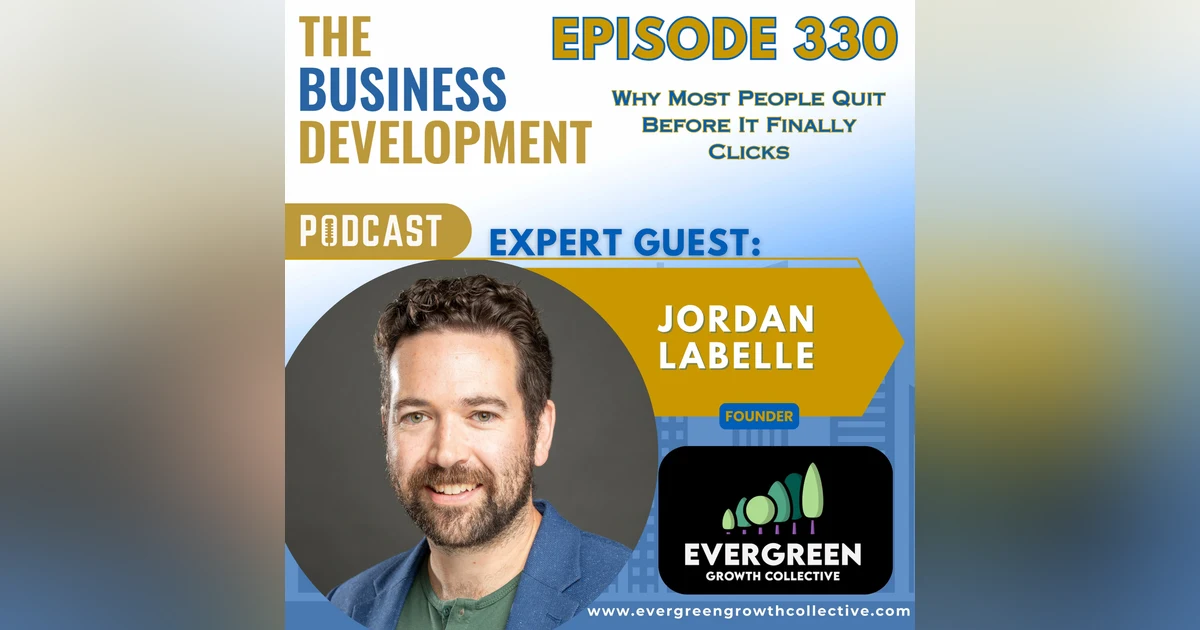
Why Most People Quit Before It Finally Clicks with Jordan Labelle


 Apple Podcasts
 Spotify
 Amazon Music
 RSS Feed
 In Episode 330 of The Business Development Podcast, Kelly Kennedy sits down with Jordan Labelle, entrepreneur, strategist, and founder of Evergreen Growth Collective, to break down what actually drives long-term success in business. Jordan shares his journey through corporate, startup, and solopreneur life, revealing how each step wasn’t failure, but refinement. Together, they challenge the traditional “hustle harder” mindset and unpack why most founders burn out trying to do everything instead of focusing on what truly matters.
This conversation dives deep into redefining failure, building a business around your strengths, and the importance of staying in the game long enough to reach clarity. Jordan explains why growth doesn’t come from doing more, but from doing the right things with the right people, and how the breakthrough most entrepreneurs are searching for only comes through iteration, awareness, and persistence. If you’ve ever questioned your path, your business model, or whether it’s all going to work, this episode will bring clarity, reassurance, and a powerful reminder to keep going.
Follow Jordan Labelle on LinkedIn: https://www.linkedin.com/in/jordan-labelle/
Check out Evergreen Growth Collective: https://www.evergreengrowthcollective.com/
Email Jordan Labelle: jordan@evergreengrowthcollective.com
Key Takeaways:
- Failure isn’t missing the result, it’s failing to learn and repeating the same mistakes.
- Every step in your journey is refinement, not failure, if you’re paying attention and adjusting.
- Most entrepreneurs burn out because they try to do everything instead of focusing on what actually matters.
- The breakthrough you’re looking for doesn’t come from planning, it comes from staying in the game long enough to find it.
- You should build your business around what you’re best at and what you enjoy, not what you think you “should” be doing.
- The things you’re best at are often invisible to you but obvious to everyone else, so ask for outside perspective.
- Growth isn’t always about scaling bigger, sometimes it’s about staying intentionally small and building smarter.
- Hiring should be based on trust, proactiveness, and willingness to learn, not just current skill level.
- You don’t need to solve every problem yourself, leveraging partners and specialists can create better outcomes with less effort.
- The people who succeed aren’t the smartest, they’re the ones who keep refining and don’t quit when things get hard.
The Business Development Podcast is Proudly supported by Hypervac Technologies, Hyperfab, Thunder Bay Hydraulics, and Atlas Elite Lifts. 🎸⭐
Hypervac Technologies is North America’s leader in hydrovac excavation, delivering safe, non-destructive solutions for critical infrastructure projects. If you’re in construction, utilities, or industrial services, check them out at www.hypervac.com
Hyperfab, the fabrication division of Hypervac, provides custom-built solutions designed to meet the toughest demands in the field. Learn more at www.hyperfab.ca
Thunder Bay Hydraulics has been a trusted name in hydraulic cylinder repair and manufacturing for over 55 years, supporting industries like mining, forestry, and construction across North America. Visit www.thunderbayhydraulics.com
Atlas Elite Lifts delivers premium automotive lift solutions built for performance, safety, and reliability. If you’re looking to upgrade your shop, check them out at www.atlaselitelifts.com
Join The Catalyst Club
If you’re serious about growth, leadership, and surrounding yourself with high-level thinkers, The Catalyst Club is where you need to be.
This is a private community for entrepreneurs, business leaders, and professionals who are committed to moving the needle every single week.
Join us here:
🌐 www.kellykennedyofficial.com/thecatalystclub
Mentioned in this episode:
Hyperfab Midroll
00:00 - Untitled
00:39 - Untitled
00:53 - Understanding Personal Strengths
05:03 - The Journey of an Entrepreneur: From Corporate to Startup
26:38 - Navigating the Challenges of Solopreneurship
34:54 - The Evolution of Business: Embracing Change
47:52 - The Journey of Growth and Learning
01:00:35 - Exploring the Evergreen Growth Collective
Why Most People Quit Before It Finally Clicks with Jordan Labelle
Jordan Labelle: What are the things that you are best at? And don't, don't just ask yourself, please ask the people who spent a lot of time with you because the thing you're best at is gonna be likely invisible to you. Super obvious to everybody else.
Intro: The Great Mark Cuban once said, business happens over years and years.
Value is measured in the total upside of a business relationship, not by how much you squeezed out in any one deal, and we couldn't agree more. This is the Business Development Podcast based in Edmonton, Alberta, Canada. In broadcasting to the world, you'll get expert business development advice, tips, and experiences, and you'll hear interviews with business owners, CEOs, and business development reps.
You'll get actionable advice on how to grow business,
brought to you by Capital Business Development CapitalBD.ca
Let's do it. Welcome to The Business Development Podcast, and now your expert host. Kelly Kennedy.
Kelly Kennedy: Hello. Welcome to episode 330 of the Business Development Podcast, and today it is my absolute pleasure to bring you Jordan Labelle.
Jordan is a seasoned entrepreneur, strategist, and the founder of Evergreen Growth Collective. A firm built to help service-based business owners gain clarity, momentum, and control with a career that spans leading product at a 400 person tech company raising over $30 million in investment and launching tools that drove more than 40 million in recurring revenue.
Jordan's experience is both deep and battle tested. He's been through the grind, corporate roles, startup chaos, and the lonely path of solo entrepreneurship, and came out with a clear mission to help others build better businesses with less overwhelm. Jordan didn't just learn to build businesses. He learned how to build resilient ones.
In a world that tells entrepreneurs to hustle harder and do it all alone, Jordan is rewriting the rules. He's showing a new generation of founders that growth doesn't come from doing more. It comes from doing what matters with the right people by your side. Jordan, it's an honor and a privilege to have you on the show today.
Jordan Labelle: Thank you. I like, did you write that or did I send that? That I'm gonna steal.
Kelly Kennedy: I wrote that.
Jordan Labelle: Okay, good. Yeah. Like I, I need to steal it afterwards. I think that's the, the most concise version I've heard in a long time. Thank you very kind words.
Kelly Kennedy: You're very welcome. Um, yeah, like I said, it's an honor and a privilege to have you here.
And, uh, yeah, I, I think every show. Has to start with a good intro, right? Absolutely. The intro sets the pace for the whole show. Yes. People forget that the intro is important.
Jordan Labelle: First and last. That's what we remember. The middle is we can do whatever we want now.
Kelly Kennedy: No, that's right. That's right. Now it's game.
It's now it's game on. We talked about it ahead of the show. This is two firsts for the business development podcast, which is actually pretty surprising at three 30 episodes.
Jordan Labelle: Yeah.
Kelly Kennedy: But you're our very first guest from, uh, Winnipeg, Manitoba, Canada, which is, uh, incredible. And you know, like you said, you're like, I hope I do a good service to, uh, to Manitoba.
I'm, I'm confident you will.
Jordan Labelle: Absolutely.
Kelly Kennedy: And you're also our very first collective, so we have two firsts on the show. Congratulations. Uh, yeah. Thank you. Yeah. Just the luck of the draw, I guess.
Jordan Labelle: Yeah. Uh, abso meant to be 330 with 2 firsts. Uh, loving all of it.
Kelly Kennedy: That's right. That's right. You've had a really varied and incredible career that has led you on, you know, this path to serial entrepreneurship at this point.
Jordan Labelle: Yep. Pretty much.
Kelly Kennedy: You're our very first collective, so I'm, I'm excited to maybe dive deep into what that means as well for our listeners today. Because I think, you know, people here at collectives, they kind of think of like maybe mental health things or things along those lines. This one's a little different.
Yeah. Mind you still helps your mental health.
Jordan Labelle: Absolutely.
Kelly Kennedy: Uh, but before we do that, Jordan, you know, take us back to the beginning man. How did you end up on this path? Were you always this entrepreneurial driven?
Jordan Labelle: It's funny. Looking back, I'm a big fan of measuring backwards instead of, you know, measuring strictly to goals.
Still have goals, we'll get to those on share. Uh, but backwards is so much fun 'cause you look at all the growth you've had.
Kelly Kennedy: Yeah.
Jordan Labelle: And, and really I can tie this back to a core memory from my childhood of my sister and i, I have a sister, lovely sister. We're like best friends now. We hang out all the time.
But I, I definitely, I was the older sibling and I took advantage of every once in a while. And, uh, my, my ethics have definitely evolved over time, but the entrepreneurial journey not, has really stayed strong. We, we used to play this game of setting up storefronts in our bedrooms. Yeah.
Kelly Kennedy: Yeah.
Jordan Labelle: Where we'd sell these, each other's stuff.
And, and I thought it was cool to like, find like, what would Alexandra my sister really, really love? Like put in my store?
Kelly Kennedy: Yeah.
Jordan Labelle: And I'd put that in my store and she had to spend her money on it. And then she would just put stuff in her store. She was younger and hadn't, wasn't as entrepreneurial thinking at that point.
She's now, yeah. Um, and so she just put out her stuff. So she'd end up buying bunch stuff from my store. I'd end up buying almost nothing from her store. And she, one, you're like, why do I have no money left afterwards? Um, so since then I did things like a, a college pro painting franchise at 18. Yeah. Which was like learning from the fire hose of like hiring, firing, learning how to paint, learning how to organize teams.
Quote, sell market, like,
Kelly Kennedy: wow.
Jordan Labelle: You name it, it was everything. Yeah. And you were, you were the franchisee for the summer. Um, and not really like lit the fire. I went to school for some, business I market, or majored in marketing and small business. So still on track.
Kelly Kennedy: Yep.
Jordan Labelle: Did a little detour through corporate life for a while because I'm like, I, let's just see what this is all about, figured out pretty quickly.
It's not for me. There are too many very sturdy boxes in place in corporate.
Kelly Kennedy: Yeah.
Jordan Labelle: Which great for some people, but not for me. It wa I was butting up against them all the time. It wasn't fun for anybody. So then I wanted to startup at bold and figured out, okay, this is a lot closer to what I want.
Kelly Kennedy: Yeah.
Jordan Labelle: Came in and employee 28, knew the founders got in early, started helping kind of shape a little bit of the business. Ended up in the product management leadership role. So, uh, the executive seat for product management and got to see like, it's a really great seat to sit at because you get to see the entire business and.
Give your thoughts and opinions on how we can shape success, but you don't have enough responsibility to like really be the one, like you get a vote, but you don't have a big team or a big budget. Okay. So you're not empire building, you're not trying to, like there's the politics you don't really play in.
You just get to be the, the advisor.
Kelly Kennedy: Yeah.
Jordan Labelle: Which turns out I'm pretty good at. So it was a good, like, that was a good career step to really lock in where my strengths are.
Kelly Kennedy: Yeah.
Jordan Labelle: And it also helped me see that I love startups early when I was there, when they were small, like to a hundred absolutely loved it.
Like job of my dreams. So many fond memories and good friends and network from those days. And as we grew and got the investments and, and really hit those, uh, money and, and headcount milestones, it's just hard to keep that kind of culture at 200, 300, 400.
Kelly Kennedy: Yes.
Jordan Labelle: And that's not a knock against anybody there.
I have so many. It's just hard. Friends still there, love the company. They're doing great things, but I just realized that wasn't for me. Yeah. The 400, the big company wasn't for me either. So when I started this now journey, it's really like these founders in these early stages, like one to 20 where they're taking what they're great at, figuring it out and building the right team around them that is like, I could live there for the rest of my life and be a very happy person.
Kelly Kennedy: Yes.
Jordan Labelle: And that's kind of the journey from, from start to finish.
Kelly Kennedy: Amazing. Amazing. And um, the thing I really love about you, Jordan, is that you don't get too many people that have spent time in all the worlds, right? Like, I don't get a lot of people through this show who've spent time, you know, who grew up in a corporate environment, transitioned over to like a startup, fast paced tech environment, and then went off to do their own thing in entrepreneurship.
And so one of the questions that I have for you is maybe could you spend some time in each of them and maybe let me know how the time in each helped you succeed in your own business?
Jordan Labelle: No, that's a great question and I love that you're asking it because even when they weren't fits. I'm, I have a, an outlook on failure of, like, failure is not following through on what you said you were gonna do.
It's not, not getting the results you thought you were gonna get. So when you take a job and it doesn't work out, it's not a failure. You learned that something about that job wasn't right for you. And so if you get another job exactly like it afterwards, then yeah, you kind of failed. Like,
Kelly Kennedy: yeah,
Jordan Labelle: you're not learning anything, but if you shape your next stop every time and take those learnings with you, I think that was what really got me here was that, yeah, each stop was a bit of like a refinement.
I'm like, not quite this. And it got sharper and sharper and sharper as time went on. So
Kelly Kennedy: I, I love that. I love Take us through it. Take us through it.
Jordan Labelle: Yeah. Yeah, yeah. So early days, like pre I was gonna be an engineer, like a, a mechanical engineer. I loved physics, I love chemistry, I love numbers.
Kelly Kennedy: Yeah.
Jordan Labelle: And I'm like, okay. I, I, I must be an engineer though. I like numbers. I must be an engineer. I went school for engineering. I'm like, holy, I do not like this at all. Cool. But I still like numbers.
Kelly Kennedy: I thought I did. Clearly maybe not.
Jordan Labelle: Yeah. Yeah. I have a friend who's an engineer and I'm like, I see the work that he does, and I'm like, I appreciate the work you do, and I'm somewhat interested in parts of it, but the whole thing, like, heck no.
Then I went in, okay, I still like numbers. What do I do next? Accounting. Did an accounting work term. Luckily as in a co-op program, I did accounting work term and like, not for me, not
Kelly Kennedy: that. Wasn't it either?
Jordan Labelle: Nope, that wasn't it either. So I'm like, okay, thank goodness. I spent four months doing accounting and not, you know, four years getting an a, a designation just to realize I didn't like it.
So check again. Like thank goodness I did that. Went back. And at that point I kind of like scratched my head. I'm like, I like numbers a lot. I like analyzing stuff. I like digging into problems. I like understanding. I'm not seeing it. And so I took marketing, I took small business. I went and got a couple of marketing analyst jobs, but I was always like the, not the pr like.
Media marketing more of like the analytical, like customer driven marketing. And so that threw my, my stops in in corporate was like, you know, a marketing analyst and then a program analyst, and then for hydros, our local electrical company, trying to build programs for customers and trying to figure out like what would they want to have from the electrical company.
But then I ran up against so many, restrictions and the way we do things, and there wasn't enough freedom of innovation there.
Kelly Kennedy: Yeah.
Jordan Labelle: I'm like, okay, I think I'm onto something here, but what about startup? More freedom, less, less red tape, less boxes, uh, went there and that, that really started clicking.
I'm like, okay, I'm obsessed about the customers and the clients and their success. And now I found a job where I can, my, my primary role is to find out what they want and then help us build what they need and bridge those two things together so they actually use it.
Kelly Kennedy: Yeah.
Jordan Labelle: I'm like, okay, love this. And then when we grew too big, I'm like, don't love this.
Mm-hmm. So now I refine that. I'm like, okay. I like the startup feel, but not at scale. So I'm a, I'm an early stage guy.
Kelly Kennedy: Yeah.
Jordan Labelle: And now when I built this company, I'm like, okay, great. I, I have all of this learning from that entire of what not to do, what I don't want this to be, so that now I know I want like max 10 employees in this business.
This is not gonna be a big scale business. This is gonna be like a relationship business where the next 30 years we're gonna be working with like a roster of clients that are meaningful to us, that we want to be part of their success. And I just know they're gonna be in that one to 20 stage. That's when we're gonna help the most.
And if they graduate and we stop working with them and they go on to big scale, fantastic. We'll find the people to help them. But we just know that's not us at this point. Yeah. Yeah. And that's only because I've gone through and like made sure, so I'm, I'm not wondering anymore of like, would I like to have a 100 person company?
It's like, I already know. I would not like to have that. So now I'm not, my, my focus is much more laser focused on like, I know what I wanna be, I know what I want this business to be. I know who I want to help. Now I can just speak their language over and over and over again. So it's really been a refinement process the whole time.
Kelly Kennedy: It's not the first time that I've heard that once, you know, once the head count gets passed a certain level, it changes everything. Yep. But not many people go deep into what happens. And I would love for maybe you to explain you know, what happens when you get past that 20, 30 person headcount that that flips it on its head, where now it's no fun to work with.
Jordan Labelle: I'm gonna throw in a timely now, and who knows if it's timely when this episode goes live, but I'll ask it with that. I like to think of it as take your Chat GPT today where you, but you can load up contextual information for it in a project or in a, in a type of interaction. And you say, when I'm interacting with you here, I want you to consider all of these things and still pull on other stuff.
But like, primarily consider the stuff that I've fed you now when you're a small company. All that information that needs to be in that project is sitting across the table from you or like you see every week, or that you're, you're interacting in some way very often with this small group of people.
Kelly Kennedy: Yeah.
Jordan Labelle: As that group gets bigger, people forget to put information in because they haven't seen you in a while. People make a decision, but don't realize that that's not common knowledge yet. And like more stuff just starts happening and it doesn't all make it back to the brain like the company. And so you end up having, unless you're really intentional about it, a lot of decisions and insights and innovation and culture and relationship norms being developed that you don't necessarily know about anymore.
And so at a hundred, 200, 300, 400, all those, all the way up, it's hard to make it one company.
Kelly Kennedy: Mm-hmm.
Jordan Labelle: And so you have to have really strong systems to make it easy for those things to make it back to the master brain as often as possible. So the company can be working on, full information as often as possible.
So when it's small, really easy to work on full information and, and move quickly when it's large. If the systems aren't there to support it, you'll just slowly die from like operational drag of there's too many good things happening but not connected.
Kelly Kennedy: Yeah.
Jordan Labelle: That it just feels like, progress in too many different directions at the same time and it's not consolidated in like a focused direction forward.
Does that make sense?
Kelly Kennedy: It really does. It really does. You know, I've always worked in fairly small organizations. I've done business development consulting on behalf of large organizations and spent a lot of time in it, but kind of in my own, like you said, my own little zone, right? Like, yeah, I fed things to the president and fairly mud, mostly that was that, right?
Jordan Labelle: Yeah.
Kelly Kennedy: So I kind of have seen it on both sides. And I guess what I saw was essentially when you work with the big organizations, even when you have good ideas, even when they agree with it. Implementing those ideas across a large organization is hard, if not impossible, nine times outta 10. And when you work with small organizations, you can say, Hey, I think you guys should do this.
And they can snap their fingers and say, great. We do that immediately. Right, exactly. Like the efficiency and speed, which a small organization can make change or, you know, turn on a dime is pretty incredible. I always say that that is the biggest advantage I think that small organizations have.
Jordan Labelle: And you know what I think it is, is that when you're small, you know everyone well enough to know how they work, what they want, what motivates them, drives them, challenges them, keeps them engaged.
Like if you have 10, 10 people who work with you, you have a good enough relationship with each of them to know if you are gonna roll something out for them. This is the way they need to receive that information. But at a hundred people, you need to have hired managers who can have that same level of empathy and understanding of somebody else.
And you need to do that scale. So you need to have every manager at that level of understanding their people like intricately of like what, what motivates them? Like how do they need to hear information? What's their work style? Yeah. How do they receive information? How do they process? Are they visual?
Are they reading? Are they demo? Are they hands-on? Like, and so at 10 people, it's easy to say, we're making this change and here's what it's gonna look like for each individual, one of you. And at 200 it, it's hard because no one takes the time to, it's hard to find enough managers to take that much time to know their people that well consistently.
Yeah. As I think the real breakdown is, and especially as we hurdle towards a more automated and AI future, like the people interactions are, what I'm most interested in in optimizing for is like, how do I get the best engagement at the people interaction points of the business, both internal and external.
So I think that's what's gonna make or break businesses over the next five years because the doing is gonna get so much easier. It's the people that's gonna remain. People are hired, people are, behavior change is difficult, and doing it well is gonna be what separates the great from the average.
Kelly Kennedy: You've worked with a lot of organizations, Jordan, of all different sizes, and one of the questions that I maybe have for you, because we have a lot of entrepreneurs listening right now who maybe have fairly small businesses at the moment, but yes.
Have the potential to grow to 20, 30, 50, a hundred people. Heck, maybe in this next year. Yeah. Is there maybe a size of company at which they should just ask themselves? Maybe this is good, maybe this is the best version. Maybe 200 people isn't the best version of my company, even though it sounds great from a revenue standpoint.
Yeah, but maybe it's 50, maybe it's 20. Yeah. Maybe it's just you, Mr. And Mrs. Solopreneur with a team of great, uh, great consultants AR and contractors around you. I would love your take on that.
Jordan Labelle: Again, it's a great question, and I think it's, it comes down to setting your own goals versus what you think your goals should be.
So I think so many entrepreneurs think that because we celebrate the billion dollar unicorns and these big exits and these giant companies on this massive success of like, some, nobody from Winnipeg, Manitoba grew this company to a thousand people and exited, and there's all this fanfare and like, so then they think, well, that, that must be what success is.
So I have to do that.
Kelly Kennedy: Yeah.
Jordan Labelle: And instead I think the the answer is, it depends, which is a cop out, but I'll give you the, the how to figure it out is you've gotta sit down with yourself. Like, I carry this paper notebook around with me for the last decade. I've just, it's in my pocket, it's my wallet, it's in my everything.
Kelly Kennedy: Yeah.
Jordan Labelle: And when I get spare minutes, I, I ask myself some questions and I really think about them of like, in a year from now, in five years from now, what does my life look like? Like I'm about to go into summer, we have a trailer out at the lake that we love. Gonna, if I want to go four weeks this summer, then maybe I can do a bit of work.
But I can't take crazy amounts of work that summer. So I have to build a business that'll operate. With me taking four weeks off in the summer. Okay, what does that look like? Who do I need, what needs to run without me? And then I can ask the questions of like, how many people do I think I need to do that?
And what level of income and revenue would be meaningful to me as success for myself? That I feel like I could, I could say that is successful for me. I can do all the things that I wanna accomplish in life now I can provide for the people that I wanna provide for, including my employees. And I feel like this is where I would like to be.
That is your answer for me, it's, one to 30 I think is a sweet spot for someone who really wants to keep a relationship with everybody in the business.
Kelly Kennedy: Yeah.
Jordan Labelle: For some people it's gonna be scale because they wanna build these systems and these people and all of this organizational that, that motivates them.
So for them, great. Do it. If you wanna have a relationship with each individual person, stay small. And if you really want to grow your revenue, think outside the box. You might have the perfect size company of 25 people.
Kelly Kennedy: Yeah.
Jordan Labelle: Instead of ruining it and going to 50 or a hundred, ask what business could I start that would benefit from this business?
Kelly Kennedy: Yeah.
Jordan Labelle: So I, I work with someone or I have a partner who we work with a lot who does social media management and she is at about 25 people right now, I think. And she's asking the very smart question of like, do I want a hundred person social media agency?
Kelly Kennedy: Mm-hmm.
Jordan Labelle: Or do I wanna create another company that I'm really passionate about?
That really great social media would make blow up. So like home cleaning.
Kelly Kennedy: Yeah.
Jordan Labelle: How many home cleaning services struggle with their social media? But if her social media agency now just did the social media for this new cleaning company, you could probably build a 25 person cleaning company that makes a ton of money.
Kelly Kennedy: Yes. Yeah.
Jordan Labelle: So it like, you don't need to build one company all the way up. If you wanna scale, you can scale this way too. And you can do it where you're not splitting focus, but you need to build it intentionally is really what it comes down to.
Kelly Kennedy: Yes. Yes. Well, not to mention, and there's a lot of different models your company can take on, which will increase your revenue with less time that a lot of people don't really think about either, right?
It's not just a time up, money up. You can actually reduce your time and increase your prices. And work less and make more money. Like people forget that too. There's, there's other aspects and you know, you talk about iteration, what you've been talking about is that everything we learned down the line, you can iterate on that literally did a show last week on iteration.
So it's funny that, yeah. This is the conversation we're having today.
Jordan Labelle: It's a, it's a,
Kelly Kennedy: but what, what I talked about was my journey with capital and how capital originally started off that solopreneur company. I was basically just doing contract business development, was doing it the same way that I understood from being an employee, which was an hourly charge.
Yeah. Over time realized that didn't really work. I wasn't, I was too expensive, I wasn't making enough money. 'cause people don't think about that when you go off on your own.
Jordan Labelle: No.
Kelly Kennedy: You have a lot more expenses that you didn't think about as an employee. Right. Heck, your vehicle charges, your insurance charges, your programs, your software, your accounting.
You have more bills than you've ever had in your life. And many people don't factor that in from the very beginning. Absolutely. So they're undercharging. They end up in trouble in that very first year.
Jordan Labelle: Yes. Yes. And I think you're, you're touching on a really interesting point. It's like broadening your scope a little bit or broadening your awareness, honestly, like even when it comes to making more money with less time, so many people think like, another great example is another friend I have works at a decking company.
They build decks. They're one of the best deck companies here in Winnipeg. They're really well known, known for their they can design anything you have in your dreams. They can build it.
Kelly Kennedy: Yeah.
Jordan Labelle: Now they were crushing it at that business, but they wanted to grow and instead of doing more decks, they started doing docks and fences and any wood structure.
And it turned a really profitable, streamlined business into chaos because now they were doing too many different things and they were spending more time because they weren't as good at building those things as they were at building decks.
Kelly Kennedy: Yeah.
Jordan Labelle: They had less happy employees because they were struggling to hit.
Their timelines 'cause they were kind of learning a little bit on the job.
Kelly Kennedy: Yeah. They're learning on the job
Jordan Labelle: and, and instead I'm like, I think people forget, like if you take a step back and you say, okay, we're really good at this thing. What's the scope of problems that people that are contacting us likely have?
Kelly Kennedy: Yeah.
Jordan Labelle: They may have other things that need to get done in that are related somewhat to a deck. What if, because we're so good at finding people who need decks, we also just got really good at finding like, what else do you need done or are planning to do in the next year? And then we partnered up with other companies who do that thing really well and we say, Hey.
Kelly Kennedy: Mm-hmm.
Jordan Labelle: We'll send you leads. They're hot, they work with us. We know they're good clients. They get 20% easy. Right? And what doc company or fencing companies not gonna be willing to pay 10, 20%. Not to meta scrap your advertising budget, not scrap it, but like, would you rather spend 500 bucks and give it to meta or 500 bucks and give it to a person that you know in your city who's gonna be sending you leads all the time.
Kelly Kennedy: Yeah.
Jordan Labelle: And then it's absolutely, it's zero effort for the decking company. Yeah.
Like they just send an email and they make 10, 20% off of the, the fence or the dock. So I think it's just broadening that It seems like expenses, like what else is all what's part of this entire problem that I need to solve, and what parts of it do I wanna solve, and what parts am I happy someone else solving?
Kelly Kennedy: I absolutely love that. And, and it really does lead us into kind of where we're going. So I'm, I'm pumped to get there, but before we do, I wanna speak to our solo printers, man. Yeah. We have a, like me and you have both been solo printer. I've had employees. I've let go of my employees because honestly, yeah, by the time I kind of figured it out.
It was, they were my greatest expense by a lot. By a lot. Yeah. The sheer monthly revenue I had to keep up consistently all the time when I had employees was just like, oh my gosh. Right?
Jordan Labelle: Yeah.
Kelly Kennedy: Right. Like it starts to become like painful because we don't really think about that. But like, you know, most employees, even if you're lucky, they're probably making you 20% over and above what you're paying them.
But you have to pay them all the time whether you have contracts or not. And so, like I was finding that like, while we had lots of contracts, when we didn't have contracts, it kind of negated all of that value. For me that was a business model problem. I'm gonna talk, I'll say that right now, that was on me.
Uh, now that I look back, I would do it differently and find another way. But I think a lot of people find themselves in that position. But asking for help. It's really hard. And when you kind of get to that solopreneur stage, be like, okay, I've had employees. It was hard, it didn't work out. I'm gonna try to continue to internalize all of this, and don't get me wrong, right?
I'm incredible at internalizing things, but I've also realized I need to get help. And so what I've found for me is that hiring consultants and contractors to help me with some of that outsourced work has been a better option for me than employees. But I would love to talk about it because you have a heavy focus on solopreneurs and the, the challenges of solopreneurs.
Can we speak to that? Because they're afraid to ask for help. They're, they don't know what to do. Talk to me, what, let's talk to our solopreneurs. How can we help them?
Jordan Labelle: And Yeah, if you're a solopreneur out there, it's a lonely journey. That's the number one thing. Scrap everything else. If you are building a business on your own, no co-founder, no partners, you are the owner.
Even if you have a team, it is a lonely journey because you have, your team can't help you make decisions at a, at a owning the company level. You can't be, unfortunately one, truly 100% transparent with them on the reality of the business. You wanna be as transparent as you can with them because the right employee, and that's part of this, hiring the right employees will appreciate the transparency more than they'll be scared of it.
Kelly Kennedy: Yeah.
Jordan Labelle: But you still can never be a hundred, like truly 100% vulnerable and transparent with your employees because at some level they're still counting on you for stability, for the confidence that, things will get figured out.
Kelly Kennedy: That's right. They have to have the faith that you, you know, enough to keep everything stable.
The moment that they think you don't got it figured out, they're gonna leave or, or they're totally, they're gonna check out, even if they're not checked out from the job, they're gonna check out mentally.
Jordan Labelle: Totally. And so I think what I've really learned is like, I think hiring an employee is a very like.
You need to do it very intentionally. It is not just whip a job description up, throw on the internet, see who applies and hire them. I think that's the, the path to a lot of pain and suffering for everybody involved for them. And you. I think what I would say is like if you are going to hire like full-time hire yourself person 40 hours in your business, they're now an employee.
You, you have to take care of them. They're like, not family, but like whatever the next level is for you.
Kelly Kennedy: That's right.
Jordan Labelle: Right.
Kelly Kennedy: That's right.
Jordan Labelle: You gotta
Kelly Kennedy: think of them like that. They basically become family. Especially the small business.
Jordan Labelle: Exactly. Yeah. So if you're gonna hire them, I would hire for trust, I would hire for proactiveness, and I would hire for willingness to learn.
And those are the only three things that I would really care about. If you're gonna hire someone permanently.
Kelly Kennedy: Yeah.
Jordan Labelle: Because you don't need their current set of skills. You need their ability to adapt to whatever comes your way.
Kelly Kennedy: Yeah.
Jordan Labelle: And you need the trust that when they get stuck, they'll tell you and you need the proactiveness that they're going to figure out on their own as much as they can and only come to you when they're truly stuck.
So,
Kelly Kennedy: well, not to mention, things are about to change, right? Like, yes. Even at, even at the release of this show, things can be almost completely different, right? Ai, AI is doubling in power every six months. Yeah, I think I agree with you completely. I think the ability to learn and the willingness to learn is gonna be almost more important than the technical skills showing up to the job.
Jordan Labelle: I, I, whatever this is gonna be a year from now, I guess this will be a good, let's see how good I'm at forecasting. I honestly don't think existing skill is gonna matter a whole lot in the near future. Like your current level of skill, it'll matter a little bit more on the consulting fractional contract than you are bringing in for skill, right?
Like, yeah, I need you to be really good at this thing and I don't need you to be around all the time. I just need you to be really good at this thing when we need it. But hiring, I think is, I'm not gonna care. I want you to show me. I can trust you. You'll learn what you need to learn. Learn, and you'll be proactive in doing it.
And if you can't, you just let me know and I'll help you unblocked you.
Kelly Kennedy: Yeah.
Jordan Labelle: That's gonna be what I'm gonna hire for exclusively. I think in the, honestly, even now, like, yeah, that is really a heavily weight towards these three things. I do wanna see some skill that you do know what you're talking about and you've, you've spent some time with these things, but with how fast it's getting better, it, it really almost doesn't matter as long as you're willing to figure it out.
Kelly Kennedy: Yeah. Yeah.
Jordan Labelle: And I, I think just to answer the, the original actual question for the solopreneurs out there. So when you are hiring, take that level of care and detail and intentionality on like who you bring in. But then don't be scared to bring in contractors, fractional people, consultants for the, the bits that you're not strong in.
Yeah. So like, instead of you struggling through doing your books, just get a bookkeeper. If you need someone and you wanna develop a, a new piece of software, get a contract in to, to come develop it with you. If you need like something that you don't already know how to do, start small and then decide if you need the employee or not.
Kelly Kennedy: Mm-hmm. '
Jordan Labelle: cause I think people, lot of people jump to like, well, I need this thing solved, I gotta hire. And there is so many other options out there that aren't hiring these days that you should baby steps, see if you like it, see if it works. If it does work and they're loving working with you, you'll get an employee.
Employee eventually.
Kelly Kennedy: Yeah.
Jordan Labelle: And if it doesn't, you have no, they're not waiting for their paycheck. They're not like expecting anything from you. They know they can get cut off tomorrow and that's just the way it works.
Kelly Kennedy: Yeah. Yeah. I, uh, I agree with you completely. Um, I. Probably the most expensive expense that you will ever have will be employees.
If you start to go down that path, it'll be more expensive than the software. It'll be more expensive than all the consultants and contractors you hire. And it will be consistent because yes, you have to show up every two weeks, but that paycheck in hand, whether you have business or not. I agree with you completely.
You have to, you have to make that decision with clarity. You have to make it with responsibility. And knowing that like, okay, from this point forward, I'm gonna have a pretty significant monthly expense. Um, yeah. And I think that's what holds a lot of Solopreneurs back in general, just from making any decision, right?
Is that we know that solo entrepreneurship, it's tight. It's tight a lot of the time, right? Like people think everyone's up just killing it, making as much, but they're not right. Most of them are just getting by. So money's a huge concern. And because money's a huge concern, solopreneurs take on everything.
Everything. Yes. Right? Yes. And I'll vouch for that. I've been there, done that.
Jordan Labelle: Same,
Kelly Kennedy: but it does hit a point. Knowing and
Jordan Labelle: doing are two different things.
Kelly Kennedy: That's right. But it does hit a point where it's like, holy shit. Like I am working all the time. This is unsustainable. Talk to me. What do, what do you like talk to those people who are hitting that unsustainable moment?
What do they do?
Jordan Labelle: Yeah I think you've really gotta come to terms with what I filter things through too. Two and a half mental models of like, one, what are the things that you are best at best? And don't, don't just ask yourself, please ask the people who spent a lot of time with you because the thing you're best at is gonna be likely invisible to you and super obvious to everybody else.
You might have some indication, so like, don't trust your own instincts too, but like, don't, don't solely trust your instincts because you might think this thing that like, oh, I'm just good at it. Uh, there's the, uh, Kruger Dunning effect. I've just been hearing it over and over the last like two weeks.
It's the reverse of that. So Kruger Dunning's, like, you think you're better than you are and you make really poor judgments because of it.
Kelly Kennedy: Yeah.
Jordan Labelle: This is the opposite. You don't realize how good you are because you're just so used to being good at it. Mm-hmm. That you compare yourself to like the next level up, which might be like world class.
And so for everybody else, you're like 90% of the way ahead of them, but you still see yourself as behind. And so find out that thing that you're like 90, 80, whatever percent, like the thing that you just crush it at every single time. Then so you, you make your list of that. Then the secret is you make your list of like.
What brings you the most joy in doing? What do you wake up excited to do?
Kelly Kennedy: Yeah.
Jordan Labelle: And you find the thing that's like, you know, weight them however you wanna weight them, but like what thing, what, what grouping of things are at the top of these two lists together? And that if you can build your business around you doing that 80% of the time, that is the target you're aiming for.
And the stuff at the bottom of these lists, that's where you start getting off your plate. If you're not good at it and you don't enjoy doing it, like you can't, the best thing you can do is not do that thing.
Kelly Kennedy: Yeah.
Jordan Labelle: Even if it's a, like if it's not mission critical, if it'd be really great if you did it, but it's not gonna destroy the business if you don't.
I'd even advocate for just don't do it, period.
Kelly Kennedy: Mm. Mm-hmm.
Jordan Labelle: You're probably better off not wasting your time doing something so low on both those scales, even if it like somewhat hurts the business because you can reinvest that time at a higher leverage thing that's higher up your list.
Kelly Kennedy: It really comes down to like to doing some deep soul searching into, into yourself and into your business.
And a lot of people don't do that. They won't sit down and say, okay, like what's working? What's not working? What do I like doing? What do I not like doing? What services don't make sense anymore versus the services that do make sense? Like iteration is absolutely everything. You know, let's go back to my story with Capital.
Started out in the beginning with Capital was doing the, the consulting services was basically just charging an hourly rate. Realized pretty early on, holy shit, I'm charging way too little. And over time had to kind of figure that out. Yeah. And then it kind of hit a point where it's like, okay, I'm making the right amount of money, but now this service is really expensive.
It only really helps people while I'm working with them. The moment my contract is up, the service ends, they can't continue it, they don't have the power. I wouldn't have been in there in the first place. So it wasn't really super beneficial. And then on top of that, I could only help like two or three people at a time because it was taking all my time.
From there we went to retainer services, which included a lot of training and helping people on their team so that there was somebody when I left to actually take over that service that was better. Still expensive, still took too much time, and eventually that's kind of pivoted now to where capital is very much like a coaching and training company.
We teach teams to actually do the, the business development work so that I can essentially walk away, feel good about it, and they can continue making money. It's a, it's a win-win, but the company is constantly evolving and changing and I don't think it'll ever stop. I think we'll always be looking for what is the better way to do this?
How do we iterate on our services, on our products to make sure that they are the best value possible? And don't feel bad if the company you started with is completely different than the company you're operating five years later. Yeah, that is completely normal and to be expected, and I imagine is the same for you.
Jordan Labelle: Totally. And it's to think that they wouldn't be right, that it would stay static the entire time. I think you can pretty like easily logically debunk that that would be what it should do. Right? Like how many companies do you see that really are the same company now that they were five years ago? Like very few.
Some, yes, very few.
But even you could argue a lot of them go through some form of change and that's okay to change. I think that's the, I, you mentioned it of like building a business. When you start, you think it's about building a business. You think it's about hiring people and finding clients and making revenue and paying bills and all this kind of stuff.
But I'll tell, someone told me this advice early and I, I, I don't even remember who it was and I feel so bad that I don't, but they said building a business is way more about building yourself than it's about building anything else. Love it. And you'll go through so many stages of feeling like you'll, you'll make a breakthrough and you'll be like, how was I such an idiot?
Like, how did I not. Realize this a year ago. Like, but then like only to a week later make another breakthrough and be like, what is wrong with me? Like, how is it two weeks in a row that I'm making these major realizations that like
Kelly Kennedy: Yeah.
Jordan Labelle: Are obvious in hindsight. Yeah.
Kelly Kennedy: Oh my gosh.
Jordan Labelle: And I tell people, it's like you have to be a open to those things happening.
Kelly Kennedy: Mm-hmm.
Jordan Labelle: B know what they're coming and you're gonna feel dumb a lot of the time. And that's not a bad thing. Yeah.
Kelly Kennedy: Yeah.
Jordan Labelle: But just be willing to embrace it when it happens and do that, that, that constant asking of like, what do I need? What is the business lead? What am I missing? What am I not picking up on?
And the more aware you become of those things, the more you'll pick up on like, oh, I'm trying to offer this service that I actually don't wanna deliver.
Kelly Kennedy: Yeah.
Jordan Labelle: Like, so yes, I can make money doing this, but like I don't wanna do it, so why am I offering
Kelly Kennedy: it? I love where you're going with this, and I wanna spend some time here because I've struggled with this.
I've, I've I many car rides I'll be riding and I'll look at Shelby, uh, my fiance and I'll just say, Hey what am I missing right now? Yeah. Like, there's something I'm missing. I don't know what it is. It's gonna change everything, but there's something I could be doing right now. I don't know it, it'll come to me, but when it does, it'll be just be like mind blown.
Like, why wasn't I doing this forever? Right? Yes. And the funny thing is, when you start that process, when you come to the conclusion that there's something that you're missing that's gonna change everything for you. It's coming. I always say like, that's when you know the big thing is coming because you're thinking about it.
You're then open to it and don't be surprised if it takes a month, two months.
Jordan Labelle: Yes.
Kelly Kennedy: Three months, six months for that big thing to show up. But it is coming man. It was funny 'cause like we're in the middle of a pretty big tectonic shift right now and I like, I feel like I had that conversation in the middle of winter saying, I don't know what the thing is that we're gonna do next, but I know, like, I know it's gonna be big and I know it's coming.
And so we're kind of in the middle of that shift right now. We're building a program called Capital Catalyst, which will be very much released by the time this comes out. And we're really excited about it. But, um, it's a, it's a very different service than what we've done in the past, but it'll have way more benefit to companies over time.
And I just couldn't quite see it. And actually, I was doing a poll on LinkedIn. Yeah. And, uh, one of my past guests came on and said, Kelly, we're doing this with, with a consultant. It's really incredible for our business. Have you thought about it? It's like, holy shit. That's the thing. That's the thing. We've been think exactly right.
But I didn't know where it was coming from. I just knew that I was gonna be open to whatever that next big thing is. And I know that I'm not going to think of it like it's something that I, I need brought to my attention. You know what I mean?
Jordan Labelle: Totally. So the, I I was writing down some notes here because I, this again, what I do you need to let that background process, so your whole point of like, like taking the time to sit down with it and really sit with it, like 30 minutes, just like.
Let's just write down whatever comes to mind. There's no goal of the sitting down.
Kelly Kennedy: Yeah.
Jordan Labelle: The the goal is that you've spent time thinking about this thing. And then when you're taking a shower, when you're sleeping, when you're going for a walk, when you're talking to a friend at coffee, it's gonna be in there and it's gonna be paying it more attention to things that might help you solve this problem.
Kelly Kennedy: You're like aware. You're aware. You're looking for it.
Jordan Labelle: So have you ever heard of like, you know, you look to go buy a car, all of a sudden you start seeing that car everywhere, right? Yes. You wanna buy the yellow Volkswagen, you start seeing yellow Volkswagens everywhere. That's right. Never seen a yellow Volkswagen before in your life, but now that you're considering buying one
Kelly Kennedy: Yes.
Jordan Labelle: Everyone drives one.
Kelly Kennedy: That's right.
Jordan Labelle: It's the same concept of like, um, and it's funny, I was talking to my sister about like all these sayings that we've been told for our entire lives, I don't think we've spent the time to sit with them either to think of like what they could actually mean. We take them at their like surface level meaning, but asking you shall receive has been on my, my mind for the last six months now.
Kelly Kennedy: Yeah.
Jordan Labelle: And I think most people think like, oh, it's like, ask for something, you'll get it. And it's like, well, no. Ask questions about the thing you want and you'll be more aware of things that might help you solve that. And eventually you will find the answer you're looking for, you shall receive. And part of that is also asking like others, what do you need, Kelly?
Because like maybe there's something you need that I can provide you that costs me nothing
Kelly Kennedy: that's right.
Jordan Labelle: And is a game changer for you. And then in return I will probably get some benefit from that that will help me as well. So by asking you what you need, I shall also receive.
Kelly Kennedy: Yeah.
Jordan Labelle: And it's these, these concepts of like, if you just sit with things for a while, you'll just become more aware of them when you see them out in the wild.
And that background processing will really unlock those big breakthroughs for you. But you gotta be willing to sit in uncomfortableness and with the not leaving with an answer. Yeah. Like you write down for 30 minutes, you walk away, you still have a problem. You gotta be okay with that.
Kelly Kennedy: Yeah, no, it's, um, iteration is a hundred percent part of the process.
Your company will change. It'll change for the better, and you won't necessarily see the next big thing coming. I always, kinda always say too that like the best things that have happened to me in business, this podcast, you know, the coaching, the consulting, uh, the advertising dude, none of those things were on the game plan.
When I started Capital Business Development. They became available and I took action on them, and now they're a thing. Now they're pretty much the whole business. Right. But I couldn't have called that, you know, back in 20 20, 20 20 when I launched the company. It just wasn't even on the table. I just knew I had a valuable service.
I could offer the world. Yes. And I took that first step.
Jordan Labelle: I, I love that so much because I think a lot of solo founders, especially because we can get in our own heads real bad.
Kelly Kennedy: Yeah.
Jordan Labelle: See, like the thing I tried didn't work. That must mean it's a failure and I'm a failure. I, I think like, and I like, so I should stop it.
I should stop this. I should go back to the job that I know I hate, but at least I know what that is.
Kelly Kennedy: Yeah.
Jordan Labelle: And I, all, I want, so this is like to your audience, like if you are listening and this is you, and you're in your own head right now and thinking like, maybe I'm just not cut out for entrepreneurship.
Maybe this business was a bad idea. Maybe this is the worst thing I've ever done. And you know that the alternative already sucks. So you already know, like corporate's not for you, career's, not for you. You, you think this is for you. You're just not getting success. You want stay in the game.
Kelly Kennedy: Mm-hmm.
Jordan Labelle: Just don't die.
Yeah. That's the number one piece of advice I can give you is like, find ways to just survive a little longer. 'cause the longer you're in the game, the more opportunities you get to see. The more at bats, the more reps, the more whatever you wanna call it, you get. And if you are good at stacking your learnings, every one of those misses should be teaching you something that didn't work.
And if you can just stay in the game long enough, it might take a year, it might take two, it might take three. And they're not gonna be comfortable. If you can stay in the game, you'll find the thing that finally you get that breakthrough of like, this is the thing I need to offer. These are the people who need it desperately.
And now it's just like, it'll feel like magic. Yes. But it can't happen. It doesn't happen through planning. It doesn't happen through like writing a big business plan. It happens from being in the game. Doing it.
Kelly Kennedy: Yeah.
Jordan Labelle: And finding out, like when I talk, when I give this pitch to a client and I see this face like, okay, that's not it.
Kelly Kennedy: That's
Jordan Labelle: not the one got that pitch no good. But when I see like leaning in, I'm like, yeah, yeah, yeah, yeah, yeah. That's what I need right there. Yeah. Okay, cool. We're onto something now. Can I deliver it? Now I got a whole new like, but that's what you see in the game for is like you'll get those insights and you'll continue to tweak and refine and iterate until you eventually end up with the thing you're supposed to have.
Kelly Kennedy: Yeah.
Jordan Labelle: So stay in the game. Don't die. Just keep going.
Kelly Kennedy: I'm, I'm gonna, I'm gonna flip this back to actually podcasting because I think this is a great analogy for podcasting. Most podcasts quit before episode 20. I think the statistic is something like, at least 50% or more quit before episode 20. Right? But if you look at the most successful podcasts, the ones that have been around for that are like number one in the charts all the time.
They have like 500 episodes. Yes. They've probably been around coming on 10 years. You know, most people haven't heard of them until they hear of them. So they always think, oh, like this show must be pretty new. But like, if you actually dig deep, oh no, they've been doing this since like 20 15, 20 16, 20 17.
They've been in the game a long time. It took consistency over time for them to get recognized, for them to get picked up, for them to get promoted, and then for them to get big, right?
Most people. You know, I look back at my podcasting journey, I guess I won't say most people, but for me, when I, when I did my podcasting journey, there were moments along the path where I'm like, shit.
Like, what am I doing? Like, do I really wanna do this? Like, one of them was big at, around episode 20, I got a message from a fan saying, keep going. This is incredible. Keep at it. And so I did.
Jordan Labelle: Yeah,
Kelly Kennedy: I didn't quit. Episode three was almost the end. I, I was questioning why I'm even doing this. At episode three really was nearly the end's with episode.
But what I realized was I'm going to have days that the show sucks. I'm sorry, I'm not, I'm human. Some days I'm not gonna be in it, but as long as I show up and I put out that show, it's it. It gives me one more week. One more week. Right. Hundred percent. And you just gotta look at it. You need to go one more week, one more week, one more week.
Yeah. You might not be feeling it, but if you give it that one more week, next week is a whole new week. And you might be feeling it. And so guess what? For sure. There's shows that like, maybe people love them. I wasn't feeling great about them. I still put them out. And that is why today we are at episode 330 and we are well on our way to being probably one of the best known business development shows in the world.
Jordan Labelle: Yeah.
Kelly Kennedy: But it's consistency over time. It's simply not quitting, even though you might feel it with every bone of your body.
Jordan Labelle: And I love the word you used simply because that if you take nothing away from the rest of this entire episode, that word is, is what I want people to take away. It needs to be simple.
If it's a complex solution that's really technical and all over the place, there's a better way to do it. I, I can guarantee you there is, because there is always a simple solution to every problem. And usually the simple solution is just keep at it. Because as long as you are learning, you will figure out what didn't work or you'll figure out how to make it better.
Or you'll, the right person will hear the right podcast at episode 20 to send you the message to be like, this is the best podcast I've ever listened to. Yeah. And that'll be all you need. But if you only went to 19, you'd never get that
Kelly Kennedy: message. You'd never get it. No. And what's super funny is the messages, the right message always comes at the right time.
Totally. Always. Like I, you know, call it universe, call it fate, call it God, call it whatever you want.
Jordan Labelle: Yep.
Kelly Kennedy: But the right message always shows up right When you need it, just hang in there a little longer. That right message is coming for you.
Jordan Labelle: Just quickly, if you're struggling with like the staying in the game piece, I'll give you one concept that's really helped me and my family and everyone that I've, I've shared it with, imagine.
People growing up, I don't know if you have kids. Yeah. Hopefully some of your listens have kids or nieces, nephews, whatever. You've all seen a baby in life, right? And you've seen toddlers and you've seen tweens and preteens and actual teens and young adults and like really stages of life. Right? And so let's say you're starting a podcast.
You've never done a podcast before, you're not at an adult level of experience at podcasting. You're a baby.
Kelly Kennedy: Yeah.
Jordan Labelle: Would you expect a baby to get it right every single time and be awesome at podcasting? No. Okay. You're on episode five, you're a toddler. Would you expect a toddler to be like killing it, Tim Ferris style podcast level of success?
No. So like, I think we need to give ourselves a little bit more grace of like, it's okay for it to not be great.
Kelly Kennedy: Yeah.
Jordan Labelle: As long as you're, if you said you were gonna do it and it's an important part of your strategy, then you do it.
Kelly Kennedy: Yeah.
Jordan Labelle: And that's the simple piece of just like be a toddler, learn things quickly.
Luckily you're an adult so you pace of learning and your pace of development will be much faster than a. Human person. But that concept, I think helps people. Like, they wouldn't get mad at a toddler for not getting it right. They wouldn't get mad at a preteen for not getting it. So give yourself that same grace as you're learning, like you're, you're figuring these things out.
Kelly Kennedy: Yeah.
Jordan Labelle: And the fact you're doing them is that willingness to develop the skills needed to become the adult version of whatever this thing is that you're doing.
Kelly Kennedy: And I would also argue that even when you're the adult version, heck, maybe even the pro version, you're probably not feeling there. I don't know whether it's human or just, you know, how we are in comparison to other people.
You can be like top of the line and still not feel like you're quite as good as the next person. Or like your show could be that much better, or your business could be that much. You could have 10 more employees than you have. Right. You could already be operating at pro level. The problem is, is that when we compare to other people, other shows, other businesses,
Jordan Labelle: exactly.
Kelly Kennedy: We're not in the boardroom. We don't see how those decisions are being made. We don't see how they produce their show. We don't see the real numbers. You could be just as good as everybody else and still feel inferior simply because none of us have all the information. You're probably better than you think you are.
Jordan Labelle: Almost always much better than you think you're, because you're, you're always comparing yourself up.
Kelly Kennedy: Yeah.
Jordan Labelle: Right. You're never comparing yourself to who you're better than. You're always comparing yourself to who you're not as good at as yet. So like I say, Tim Ferris. Right. Like pretty university.
Very successful podcast.
Kelly Kennedy: You bet.
Jordan Labelle: And like I could see a lot of podcasters that being like their, one of their gold stars or like their, their north stars. That's where I wanna aim towards.
Kelly Kennedy: Sure. Yeah.
Jordan Labelle: But like you're missing all the people that, like you've become, be all people who, who wanna start a podcast but never start a podcast.
Kelly Kennedy: Yes.
Jordan Labelle: You know how many people that are in that group that you're now further ahead then. And it's not about comparing yourself like it really is, like, compare yourself to yourself. That's the best way to move forward. But everyone naturally just like, looks around.
Kelly Kennedy: Of
Jordan Labelle: course. Where am I in, in relation to people I, I'm paying attention to.
Kelly Kennedy: You bet.
Jordan Labelle: But we, I think a human tendency is to pay attention to better. Not equal and not worse.
Kelly Kennedy: Oh man. Yeah. And and it's brutal because you're right, if you're always kind of chasing, it's, it's the entrepreneurial challenge where we're never okay with where we're at.
No. And I don't care who I talk to.
I don't care whether, you know, they sold their company for $400 million. They're not okay with where they're at. They're looking,
Jordan Labelle: Nope.
Kelly Kennedy: How do I make a billion? Right? Like,
Jordan Labelle: yeah,
Kelly Kennedy: it sucks. But it's what keeps entrepreneurs going. It keeps the drive, it keeps you showing up and moving forward. But at some point, if you never stop and smell the roses, you never will get the reward from it.
And know I've struggled with that.
Jordan Labelle: And that's that. I think that's that growth mindset that entrepreneurs have. Like you talk about growth fixed mindset. I don't want people who are the same person they were 10 years ago, more or less. Right? They maybe have kids now. They maybe, but like their personality's the same.
Their aspirations are the same, their job's the same. And that's, again, there's nothing wrong with that. 'Cause it can be hard. As an entrepreneur. We've got the growth mindset. We have the opposite. We're not happy being the same, staying the same. We always want bigger, better next. And I think that's why I'm such a big fan of measuring backwards of like, where was I a year ago?
Mm-hmm. Like, yes, I have, I don't, believe me, I have goals for where I wanna be in a year. Don't get me wrong, still believe in goals. They have a ton of benefit to them. But when you're measuring your success in your growth, I think you have to measure backwards so that you can really smell the roses of like, over the last year, what have I learned?
What did I accomplish? What did I figure out? Yeah, what did I get wrong? But now I'm doing right. What? What was my life like? What was my energy like? What was my attitude like? Like what are all these things that might have changed over the course of the years, not just dollars. There's so many other elements of growth and that's why when we set goals, I, I tell my clients the minimum number of goals we're allowed to have is three.
Kelly Kennedy: Yeah,
Jordan Labelle: there's a maximum too. Too many is also too many. But if you only have one goal, let's say it's revenue now, do you know how many ways there is to get like a million dollars? Some of them include working 120 hour weeks. Some of them include not seeing your family for six months at a time. Some of them include all of these negative things.
Like you can hit that goal easily, a million dollars in a year. If that was your only goal and nothing else mattered. I, I can almost guarantee you, you can make a million dollars in a year, but if you make that goal, go along with, and mm-hmm. I only wanna be working four days a week by the end of this, this full year, and I want my employees to earn as much as I do or more than I do or whatever.
Like, so you give it some color of like,
Kelly Kennedy: yeah,
Jordan Labelle: yes, this is the goal, but it comes with these other, these other measures of growth that I care a lot about. Yeah. And those should be different for every person, but then it keeps you a bit more honest. You can't just go and like, you know, burn bridges and, and get to the million and then what it's like you, you've done it in the way you wanted to do it and that, that shows you a lot more growth in a lot more different ways that can, again, maybe you missed a million.
But you got to the four days a week and your employees are making a ton of money and great, okay. We, we made progress. We're so much better than where we were a year ago. We still have these goals, but we measure backwards of look how much better off we're now.
Kelly Kennedy: Yeah. Yeah. And I think too, people get it in their head, that growth has to be linear.
And I would argue that it's never linear,
Jordan Labelle: never.
Kelly Kennedy: Growth is never linear,
Jordan Labelle: never.
Kelly Kennedy: Growth may come with dips and, and we're talking, this could be revenue, this could be skills, it could be all sorts of things, but growth tends to have dips. It ha has bumps and then it has, you know, sometimes straight ups, right?
Like,
Jordan Labelle: yeah.
Kelly Kennedy: If you look at a lot of growth, you, I love that you said don't just measure growth in revenue. I, I'll leave this as an example. The show has changed drastically in the last year. Our revenue hasn't necessarily changed, but at the same time, the amount of skills that I've learned, the changes in my business, the setup for that next big exponential growth curve.
Totally it has been building, right? And so don't feel bad if like one year you didn't quite hit the revenue number, you thought, look at, like you said, look at the skills, look at the changes in your business, look at the employees you brought on. Look at all of the stuff you did that set you up for massive success a month from now.
Jordan Labelle: A hundred percent. And I'm a big fan of like using a timeframe to help situate yourself for goal setting. So I like to actually write down a date of like, you know, May 2nd 20, 26. I'm about to get into summer. What's either just happened over the holidays, my, my kids' sports in the winter, the summer that's coming up.
And like, I try to like imagine myself a year from now what is true at that point that matters to me.
Kelly Kennedy: Yeah.
Jordan Labelle: And that's how I do goal setting. But then what I do is like, okay, that was a date I used to generate these goals and I think I can accomplish them within 12 months. But now that I've set them in some real clarity of like a meaningful.
Visualization of what that looks like in 12 months. Now the 12 months is out the window. Yeah. Now I just know I want these things to be true and I'll keep working until they're, if it takes me 18 months, cool. Not the end of the world. But I know that these goals are so important to me now because I framed them in a way of like visualizing my life when they're true.
Kelly Kennedy: Yeah.
Jordan Labelle: So now the goal is directional. And it's not to make me feel bad if I missed a date and I can measure backwards to see, if we said this was the goal and we gotta here look how much further we got. And it's not like, not measuring this of like, oh, we missed by 15%. Don't set goals that are like, you'll, your business will die if you don't hit them.
Yeah. Those aren't goals. That's just like operational that's just running a, a stable business. The goal should be what, what, how do we wanna grow? What do we wanna be different about ourselves? And then those are the things that, like, you don't change those outcomes unless you get really good in new information.
That means. They either aren't what you care about anymore or something changes that it just aren't possible anymore for some reason. But really those goals shouldn't change, but the date is flexible. You'll get there when you get there because you know it's important.
Kelly Kennedy: Yeah.
Jordan Labelle: It's more about like how much further are you than where you started?
Kelly Kennedy: Yeah. That, that's what's
Jordan Labelle: important to
Kelly Kennedy: me. Well, not to mention, physically writing down your goals makes it, I believe it's 42% more likely to achieve them, which is a pretty damn high percentage. Right. I would take near 50 50 by simply writing something down, that's for sure.
Jordan Labelle: Right. So easy. Right? Yeah.
Again if anyone's looking Bellroy makes a fantastic, it's called the Everyday Inspiration. I'm not sponsored by them in any way, shape, or form, but this has been in my pocket since I worked at Bold because people would stop me at the coffee machine and ask me like, Hey, what's the update on this project?
And I would inevitably forget by the time I got back to my desk. So everything goes in here.
Kelly Kennedy: Yeah.
Jordan Labelle: But the nice side is now when I have dead time, instead of me like doom scrolling on my phone, I just take it out and just like start writing about like. A thing that's on my mind.
Kelly Kennedy: Yeah.
Jordan Labelle: And I just explore like, why is it on my mind?
What about it is stopping me? What's the obstacle? Okay what could I try to solve it? And like sometimes I don't leave with an actual solution, but it's the act of just writing those things down, the goals, your thoughts. It's just you get to see them from a different perspective. The reality doesn't change.
The facts don't change, but you can get some space to think about it. Like, well, what would it look like if it wasn't a problem?
Kelly Kennedy: Mm-hmm.
Jordan Labelle: You know? Mm-hmm. What would it look like if I did get there? What if someone else who's doing that already look like if someone has a business that's running a million dollars a year, could I ask them what their business looks like on the inside?
I could probably find someone that runs a million dollar business and ask them like, what does your day to day look like? Yeah. What did you have to get through to get that point? And then you can start generating answers. Okay. You know the answer I can take a towards that works for. It's slowing down to speed up.
You, you really have to ask those questions. Take that time. Don't jam every minute of your day with productivity and growing the business. You have to slow down and ask yourselves the really hard questions and be willing to be uncomfortable and just explore a bit.
Kelly Kennedy: And I love the fact that you said simply ask the question because I think many people are not asking the question, and if you don't ask the question, you can't get an answer.
You have to asking shall you have to essentially say out to the world, to the universe, to God, whatever. I need an answer to this. I need to know the answer to this. And that answer may not come immediately. And I think that's important too. Like you can have the question and might be surprised when that question is answered six months later.
Exactly. By simply asking the question, at some point that answer is gonna be provided to you.
Jordan Labelle: Absolutely. Yeah. And I, I, I think it is that opening yourself up to. Of the answer. Yeah. Because the more time you spend thinking about the things that really matter to you, just the more you'll notice them in your day to day, the more like there was one time I played a video game and the video game happened to trigger something in my brain that I'd been working on for like three months at Bold.
And I went into the office the next day. I'm like, I think I figured it out. And it was like an entire model around how product management, developers and designers could work more effectively together in product pos. And it, it helped us break through so much that we made like a presentation on it. It was the way we shaped the entire scale up from a hundred to 400 of the teams.
Wow. Like it was like a massive, like we were struggling on how to make this work for us. And like a random video game was the thing that, like something happened in it that clicked.
Kelly Kennedy: Yeah.
Jordan Labelle: And then that was it.
Kelly Kennedy: Yeah.
Jordan Labelle: So it's I'm not advocating for playing video games for eight hours a day or like just all recreation.
But you do need to give yourself that space to do just stuff. Yes. That is not productive. That is not like. A good use of your time because that downtime is when stuff back here, as long as you're staying aware for it, it's working. Yeah. Like it's working all the time.
Kelly Kennedy: Yeah. I love that. I love that. And, and I, and I think it also further, further goes to our point that you don't know where that answer's coming from.
Jordan Labelle: No.
Kelly Kennedy: But it'll come.
Jordan Labelle: Absolutely. And it's not from, it's not from spending six hours trying to search for the answer.
Kelly Kennedy: Yes.
Jordan Labelle: It's gonna come from spending a bit of time walking away. Spend a bit of time walk away. Yeah. That's when it, that's when it really hits you.
Kelly Kennedy: I absolutely love it. Jordan, this has been an incredible conversation and now I would like to lead it into Evergreen Growth Collective your business.
Mm-hmm. Uh, please tell me, tell our listeners what is it.
Jordan Labelle: Okay. I love this part. So we uh, uh, honestly, genuinely have struggled with what we called ourselves that grounds people in something similar because I think the first thing people think of is like business coach. And unfortunately, I think there's a lot of business coaches that.
Have ideas and good advice, but that's what they give is ideas and advice, and they leave the rest to you. There is a time and a place for that. There are lots of fantastic coaches out there. I have nothing wrong with business coaches. We do business coaching as part of what we do, but what we really want is true success for the entrepreneurs that we work with.
So we don't, we don't do any projects that are just like, we do them and then we leave. Our entire model, and I'm confident saying this now into the future, is whatever services we provide, we try to find a way to make them, you win. We win so that we are tied to your success. Our best clients right now are the ones that pay us a small monthly fee just to kind of cover our bases.
Kelly Kennedy: Yep.
Jordan Labelle: By no means is it a profitable engagement for us at a base, but then we get a percent of their success and so. They pay very little upfront to get us to work with them. We bet on ourselves being able to actually affect change in their business and then we provide them an outsider's perspective. So we act as like a co-founder, a fractional co-founder, but no equity.
Yeah just off of like dollars in, and we help them on revenue stability, so marketing and sales. We help them on operations. So AI automation, streamlining what, how can we be more effective in our time? And we get to be the peer for them in their business, especially for solo founders where like, yeah, now they have someone who can, you can be a hundred percent transparent with who you can tell all those deepest, darkest thoughts you have about like, am I doing the right things?
You can share this with us and we can help give you the confidence that when you make a decision you feel like it's the right one because you've vetted it, you've looked at it from different angles. We're bringing our experience from all these businesses we've worked with in the past, all of our connections in the collective, and we're really making sure that you have the confidence to go forward and build your business.
Without stepping in the pitfalls, without wandering around in the forest, like we really wanna be that advisor, that architect, that person who helps you build the business that you wanna have instead of the one you think you have to be stuck with.
Kelly Kennedy: Love it. Love it. How do people find you?
Jordan Labelle: This is a great question.
Right now, the best way to find us is through the networking that we're doing is, is really the, the true, honest answer. We are starting to develop some ways to, we have a newsletter we can sign up, you can sign up for it. They can just keep, we do a weekly insight. We try to keep it really short so we know no one has time, they want the goods without having to wade through a bunch of stuff.
So we try to keep it really short and link you out to podcasts, to videos, to sources. If you want all the rest of it, it's still there for you. Uh, but we try to be respectful of people's time with the newsletter. We also are starting to do some more content and, things like podcasts, things on LinkedIn.
So LinkedIn's a great place to connect with us. Instagram's a great place to connect with us, but really, I'll be honest, we don't do a ton of like prospecting or marketing for leads. We wanna build relationships, so we do a lot with our partners. We do a lot with the collective members, we do a lot with our clients, and we're obsessed with our client's success.
So we believe that if we just do a really good job with our clients and get them to be really successful, we'll grow not only with them, but with our roster. So you can absolutely email us, we can absolutely have a discovery call. We can go through your business and, and see what, where we can help or who we can recommend that if it's not us.
But we don't, we don't really actively pursue cold leads. We, we just wanna build relationships and, and grow naturally through the people that we're helping.
Kelly Kennedy: Amazing. Amazing. And you know you're Canadian just like me.
Jordan Labelle: Yes,
Kelly Kennedy: yes. Uh, I'm in Alberta. You're in Manitoba, you're in Winnipeg. Do you service all Canadians?
Is it limited to Canada? What is the service area?
Jordan Labelle: So we, we're all North America, so it's all remote. We will travel when it makes sense, we will come meet. I, I love to be able to sit down with people at least once, ideally more than once, but like, it's not an in-person type of, uh, service. We really are there for you remotely whenever you need.
And we take on some of the work as well. We actually do, that's the other piece I didn't mention. We try to find things that we can actually take on and do for you. So it's not just advice of like, Hey, you should do this. It's like, hey that email sequence you, you've been putting off writing for the last three months.
We'll just do it for you. Hook it up, and then you're good to go. And like, is it the best email sequence that could possibly be written? No. Is it 80% of the way there and like way better than the no sequence you currently have running? Yes, absolutely. Yes. And then if, if email marketing becomes like a real thing for you, we have people in the collective who are expert email marketers that we can connect you with and have them do the hundred percent version.
Kelly Kennedy: Amazing.
Jordan Labelle: But before we do that, let's see if the quick version is gonna produce any results.
Kelly Kennedy: Maybe explain to the solopreneur who's doing everything mm-hmm. Why this collective would be super valuable to them.
Jordan Labelle: Okay. Thank you. Yes. The collective is all geared around finding people who do something really, really great, including our clients.
And the goal is that everyone in the collective is people that we've connected with. We've, we have a relationship with, we've some vetted to some level that they're a trustworthy person, they're as good as they say they are, and they will follow through on what they tell you they're gonna do. That's kind of our, our criteria for a collective member.
And the idea is that. If you are a, if you are someone who provides a service to solopreneurs, solo founders, small businesses, we wanna talk to you because there's a good chance we have clients that could use your service and we can just play matchmaker of like, Hey, we know we get a percent when the client does better, we know you're gonna make them do much better.
That just seems like good business.
Kelly Kennedy: Yeah.
Jordan Labelle: Let's put them together.
Kelly Kennedy: Yeah.
Jordan Labelle: So that's one advantage of the collective. And then for our clients who join the collective, that's the clients who are on this base plus percentage, we, we do one year commitments because if we're gonna do it, we're gonna do it for, we really wanna get into it.
Kelly Kennedy: Yeah.
Jordan Labelle: The benefit for them is that now they have all the rest of the people in this network that we can go and pull on and like, Hey, we need to get, we need to get access to people. Uh, working in credit unions, we probably know someone in the collective who has really good network connections to credit unions.
And so it becomes this really like fast track for us of you're not joining Evergreen because I'm smart. I'm not that smart. We hire really smart people and we bring in really smart people, but we build this collective of really smart people so that I can just play, like our team can just play matchmaker and connect the dots and get stuff done for you when it needs to get done.
But the benefit is you come into this place that really wants everyone to succeed and really genuinely are trying to find ways to position their services as a you win. We win. Like,
Kelly Kennedy: yeah,
Jordan Labelle: we're all about trying to find like what is easy for one person to do that gives a ton of value to somebody else as many times as possible.
Just like effort arbitrage all the way around.
Kelly Kennedy: Yeah.
Jordan Labelle: So joining the collective means you have people who are genuinely looking out for opportunities to advance your business in ways that are cheap for them and valuable for you.
Kelly Kennedy: Yeah. Like we talked about it early on, there's that thing that you don't know right now.
There's that thing, yes, there's that thing that someone else knows that would change your business 180%, maybe exponentially, maybe 10 x, and it's simply you don't have the answers because that knowledge isn't yours. But if you join a collective like this. Somebody there might have that answer that changes everything for you and not just might Very likely.
Jordan Labelle: Absolutely. And that like when I did my reflection of like, what business do I wanna build? What am I really great at? The thing that I'm really great at is like hitting the dots. That was like, product management is really, you are the hub and there's like a million spokes coming off of it, and it's your job to collect all the bits of information from customer sales, marketing, partnerships, hr, finance, CEO, like you name it, you talk to them as a product manager or you should.
And your job is to make sense of all of those different perspectives into the roadmap for your development, your software, your SaaS model, whatever it is, your job's to take all those considerations and figure out a decision. And it turns out like that's what I'm really good at is like making sense of the chaos and the mess of like all the things we could do or all the things that might matter.
I'm really good at figuring out how to make sense of it all. And then here's the plan. Where I struggle is like the follow through on, on, like making it a reality, which is why I've surrounded everybody with this collective of people who are really good at following through and getting the things done.
So we can be the matchmaker, the connector, the mapmaker, whatever you wanna call it. The architect of here's what we need and here's how we're gonna accomplish it. And then we can hook up with the people who are really good at making that a reality.
Kelly Kennedy: Yeah.
Jordan Labelle: So that the founder doesn't need to all of a sudden be good at everything because that's an impossible, no one person can be good at everything.
That's just like, it's not even a dream. That's just impossible. You're much better off finding the things that you're really, really good at and building supports for everything else around you to do the rest.
Kelly Kennedy: This sounds incredible. Um, for the people listening right now who are like really engaged, they just wanna reach out.
What's the, what's the best way? Do you have an email, a phone number that they can call? Yeah.
Jordan Labelle: Yeah, you can, you know what? For people on this podcast, I'll give you my email directly 'cause I just would genuinely love to talk to anybody who's heard this, been engaged and is still here with us. An hour in, if, if you're listening to this, you can reach me at Jordan@evergreengrowthcollective.com.
Simple as that. So I know it's long, but it's literally just the evergreen all spelled the same way. You'd see it here and would think to spell it. Uh, and then my name, J-O-R-D-A-N at evergreen growth collective com. Amazing. I would love to talk to them. And again, I tell everybody a, an email or a discovery call with us is not a sales call.
It is a, how can we help call, and we might be the best solution for you, in which case we will tell you how we can help. But it might be the case that we, you shouldn't be working with us. There's someone in the collective that I should be connecting you with because you just need this thing done and then you're off to the races.
So that is what these emails and calls are for, is to figure out what do you need what do you asking for that you want, what do you actually need to move the business forward? And can we help you connect the dots to make that a reality? If it's us, awesome. If it's not us. Also awesome. So no pressure on these calls, no pressure on the emails.
We genuinely wanna help.
Kelly Kennedy: Amazing. Jordan, this has been a really great conversation. I'm happy we had it. Thanks for joining us today. Yes,
Jordan Labelle: Sam. Absolutely. This has been a, a blast. I feel like this flew by.
Kelly Kennedy: It really did. It really did.
Jordan Labelle: Thanks so much for having me.
Kelly Kennedy: Until next time. You've been listening to the Business Development Podcast and we will catch you on the flip side.
Outro: This has been the Business Development Podcast with Kelly Kennedy. Kelly has 15 years in sales and business development experience within the Alberta oil and gas industry, and founded his own business development firm in 2020. His passion and his specialization is in customer relationship generation and business development.
The show is brought to you by Capital Business Development, your Business Development Specialists. For more, we invite you to the website @ www.capitalbd.ca. See you next time on the Business Development Podcast.


Founder
Jordan is a seasoned entrepreneur, strategist, and the founder of Evergreen Growth Collective. A firm built to help service-based business owners gain clarity, momentum, and control with a career that spans leading product at a 400 person tech company raising over $30 million in investment and launching tools that drove more than 40 million in recurring revenue.
Jordan's experience is both deep and battle tested.
He's been through the grind, corporate roles, startup chaos, and the lonely path of solo entrepreneurship, and came out with a clear mission to help others build better businesses with less overwhelm. Jordan didn't just learn to build businesses. He learned how to build resilient ones. In a world that tells entrepreneurs to hustle harder and do it all alone, Jordan is rewriting the rules. He's showing a new generation of founders that growth doesn't come from doing more. It comes from doing what matters with the right people by your side.