
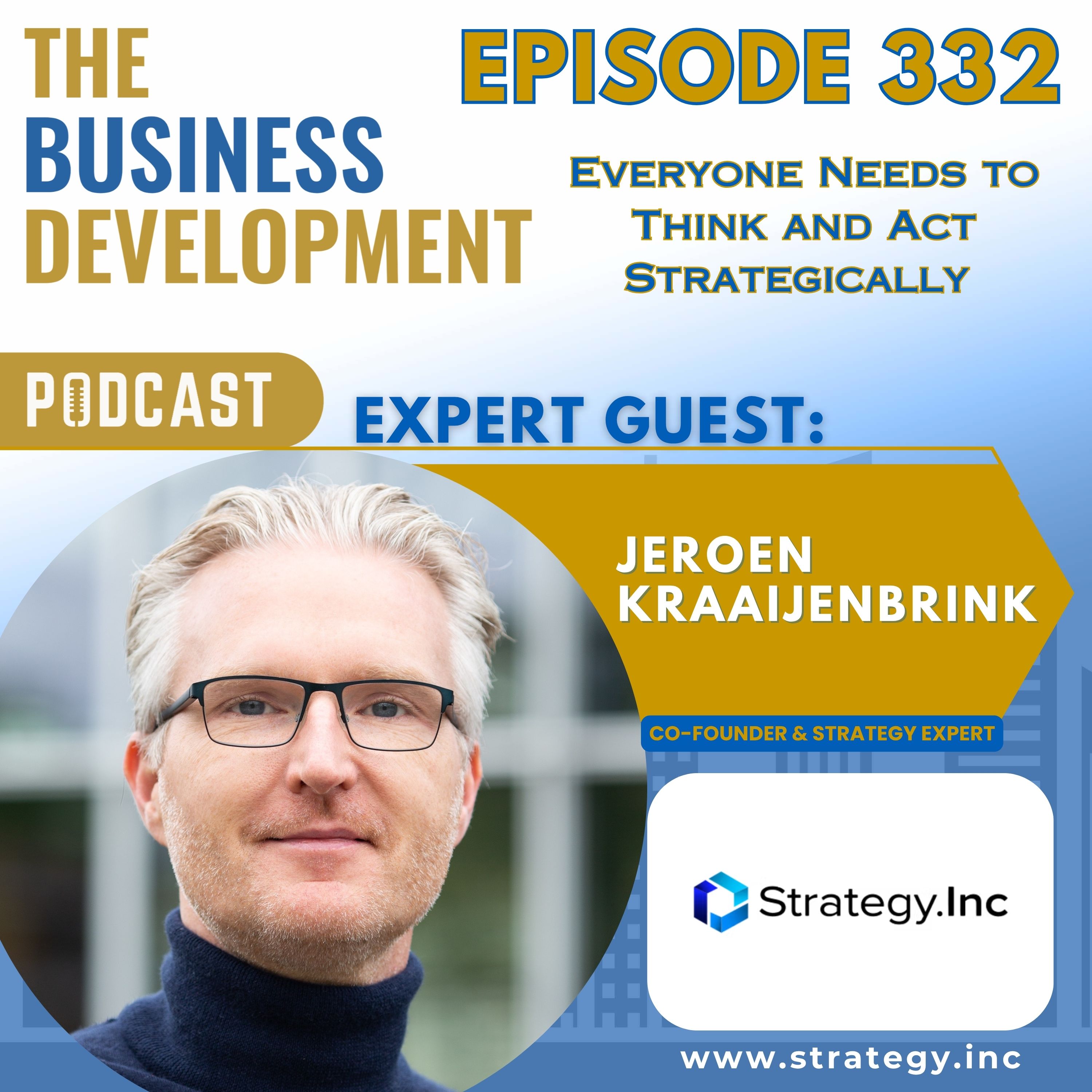
Everyone Needs to Think and Act Strategically with Jeroen Kraaijenbrink


 Apple Podcasts
 Spotify
 Amazon Music
 RSS Feed
 In Episode 332 of The Business Development Podcast, Jeroen Kraaijenbrink challenges one of the most common misconceptions in business today: that strategy belongs to leadership. With over 20 years of experience across academia and consulting, Jeroen breaks down why traditional, top-down strategy approaches consistently fail and what it really takes to build strategies that stick. His human-centered approach reframes strategy as a shared capability, not a static plan, and introduces the idea that everyone in an organization should be thinking and acting strategically.
This conversation dives into the shift from strategy as a one-time exercise to strategy as a daily practice. Jeroen explains how organizations can build strategic competence across teams, why adaptability is the most critical skill in today’s environment, and how leaders can move from control to empowerment to drive real execution. If you’ve ever built a plan that didn’t translate into results, this episode will challenge your thinking and give you a new way to approach strategy that actually works.
Key Takeaways:
- Strategy should not belong only to leadership. It needs to become a capability built across the entire organization.
- Strategy works best as a daily practice, not a once-a-year planning exercise. Real execution happens when it becomes part of normal operations.
- Strategic thinking is not enough on its own. People also need the ability to act, align others, and execute.
- Most strategy failures happen because the human side gets ignored. If people do not believe in it, they will not carry it forward.
- Adaptability is one of the most valuable strategic skills a person can build. The people who adapt best tend to have stronger long-term success.
- A plan still matters, even if it changes. It gives you direction and helps you recognize the right opportunities when they show up.
- Tools do not make strategy work on their own. Frameworks only help when the people and processes behind them are strong.
- Everyone in a company should spend some time thinking strategically. That habit cannot sit only with executives.
- Big strategic change can start small. A single team or department can prove a better way before the whole company adopts it.
- The best strategy leaders stay open-minded. They listen, learn, and stay willing to challenge their own assumptions.
🔗 Connect with Jeroen Kraaijenbrink
🌐 Strategy Inc: https://www.strategy.inc
🔗 LinkedIn: https://www.linkedin.com/in/jeroenkraaijenbrink/
📘 The One-Hour Strategy
Jeroen’s latest book, The One-Hour Strategy, flips the script on traditional planning and shows how to make strategy a daily habit across your entire organization.
Get your copy here: https://www.jeroenkraaijenbrink.com/One-Hour-Strategy
🎸 Sponsor Shoutouts
The Business Development Podcast is proudly supported by Hypervac Technologies, Hyperfab, Thunder Bay Hydraulics, and Atlas Elite Lifts. 🎸⭐
Hypervac Technologies is North America’s leader in hydrovac excavation, delivering safe, non-destructive solutions for critical infrastructure projects. If you work in construction, utilities, or industrial services, learn more at www.hypervac.com
Hyperfab, the fabrication division of Hypervac, delivers custom-built solutions engineered to handle the toughest demands in the field. Learn more at www.hyperfab.ca
Thunder Bay Hydraulics has been a trusted name in hydraulic cylinder repair and manufacturing for over 55 years, supporting industries like mining, forestry, and construction across North America. Visit www.thunderbayhydraulics.com
Atlas Elite Lifts delivers premium automotive lift solutions built for performance, safety, and reliability. If you are looking to upgrade your shop, check them out at www.atlaselitelifts.com
Mentioned in this episode:
Hyperfab Midroll
Everyone Needs to Think and Act Strategically with Jeroen Kraaijenbrink
Jeroen Kraaijenbrink: We need to get rid of the idea that strategy is something for the boardroom. We also need to get rid of the idea that strategy is something for consultants. But it's a competence that organizations should develop, uh, and individuals as well.
Intro: The Great Mark Cuban once said, business happens over years and years.
Value is measured in the total upside of a business relationship, not by how much you squeezed out in any one deal, and we couldn't agree more. This is the Business Development podcast based in Edmonton, Alberta, Canada. In broadcasting to the world, you'll get expert business development advice, tips, and experiences, and you'll hear interviews with business owners, CEOs, and business development reps.
You'll get actionable advice on how to grow business, brought to you by Capital Business Development www.CapitalBD.ca.
Let's do it. Welcome. To the Business Development Podcast, and now your expert host, Kelly Kennedy.
Kelly Kennedy: Hello, welcome to episode 332 of the Business Development Podcast, and today it is my absolute pleasure to bring you Jeroen Kraaijenbrink.
Jeroen is a strategy expert, educator, and author who helps leaders cut through complexity and turn vision into reality. With over 20 years of experience at the crossroads of business and academia, his work draws from cognitive psychology, systems thinking and human development, allowing him to guide organizations through meaningful strategy design that sticks.
As co-founder of Strategy Inc. And author of seven widely respected books, he is a trusted voice for executives looking to lead with clarity and purpose. Jeroen doesn't just deal in generic frameworks or buzzwords. He brings strategy back to what matters, people, priorities, and progress. His no nonsense human first approach helps leaders build strategies their teams believe in and act on.
If you are ready to stop talking about strategy and start making it work, Jeroen is the partner you want in your corner. It's an absolute pleasure to have you on the show. Jeroen, thanks for joining me.
Jeroen Kraaijenbrink: Thanks Kelly, for the wonderful introduction. So let's stop it here Now, uh, this, this, this was, this was good.
It can't get better.
Kelly Kennedy: Oh, my go, my gosh. Yeah. Seven books in like no time Flat. Hey, like you authored your first book in 2015. Is that correct?
Jeroen Kraaijenbrink: Yes. Yeah, that's correct.
Kelly Kennedy: Wow. Wow. That is a, that is an incredible cadence. Congratulations on that.
Jeroen Kraaijenbrink: Yeah. Thank you. Thank you.
Kelly Kennedy: What, um, you know, why the passion for so many books in such a short period of time?
Jeroen Kraaijenbrink: I think, yeah, the, the, the real answer is I need to write in order to clarify my own thoughts.
Kelly Kennedy: Mm.
Jeroen Kraaijenbrink: I think that's the big pattern in everything I've been doing, uh, through my academic career, uh, but also today. And whether it's books, articles for Forbes, um, post for LinkedIn, I need, I need to write things down to, to clarify, clarify my own thoughts.
I think that's how these books come up. Part of it is, is so clarifying my own thoughts. And part of it is also being dissatisfied with the books out there. I know there's kind of unlimited books out there, and even on strategy.
Kelly Kennedy: Yeah.
Jeroen Kraaijenbrink: But not exactly. As how I like them.
Kelly Kennedy: Mm-hmm.
Jeroen Kraaijenbrink: Be not as practical, not as useful as I think they could be.
So I, I see an opportunity for something that is new, that's different yeah. And, and I said I need, I need the writing for myself as well.
Kelly Kennedy: I, uh, I absolutely love that, honestly, uh, in awe a little bit. Um, as an aspiring author myself, I haven't written anything yet, but it's in my, it's in my to do plans.
I'm gonna write a book on business development here when I can get around to it. But, um, yeah, I absolutely love interviewing authors. And you know, as we talked ahead of the show, I have only interviewed really one other guest in a well over 300 episodes where we really dove deep on strategy and execution.
And that is Monte Pedersen. And, uh, you mentioned that you actually know him.
Jeroen Kraaijenbrink: Yeah. Quite well. Yes.
Kelly Kennedy: That's incredible. Yeah, I really enjoyed, I really enjoyed meeting him and speaking with him as well. Jeroen, you know, how did you end up on this path? You're, you're an author, an educator, an academic, and an entrepreneur, like incredible trifecta.
But please do, you know, take us back to the beginning. Mm-hmm. Did you always think you would be on this path?
Jeroen Kraaijenbrink: Oh, not at all. So this is not by design, not by plan which is kind of reflecting a bit how I look at strategy. But we, we get to that later on, I think. I always think, if I look at my entire career, I've always just looked at, okay, what's the next step?
And then mostly intuitively follow, like the next step that makes sense to me. So as a metaphor and the same metaphor I also use to describe strategy, you have some idea on where you want to go or what you wanna do, but you are very dependent on the next wave. And the only way to kind of make progress is jump on the next wave.
And that's also how I see my career is, is at some, even when I was still, um, at college. Then there is a next opportunity. When I was, was, was, was a, was a student. The, at the end of my, my, um, my studies that came the opportunity to do a PhD.
I had never thought about that before, but I kind of liked doing my master thesis.
Uh, and my professor kind of liked what I did, so there was an opportunity and then I said, okay, why not? So why not? That's the, the main theme.
Kelly Kennedy: Yeah.
Jeroen Kraaijenbrink: Uh, and from that I got to a tenured position as an assistant and an associate professor. Also not really by also thinking a lot about this upfront, but more like, yeah, why not?
It seems like a, a good next step. It helps me enrich my competencies. It, it helps me kind of, it sounds interesting. So yeah, let, let's just dive into it and from there on, I think that's always how it has been is, is after a while I got, I got a bit frightened like, okay, if this is my career, if I'm a professor by, I dunno, 35, uh, and will remain so the rest of my life is that all, is that everything there is so some dis dissatisfactions there in terms of how I looked at my career and I wanted to have a bit more of a, a real impact on the real world.
So thought, okay, why don't I go into consulting? I did not really want to go into one of the big consultancy firms. Which I probably couldn't because I was already too opinionate opinionated, uh, by teaching strategy for a couple of years.
Kelly Kennedy: Yeah.
Jeroen Kraaijenbrink: So I basically declared myself a consultant, uh, got my first client, my second client, and so on.
And while doing that, uh, and even already while teaching I became also kind of dissatisfied with what I was teaching.
Kelly Kennedy: Mm-hmm. So
Jeroen Kraaijenbrink: I was teaching from the, the typical standard strategy textbooks with kind of a new model on every page and five forces framework, a d step, a SWAT to balance scorecard, and so on and so forth.
Kelly Kennedy: Yeah.
Jeroen Kraaijenbrink: And increasingly, I was wondering like what's the point? What's the use of this? How is this really going to help managers, leaders, organizations, uh, to actually develop and implement strategy? So in that kind of looking critically at the status quo has also been a main theme in, in everything I've been doing ever since.
And then while based on the research, based on my teaching, based on the consulting, I kind of figured out like, there there's room for improvement, there should be other ways of doing this. And that became my first book, uh, which in the end was, was published in 20, 20 15. Yeah. So that, that's how my career has, has, has gone.
Uh, so I started as an academic, uh, as an academic for a long time, and then kind of gradually faded in, faded out outta the university, more into business as a consultant. I've done that. I'm still doing some of that. And the most recent step has been, I think to become truly an entrepreneur. I think being an independent consultant is kind of entrepreneurial as well.
You bet it is.
Kelly Kennedy: Yeah. Yeah.
Jeroen Kraaijenbrink: But it's, it's the one person, uh, game. So it's, it's not really kind of. Scaling it, it's, it's, make sure you get your client, your revenues and, and do your job. Um, but since two years I've joined, um, I've, I've created a company together with Timothy Teriyaki Strategy Inc. With really the intention, okay, let, let's join forces and make this much bigger than the two of us can do alone, uh, and turn this into an actual company, an actual business.
And the one thing we started with is teaching other consultants. So my focus has always been more on the front side on the strategy development. Tim's focus more on the implementation side.
Kelly Kennedy: Yeah.
Jeroen Kraaijenbrink: And both of us having this very human centered approach that you already referred to in the intro. And then we decide, okay, let's, let's create a course for strategy.
So seasoned senior experience strategy consultants, uh, run a couple of times and kind of that's where we are now. Currently we're at, we're very hardly hardworking on launching our next big problem product, which is the big five of strategy, which is a competency framework for individuals. So the whole idea, and that you can see even in my books, is the whole idea is we need to get rid of the idea that strategy is something for the boardroom.
We also need to get rid of the idea that strategy is something for consultants but it's a competence that organizations should develop and individuals as well. So the next big thing we focus on, and that's the real scalable, uh, product, uh, is a, is an assessment where individuals like yourself, like, like our, our, our listeners, like everyone can assess their own strategic competencies and from their own kind of build a roadmap on.
Where does that put them in terms of their career? How can they develop that? So that's interesting, almost kind of not back full cycle, but one thing we did for that, or I did for that is, um, is a pretty large scale study. So I, I could use my research skills again, did my statistics, uh, my tests, uh, and, and, but now with much more enthusiasm because it was not just for writing an academic paper and hoping for citations, but for developing and testing an assessment instrument that actually makes a difference in practice.
Kelly Kennedy: Wow.
Jeroen Kraaijenbrink: So that's how I've been kind of building and using my, so strategy has been a theme. But then research, consulting, writing the different skill sets around that. And they they are combined in, in what I currently do with our company Strategy Inc.
Kelly Kennedy: That's amazing. That's amazing. Oh, I can't actually, I can't wait to get back to that.
'cause now you got me. Very curious, what does strategy mean on an individual and employee level? I, I'm excited. I can't wait to learn a little bit more about that. But one of the questions that I had just kind of in this conversation, I think you're the first guest that we've had that has come from a strictly ACA academic background and then transitioned into entrepreneurship to put those skills to the true test.
And I, I absolutely love that. And I, and I, one of the questions that I have is, did you find that the skills that you were teaching in university were transitioning into, into the real world of business? When you finally did make that transition, were, was it like, or were you very surprised that there were a lot of skills that you had to learn outside of the classroom?
Jeroen Kraaijenbrink: The skills that I was teaching, not, and that was my frustration, uh, like, Hey, what am, what am I teaching here? How does this apply in the real world?
Kelly Kennedy: Mm-hmm.
Jeroen Kraaijenbrink: Um, because it's far too analytical, far too simplistic. And a few other things. The skills that I had developed being first being a PhD student and then being a, being a professor, surprisingly applicable.
And that has been, that's been my interesting experience. Even though I, let's say the academic label may not necessarily help, at least not in the Netherlands, where I'm from and where I'm living. And I know in some countries having, being a PhD really helps as a consultant in the Netherlands rather hurts than helps.
Theoretical and unal. Mm.
Kelly Kennedy: Mm-hmm.
Jeroen Kraaijenbrink: Um, but the skills that I learned, especially like teaching, uh, but also research, I use them every day. Yeah. I think if you, if you look at what I write, uh, even if it's just this, the simple short post on LinkedIn, it's teaching, it's educating.
Kelly Kennedy: Yes.
Jeroen Kraaijenbrink: Uh, it's simplifying complex material in a way that people can understand it.
Kelly Kennedy: Yeah.
Jeroen Kraaijenbrink: And can apply it as well. So the, the teaching skill is, I think it's core to what I'm, what I'm doing also as a consultant. So the way I look at consulting is a very developmental approach to consulting, which is actually very much a teaching and a coaching approach to, to consulting.
Kelly Kennedy: I love it.
Jeroen Kraaijenbrink: And the research part as well, and not just what I just mentioned, like for the development of this big five of strategy framework.
We've actually conducted a large scale study, uh, with over a thousand professionals. So the statistics, the conceptual framework, development, all of that, all of those skills were extremely relevant because we wanted to build a framework that is not just nice looking and simplistic, but so thoroughly founded in both the, is it the conceptual literature, but also empirically tested.
So there, those skills have been very useful. But also more generally, if I look at what strategy is and what it takes to kind of develop a strategy for a company or with a company that's also quite similar to, let's say, qualitative inductive research, where if you do as a qualitative researcher, you kind of jump into a field, you gather lots of unstructured data.
You do interviews, uh, you get a very rich picture of reality. That's the whole idea of doing qualitative research. Strategy is exactly the same. When I work with a client, I wanna, my task is to develop this, this kind of high density, very detailed picture of the company, like where they stand, what they want, where they wanna go, all of the developments around them.
So really get, immerse myself into the company and then see patterns make the connections, connect the dots. So those research skills are extremely relevant as a, as a strategy. As a strategy consultant.
Kelly Kennedy: Yes. Yes. I love the fact, and, you know, I kind of hit on it earlier, just the fact that. You are you're doing more of teaching, right?
As a consultant, you're kind of, you're trying to set them up for long-term success. And it's something that I kind of realized in my own entrepreneurship journey when I started out as a business developer, I was really just like doing that work for them. I was doing all the work and saying, you know what?
You stand back. I'll come in, I'll facilitate your program for you. We'll, we'll call you in when the meetings, and it worked great and they were happy, but the problem was, is that it would end. And inevitably your contracts come to an end and that whole machine that you helped create grinds to a halt because the right things haven't typically been put in place to keep it going at the same pace that you were working.
And so what we've found throughout, you know, the transition of our company is same thing. We're going to more of a coaching training and teaching model of our consulting because it sets them up for long-term success. And what we're finding too is those tools are getting better for them to use. And so companies are be becoming better and better able to manage their own programs internally using tools like AI and things like that to help streamline those processes.
And I think as we move forward, consulting as we move forward into 2026 and beyond is going to start to transition to a less of, I do it for you to more about, let me teach and stand in your corner and lift you up and help you figure out how to do that yourself. And I love that you touched on that.
Mm-hmm. Because it sounds like you guys are going through a very similar transition on your own.
Jeroen Kraaijenbrink: Yeah. That that's why we focus on the, not, not even a transition. It has always been, I think our focus, um, but now even more explicitly so is because we we're not fully moving away from consulting. Our main focus is now competence building, which it's really teaching if you, if you like.
Uh, beyond that though, it, it's not just so the way we look at it, it's, it's assessment. So assess, development and met. So first, make sure that people understand where their strengths are, where their weaknesses are, so which competencies they already have, which competencies not, and then at every level, departments, teams, individuals, uh, entire organization, then help them develop.
Uh, of course you will always have your weak spots and your strength. Uh, and the idea is not that you need to develop all of them.
Kelly Kennedy: Yeah.
Jeroen Kraaijenbrink: Um, but at least to some minimum level. So it's about leveraging your strength and kind of fixing your main weaknesses because they may really become a problem if you don't work on them.
But then the final step there, uh, is embed this into your, your, your ways of working. So in the end, and that's the, the big consulting work is helping organizations transform in a way that this kind of decentralized approach to strategy where people have developed or they have their individual strategy competencies, but also have the responsibility and the freedom and the, the, the tools and resources to actually apply this and use this.
Because if you don't change that, it's nice. We, we, we can, we can sell assessments, we can sell trainings, but nothing really changes. Yeah. So you need to help the company transform their processes, their ways of working, job descriptions, profiles, so the whole, yeah. Actually the whole governance and structure and processes of an organization needs to, need, need to fit to actually develop this strategic competency as a, as an organization.
Kelly Kennedy: Interesting. Okay, so let's lead into that because you know, you had, you had led into the fact that strategy isn't just a top down model. It shouldn't just be coming from the CEOs and the executives strategy needs to be a company wide, a company wide initiative, essentially. But we haven't been empowering our employees to be strategists.
Right. At least not in North America.
Jeroen Kraaijenbrink: No, no. Same here.
Kelly Kennedy: Yeah. It's very much typically a top down. The executive team comes out, we came to this conclusion, this is what we're implementing, and they just say, here's what we're doing. Do it. And as we talked about earlier, I know when I was talking with Monte for instance, he was saying that like, most strategies fail, like 60 to 90% of strategies fail to be executed correctly or properly.
So obviously that system doesn't work very well.
Jeroen Kraaijenbrink: Yeah. And, and yet we keep on doing this and it's, it's kind of a rain dance. It is. We, we have our offsites, we do our brown paper sessions, we do our SWOT's we are energetic and, and, uh, and have a lot of fun. And then we go back to work and nothing changes.
Kelly Kennedy: Mm-hmm.
Jeroen Kraaijenbrink: And I know this is exaggerated. It's not always like that. There are many, much better examples. But for the bulk of the organizations, I think it's strategy is still something similar to that. It's exceptional. It, it's irregular. It's not part of the, the day-to-day business. It's literally separated by going to some nice resort.
While my, in our approach to strategy is a much more, in a sense, a much more mundane way of looking at it, it, it's yet another business process. It needs to be yet another business process, which is, which it currently isn't. And it can't be because you, there's no place on this planet where you can actually learn how to do this.
Yeah. 'cause I think all, if you look at the, the books, the education programs, it's still this old fashioned approach that we're teaching for, for 50 years. Some of the tools are new, so we have our Blue Ocean strategy, we have our business model canvas. But the essence is still very much the same.
Kelly Kennedy: What I've always found really interesting about my plans, because I really only speak to my own, is that they rarely go to plan.
Um, you know, I can sit down and I can write a three year plan or a one year plan, or a five year plan and I think the problem with these plans is that I don't have all of the information in the moment. Mm-hmm. Right? I can't see the future. And what I typically find is that the best opportunities that come to my business, you know, like the wave that you mentioned earlier.
I couldn't see it coming. Right. You can't see it until it shows up right in front of you. And so I found that, you know, with capital, with this podcast, really none of the big changes that have happened, you know, with this show or with my company, were in the plans. They just ended up being really great opportunities that I was in the right place at the right time and I could just say yes to.
And so it's kind of skewed maybe my view on, on planning and strategy, just because maybe so many times I couldn't, I could even, even at the time had I had all the information I'm not sure I could have predicted the outcome that actually happened.
Jeroen Kraaijenbrink: Yeah. And, and there's a, there's a balance here, um, because kind of fully doing away with, with the whole planning then we're back at square one because the whole, if you look at the history of strategy, the whole point of strategy is to bring some stability in uncertain times, which is very fascinating because if you look at scientific articles from 55 0 years ago, they have titles like planning in the Age of Uncertainty, like as if they have been written, uh, today or tomorrow.
Kelly Kennedy: Yeah.
Jeroen Kraaijenbrink: So the whole point of strategy is kind of giving this long term vision, views, stability of course knowing that the real world is changing as well and that things won't go. Don't think the, the, the plan is still quite important. Not because you'll stick to it, but I think what you just said is kind of, I was sort of at the right place at the right time.
Or you see the opportunities. That's not a coincidence. It's not luck. It's because you have some, some idea in mind of where you want to go that you see the opportunity and you need to have the intention, you need to have the idea, you need to have the ambition in order to see the opportunity. And I think that's where having a strategic plan is still very important because then you can, it, it sets your mind on a certain direction.
Kelly Kennedy: Yeah.
Jeroen Kraaijenbrink: And it'll help you recognize an opportunity as an opportunity and not as a deviation or as something that even goes unnoticed.
Kelly Kennedy: Interesting. Does that okay, so one of the things that's coming to my mind right now is strategy, then a mindset.
Jeroen Kraaijenbrink: That's a philosophical question. Yeah. Uh, I think, but largely it, it's mindset and, and, and skill.
I would, I would think so mindset in, in either way of thinking. And if you look in, in the work on individual competencies, it's very often about strategic thinking, which is largely about mindset, is being able to look differently at the reality. Look more at the bigger picture. Yeah. Look at the long term, uh, rather than just being absorbed with the day-to-day details.
Um, but it's not just that. So it is mindset, but also ability to actually act on what you see.
Kelly Kennedy: Yeah.
Jeroen Kraaijenbrink: So the ability to, uh, ability to put, to, to get others involved, uh, to, to motivate others to, to align their, their interest, their stakes, their, their resources and also plain execution skills is it's action planning, uh, resource allocation that as well.
The overall ability to adapt and, and what I'm saying now, it's largely kind of in, in the big picture exactly the, the, the framework we've been developing. Like what are the competencies that people need in order to be called strategic? So what is strategicness of an individual?
Kelly Kennedy: Yeah.
Like how do you measure that? What does that mean?
Jeroen Kraaijenbrink: How do you measure that? How do you define it? What what does it mean? And that has been the, the interesting start of this whole journey on what we call the big five of strategy is to, to define that and develop a structure systematic model that captures what these competencies are because it's not there.
It's not out there.
Kelly Kennedy: Yeah. Yeah. Like I, I wouldn't know how to sit down in, in a boardroom and even after, let's call it an hour long conversation, I wouldn't be able to say, yeah, this person's a nine out of 10 outta strategy. Right. Like, I don't know what the measure is. I've never seen anything like it.
Jeroen Kraaijenbrink: No, there isn't. Un until, until we've developed it now. Yes.
Kelly Kennedy: That's amazing. That's amazing. Yeah. No, uh, it's really interesting. It's funny because, um, I, I like to try to think that I can, I can prepare for the future, right? I like to think I can, yeah. You need
Jeroen Kraaijenbrink: to do the assessment then when it's ready.
Kelly Kennedy: Me and, uh, me and my fiance were sitting down at the table not three weeks ago, and what we were trying to understand was, what are the implications of AI going to mean it, you know, when it's a thousand times more powerful?
Because what we'd done I'd done a show a little while before, and one of the things that had come up was that AI was doubling in power every six months and basically that it was going to be a thousand times more powerful than chat GPT version one in 2023 by 2028. So a thousand times more powerful AI in 2028 than what existed beginning of 2023, which was my very first experience with any type of, uh, of AI chatbot, essentially.
Um mm-hmm. Large language model. We were trying to figure out, 'cause we have, we have four, four little boys. We're like, well, what is, how do we prepare them for that future? Because I was thinking at the time, you know, when the iPhone came out as a great example, we weren't thinking about what you would use an iPhone for.
I remember seeing the commercial or the, the, it was on YouTube, I think at the time, watching the, the release. And, uh, it comes out and he's like, it's a phone and it's an iPod. It's a phone, it's an iPod. Right. Like we had, we don't even use a phone for an iPod anymore. We use it, you know, for streaming services, for YouTube, for every app you can imagine for business, for banking.
Like at the time we could not see, even though, even though the tool was right there, it was being shown to us, this tool hasn't changed much in, in the past, let's call it 20 years. Mm-hmm. But at the time, we couldn't. We couldn't imagine what that was actually going to mean for us today. And I think AI is that too.
And, and while we can see it for maybe the tools we use it for today, the true use case of it is going to be almost unbelievable or unimaginable from what we can imagine today, right? Mm-hmm. And so we were trying to do that exercise and a little bit of strategy to it, but just trying to understand like, what does that mean for day-to-day life?
What does that mean for business? What does that mean for our business? And I know I'm not alone in this. There's a lot of business owners right now thinking, holy crap, like what does this massive shift coming not, you know, not four years from today.
What is that going to mean for me and my business?
How do we strategize for a world that we can't see and yet we know it's coming at us like a freight train.
Jeroen Kraaijenbrink: Yeah. I think once again, the answer is build to strategic competencies. That this is why. And I think that has always been relevant. Um, but even more so today. If you look in the, um, a little bit of a sidetrack, then I get back to, uh, to the topic.
If you look in the history of, of, of strategy as, as a research field, one of the, the dominant theories is what is called a resource based view is basic, very simple idea, is you need unique, valuable, hard to imitate resources, to be successful, to have a competitive advantage. Simple idea. The problem if you really look at like, like that is it's, it's a very static thing and you have certain resources and un until someone else has them as well, that has turned into a more dynamic knowledge view.
I think we are now at a, at a point where the only true core competency of an organization is its strategic competence.
Intro: Mm-hmm.
Jeroen Kraaijenbrink: Which is its ability to basically, to reinvent itself. To transform itself.
Intro: Mm-hmm.
Jeroen Kraaijenbrink: And at the same time, kind of, keep building on what is there. So one, one of the dimensions in our model is stabilizing versus transforming.
And I think that's, that skill is being able to build on the past. Uh, but also change for the future is, is an essential skill for individuals because everyone needs this in their, in their own job because the world is not changing just for, um, for organizations, but also for teams and also for individuals.
Every job. Every job. I think every person, uh, that, that's working in. Has the responsibility to, to think about where is my job moving?
Kelly Kennedy: Yeah.
Jeroen Kraaijenbrink: And AI is a big factor, but not the only one. There's all kind of other changes in the world happening, uh, big transformations that will make sure that the future is different.
So being prepared, we can't predict, but one, some of the skills relate to being aware of what's happening. So what the exercise you did is a very good one there is kind of thinking about possible futures.
Intro: Yeah.
Jeroen Kraaijenbrink: Where could this go? And of course you dunno the answer, but it makes you sensitive and once again, it makes you aware of the opportunities of the science you need to look at.
So once the world is moving in a certain direction, AI is moving in a certain direction, you'll recognize it. You'll not be amongst the, among the early ones, recognizing it. And then you, you need, you need the skills to seize those opportunities to, yeah. To, to, um, to think. To take risk, uh, to, to understand how you bring others on board.
So that competency, I think that's the answer. The long term answer is moving from, basically from strategy to strategizing. So from a, from a noun to a verb, I think that's what we, uh, what many companies still need to learn. Yeah. Um, and then that's really what we, what we focus on.
Kelly Kennedy: So basically what you're saying is, instead of just sitting on this thing and thinking about it and thinking about it and thinking about it, the action itself is worth is worth a hundred times the thought.
Is that kind of what you're getting at?
Jeroen Kraaijenbrink: No, the, the, the thinking and the action because that's actually the second dimension of a model thinking and doing. Um, but on a continuous basis that you make this a competence skill, a habit, a routine, that thinking about the future and acting accordingly and balancing this stabilizing and transformation is something you do.
At a daily basis and at every level in an organization. Think only then can you be truly strategic and prepared for the future, whatever the future will be.
Kelly Kennedy: Yeah.
Jeroen Kraaijenbrink: Because it's, it's a way you've been, you are systematically prepared for, for an uncertain future.
Kelly Kennedy: Yeah. It's, uh, you know, I would be lying if I said that.
It, it doesn't worry me. I think things are changing faster than ever and I genuinely think that like the best skill anyone can have right now, no matter what your experience is or your expertise is, your best skill you have today is your ability to continue learning and continue to learn new tools and skills and ways to do your job better every single day.
Oh, yes,
Jeroen Kraaijenbrink: yes.
Kelly Kennedy: It's right. It's like what you knew yesterday. Great. You were an expert until yesterday. Tomorrow's a brand new day.
Jeroen Kraaijenbrink: Yeah. And actually we, we've conducted. The research I mentioned is, is exactly on this. And that's actually one of the, one of the, uh, important results. So, spoiler alert here. So we roughly, we, we have five competency one.
One is um, graph the present. So that's understanding where you are, what's happening, and so on. Second, shape the future. So that's more the bold thinking, the inno in the, the innovation. Third, uh, move the system. It's more so change management, helping others change their behavior, their mindset, and so on.
Fourth, deliver the results. It's more action planning and, and, and project management. And fifth, it's adapt to change. We just change your resources, change your goals, learn, uh, be resilient and, and so on. The research we've done, we've tested, like which of these five has most effect on career success and adaptability?
So the adapt, um, competence clearly had the, had the most effect. So that exactly confirms what you're, what you're saying. It's not just intuitive, but our research shows that it, it's actually also what, not just we haven't looked yet at what what explains the success of an organization
Kelly Kennedy: Yeah.
Jeroen Kraaijenbrink: And the individual level.
So we, we looked at subjective career success. So how, how do people look at their career, how successful they find their own career.
Kelly Kennedy: Yeah.
Jeroen Kraaijenbrink: There's a very strong effect of those who are more adaptable, have more successful careers.
Kelly Kennedy: Yeah. Yeah. I, um, I guess one of the questions I have is that you've been in strategy for so long, well over 20 years at this point.
Do you find that like the pace at which strategy needs to be implemented is increasing as well with just the shift of change? Like when you got into this career many, many, many years ago, what were companies needing to change as, as rapidly as they need to today?
Jeroen Kraaijenbrink: Maybe not. But at the same time, and I'm, I'm always a bit stoic, maybe perhaps in this or skeptic, is the fact that everyone is saying the world is moving faster than ever mm-hmm.
Doesn't mean, doesn't necessarily make it true. And just to, if you put it in perspective and look, look back 10 years, 50 years, a hundred years, 2,005,000 years, it's a common theme that at every point in time of the recorded history, people felt the world is moving faster than ever before.
So I think it, it may be, but it's also good to be aware that this feeling is something kind of human.
Kelly Kennedy: Yeah.
Jeroen Kraaijenbrink: Okay. And so that people, and that's what I, what I said the articles in, in, it's in long, long range planning, which was by then the only, uh, the only kind of scientific article and strategy.
Kelly Kennedy: Yeah.
Jeroen Kraaijenbrink: The titles there are exactly like, oh my God, the world is changing. So far everything is so disrupted.
Everything is so uncertain. Yeah. We need to, to do strategy differently. It's 50 years ago, half a century ago.
Kelly Kennedy: Wow.
Jeroen Kraaijenbrink: Uh, and kind of, that's, that's always my perspective. I'm not, not saying the world is not, uh, changing, uh, not ev and it's changing fast, but in many respects it was also changing fast, uh, half a century ago.
Kelly Kennedy: Yes.
Jeroen Kraaijenbrink: And, and at the same time, we now, we have much better tools, much better information. We're much better equipped to, to deal with the, the complexity, to deal with the change, to deal with the uncertainty. So our capacity to handle the uncertainty has also co-evolved with the uncertainty love. So in that sense, we're, we're kind of, we always maybe stay on the same kind of balance level where what we can do and the, the uncertainty we face are kind of in balance.
Kelly Kennedy: I love that. Thank you. Because I'm not gonna lie, I was starting to get a little bit worried.
Jeroen Kraaijenbrink: Yeah.
Kelly Kennedy: That the pace of change was definitely outpacing, you know, most entrepreneurs' ability to try to keep up with it. Because, you know, even since I, I'm a relatively new entrepreneur, I've only been in the game for five years myself, but even in those five years, it's like, holy cow.
Like every year it feels like you're reinventing the process, reinventing the service, reinventing the podcast, whatever. It's all, it feels like it's, the changes happening, happening so rapidly that it's kind of nice to have someone like you step be like, you know what? At the same time's not is bad.
Maybe, maybe that's normal,
Jeroen Kraaijenbrink: but at the same time, this is a podcast. It's a, it's a conversation between two people.
Kelly Kennedy: That's right.
Jeroen Kraaijenbrink: That, that's what a podcast or many podcasts have been. Always, always, and even like interviews on, on the radio. So what's the real difference? True. There's differences in, in, in nuances.
And of course, in some cases there are radical differences. I think having this, this kind of stoic mindset okay, let's not worry too much, uh, put things in perspective. Look at the bigger picture. Because if you kind of zoom out enough, what's the relevance of this anyway?
Kelly Kennedy: Yeah.
Jeroen Kraaijenbrink: So nuanced thinking.
Uh, I think we, we need more of that kind of more stable minds who do not just, just jump on every trend and not, are not getting anxious, uh, because of the changes.
Kelly Kennedy: Yeah.
Jeroen Kraaijenbrink: Because there always have been changes.
Kelly Kennedy: Yeah. Yeah. Well, you know, if we can talk to podcasts, right? Like a conversation with you and me.
I'm in Canada, you're in Netherlands. It wouldn't have been done this well, five years ago. Like the technology is, is really shrinking the world and bringing, you know, experts like you from the Netherlands to be able to come to Canada and North America and have these exact same super valuable conversations that maybe wouldn't have been as easy to facilitate or maybe would've needed a broadcast or a major network, not five, 10 years ago.
Jeroen Kraaijenbrink: Yeah. And my company, our company wouldn't even exist because I, I met my co-founder, Tim Tiryaki through LinkedIn.
Kelly Kennedy: Wow.
Jeroen Kraaijenbrink: And I, I've only met him in real person like a month ago, literally a month ago today, after one and a half years being in the company. He, he's Canadian by the way, as well. Um, oh, cool.
Despite the time zone differences, despite the, the, the distance, so of course technology has made, but that's exactly my point. Technology has made it also more, much easier. To catch up with. Uh, now, now you can record a podcast and publish it immediately.
Kelly Kennedy: Yes.
Jeroen Kraaijenbrink: While in. So the technology allows you to, to act much faster than, than in the past.
Kelly Kennedy: Absolutely. Um, lead us into the whole person strategy. You know, I think we got, got into that really briefly earlier, but I would like to maybe dive a little bit deeper because how does strategy work? Like I said, on an individual level, on an employee level outside of the executive team, how do we get everybody thinking strategy?
Jeroen Kraaijenbrink: Yeah. For me, those are two questions. The whole person, uh, approach means with like within an individual, making sure we are using the full capacity of us as human beings. So not just one half of our brain, which is the analytical, rational, analytical part, but use our holistic, intuitive side. Use our emotion to use our our body use, use our complete.
Yeah. All characteristics as a human, uh, human being, that's kind of the whole person approach, which I think applies to strategy, to consulting, to every job. Mm-hmm. As an executive you're not just one half of your brain. You're not just a calculator. You are a full human being. And for a very long time the, we've kind of tried to rule most of the human side out of strategy.
Literally. It needs to be objective, it needs to be quantitative, analytical, predictable through the tools. It should be a calculation, and then there should be an objective result.
Kelly Kennedy: Yeah.
Jeroen Kraaijenbrink: Which leads to these 60, 70, 80, 90% failures because we completely ignore the human side of it. Your strategy is completely human, I would say, of course.
Lot of technological support we can have, and also with ai in the end, it's a transformation process. Mm-hmm. And that involves. Human being. Like if you strategize for an organization, the organization changes and it changes relationships, it changes people jobs. So there's lots of human sides to, to that as well.
So that's the whole person approach. If we, the other side of it, which you were asking is like, how do we bring in the, uh, the whole organization part of it's the competence, so we, we need to make sure that, uh, and sorry for, uh, repeating that so often in this podcast, but it's okay. Yeah. It's really the core of, of what I'm currently doing, and then where we see so much need and improvement, uh, in, in any organization, we need to equip people with the tools and the skills to actually, and, and teach them that this is actually something important.
That even if you're a, a leader at every level, um, but also if you're not a leader, you're just, you're, you're doing your job. Thinking and acting strategically. Just the very facts to realize, to be aware of that is a very important thing. And help help people discover that. Help people get the insights in their gaps, in their, in their strength.
Help them develop that. That's one very important ingredient because if we have, do not have the awareness, we do not have the capability to, to strategize. We, we can't do anything else.
Kelly Kennedy: Yeah.
Jeroen Kraaijenbrink: That's one, one aspect of it, building competence at the individual team and organizational level. The other aspect, and that's more what I've laid out in my, my book, the one hour strategy, which is this short story which I think you can almost read in one hour.
Um, there was a simple story, but a complex, um, a complex underlying story.
Kelly Kennedy: Yes.
Jeroen Kraaijenbrink: Because the whole idea there is you need to. Structure, processes, systems, procedures, governance in an organization to make this work. So we need a mechanism where people at the say professionals or people at the shop floor can think about their job from a strategic perspective, have the tools there, have a mechanism, have a process where they meet, where they discuss, where they talk to their manager, and so on.
At the manager level, we need the same, we need to make sure that we have, that we facilitate conversations on the strategy of their team, of their department, their unit, their division and at the top level of course as well, we need the same conversation and not just on an incident basis or just ad hoc or every five years, but on a continuous basis.
So we need a continuous process involving people at every level. And that requires, for instance, that you have a very kind, standardized, structured. Approach and system with, uh, with clear definitions, with templates that you can use at every level so that what you do at the lower levels kind of adds up to what you do at the higher levels.
That's the idea you see in the one hour strategy where the one hour is, is the idea that as, um, as an executive, you need to spend one hour per day as a manager, one hour per week, and as a, an employee one hour per month. So of course it's not equal. Uh, yeah. But, uh, everyone needs to spend time on this.
So blocking time for that, reserving time for that is an important requirement, uh, because most, in most organizations, it's kind of the last thing and the first thing that kind of got cut because it's not immediately urgent. So let's not do it. Let's focus on cost cutting first.
Kelly Kennedy: Yeah.
Jeroen Kraaijenbrink: No, you need to kind of build that in systematically to various time.
There's competence, there's the tools, there's processes. So in the end, it's, that's a big transformation.
Kelly Kennedy: Yeah.
Jeroen Kraaijenbrink: For while, and for some companies it's, it's, it's a big transformation, especially for those who are kind of hierarchical, top down, traditional. Then it's really kind of a, it probably requires a new leadership even, um, because they can't even imagine this way of working.
Kelly Kennedy: Yeah.
Jeroen Kraaijenbrink: Some other companies who already have more decentralized structures, uh, with autonomous teams or holacracy, uh, any more flexible, decentralized structure is already much, much more ready for this. Because the basics, uh, in terms of more decentralized, more say autonomous working, treating people more as adults rather than as slaves or kids that have to be instructed and told what to do
Kelly Kennedy: Yeah.
Jeroen Kraaijenbrink: Is already in place. So then it's much easier, much less of a transformation. So it really depends on, on where you stand, how traditional, how hierarchical you are as a company.
Kelly Kennedy: Oh man. Yeah. Yeah. And I've seen it the other way too, where like for instance, a company wants to go through a big change typically comes from the top and they almost have to start fresh with a whole new team because the exact same thing happens is that the culture was something completely different.
The way things were done were completely different and it would be almost impossible to get the buy-in on this new structure from the current team. Yeah. And so I've seen it the other way around. You know, you mentioned the leadership might need to change. I've seen it the other way around where they're like, okay, well we need a whole new sales team 'cause they're not gonna do it in this new way that we want.
So I've seen it both ways. Yeah.
Jeroen Kraaijenbrink: Yeah. And this is an interesting, it's, it's a little, a bit of an older book. Um, I think the English book is Maverick. It's by Ricardo about Emco which is his story, like when he took the company over from his father. He kind of, he wanted to kind of radically democratize our work.
Uh, and I think it has become an example of kind of radical bottom up democratic type of, uh, work where employees choose and evaluate their managers, pick their own wages, uh, decide when they, when they, um, when they work and when they don't. But doing that required a very almost like dictatorship type of executive who did not accept, who did not wanna accept the current way of working, including firing, I think most of the board because, so it requires a very top down strong leadership in order to make this happen because you, you, you'll be facing lots of resistance, especially people who think this cannot be done.
Kelly Kennedy: Yeah.
Jeroen Kraaijenbrink: Which is one of the reasons I wrote this book in, in kind of a story form to help people at least see it. To make it imaginable, because if it's not even imaginable, then it, it'll never happen. But if you can kind of see, see it happen, then the, all the rest is detail.
Kelly Kennedy: Yeah. Yeah. Vision. That's a really, that's a really good example.
'cause you're absolutely right. Like from the standpoint of, especially from a top down strategy, typically that strategy is coming from the CEO or an executive team member of some level, and then they have to sell it to the executive team, and then somehow that executive team needs to paint that vision inside of the employees in order to get them on board with it.
How critical is, is getting that vision out there to, to making strategy actually happen?
Jeroen Kraaijenbrink: I think it's pretty critical, but the way you would get there is not necessarily the way you describe.
Kelly Kennedy: Mm-hmm.
Jeroen Kraaijenbrink: Uh, I think you can also do it the engage way, the involved way where, uh, you, you do include.
Insights, information, ideas from all layers in the company to make this a collaborative process. I know it's a, it, it's a bit more complex, but again, here is, it's technology allows us to do this. Without software, we could never do this. Probably even without ai, we could not do it. But now we have all of, all of these tools, why not?
Mm-hmm. We can automate so much. We, we can, we can have, let's say AI do do most of the work. And this is still untested territory where I think the tools helping us to do strategy in the way that I kind of anticipated in, in, in this, this little book still need, most of them still needs to be developed or are currently under development.
I think as far as I'm a little bit aware of what's happening but then why not? Yeah.
Kelly Kennedy: No, I, I, I agree. I think, I guess from my standpoint, what I'm kind of thinking is how does a company go about doing that? Because typically an idea for a change comes from the top. So in, in your mind, would they then pitch that to the team and then start to just get feedback and input on how they could improve that idea or what they're missing?
Like basically what you're kind of saying is, sure, the idea has to come from somewhere, but put that idea out to the organization as a whole. Mm-hmm. Start to get feedback and start to work as a team to execute that idea. Or maybe something completely different as, as all of the knowledge starts to roll in.
Jeroen Kraaijenbrink: Yeah. So one of the requirements that I also wrote in, in the one hour strategy is you need to have at least one high level executive that's strongly convinced this is the way to go.
Kelly Kennedy: Okay.
Jeroen Kraaijenbrink: Because otherwise it's not gonna happen because that if, if, if a company, if you're just somewhere in the middle and none of the top executives is kind of behind you.
Go and find another job, I would say. Mm-hmm. Mm-hmm. Uh, because it's, it's, it, it won't happen because the force is that the, the traditional structures are too strong. But if you have one, if there is one, and so the idea does not have to come from, from the top, but you need very strong support from someone at the top with powerful, uh, or with, with lot of influence.
Kelly Kennedy: Mm.
Jeroen Kraaijenbrink: Um, and then I think once you have that, you can, you don't have to, to kind of, to make, to make it a big announcement and into kind of, you, you can start making changes incrementally. Um, because who cares if, if you do things a bit differently at, at a department, that's, even if you are, if you are a department leader or, or you're, you're head of marketing of it, or a business unit or a division, assuming that within that department team or business unit, you do have quite some.
Freedom to do the things the way you are. Yeah. Uh, you, you want them to do.
Kelly Kennedy: Yeah.
Jeroen Kraaijenbrink: You can start there. So have your own little island of let's say, decentralized strategy with your marketing department, with your HR department. Why not as long as you, you do what you need to do. As long as you report what you need to report, as long as you perform how you need to perform, no one will probably stop you in, in doing it a bit more decentralized.
And once that works, you have, you've factually been an effective pilot within the company. And if, if there are good results, then uh, big chances that people will see it and, and will, will do it. So use your kind of local, the local little empires and silos for you. Because there you can, you can play, you can try things differently.
So maybe I have to correct what I just said. It's at the start. You don't need to have full buy-in from someone at the top as long as you can. You have freedom to do things the way you would like them to do as a leader, uh, within, within the boundaries. Uh, you can just start and be an example. And I think that's very important because people need to see that there are alternatives, that things could be different.
That strategy does not have to be this, this traditional approach.
Kelly Kennedy: Mm-hmm.
Jeroen Kraaijenbrink: And once they've seen it, once they've seen it work within the company at this one department, you have a very powerful story to expand and, and do it somewhere else in, in the organization.
Kelly Kennedy: Yes.
Jeroen Kraaijenbrink: Until at some point of time, if you've tried it at three different departments in a business unit why not make this the approach?
So there's kind of some, some call for activism here is like whatever, whatever leadership position you are. Do things differently.
Kelly Kennedy: Is there like a one size fits all strategy playbook that works in all situations, or do they all have to be molded for certain situations?
Like for instance, let's just call like EOS or like, you know, that's the one that tends, tends to come up quite a bit is people talk about traction and the EOS systems.
Yeah. Or the OKR systems, right?
Jeroen Kraaijenbrink: Yeah. Yeah. Those are, those are tools. Those are tools, yeah. And whether it's O-K-R-O-G-S-M or the X Matrix or, or any of these others I, I don't mind. All of them can work because all of them depend again, on, on competence, on structure, on process, and how exactly you use them.
Whether you call it OKR or a balanced scorecard, you can make it work. Yeah, so, so the way I look at this is much more principles and more, there's the higher levels of obstruction. It's the way of thinking and structuring a company and, and then all these other things are tools. Many of them can be used, some of them may be a bit better than others, but let's not get stuck into, uh, you need to use OKRs because OKRs is best.
Uh, it's just a simple tool. Mm-hmm. If you use ogsm, that may just be as effective, uh, because in the end what they do is find some way to cascade from a high level objective to a lower level, more specific objective. And whether you call it an objective, a key result, a target, a goal, who cares?
Kelly Kennedy: Yeah, no, I just wondered because ultimately, you know, I've been at organizations where like, OKRs are the way to go.
This is the way we're Yeah, of course. That's right. But once again, that's stick
Jeroen Kraaijenbrink: with OKRs. Yeah. Yeah. But use it, you can use OKRs perfectly with, with what I just described.
Kelly Kennedy: Yes. No, I, I understand. I understand. Yeah. I guess, um, it's just one of those things that I think we all struggle with executing on strategy, right?
I think that's pretty universal across probably nearly every organization around the world. Um, so I appreciate your insights into that. I guess one of the questions that I had before we, before we lead a little bit more into, uh, into, sorry, strategy Inc. Is, you know, you've worked with leaders around the world, specifically with strategy and execution.
What separates a good strategy leader from an exceptional one?
Jeroen Kraaijenbrink: Good question. Um. First thing that comes to mind, I think is open-mindedness is open, and that in, in the broader sense of the wor of the word is, is being open to critique, open to feedback, open to alternatives, open to learning. And I think the great leaders I've worked with were modest open, assuming they were students rather than, than teachers, not the knowit all type type of person.
So I think you can be a very, still a good leader if you are more of the, uh, the other type. I think the great leaders are much more yeah, learning students open, uh, willing to admit that they were wrong. I think that's for me, not just as a leader, but also as a person.
Kelly Kennedy: Yeah.
Jeroen Kraaijenbrink: I think that the difference between a good person and a great person,
Kelly Kennedy: I love it.
I love it. Yeah. Be willing to know that you don't have all the answers. I find myself there all the time, so I appreciate that. No, and, and like I said, you know, like even if you're an expert in something, I truly believe at the rate of things, at the rate things are changing, at the rate things are transitioning and advancing.
You're really only an expert until yesterday. Tomorrow's a brand new day. I like to say that. And, uh, you gotta keep learning. It's really the thing that keeps us keen, keeps us sharp, keeps us on top of things. Yeah. The moment you stop learning, you're dead in the water.
Jeroen Kraaijenbrink: Yeah, that's whole, the whole evolution of, of, of nature as well.
It's an evolution. We need to adapt, we need to learn, we need to continu continuously reinvent ourselves.
Kelly Kennedy: Yes, absolutely. Jeroen, it's been, uh, absolutely my pleasure to have you on the show today. Thank you for joining us. Please do, before we wrap up today though, lead us into Strategy Inc. Talk about what it is.
I know you did briefly at the beginning, but let's dive a little bit deeper into it. Who is it for, what organizations? And then, uh, we could also chat about, uh, your latest book as well.
Jeroen Kraaijenbrink: Yeah. Uh, Strategy Inc. Of course. We're, we're a startup company with currently, I think already quite a lot of traction because we were propelling a new human centered approach to strategy and three pillars.
One, one of them is certification. So training other people, coaches and consultants, uh, help them. Become better consultants, become better, uh, coaches with their clients. Two is the, uh, consulting.
We do our own consulting, but also through the training we've done. We have a network of consultants who can, uh, who are all trained in the same kind of mindset and way of working, knowing the same tools.
So that gives us quite some coverage, uh, over the globe. Uh, and the third is what we call the strategy as a competency, which is what I've been talking about a lot, which closely relates to certification and also consulting. But it's much more, it's not for experts, it's not for consultants and coaches, but it's for individuals and individuals, teams, organizations for everyone.
So our focus on competence building in, uh, throughout organizations. So that's the three things we did. We're global startup. Our founders, founders. I'm, I'm located in the Netherlands, and my co-founder, uh, is Canadian. Yeah, and we were really having very international group groups of clients.
Kelly Kennedy: Amazing. Amazing. And, uh, ura, if they wanna get a hold of you to book one of these sessions or to just get in touch, what is the best way for them to do so?
Jeroen Kraaijenbrink: Probably LinkedIn. Uh, if you, if you type my name correctly, wherever, whether it's LinkedIn or Google, that's me, because there's just one that's spelled like this,
Kelly Kennedy: that's unique,
Jeroen Kraaijenbrink: which is, which is the advantage of a name that no one can pronounce.
It's, it's a unique, uh, it's a unique name. So send me a connection request, send me a, a message on LinkedIn. I think that's the easiest way. And of course, otherwise go to Strategy Inc. Fill out, uh, yeah, the contact form. Reach out to us. Uh. And it'll, we'll end up with me as well.
Kelly Kennedy: Amazing. And you know, we mentioned it ahead of the show, but you know, many, many books, seven books at this time that you've, uh, authored or co-authored.
Please take us in briefly to The One Hour Strategy.
Jeroen Kraaijenbrink: Yeah. Or of course, I've already mentioned a little bit, uh, about this. It's, it's, it's a short story about Martin, a fictitious character who's joining a new company and why is he joining? Because this company has this strange, unique, amazing way of doing strategy, which is The One Hour Strategy approach.
So what you learn in the book is through the eyes of Martin, uh, kind of talking to different people at the company how this company is a strategy, uh, which is kind of an old way, uh, because it involves everyone. It actually means people at the shop floor spend time on strategy, not to think about the whole company, but to think about their job, their department.
There's a couple of tools in there, simple tools. One of them is what I call the six M model which is a simple templates with six, six elements that you can use to describe, analyze, design strategy for your team, your department, your organization. Yeah, and of course lots of exciting uh, takeaways there.
And since, since. A month or two, I think there's no, also there's an audio book. There's an audio version. Amazing. So if you don't like reading, and I assume lots of people like listening, if they're listening to this podcast, there's an audio book beautifully narrated which is a fascinating experience to have someone else professional narrating your, your own book.
Yes. It feels kind of, did I write this? Um, yeah. So I can recommend, recommend, uh, the audio book as well, and it's probably a, it's available through all the, um, the normal channels.
Kelly Kennedy: Amazing. Perfect. If you're hearing this, the link to probably the Amazon book as well as the audio book will be in the links, um, as well as a link for Strategy Inc.
Irun, it's been an absolute pleasure having you on today. Thanks for joining us.
Jeroen Kraaijenbrink: It was a pleasure. Thanks for asking all those interesting questions.
Kelly Kennedy: My pleasure. Until next time, you've been listening to the Business Development Podcast and we will catch you on the flip side.
Outro: This has been the Business Development Podcast with Kelly Kennedy.
Kelly has 15 years in sales and business development experience within the Alberta oil and gas industry, and founded his own business development firm in 2020. His passion and his specialization is in customer relationship generation and business development. The show is brought to you by Capital Business Development, your Business Development Specialists.
For more, we invite you to the website @ www.capitalbd.ca. See you next time on the Business Development Podcast.

Strategy Expert
Jeroen Kraaijenbrink is a strategy expert, educator, and author who helps leaders cut through complexity and turn vision into reality. With over 20 years of experience at the crossroads of business and academia, his work draws from cognitive psychology, systems thinking and human development, allowing him to guide organizations through meaningful strategy design that sticks.
As co-founder of Strategy Inc. And author of seven widely respected books, he is a trusted voice for executives looking to lead with clarity and purpose. Jeroen doesn't just deal in generic frameworks or buzzwords. He brings strategy back to what matters, people, priorities, and progress. His no nonsense human first approach helps leaders build strategies their teams believe in and act on.
If you are ready to stop talking about strategy and start making it work, Jeroen is the partner you want in your corner