Turn Your Story Into a Brand People Trust with Jake Karls
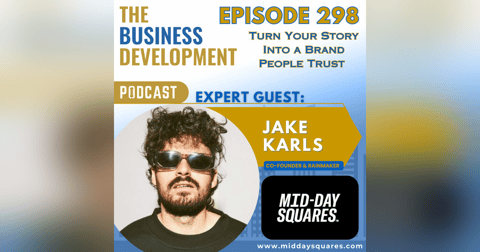


Episode 298 features Jake Karls, co founder and chief rainmaker of Mid Day Squares, breaking down how a kitchen table idea turned into a multimillion dollar brand by winning attention the hard way, through relentless storytelling and real human connection. He explains why attention is one of the most valuable assets in business, why you cannot buy trust with generic marketing, and why your story is the one advantage competitors cannot copy, if you are willing to share the good and the ugly.
The conversation also goes deep on the cost of building at full speed. Jake opens up about burnout in a way most founders never do, from chronic fatigue and brain fog to spiraling anxiety and feeling completely out of control, and how stepping away, therapy, and real recovery practices helped him rebuild. It is a powerful reminder that growth is a long game, and the strongest leaders are the ones who protect their health while they keep showing up.
Key Takeaways:
1. Attention is one of the most valuable assets now, and you have to earn it, not just pay for it.
2. People do not connect to product claims, they connect to emotion, meaning, and a story that feels real.
3. Your story is the one advantage competitors cannot copy, so treat it like an asset and share it on purpose.
4. Trust is built by showing the good and the ugly, not by trying to look perfect.
5. Impostor syndrome gets louder when you perform for approval instead of showing up as yourself.
6. Comparison is only useful if it inspires you, otherwise it quietly poisons your energy and progress.
7. Overworking for too long is not toughness, stepping back can be the move that lets you go ten steps forward.
8. Therapy is not a crisis move, it is leadership work that strengthens communication, perspective, and resilience.
9. Your business cannot be your identity, because that pressure will break you when life hits.
10. Surround yourself with real people who want you to win, and talk about the hard stuff before it turns into chaos.
Follow Jake Karl's on LinkedIn
If you love this show, you will love The Catalyst Club. It is where founders and leaders take these conversations off the podcast and into real rooms, real relationships, and real support that helps you move faster and lead stronger.
Join us today www.kellykennedyofficial.com/thecatalystclub
Turn Your Story Into a Brand People Trust with Jake Karls
Jake Karls : I hurt my back and it was the strangest injury. And then it, physically I was so, I was mentally in a weird place. I was stressed and then I physically got hurt. And then identity, I started to think was, oh my God, am I gonna lose it? I, I, I'm physically injured. I can't get somewhere. I, I, I'm always need to be physical, you know?
And then that brought me down a worse spiral. And then I couldn't get out of it, and it just got bad. My injury got bad. And then my, I started to worry about everything in my life. Like everything started becoming like a worry. And OCD started coming that I never had before. I had electric shocks going down my body.
I thought I was dying. Like there was this weird, I had no control.
Intro: The Great Mark Cuban once said, business happens over years and years. Value is measured in the total upside of a business relationship, not by how much you squeezed out in any one deal. And we couldn't agree more. This is the Business Development podcast based in Edmonton, Alberta, Canada.
and broadcasting to the world, you'll get expert business development advice, tips, and experiences, and you'll hear interviews with business owners, CEOs. And business development reps. You'll get actionable advice on how to grow business, brought to you by Capital Business Development CapitalBD.ca. Let's do it.
Welcome to the The Business Development Podcast, and now your expert host. Kelly Kennedy.
Kelly Kennedy: Hello. Welcome to episode 298 of the Business Development Podcast, and today it is my absolute pleasure and honor to welcome Jake Karls. Jake isn't your typical business leader. He's an actuary turned modern day Willy Wonka, an unapologetically bold entrepreneur who thrives on human connection.
As the co-founder and chief rainmaker of Mid-Day Squares, he's helping turn a kitchen table dream into a multimillion dollar chocolate empire, selling over 47 million bars and generating 30 million in revenue, all while growing at an astonishing 40 to 50% year over year. He didn't do it by following industry norms.
He rewrote them. Jake's superpower lies in building relationships, crafting compelling narratives, and proving that authenticity isn't just a buzzword, it's the foundation of a brand that stands out in one of the most competitive markets. His approach to marketing is unfiltered, raw, and refreshingly real.
Turning Mid-Day squares into more than just a product. It's now a movement, but Jake isn't just selling chocolate. He's selling a new way of doing business. One that prioritizes radical transparency, emotional resilience, and relentless storytelling. Whether it's breaking records at Costco, captivating 17 million organic LinkedIn views,
or raising 17 million in venture capital by building in public, Jake is proving that bold storytelling beats traditional advertising, a Forbes 30 under 30 entrepreneur and an EY Entrepreneur of the Year finalist. He is redefining what it means to scale a brand without losing its soul. He's not here to blend in.
He's here to shake up the industry. Challenge conventions and show the world that being yourself is the ultimate business advantage. Wow. I can't even say it. Jake. I am absolutely honored to have you on the show today.
Jake Karls : Kelly. You're an absolute rockstar. That was pure momentum, pure energy. I'm fired up to be here.
Um, I'm excited to get deep with you and have a good time and, uh, building a business is tough, but there's so much fun to it as well. So, um, I'm excited.
Kelly Kennedy: I, I love it. Dude, I've been following you for years, like literally years before I think I launched the show. I've been following you and honestly, it's been a dream of mine to have you on the show, and it's been a long slog and it's been a lot of back and forth to make it happen, but honestly, I'm super psyched and.
I just love, I love the way that you approach business. I love the way that you handle yourself on social media, and I love the way that you just dance. Like no one's looking, man. I, well, I love that about you.
Jake Karls : Dancing reminds me of being a kid, and I think that more of us need to be kids in both business world and in Regi in in, in personal life as well.
And Kelly, I wanna say congratulations to you. 298 episodes is a lot, and that's not easy to get done. And also congratulations to all your listeners for, you know, being along the journey. And I'm excited to be the 298. I would've liked to be 300. But, uh, it's part of the game. 298 still sounds sexy.
Kelly Kennedy: 298 is pretty cool.And actually this puts you out right when people are thinking about chocolate. Actually, it's gonna be right before Christmas of 2020 2025. I love it. So people are gonna be pumped and fill in stockings full of Mid-Day squares. So that's the call to action here is go out and buy like 20 Mid-Day squares and toss 'em in your kids' stockings.
They're gonna love them.
Jake Karls : How about buy? How about buy a hundred? I'm kidding. I'm kidding.
Kelly Kennedy: There you go. Kidding. You're gonna need lunches, man. You're gonna need lunches.
Jake Karls : You're, you're gonna need your Mid-Day snack. You're gonna need your Mid-Day snack. You know? Your kids are gonna need it. Everyone's gonna want it.
It's all good vibes. But, uh, Merry Christmas, I guess.
Kelly Kennedy: Yes. Yes. Well, Jake, you know, dude, you're a family business, not just a family business. A Fri rockstar from business. I wanna, I wanna know the whole story, man. I want you to take me back to being a kid who is Jake Karls, were you always an entrepreneur at heart?
Were your family entrepreneurs? How did you end up on this journey that led you today?
Jake Karls : So I think it's super important to note that I've always seen entrepreneurship, so I've been around it. You know, my, my father started a business a long time ago and worked his bum off to build it for 30 plus years.
And, you know, traveling, you know, six months across the world, you know, at times. And I saw how hard work can really you know, there's no limit to the hard work. Once you do it and you execute and you believe in something, no matter how hard it is, you can achieve some sort of dream of yours. There's a potential, there's a possibility.
It might be small. But there's a possibility. And you know, seeing that growing up and then going to school and really not doing well in school, I was like, I was, I was probably bottom of the class in terms of academia, but I was always the fun guy. Like I was the one pranking everybody, class clown, having the time of my life.
Yeah. And I thought high school was a playground and that was until. Grade 11 and where you graduate in Montreal. And you know, my principal told my mom that I might not graduate 'cause my grades were so bad. And in that moment I kind of felt like a, this weird feeling of life. I was having the time of my life for the last many years.
And then now I feel like a kinda loser because I'm like, wait, everyone of my friends is gonna move forward. Everyone of my acquaintances is gonna move forward and quotations in life and I'm gonna move backwards. So maybe being the class clown, being the fun person, being authentically myself, was actually the wrong strategy.
And that moment I questioned everything that I. Believed in prior. And I was like, I need to follow the rules. I need to follow the herd. I need to be like everybody else and be average. And I ended up taking that and I said, I'm gonna study really hard. I'm gonna work my bum off in school, get a job, hopefully have a family one day.
And that's it. That's all I need to do. And I'm playing it safe and it's all good. And there's no judgment. That's a great life. No, no. I, there's no negative to that.
Kelly Kennedy: Yeah.
Jake Karls : But inside I felt something uncomfortable throughout that process. I felt like I wasn't being me. I went to school, I went to business school after, and then I studied to be an actuary and I chose actuarial science, not because I wanted to do it, but because I wanted to prove to everyone.
I was no longer in quotations then Less smart person. Right? Yeah. And even though I hated what I was doing, you know, it's a very hard program. And, you know, shout out to the people that do do actuary, they're brilliant. When in the third year when I applied in the summer to every investment banker insurance company, I got rejected by 36.
Wow. First round interviews, and I couldn't make it through. And, I just didn't fit in. It wasn't for me. I wasn't being authentic. I was trying to play someone else's game that was doing, they were doing it a lot better than I was. And in that moment, I was sulking on my parents' couch. And I'll never forget this.
I mo I was in my parents' house. I lived there 21 years old. No job, uh, you know, failing in school and I was flipping through the channels, saw looking like a baby, and I saw Shark Tank and I saw this guy, middle-aged guy, pitching his dream. I dunno, he had two or three kids. He had two mortgages on his house.
He could barely pay for his life. But he was so fired up, he was so energized, he felt this momentum. And I, I was watching TV and my eyes kept going closer and closer. I'm like, whoa. And I was like, attracted to this energy and I was attracted to this, this momentum that I was like in that moment, I dropped outta the actual program.
I'm stopping to play the game. I'm stopping to follow the herd. I want whatever this guy's on. And I pointed to the screen and I yelled. I said, I need that. Yeah. And all that he was on was. He was living what he believed his purpose was or his passion. Sure. And he thought he could make it happen. I don't know where the business is today, but the truth is in that moment, he inspired me to say, you know what?
I'm gonna try something I like for the first time in 10 years. And that was when I, I basically said, I'm done playing another game. I dropped outta the program. I graduated with a financial economics degree in the end, but I ended up opening my first business, which was a fitness business. I loved fitness at the time, and I ended up making a ton of money doing it.
I had so much fun. Did it for three years, then did a second business after that, because I lost passion for fitness. I launched a party business where I wanted to throw parties on college campus and sell clothing. Failed miserably. But literally fell to my head, all my ass, sorry down to the drain.
And then my sister and brother-in-law approached me and they're like, Hey, you wanna join, uh, Mid-Day Squares? We're about to launch this chocolate bar company Better for you Chocolate Bar company, and we need you to blow it up. Be our third founder, and make as much noise as possible. And I looked at 'em, I said, oh, you're outta your fucking mind.
You're outta your effing mind to start a chocolate bar company. You gotta be delusional. Yeah, there's so many chocolate bars, there's so many, there's 40,000 products in a large supermarket. How do you expect your chocolate bar to stand out? And they said, that's your job to do. And I looked at them and I said, I just came off heartbreak from an ex-girlfriend.
Best decision that she made. It helped me a lot in life. I was kind of feeling depressed. I just closed my other business. I went, I lost all my money in that business and I had nothing else to do. So I was like, you know. This will keep me busy. I'll dump the rest of my money, move back to my parents' house and take my one last risk.
And that's been the last six and a half years. That was six and a half years ago.
Kelly Kennedy: Wow. Wow. And like just for the record, are you 32 now? 31. 31 Started this when I was 25. So that's crazy. So basically 10 years ago to right now was the moment, was that like entrepreneurial switch? Yeah. And look at what you've done in 10 years.
Jake Karls : Well, Kelly, it's been a dec Yeah. That decade's been insane. Like the, the failing I've done, the learnings, the experience, the good, the bad, the ugly has really happened. I've changed as a human a hundred percent. And I, I have different perspective on a lot of things. Yeah. But I think what was critical is.
You don't just need to be an entrepreneur to go through that. You could be anybody in the world, you could be in a career, you could be in a, there's no one better than the other. I think that it's just entrepreneurial allowed me to experiment things that, you know, I couldn't get a job for at the time.
Yeah. So I, I, I just tried it myself. I took on a massive risk, but I have some friends that inspire me every day. They are killing it in their careers and growing and having so much fun. So I think people like to say that. I hear this all the time, is, oh, you need to be an entrepreneur to have this freedom.
That's bullshit. That's bull crap. No offense. You can have the freedom and the purpose within a career, or you can have the freedom and purpose within an entrepreneurial journey, or even being unemployed. As long as you choose to do what you want every day and wake up feeling alive, then you're winning.
Yeah. It doesn't matter how much money, how much success. I think that that's success is the freedom and the idea that you wake up alive, excited, every day is a winning formula.
Kelly Kennedy: Absolutely, and I wanna at some point in this conversation get to balance. You know, I like to talk to, you know, all my founders about work-life balance because I know I call it bullshit, but I know a lot of them do find it.
Here's the thing I've found a lot of founders say, yeah, I did achieve work-life balance. Took me 10 years to get here, went through a divorce. I don't talk to my kid, but hey, I got work life balance. And you know what they probably do. I don't think it's impossible. Like you said, I think it maybe falls a bit on a mindset.
You know, before we kind of go down that journey. I, you know, and something else, sorry, I wanna talk to you about as well is just resilience. I know that's something that you, you hammer and I'm totally right there with you. Like, as somebody who frankly has slogged it out to get to where I'm at today. Like, there's been many, many days where I was like, I do not want to record today.
Or I had a horrible screw up and I screwed up the entire recording and I had to redo it. And you're just sitting there thinking like, oh my God, why did I choose this? And that's entrepreneurship. I think many of us. Find ourselves asking ourselves, why did we choose this? You know, it's, it's so worth it because I'm passionate about it.
I think that's really what it comes down to.
Jake Karls : Listen, it's painful. Entrepreneurship is truly, for anyone that isn't an entrepreneur or isn't an entrepreneur, the ones that are know this deeply, it's a ton of pain. Um, every day is pain, but there's huge moments that are so empowering and, and, and you feel so energized and fired up that they almost overpower the pain.
And I, I always learn one of, one of one of our board members taught me a very valuable lesson. Um, he. Said he said. Whoever can withstand the most amount of pain. The longest usually wins the biggest. And whatever winning is to that person doesn't, it doesn't make a difference. But what I realized is the game of entrepreneurship is, like you said, it's resilience and it's, it's, it's, it's how much pain can you actually withstand and keep going and.
Yeah, you're right. You know, at the end of the day, like the amount of sacrifices I've made in the last 10 years have definitely taken years off my life. And do I, am I proud of that? Absolutely not. But am I proud of some of the stuff that we've gotten to achieve and, and the impact we've gotten to make?
150%. And I don't regret anything. That being said, I've had a major burnout a year and a half ago. Mm-hmm. That, that damaged. I actually had damage from in my life, both health-wise, I believe, and just, just, it changed who I was for forever, I think. And my sister literally who stepped down as CEO and took a sabbatical for a couple months, uh, a couple months ago.
She's coming back now to work, now, right now again, but she had to take time off because she burnt out too. Yeah. And. It happens when you just go 24 7 and you believe so much, you're so excited, you're so fired up, you're so energized. You believe so much in what you can accomplish, and, and, and build.
Sometimes you forget to look at the signs that say, Hey, take a second. Slow down. Come back, take a second. Slow down, come back. Yeah. Reflect, feel reenergize recharge your Tesla. And you know, I always give the analogy, it's like a car. You know, we like cars, um, except we're not machines, but we have engine lights.
Come on. We have flat tire lights that come on. We have low fuel tanks that come on. But, sometimes we, as entrepreneurs, we're going so hard that we just say, you know what, we'll deal with it later. We'll deal with it later. Eventually the car doesn't work and you don't know what the damage can be how bad your burnout can be.
It could be one day, it could be an hour, it could be 10 years. It's a chemical change in your brain. I had a major issue that my brain, I, I started getting like major OCD and major anxiety that I'd never had. Wow. Yeah. And I had no control on it. Actually had to. Like I, I felt so unhappy, so lonely, so depressed, so empty that I've never felt that in my life.
Even though the business was going well and all this stuff, it's that I had this reaction happen and it was all because I went way too hard for too long and eventually my body told me no. That being said, I. Is work life balance as easy as people say? No, I think it's crazy to think that, I think that you gotta do things you like, like for now, I, I work out, I, I eat well, I sleep, I, I make non-negotiables.
Yeah. And those have helped me get through and keep going and feel energized as I keep achieving. Um, but I think that idea of saying 50 50, you know, it's very hard for me to say that I'm not against it. I, I don't judge people that have it. I just, I haven't figured it out yet, is what I think the answer is.
Kelly Kennedy: Yeah. And that's fair. That's fair. And I would say me too. You know, I mean, I'm learning to recognize the warning signs and what I can potentially do to put a roadblock in the way. And I want to kind of like chat with you about that because I think you probably learned a lot from your burnout. I think many people hear burnout, entrepreneurs, content creators.
We get burned out all the time and you're doing both. So I can't imagine how challenging that must be. But, um, when you're a content creator, you find yourself regularly trying to run a business. Create content and people don't realize how bloody hard content creation is. And dude, you are a king, a legend, a Canadian legend of content creation.
Lemme just say that right off the bat. Thank you. Thank you. You do it better than I say 99%. Like you're absolutely crushing it. But. But as somebody who's running podcast for 300 episodes, there is a massive cost to that. Yeah. And people like to think that content, once you know how to do it, it's easier.
And I, I always throw the challenge up that actually content creation does not get easier ever. It actually gets harder every single time because you're always trying to improve. You're always trying to stay fresh and keep up with what's new and hot, and it is flipping hard. And that can definitely drive somebody to burnout.
Talk to me about the balance of that. Dude, you are. You could just stop doing content. You could just, you know, Mid-Day Squares is known around North America at this point. It's in every major center. We're gonna talk about that. But you could just be like, you know what? I did it, but you don't.
You're out there week over week, crushing it on the content. Talk to me about the balance of being a content creator and being an entrepreneur, and can you be one or the other anymore? Or is it just mandatory to be both?
Jake Karls : You know, I love that Kelly, I love you saying it. First of all, you feel it because, you know, 300 oh, close to 300 episodes, like, you know, it's no joke.
It takes time, it takes energy, it takes, um, you know, care. And these take energy outta your system, right? Even the days you don't wanna do it, you do it, you show up because you believe in what you're doing, and I respect that so much. For me, I think that content is critical. Today's, today's success in any business that you're going to create.
Because if you're providing a service or you're providing a product or a or an a content side. You need to grab attention. Attention has become, uh, in my opinion, one of the most valuable assets in the world. And attention is hard to get because we're overloaded with information. There's commodities everywhere.
There's, there's, there's, there's tons of things happening that are, are, are competing with attention. It's not just other businesses now it's Netflix, it's it's social media. It's, it's everything. It's no longer, hey, as a business, put a billboard up and get attention 'cause no one else has anywhere to pay attention to.
No, you need to earn people's right to get their attention. They need to give you. Hey, I wanna listen to this person, or I wanna listen to Kelly's podcast, or I wanna watch Mid-Day Squares of Stories because I like them. I, I appreciate 'em, I respect them. I, I have, there's inherent value. Today to get attention you can't just pay and expect to get it and put out commoditized things.
Hey, my product tastes like this. It's so good. You should try it. No one cares about that. What people care about is some emotional connection, and I think that if you wanna win in today's world. Create a great product or a service. That's number one product market fit. But the second thing is tell a story that's meaningful.
Get out there. Share your story. That's what makes you different in the world. No one can copy your story. They can copy your products, they can copy your services, but they cannot copy your story because you've had millions of experiences different than I have. And that's what makes us unique other than our DNA.
So I think that we as brands, we as individuals, we as career professionals. We need to share our stories more. We need to be proud of it. We need to, celebrate the good and the bad. And when you do that, you create a deeper connection with the audience. You get more of an audience, you get a respect, level, relatability, trust.
These are things you can't buy. You get to earn it. So I think that for Mid-Day Squares and myself is, we're huge on storytelling. We're huge on vulnerability. We're huge on sharing you the biggest successes we've had, but also the ugliest moments. And when we do that, you feel closer to us. So when you go to that grocery store.
That big supermarket that has 30 to 40,000 products, we're not one product under the 30, 40,000. You're laser focused on us, and you're like, I know those people. I like them. I wanna buy from them because I'm a fan or I'm a friend. And that's the strategy. And it takes a lot of time. I think burnouts come from creating that content and running a business or just creating content.
It's a lot. And then to make sure that you're authentic is also a lot. Right. You know, we, we live in a world where we're, we're highlighting perfectionism for some reason, or. Or just the good stuff. But when you don't share the transparent conversation, it's almost like you're telling a different story of something else and you're keeping up with that.
And that's a lot of energy to deplete. So I think for us, the cost of doing this whole business with the content is critical to our success of our business to continue to succeed and continue to grow. But the second part is it's, is how can we remain healthy as we do it? And we're learning that as we go.
We have therapy, we have all these other things that we do, but it's, it's quite hard.
Kelly Kennedy: Well, I would argue that Mid-Day squares, it has revolutionized, and I mean, this revolutionized the way you launch a product. And I have to talk to you about that because before you, I've never seen anybody do it the way you've done it.
And you know what? I don't really give a shit about O Henry. I sure care a hell of a lot about Mid-Day squares, and I care about it because I've been following you guys for a really long time. And, you know, I wanna just chat about it because actually the company itself is really, you know, we're talking about eight years at this point.
We're going on, we're going on six, six and a half. Six. Okay. So like the fact that, that you've been doing this since, I believe it's 2018, was the launch pre COVID, and you took this approach. Were you thinking about this before this all started? Because I can tell you right now, I was never thinking about building Kelly Kennedy's personal brand.
When I launched this show, I would've been, I would've been happy if Calgary listened. Like I just, I wanted to, I wanted someone in the next town to know about me and what I was doing. I never thought we'd be listened to in 145 countries and be a top show in 41. You know, like I just, I never saw that, that was never part of the plan.
Was it part of the Mid-Day Squares plan back in 2018?
Jake Karls : Yeah, Kelly, a hundred percent. You know, our whole, our when, when I, when we launched August 4th, 2018 Mid-Day squares, we were making 'em in our condo kitchen hand, making these bars. I said to my partners, if we wanna stand out, we need to get documenting and sharing the authentic story of how we build this.
We cannot market our products the way that most consumer packaged goods companies market them, which is basically talk about the features, the benefits, the price, all that stuff. I said, if we wanna stand out, we need to tell an emotional story. So that means, you know, showing things that. Companies don't often show, you know, it's more about showing the behind the scenes of how we build it.
And I said to my partners, you know, them being introverts, they're like, that's not, we don't wanna do that. And I said, well guys, this will allow us to step aside from everybody else and allow us to get the growth that we needed to get. And, um, long story short. It's been in our DNA since that moment.
We've been telling the story, documenting, sharing, and you know, we have terabytes of content from day one and we're hopefully gonna have a documentary one day showing, the road to, we call it the road to a hundred million of exactly what happened when it happened, why it happened. Wow. And you're gonna see the insights of that.
And that's what I think, that's what people care about today, is they don't just care about buying based on, function or, or, or commodity. They care about. There's an emotional attachment now that comes with products and services that has never been around as much, I believe, and I think that social media is the reason for that.
That being said. If you could start sharing your content, you don't have to go as aggressive as Mid-Day squares, but you could start sharing your, your story and building a brand, um, just by starting to share some content. It doesn't have to be that you did it early on. No, it's never too late, is what I'm trying to say.
It's ne it's still getting started. The party's still going. Maybe it's on different platforms. Yeah. Yeah. But you're still having fun with it and people will still be on their phones scrolling all day and looking for a. Something that gives them value, uh, entertainment, education, or connectivity. So be that brand or be that individual that gives them that.
Kelly Kennedy: Yeah. And I have to ask because you guys were, like I said, so ahead of the curve, so ahead of the curve, like we're, I don't think people even started thinking about what the hell a personal brand was until last year, 2024. That was it. That was the moment where people were like, oh shit, we need to care about this.
Like, this is a real deal thing and it's really the differentiator here as we move forward in this sea of people, products, and services. Right. But for you guys to have seen that in 2018, and then obviously that led into this like immediately isolated time of COVID, talk to me about that. Was that like a way that you could connect at that time, did COVID play a role in your strategy?
Jake Karls : Building a community, I believe is, is the best way to build trust. And when you're going through hard times, you're going through like a COVID. When we lost 70% of our sales, our community supported us and they, they really tried to help us win. And they did. And I think that only happens when you have that connectivity.
If you're just a commodity or you're just a product talking about features, they will go somewhere else. You know, to get through those hard moments. It works to our advantage. And look, there's moments where content also gets us in trouble too. Like it works in both ways. But again, having a brand that's personalized or humanized is super empowering, is super powerful.
It's super, it's, it builds something stronger than just a transaction. It makes it a, uh, a friendship, which I think is, is everything.
Kelly Kennedy: Absolutely. Absolutely. And you know, like you guys have obviously done so many things with Mid-Day squares. You, you're everywhere at this point. I want to lead into that, but before we do, I wanna just talk to you like a chocolate bar, right?
Like was this, was this your sister's idea? Uh, it is Leslie, correct? Yeah. Shout out to Lindsay.
Jake Karls : Love her incredible job, love her dearly. And she created the product Pro two years prior to launching the business because she was making this as an afternoon snack for her husband, who's my other partner.
Yeah, her, my brother-in-law, Nick, shout out to him. Two. Brilliant guy. And he was eating, a little bit more sugar, chocolate bars, let's call it. And she made him a healthier snack to take for the afternoon to get him through his afternoon. And this was the Mid-Day square, but it was a hobby snack.
And then finally, you know, she ended up closing her fashion business. Brother-in-law sold out of what he was doing. Yeah. And uh, they wanted to work together and they realized that food was a passion of theirs. So they were making this product consistently at home, you know, for two years prior. And everyone loved it.
And they saw a report that came in that showed dark chalk that was growing year over year. And that protein and plant praise proteins were also growing year over year. So we just made the baby of that and they said, oh, we'll commercialize this product that we're already making. And that's when they approached me in July of 2018, I think it was, to join in and say, yeah.
You're gonna blow up this business because if we're gonna do something that's in the consumer packaged goods, we need to make as much noise as possible. So yeah, this product was made as a afternoon snack to give you indulgence, but also some function. So protein, fiber, and keep you full. Yeah. And we knew it was a white space.
And, um, we live in the refrigerated section, which is cool too, where fresh we believe that's a new category and Canada, and it's already developed in the us but it's, it's something cool and, and going to be here for a long time, we believe.
Kelly Kennedy: That's amazing dude. And you know, I just wanna talk to you because obviously you said it in the beginning.
Jumping into the chocolate industry is an incredibly competitive industry. Had you known how like competitive and hard it was going to be, would you have approached it differently in the beginning? Would there, would you have done anything
Jake Karls : differently? I think that we made a ton of mistakes. You know, we self manufacture and that, that's been one of the hardest moments of our, of our journey.
And also one of the best you know, so I think that, where we got things wrong is we were so naive and, we, we listened to some noise and how to build these CPG teams and all this stuff, and I think that we would've done it a little bit differently and actually trust more of our gut during the time.
But look, like I said, like, you know, like where, where, where we really went wrong was, based on like, just trying to explode really quickly and, and, and it was all new information. But we learned a lot along the way and we're super grateful for all the mistakes that we made that have led us to here.
We've made more, we've made more decisions that were right than decisions that were wrong. Thank God. Yeah. But, uh, that's why we're still standing today. But look failure has been part of this journey throughout thick and thin day in, day out every day actually.
Kelly Kennedy: Talk to me about, about the manufacturing process and I actually had the same conversation with Mitch Jacobson of Rvvita Energy Tea.
Yeah, great guy. She's incredible. But you know, he ran into a lot of challenges when it came down to the how do you get a product, a food product to, you know, through Health Canada to market. Can you talk to me a little bit about that process? What was that process like for people that maybe are thinking of getting a food product to market?
Jake Karls : So I think that look. When you start a product, like we started in our condo kitchen and we made it, and we followed Health Canada's rules that we had that were given. Obviously, the auditing process doesn't happen until you get a little bit bigger typically. Um, but we were focused on food safety as much as we knew and as much, as much as we could at the time.
And then as we grew, we started to, um. Major certifications and major, you know, and 'cause again, safety of the consumer is the most important thing for any business. In food. It's the most important thing, and you need to have that so that trust is there and that you, you make sure that you, you avoid any danger for your con the consumer, the Canadian consumer.
Um, but when we started, we went to 26 co-manufacturers to scale our product basically to, to then take our made.
This product's very hard to make at scale. It's very art. It's kind of like artisanal is the word, but not really. But it was like this needs, we need to change certain things. Every time we come outta a square, it'd come out as a circle or the ingredient would change. Mm-hmm. And so we said to my, my partners and I said, let's just build this.
Let's build our own facility. It's let's, let's invest. It's a lot of investment, but over time it will benefit us in the long term, both from an innovation control standpoint and, and being a manufacturer is really interesting, uh, especially in Canada. And um. Like I said, like it was, it was a hard decision, but we ended up securing some debt financing from government programs, which are great for manufacturing.
And we ended up building the facility and it was all based on theoretical. We didn't, none of us were engineers. Um, we worked with engineers, but you know, this was all based on, I, you know, 80% chance of working and it ended up working not to the a hundred percent ability that we wanted it to, and we're gonna.
You know, build on that now more further as we go. But you know, we can now get a capacity of 66 million out of our Montreal facility. Wow. And we're proud of that. But that took years, man. That took like since the PO of the machine, it took, like now we're at four and a half, four, four plus years into that, and it's still not perfect, which is crazy.
Yeah. Um, but. Now we're BRC certified, which is great, which is one of the highest safety certifications in food manufacturing. But look, it takes time, right? And I think people in this world unfortunately, have this idea of instant gratification. Oh, you start a product, it's gotta scale. It's this, that, blah, blah, blah.
No things take time. Yes, you hear about the overnight success story once in a while, but that's really rare. The usual overnight success stories are 20, 30 years, 15, 20, 30 years, and that's the overnight success in quotations.
Kelly Kennedy: Yeah. Yeah. You only see it when it finally is like big and blown up and it looks like overnight, but it's like nobody's seeing the, like, the labor of love that took it there over years and years and years of effort.
I, I completely agree, man. I, um, I did a show the other day talking about podcasting, and honestly, I, I did not pull punches, man. I, the podcast industry is a total mess. The marketing companies in it are a mess. The whole thing is out to crush podcasters. It's a really shitty. Industry, the way it's set up right now, but the only way you make it is through grit and determination and going through that slog and yeah, you're seeing people blow up, but most of those shows, if you do the back, the background, they've been at it for five years, man.
Like they've been at it for five years. They got 500 episodes plus. That is what made them an overnight success. It wasn't like, oh, we released 10 shows. I'm not even sure that that works for celebrities.
Jake Karls : So I think that you're right, overnight success is the worst thing that can happen because it, it basically overnight success.
Sorry. In terms of the, the idea of it, thinking that that's how everything works is dangerous because it allows for people to think that things happen right away all the time and they don't. Things take time, systems, places, standard processes. You know, greatness takes time. You know, you know, if you wanna win big, you know it's gonna take a long time because things compounds, very small things compound over time, but eventually lead to something massive.
But it takes time. And I think that Mid-Day Squares is trying to show that, we're gonna hopefully grow into something really big over time and we're gonna stagger it consistently. And, yeah. This was built in 10, 20 years, this company. And yeah, impactful and meaningful. But at the end of the day, that was, that was the truth, right?
And anyways, long story short, um. Congrats to your, you know, I guess, like I said, your 298 episodes, that's a lot of work and it takes time. And, uh, once you understand that things take time, the world's your oyster, you can win. So big patience is bliss, man. It's really is.
Kelly Kennedy: Yeah. Yeah. It really, really is.
And it, it's, uh, it's a labor of love, right? Like that, that's why you have to love what you do. Like at the end of the day, if you don't love what you do, there's no way you'll ever become the best at it, because you're gonna have to put in a lot of hard, long days. To make it happen on times that you don't wanna do it right.
But you're absolutely right. Talk to me a little bit about that resilience, because obviously you guys have been incredibly resilient. You are growing, you know, 40 to 50% per year. That is not easy. That is absolutely challenging. Talk to me a little bit about. The resilience you've had to have along the way, have there been major hiccups in this journey for you?
Jake Karls : A hundred percent. So, you know, there, you know, we've gone through major inflation, record breaking inflation. We've gone through a global pandemic. You know, we've gone through supply chain disruptions. Right now we're going through a cocoa crisis, which is a hundred year high price point. That's one of our biggest ingredients.
That is the largest ingredients that we use. And, every time these stuff happens, one thing that I know is you don't sit still. So, you know, resilience is coming from the action that we take and being very, having a lot of conviction in the decision that we will make. And that's what we know with crisis.
Whenever we're in a crisis, we or a moment of, of failure or, or disruption that's for the negative. We just take action. And obviously strategically we think it through, but I think that. What makes a great business or a great career professional or a great entrepreneur is the ability, like I said, to withstand pain and act on it and keep going and keep fighting for what you believe in.
And, um, having that conviction in, in, in the dream that you have, but also know when to stop too, when it doesn't make sense, is critical as well as a company. But yeah, we've, we've almost thrown the talent like six to eight times. Wow. You know, just moments of just pure carnage and. The, you know, I, I, I would go to bed that night thinking that, that that was it.
The party's over. And all I know is everything passes, number one over, over a period of time. And at the end of the day. You're not, your identity is not your business either. You know, you are, you are. Something other than that. And I think that that's important for entrepreneurs specifically to go through.
Mm-hmm. Um, is to understand that they are not just their business and their value isn't just in that they are something valuable outside of that, which is their self, their sense of human, whoever they are. So yeah, I dunno. I, like I said, grit and resilience is, is probably a prereq for anyone starting a business or anyone trying to win in the career world.
Like you can't get to the top without having that. Dedication, perseverance, resilience. It's impossible. Um, greatness takes time. And greatness takes a lot of pain. A lot of failure to get to.
Kelly Kennedy: Yes. And you know, we're in a bit of a mental health epidemic. I think gen like, not just as a country, I think, you know, I think as a world, right?
Yeah. I grew up in a world where you just toughed it out. I'm Canadian, I grew up in Alberta. It was oil and gas. Just get her done right? Like, yeah. Get her done. That was the mentality. I kid you not from a little kid. Oh, you hurt yourself. Boohoo feel better in a minute. And so I grew up in that world where I was really frigging tough man.
Like I got through it, I was good. I went through a lot of hell and I didn't talk about it and I didn't, you know, I didn't share it and I just dealt with it internally. And, you know, I dealt with it later, like it wasn't, you know, major trauma stuff, but it was definitely stuff that, like, as an adult I've had to look back on and be like, you know what?
That was kind of shitty. Like, I probably, it could, probably could have been handled a little better. Um, and I wanna just talk about entrepreneur mental health with you, because I know it's such a passion for you. You talk about it all the time, you've been through burnout. What mental health challenges do you think entrepreneurs are struggling with the most?
And in your experience, how would you maybe help them?
Jake Karls : I think number one is impost syndrome's a definitely a big one. So, trying to put on that show is definitely, uh, a, a problem because that's sometimes not your authentic self. And then thinking you don't deserve to be there when you maybe do.
Is, is that self-doubt is, is dangerous. Number two is comparison is the thief of joy, in my opinion. If you compare yourself to others it's not, you can't do that unless you're inspired by it. So if you get annoyed by it it will cause a lot of carnage on you. Meaning like, when I first started I used to get, this was a, a learning lesson, but I used to, instead of being happy for people that are doing great things, I would always be like, why not me? Why didn't I get that? And it would cause this damage and negativity, negative energy in me. And it, I did tons of therapy to get through that. And now, now I'm inspired.
I want everyone to win. I want people to win because there's an abundance mindset, not a zero sum game mindset. Um, and then I think another thing for the entrepreneurs is they overwork, um, you know, they, they go way too hard, uh, for too long without taking a moment to step back because they think that they can't step back.
And strongest thing you could do, take one step back to go 10 steps forward. Um, but when you go through burnout or you're going through mental health, uh, issues or, or experiences, I think therapy is a really good one. We're huge com huge advocates of, uh, therapy. We go to therapy once a week, uh, you know, uh, either together or individually as partners and, and as leaders to better become better communicators, understand each other, understand perspective.
Um, number two is, knowing that this isn't your identity is critical, and, uh, it will relieve pressure. And number three, I would say is, is surround yourself with good people. That, that care about you want you to win are constructive with you, but also just, just real. I think that energy is critical to going on the journey.
And, and don't be afraid to speak about it. 'cause if you hold it in, the tension builds the, the, that tension can cause absolute. Chaos in your system from both a health perspective, from physical health to mental health. And I think that we need to be open about this, uh, therapy. We need to be open about, uh, communicating.
We need to be open about that. It's okay to go through hard moments in your life. Doesn't mean you're not tough, doesn't mean you're not great. And, uh, yeah, I'm a huge advocate for mental health. Been through hell and back. So like, you know, once you go through that, you're like. This is real. This isn't a joke.
So yeah, I, that's my thing. And if anyone wants to ever chat, um, by the way, Kelly is listening to this, they could add me on LinkedIn, Jake Karls, and reach out to me about this stuff. I'm happy to chat and get on the call, FaceTime, hang in Montreal, if you're in Montreal and talk about it because, uh, I know that when I first went through the burnout, I wasn't talking to anybody about it.
So, uh, it could've helped a lot.
Kelly Kennedy: Okay. I wanna chat about the burnout. And the reason I wanna chat about the burnout is because most people. I think if they haven't experienced it, they don't think it's real. Like it to me and you, I know for a fact, I know for a fact people told us about burnout and to be careful about it and to avoid it, and both of us, I'm sure I, you know what I mean?
I never completely burned out. I was able to like take that step back and for me it was an evacuation. I like evacuated the household. We went on vacation, like I was like, we just need to get out. I need a reset. So thank God. But I've hit that wall many, many times where I know that if I pushed any further, I was gonna be in some serious trouble.
And here's the shitty thing, Jake. I suck at it. I really suck at it because I keep finding myself right back there over and over again as a content creator, as an entrepreneur, because I am, I do want to win. I do wanna succeed, right? Like we're not at 300 episodes because I don't. I don't wanna make it.
We're at 300 episodes 'cause I'm gonna make it to a thousand. You know what I mean? Like I'm going. But yeah, it takes a lot of resilience. It has a lot of hard days. Uh, there's plenty of times where I've like, I've really hit the wall. I put in, you know, way too many 18, 20 hour days in a row, and my body's just like, Kelly, you're gonna die.
Yep. Talk to me about what were the symptoms of your burnout? What was the path of the burnout, and at what point were you, like, did you really feel like you had no choice but to do something about it?
Jake Karls : I think the symptoms were lethargic not being inspired, feeling lonely tired, all the fatigue, like consistent fatigue, chronic fatigue, I think was the most thing.
And then not being excited, um, about, uh, about life, let's call it. And, um. My work was, I had brain fog all the time when I was working, and I think what led up to it was I had all this hype and all this wins and all this momentum and I didn't wanna lose it. I was fearful of losing it. So I was doing everything to keep it, to chase more attention, to Chase more awards, chase more, which isn't who I am, but I was on that path, so I was taking me off my path.
Mm-hmm. Which was causing the carnage. And then, I ended up playing hockey one day and I, I was playing outside because I, I love hockey. It releases stress and I took a wrist shot and I fell in a weird way and I, I hurt my back and, um, it was the strangest injury. And then I physically, I was so, I was mentally in a weird place.
I was stressed and then I physically got hurt and then my identity, I started to think was, oh my God, am I gonna lose it? I, I, I'm physically injured. I can't get somewhere. I, I, I'm always need to be physical, you know? And then that brought me down a worse spiral. And then I couldn't get out of it, and it just got bad.
My injury got bad. And then my, I started to worry about everything in my life. Like everything started becoming like a worry. And OCD started coming that I never had before. Yeah. I had electric shocks going down my body. I thought I was dying. Wow. Like there was this weird, wow. I had no control. I had no control.
So then I took 40 days off. I did a ton of therapy, I did a ton of stuff. Osteos and then, and hypnosis. I did everything you could imagine.
Kelly Kennedy: Yeah.
Jake Karls : It took time, but I got myself back up. Um, I needed rest. I needed to understand, a little bit more about my purpose again and bring it back to that. And then I needed to understand that, um, you know, health is serious.
Like it's not a joke and burnout is real, I guess. Now I try to talk about it a lot to help others, but at the end of the day, like, look, it's it, this is a real, uh, this is real. And, and you gotta be careful 'cause you don't, it affected me for. Let's say a total of couple months. At the end it was 40 days out, but it was a couple months of actual effects.
Yeah. But some people it could be way longer or it could be way shorter. Again, it's how your body reacts.
Kelly Kennedy: I've heard of people ending up in hospital, man. Yeah, I've heard of, I've heard of burnout. Putting people right in the hospital, like just completely outta commission. I, um, yeah, I, and it's crazy because I think.
Many entrepreneurs, we don't actually think it's real. Like, we're just like, oh, that's bullshit.
Jake Karls : Well, you just, you never think is gonna happen to you. You never think's gonna happen to yourself. Right. And then it does. Yeah. And, uh, look, the only way I could say you could avoid is understand the signs. And then create a great support and, and take time for yourself.
Like, uh, you know, if you need to take, if you need to take a trip to, you know, uh, you know, drive for an hour during two o'clock in the day, go, um, you know, if you need to, uh, you know. If you need to take time off, like you just do it, like it won't go anywhere. Yes, there, there might be a little bit of damage or whatever, but at the end of the day, like we're building our business so that we don't, we have to be, we wanna be as irrelevant as possible in the day to day, and we're becoming more irrelevant.
My partners and I, our team is so strong that they're great. The team we have now, they're building this business and that gives us time to kind of like reflect, recharge. Build back. So we come really strong to everything we get to do. Right? So just, just be aware for anyone that's listening to this episode, just be aware and, and don't be afraid to share with people.
Kelly Kennedy: Absolutely. Absolutely. You know, you mentioned hypnotherapy. Yeah. Can we talk about that really quick?
Jake Karls : Yeah. Dude, not, not a medical advice here, but like, and this is not medical advice to anyone, but it worked really well for me. Basically, I had so much OCD and anxiety that came outta nowhere, right? So like, I would literally, like, would think I'd burn my hand and it would be third degree when I wouldn't even burn it.
Um, I, I went through like a. Crazy psychological thing that I was like, I don't know what's going on. And I was on a treadmill one day, uh, walking because I needed to get exercise. And this is after I got injured, after the burnout. And, uh, this lady next to me in the treadmill said she had a friend that hurt her back too.
And, and long story short, the only thing that worked for him was hypnosis. So I was like. That sounds crazy. Um, so she's like, just try it. So I tried it, uh, skeptical and I went to 15 sessions, uh, over a period of like 10 months or so. And all, a lot of my OCDs I'd say 90% have volume have gone volume down completely.
Wow. And there's still 10% little bit here and there, but I live my life. I, control which is so strange. I never thought that that would be a case. But it worked. And again, it's not medical advice for anybody, but it did work for me.
Kelly Kennedy: Yeah. No, that's incredible. What is next for Mid-Day Squares?
Jake Karls : Oh, dude, we, we we're global expansion number one. Number two is we're launching an innovation. By the time this episode comes out, there will be a new innovation that's a non cocoa product. So we're, right now we have all chocolate products.
Kelly Kennedy: Yeah.
Jake Karls : But we're working on a really cool afternoon snack that's non cocoa. I don't wanna announce it yet, but it's epic and it's indulgence with function protein, fiber. So get ready. It is going to be insane.
Kelly Kennedy: Amazing. Amazing. I will be like, I'll write about it when we launch this because I'll, I will have tried it by then and I'll be able to give like a little my comments on it, hopefully if it's out by this time next year.
And last but not least, dude, you're talking to a lot of entrepreneurs. I think you've, you've helped a lot on the mental health aspect or on the mental health aspects. I can't talk and the inspiration, but if you could just give one incredible piece of advice to these people from your journey, what would that be?
Jake Karls : Lean into yourself 'cause you are your greatest superpower and no one could be you other than you.
Take that and use that to your advantage rather than being afraid of it.
Kelly Kennedy: Amazing. Amazing. Jake, it's been an incredible honor to have you on the show. I'm a huge fan. I will continue to be a fan for a long time. Mid-Day Squares is amazing. You're an incredible Canadian entrepreneur, and you are leading it in the personal branding space for Canadians.
And I just wanna thank you for that.
Jake Karls : Kelly. You're a rockstar. Thanks for having me on the show, and thanks to all the listeners that listened. Keep rocking, keeping amazing, and never stop being bold.
Kelly Kennedy: Amazing. Until next time, you've been listening to the Business Development Podcast, and we'll catch you on the flip side.
Outro: This has been the Business Development Podcast with Kelly Kennedy.
Kelly has 15 years in sales and business development experience within the Alberta oil and gas industry, and founded his own business development firm in 2020. His passion and his specialization. Is in customer relationship generation and business development.
The show is brought to you by Capital Business Development, your Business Development Specialists. For more, we invite you to the website @ www.capitalbd.ca. See you next time on the Business Development Podcast.

Co-Founder & Rainmaker
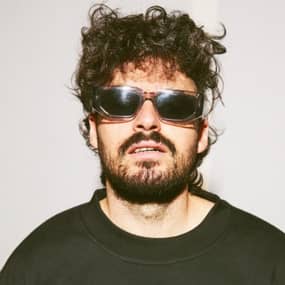
Jake Karls isn’t your typical business leader. He’s an actuary turned modern day Willy Wonka, an unapologetically bold entrepreneur who thrives on human connection. As the Co founder and Chief Rainmaker of Mid Day Squares, he’s helped turn a kitchen table dream into a multi million dollar chocolate empire, selling over 47 million bars and generating $30 million in revenue while growing at an astonishing 40 to 50% year over year. But he didn’t do it by following industry norms, he rewrote them. Jake’s superpower lies in building relationships, crafting compelling narratives, and proving that authenticity isn’t just a buzzword, it’s the foundation of a brand that stands out in one of the most competitive markets. His approach to marketing is unfiltered, raw, and refreshingly real, turning Mid Day Squares into more than just a product, it’s a movement.
But Jake isn’t just selling chocolate; he’s selling a new way of doing business, one that prioritizes radical transparency, emotional resilience, and relentless storytelling. Whether it’s breaking records at Costco, captivating 17 million organic LinkedIn views, or raising $17 million in venture capital by building in public, Jake is proving that bold storytelling beats traditional advertising. A Forbes 30 Under 30 entrepreneur and an EY Entrepreneur of the Year finalist, he’s redefining what it means to scale a brand without losing its soul. He’s not here to blend in. He’s here to shake up industries, challenge conventions, and show the world that being yourself is the ultimate business advantage.