
Why You Freeze Under Pressure and How to Take Control with Nausheen I. Chen

 Apple Podcasts
 Spotify
 Amazon Music
 RSS Feed
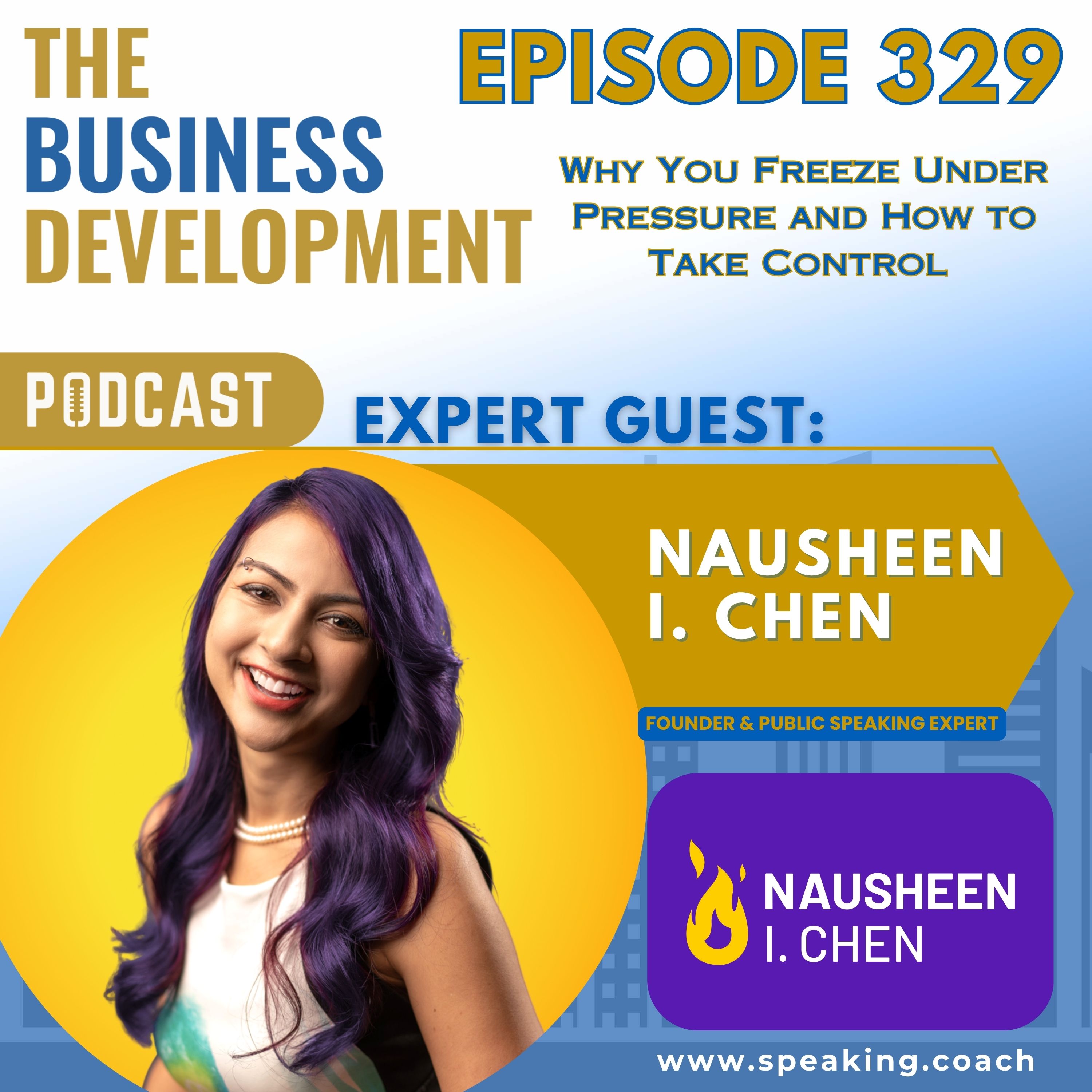
 In Episode 329 of The Business Development Podcast, Kelly Kennedy sits down with Nausheen I. Chen, 3x TEDx speaker and Fortune 500 communication coach, to unpack why so many capable leaders struggle when it’s time to speak. From the fight, flight, or freeze response to the pressure of being seen and judged, Nausheen explains what’s really happening in your brain when you feel nervous, lose your words, or freeze under pressure. This episode breaks down the psychology behind communication and why even highly successful professionals can sound flat, robotic, or disconnected when it matters most.
More importantly, Nausheen reveals the shift that changes everything. Public speaking isn’t about confidence, it’s about focus. When you stop trying to perform and start focusing on delivering value, the pressure disappears and your ability to connect skyrockets. If you want to communicate with more clarity, presence, and authority in meetings, presentations, or content, this episode gives you the mindset and tools to finally take control.
Connect with Nausheen I. Chen and learn more about her work:
Website: https://www.speaking.coach
Speak as a Leader Podcast: https://open.spotify.com/show/5QTpeh8l5ow8y72rtr8np2
YouTube: https://www.youtube.com/@nausheenichen
LinkedIn: https://www.linkedin.com/in/nausheenichen/
Instagram: https://www.instagram.com/nausheen.speaking.coach/
Email: nausheen@speaking.coach
Key Takeaways:
- You don’t freeze because you lack confidence, you freeze because your brain thinks you’re under threat.
- Public speaking fear is a primal response, not a personal weakness, and it can be trained.
- The biggest shift in communication is moving from performing to delivering value.
- When you focus on the audience instead of yourself, pressure drops and clarity rises.
- Confidence is not something you’re born with, it’s built through repetition, self-talk, and preparation.
- Your voice, energy, and body language are the three levers that determine how your message lands.
- Most people fail in communication because they focus too much on what to say and not how it’s delivered.
- Memorizing scripts creates pressure and increases the chance of freezing, speaking naturally creates connection.
- Exposure and repetition reduce fear, but only if you review and learn from each performance.
- The goal isn’t to impress people, it’s to make their time feel valuable, and everything changes when you do.
Sponsor Shoutouts
This episode of The Business Development Podcast is proudly supported by Hypervac Technologies, a leader in hydro excavation equipment helping contractors excavate safer, faster, and more efficiently across North America.
Alongside Hypervac, Hyperfab delivers custom-built fabrication solutions designed for durability, performance, and real-world industrial application.
This episode is also proudly supported by Thunder Bay Hydraulics Inc., specializing in hydraulic manufacturing, repair, and systems integration across Canada.
Alongside them, Atlas Elite Lifts delivers high-end lift solutions for luxury homes, condos, dealerships, and elite garage spaces, with systems that are truly Bat Cave Ready.
🌐 https://www.thunderbayhydraulics.com
🌐 https://www.atlaselitelifts.com
If you enjoy the show, please take a moment to support these incredible companies who make conversations like this possible. 🎸⭐
Join The Catalyst Club
If you enjoy conversations like this and want to connect with entrepreneurs, leaders, and business builders focused on real growth, join us inside The Catalyst Club.
🌐 https://www.kellykennedyofficial.com/thecatalystclub
Mentioned in this episode:
Hyperfab Midroll
00:00 - Untitled
00:39 - Untitled
00:43 - Understanding Selfishness in Business
05:19 - The Power of Communication: Overcoming Fear and Building Confidence
24:41 - The Magic Trifecta of Communication: Voice, Energy, and Body Language
41:37 - The Power of Self-Talk and Confidence Building
01:00:13 - The Confidence Accelerator Program Overview
Why You Freeze Under Pressure and How to Take Control with Nausheen I. Chen
Nausheen I. Chen: Everyone in that room is selfish and that works for me. They're selfish because all they want is value. They wanna know that their time spent in that workshop was worth it.
Intro: The great Mark Cuban once said, business happens over years and years. Value is measured in the total upside of a business relationship, not by how much you squeezed out in any one deal, and we couldn't agree more.
This is the Business Development podcast based in Edmonton, Alberta, Canada, and broadcasting to the world. You'll get expert business development advice, tips, and experiences, and you'll hear interviews with business owners, CEOs, and business development reps. You'll get actionable advice on how to grow business, brought to you by Capital Business Development CapitalBD.ca
Let's do it. Welcome. To the Business Development Podcast, and now your expert host, Kelly Kennedy.
Kelly Kennedy: Hello, welcome to episode 329 of the Business Development Podcast, and today it is my absolute pleasure to welcome to our stage Nausheen Chen. Nausheen is a three times TEDx speaker, fortune 500, public speaking coach and founder of the Confidence Accelerator, a program built to transform leaders into confident, high impact communicators.
She has coached over 350 CEOs, founders and executives from companies like Amazon, Google, SAP, and the United Nations, helping them generate more than $65 million in revenue through stronger communication, sharper messaging, and more powerful presence. She also teaches public speaking at the executive MBA program at Central European University and is a LinkedIn learning instructor shaping how professionals communicate on a global scale from boardroom to global stages to the camera lens.
Nausheen helps leaders step out of the shadows and into clarity, confidence, and most importantly, influence because in today's world, the people who win are not just the ones with the best ideas. They're the ones who can communicate them in a way that moves people to act. And if you can't do that. You're not just being overlooked, you're being left behind Nausheen.
Honestly, it is an honor and a privilege to have you on our show today.
Nausheen I. Chen: Thank you so much, Kelly. Thank you for the kind words for that amazing intro, for your amazing vibe in general that is super contagious. I love it. Thank you so much for having me.
Kelly Kennedy: You know, since the moment we met, I've been looking forward to this conversation.
There's certain people who are just absolutely magnetic and you are one of them. And, uh, you know, communication is just one of those things that is absolutely critical. Um, and I, you know, I mean, I'm not the best communicator. I took a lot of bravery to get here, and I think we're gonna be talking about that today.
Actually. I'm a very introverted person. For the people who are very close to me, they actually know that I, I prefer to be at home with my family most of the time. Mm-hmm. But, uh, but I'm out here doing a podcast, doing two podcasts now, actually running a business development company, putting myself out there as the head of the Catalyst club and kind of trying to inspire and educate leaders.
And it's funny because I've had to learn along the way and, and one of the things that I've realized is how critical becoming good at communication is, but not just becoming good at communicating, being brave enough to do so.
Nausheen I. Chen: And I love that you're doing this intentionally, and that's really what it's all about, right?
Not just waiting for opportunities to come to you or hiding behind. A specific personality trait or saying that this is just not me, but really putting yourself out there. So I love that you've done that and you continue to do that.
Kelly Kennedy: Yeah. Thank you. Thank you. I'm excited. Like I said, to just dive into it today, I'm always looking to improve.
Every listener of this show is always looking to improve. I would say that, um, I'm the biggest learner on this show. At the end of the day, I'm super curious and I want to know, and I wanna learn from leaders like you because I wanna become good at these things. I wanna become a better entrepreneur, a better business owner, a better partner, a better founder a more healthy, more well-rounded human.
And the only way you get there is by accepting the fact that there's a lot of things you don't know. And it's not uncommon for me to be riding with my partner in the car and look at her and just say. What is it that I don't know right now that is absolutely holding me back and I feel like this conversation is mm-hmm.
Absolutely. Gonna be one of those things.
Nausheen I. Chen: I love that. No pressure.
Kelly Kennedy: Yeah, no pressure at all. Alright, before we get into it, Nausheen, who is Nausheen Chen? How did you end up on this incredible journey? Like obviously the bio speaks for itself, but how the heck did you get here?
Nausheen I. Chen: One of those annoying kids who always.
Gets up in front of the entire family and recites the most boring poem that used to be me. I was that annoying kid. So I've been in love with speaking and performing for as long as I can remember. I actually did a whole psychoanalysis on this on why I, I seem to love this thing that a lot of people hate.
A lot of my clients don't share my love for the spotlight. I'm the one who's like guiding them and nudging them into it. And some of them are like, I really dislike what it, when all eyes are on me and the pressure is on. But I've loved that for as long as I can remember. And I, I trace it back to, I trace it back to my childhood, the formative years as they call them, right.
Where,
Kelly Kennedy: yeah,
Nausheen I. Chen: I was the youngest by far in the family, and so no one took me seriously. Everyone was easily decades older. And I'm talking cousins that are decades older and I was an only child. Yeah.
Yeah.
So no one ever thought that I had anything worthwhile to say, but at the same time, I had this burning desire to share my opinions and my takes on things.
And I realized the only time that I could really get that attention is when I would perform something. Because when you're in the spotlight, when you're on stage, people actually give you attention. You feel that you're saying something that's worthy of being said. And that's when I realized, wow, this is what I really like.
I want people to tune into my message. I had this weird conviction that I, I have things to say. I just need an audience. And so I. Always loved having that audience, engaging that audience, creating conversations with them. And that led me to doing a radio show for millions of people when I was still in my, my late teens, early twenties being.
Kelly Kennedy: Wow,
Nausheen I. Chen: that was awesome. That was great. It was my first job in the radio.
Kelly Kennedy: That's so cool. That's so cool.
Nausheen I. Chen: Thanks. And after that, becoming a communication skills trainer. So I was, my entry into the Fortune 500 world was also very early. It was my first real job out of college. I was at Procter and Gamble, and I was doing marketing and PR as my main work.
And then I got trained as a communication skills trainer, which is the part that I loved. And at one point I was the youngest communication skills trainer at that part of the company. I was training people twice my age in communication skills, presentation skills, and really took that training and used it.
In life. When I changed careers, I became a, a director. I was a commercial director creating commercials for American markets. And I was working with a lot of Asian companies. And at that time, I started working with a lot of CEOs, startup founders, entrepreneurs who were telling their story on camera for the first time.
And I noticed something weird. So these were really impressive people. These were people that had raised millions of dollars for their companies. They had done, uh, seed rounds, they had done funding rounds, but you put them in front of a camera when the spotlight is on them. They became these pale robotic versions of themselves.
They did not tell their story in any kind of an engaging or interesting way. They lost all personality and all impact.
Yeah.
And at that time. I was the director. My job was to get the best performance out of them. So I started coaching them without realizing that I was coaching them to actually speak better on camera.
Yeah.
And then that led me to a second career change after the PR and marketing stuff, after the filmmaking stuff, getting into public speaking, coaching full-time. And that's where I really combined my love for the stage that had gotten me onto hundreds of stages over 17 years, including TEDx and my love for the camera.
Yeah. 'cause now, as you said, it's about putting yourself out there, especially if you're a business owner. If you're an entrepreneur, a founder, anyone who is building their brand, anyone who wants to be known and recognized as a thought leader in their industry, you cannot hide behind the keyboard. So it's all about ensuring that you're visible first on camera.
That is the easier part. Doing
Kelly Kennedy: sure.
Nausheen I. Chen: Amazing podcasts like yours, creating videos, doing live webinars, events, and then eventually also putting yourself out there in terms of in-person events, speaking on stages, meeting people in person, getting that recognition for your idea. So that's the work that I do.
I work now with a lot of brilliant founders, entrepreneurs, business owners, and turn them into powerful communicators regardless of which room they walk into.
Kelly Kennedy: Wow. And, and not just one TEDx, three TEDxes. That just blows my mind. You definitely have the record for most TEDxes on this show.
Nausheen I. Chen: I like that.
Kelly Kennedy: We've definitely had one time. I'll take it. Thank you many one time, not many. Three time or even two time. Um, yeah, that's huge. That's huge. I think, it takes a special kind of person though, right? Like I know for me, right? Pick up my cell phone. I have always struggled to record myself on a phone, which sounds crazy, right?
I should be able, like I have a podcast, I have 300 episodes. I talk to people all the time virtually, but I like it. I feel that the moment that I pick up my phone, I'm like, well, what? What do I say?
Nausheen I. Chen: Well, if you're trying to,
Kelly Kennedy: why am I doing this?
Nausheen I. Chen: That is a hard part.
Kelly Kennedy: It's like, for me, the podcasting has been such like a, I don't know. I don't know the way to put it. It's been, it's pushed my boundaries to get here. I'm a much better communicator. Mm-hmm. At episode, you know, whatever, whatever. You 3 29 that I was at episode eight by a lot.
Yeah, right. Like just by like nature of doing this many conversations, this many shows, you get comfortable and then you can do it. But I think that's it. It's like, it's taken a lot of repetition, a lot of practice to get comfortable and confident. There was a time in my life Nausheen where like, you know, people in your position, uh, founders, executives, high level leaders, they would scare the shit outta me.
And I mean that in the best possible way. I don't know why. Yeah. But I would have like a very anxious response. I remember going to job interviews and literally shaking. I know there's people listening. Be like, Kelly, are you for real? Like you Yeah. Me. Me, I, I really struggled with the pressure of that moment.
And I, and I always wondered if it was just me. Right.
Nausheen I. Chen: It was absolutely not just you.
Kelly Kennedy: Yeah.
Nausheen I. Chen: This is very common. Yeah.
Kelly Kennedy: So what is happening to us Nausheen in those moments? What is happening to us? Like, why are we feeling so overwhelmed in those moments?
Nausheen I. Chen: So when the spotlight is on you. Some weird things start happening in your brain, and if I take you back to caveman times, right?
When we all used to live in caves, life was simple and very, very, very hard.
Yeah. Very hard and cold.
Yes. Cold, cruel, insane in so many ways. When we were at that time, at that point in our evolution, if you were singled out, if you did not have any members of your tribe around you or behind you, you were really singled out if people were looking at you, if you were in a clearing where you couldn't hide, if you didn't have any weapons.
All of those things were gigantic red flags. Your brain is just like, I'm being attacked. I'm being attacked. I have nowhere to hide. Nowhere to run. Yeah. No strength in numbers, nothing. I am singled out in the spotlight. Yeah. So there's this very specific thing that starts happening to us where, where our fight, flight, or freeze response kicks in.
So some people, they wanna fight. So they get into this mode where you have an adrenaline rush and you start speaking faster because you wanna get it over with. Mm-hmm. But also because you have all this adrenaline running through your body, you have excess nerves, that's when your hands start shaking.
Yeah. Your voice might tremble.
Kelly Kennedy: Yes.
Nausheen I. Chen: You start feeling butterflies in your tummy. All of that is just a physiological response to the fact that you are not comfortable, you are not in control, and you feel like you're in danger. So
Kelly Kennedy: it's interesting,
Nausheen I. Chen: the lizard part of our brains,
Kelly Kennedy: it's literally primal.
Nausheen I. Chen: It's primal.
It's literally primal. And so that's one response. Everyone doesn't feel that way, but a lot of people do the fight responses. Potentially the most common that I've studied come across and ex and and experienced as well, for sure myself. There's the flight response, which is really people running off stage, people going off camera, people just not wanting to deal with that pressure.
Yeah. I actually once worked with a very, very introverted and shy vp. She was a new VP at a multinational bank. She'd always been introverted, super, a plus performer, but was never, ever comfortable on stage. And the first time that she had to address the whole company as a new vp, she couldn't get through her talk.
She had to really bolt. She ran off stage, I believe within a minute or so of her talk actually starting, and she felt humiliated and traumatized and embarrassed. Mm-hmm. She couldn't get through it. It got too much and that. Is a challenge. Challenge that is absolutely solvable. It sounds like something that is very, very intimidating.
And it was, but then when we worked together in, in a few months, she was able to do many other presentations for the company, for the same audience. It's just a matter of changing your mindset. So that's the flight response. And then of course there's the freeze response. Yeah. Which a lot of people are scared of.
They're scared of, their minds going blank, but thankfully it doesn't happen as often as we are scared it'll happen.
Yeah,
yeah.
So,
but it does, it does. You do have people that freeze. Again, I, this is actually this, this one time I was in the audience and there was this senior leader who was on stage.
And she went blank. She had started her speech.
Mm-hmm.
And really in, within the first 20 seconds, she was just looking around at the audience and we were about 500 people. And she was just like I I, I'm sorry. This is the first time that I'm speaking to an audience as big as this.
Yeah.
And everyone started clapping.
Everyone was just like, we're here for you. Yeah. We're here to support you. And her words came back. So that's essentially what happens in our brains. All three challenges are absolutely solvable. Uh, but it is something that we feel that we can't control because it just, it starts happening to us before we have an idea of actually what's happening.
Kelly Kennedy: Yeah. I love that. And I, I think for me, I definitely resonate with the fight response. I think that's exactly what happens to me, and I've actually had it where, and it never lasts. It's always very short. Yeah. I think maybe that's the important thing to remember is that like, whatever you're feeling, it is very temporary.
It feels in the moment like it's gonna last forever and you're gonna die. But it's really only about 20 to 30 seconds. For the whole thing. Mm-hmm. To go through its loop. Right. But I've had it where like I couldn't talk, like it was like my words were gone and I'm like trying to talk and I can't, I can't talk.
Um, and I knew what I needed to say. It's just for whatever reason, my body's response was, you are not talking.
Nausheen I. Chen: That could have been the freeze response.
Kelly Kennedy: Yeah. Interesting.
Nausheen I. Chen: Cross between the fight and freeze.
Kelly Kennedy: Yeah. It felt like I lost my voice. And it was very temporary. It came right back. Yeah. But yeah, I, I, and I think in the moment too, I had had this like really rehearsed introduction that I was trying to do.
And if you know me, I'm not a rehearsed guy. Like that's just not who I am. I'm a let's get on, let's have a great conversation. Let's shoot from the hip and learn some shit. That's who I'm Right. And so for me, I was trying to do something that isn't my natural way. And uh, yeah, it screwed me up. And so the moment I went back to my natural way and got on with what I was going to do in the first place, life was good.
But I think I got about halfway through that introduction and decided I'm not gonna do this. I'm.
Nausheen I. Chen: Yeah.
Kelly Kennedy: And, and that way we went and life was good.
Nausheen I. Chen: And actually I, I, I had a chance to have many conversations with President Obama's, uh, speech writer, Terry Szuplat. Wow. And so, yeah, that was, that was awesome. That is amazing. He's an amazing person.
Kelly Kennedy: Yes.
Nausheen I. Chen: Uh, and in his book, he writes about this time where President Obama, before he became president, he had a very specific incident where he went blank.
And this is someone who's been trained in public speaking. He was very confident. It wasn't nerves, but he literally, he went blank because there was a point where he was leveling up. So he was speaking to bigger and bigger audiences. Yeah. And this was the, the biggest, highest stakes event that he had to speak at.
And his mind just went blank. And he felt traumatized by that himself because it had never happened to him before.
Kelly Kennedy: Yeah. Yeah,
Nausheen I. Chen: but it's the pressure. It's the pressure that if you let it get to you, it absolutely gets to you.
Kelly Kennedy: Yeah. Yeah. So bring me into that, right? If, if even presidents can struggle with this and can find themselves in a moment, a very traumatic moment.
I agree. I think for that VP story that you were talking about, being up there introduced for the first time as a leader and then freezing up and having to walk off stage, that is insanely traumatic. And not to mention
Nausheen I. Chen: Yeah.
Kelly Kennedy: Every, it leaves everybody else questioning, is this the person we should have leading us?
Nausheen I. Chen: Absolutely.
Kelly Kennedy: It has a lot of negative outcomes,
Nausheen I. Chen: even if they're convinced.
Yeah.
Kelly Kennedy: Because it's one thing to wear a title, but it's another thing to own that title.
Nausheen I. Chen: I like that. Right. That's very true. It's about the fact that yes, people logically understand that you have this expertise, but if you're not good at showing it to them at being able to express your ideas in an impactful way, then they just have to trust that you know what you're doing.
And trust is very, very low these days. Yes, overall, everyone's distrusting and mistrusting people and companies, and that's, uh, I would say it's a good thing. It's a good thing to have a healthy level of, of mistrust till you feel that the person or the company has proven themselves to you. So this happens very often, not just in these extreme circumstances, but also how many times have you watched a talk or a presentation or even been engaged with someone in conversation?
Someone who is very qualified, who is an expert in what they do. You know that they're an expert, but when they speak about it. They're so boring. They speak in a flat, monotone. They use jargon. They're not interesting. You at all. Your mind's wondering and you're like, okay, okay. I gotta come back.
I gotta come back. I gotta retune in. Has that happened to you?
Kelly Kennedy: Oh yeah.
Nausheen I. Chen: Right. Definitely SAP to all of us.
Kelly Kennedy: Yeah.
Nausheen I. Chen: And we, of course, we make allowances. We say, no, this person's just very well qualified. They're just not a good public speaker. They're just not a good communicator. And that's potentially us making, finding a silver lining somewhere.
Yeah. But imagine if you're an expert in your field and you're an excellent communicator, that's what the top 1% does. That's what Simon Sinek does. That's what Mel Robbins does. That's what, that's what Cody Sanchez does. Alex Orosi, yes. All of these people have insane amounts of experience and expertise.
Also they're amazing communicators. So once you marry that, then there's no stopping you.
Kelly Kennedy: Yeah. That's amazing. I, I almost link it to marketing materials because I, you know, I mean, I teach people on marketing materials, right? And what I always say is, it doesn't matter how good the words are or what you have to say if nobody looks at it,
Nausheen I. Chen: right.
Kelly Kennedy: And so I kind of look at it the same way with marketing materials. You have to have a nice pretty image in order for them to care about what is inside your brochure, what is on your website, right? If it's boring, nobody's gonna give it a second look. And it doesn't matter how good your message is. Yeah.
It sounds like public speaking is the same way. How you say something is actually more important than what you say because how you say it. Will basically allow people to either care and pay attention or tune out. And if they tune out, it ma, it matters, not what your message was.
Nausheen I. Chen: Yeah. And this is so important because the, what people actually do is they do it backwards.
Where the moment you get a keynote opportunity, a presentation, a webinar that you need to do, the first thing you start doing is working on your presentation, working on your slides.
Kelly Kennedy: Yes.
Nausheen I. Chen: And very often that's the last thing people do as well. They keep working on their slides, beautifying them, adding things, working on their script, working on all the, the, the stuff that they're gonna say, but they don't focus on how that message will actually be delivered and how people will actually receive that message.
What does the audience actually want? What do they wanna walk away with? Yeah. What's gonna be a good use of their time? That's where the missing piece is. That's why we walk into events and are on our phones or checking email or sometimes on our laptops. That's why we multitask when we're in Zoom meetings and presentations and we keep our cameras off and start checking our email and doing work on the side because the person who's presenting is just not engaging enough.
Kelly Kennedy: Yeah. Yeah. Okay. Well let's speak to that then. Mm-hmm. 'cause I think maybe that could be one of the biggest takeaways from today's show. It's not what you say, it's how you say it. Nausheen teach us how in the world do we deliver a powerful message in a way that people will actually pay attention.
Nausheen I. Chen: And this is, this is great because a lot of people think there's a lot of stuff that you have to pay attention to, is actually just three simple things.
So I call this the magic trifecta. When you watch a TEDx talk that you love, when you listen to a podcast, that is really inspiring what the speaker is doing, essentially, they're always playing with these three things, their voice, their energy, and their body language. Really, that's it. It's as simple as that.
But people do not do this intentionally. A lot of people don't. The 1% that do, they rise to the top. So it's about mastering your voice, not speaking in a flat, monotone, not speaking too fast, or that you're mumbling and your words are coming out super fast, not speaking so slowly that you put people to sleep.
So finding the right pacing, changing it up based on your message, adding pauses, changing your pitch based on the message that you're delivering. And making sure that you're using your voice intentionally as a powerful instrument, which it's, and then bringing the right level of energy. Very often you walk into a presentation or, or even a, a zoom call and the other person's energy's kind of low.
They've had a long day, it's been a long week. And then you, as the audience. You follow them, right? You follow their cue. So you,
Kelly Kennedy: yeah. You're literally body mirroring because it's an automatic response.
Nausheen I. Chen: Yes, exactly. So if this speaker, the presenter, if their energy is low, the audience's energy is gonna be low.
Mm-hmm. But if they bring an appropriate amount of energy, and I, I say appropriate because you can also go the other way. If I had come onto this podcast, Kelly, and I was like, come on Kelly, let's go. Let's go. I'm ready. Alright. You'd be like, what is she on? I'd be like,
Kelly Kennedy: I'm still on my first coffee.
Nausheen I. Chen: Right.
You'd be like, gimme some of that stuff that, that you are on because this coffee and doing it. So some people really go the other extreme. So it's about finding that Goldilocks balance of figuring out where the room is at and then bringing energy that's about. One step above because you really are the energy bringer.
If you, if the stage is yours, if you are speaking, you are responsible for the energy in the room. It's, yeah, it's a great responsibility, but
Kelly Kennedy: it's, it's a, it's a job you didn't know you were responsible for. Yes. But apparently you are.
Nausheen I. Chen: Exactly, exactly. So that's, that's the energy piece. That's the second part of the magic trifecta.
So we talked about the voice, we've talked about the energy, and the third piece is body language, which includes your facial expressions. Very often you have speakers who are so under pressure, who subject themselves to so much stress in terms of trying to remember their message, that they have a poker face on the whole time.
They're just mm-hmm. Like they, they will not intentionally express anything with their face because the brain is just is overloaded with, what did I write? What did I write? What was in my script? What did I have to say here? Yes. And then
Kelly Kennedy: there, I know that feeling,
Nausheen I. Chen: right. And then the whole phase, the entire way through would just be like, so we're gonna be talking about this and this is the next slide, and now we're gonna be doing this.
Yeah. And that absolutely messes with you as the audience, because
Yeah,
there's a disconnect now between what the person's face is saying and what their mouth is saying. So
yes,
bringing the right type of facial expression that goes along with your message, actually having things in your message that prompt and trigger those expressions because.
You don't want your message to be so dry that there's no opportunity to bring any kind of feeling to it. There's, that's
Kelly Kennedy: yes,
Nausheen I. Chen: where the messaging piece is important. And then of course, body language, uh, including your gestures, what you're doing with your feet. So this is, um, a secret that you may not know when, especially when someone's on stage, you can tell how nervous they are by looking at their feet.
Kelly Kennedy: No way.
Nausheen I. Chen: By looking at their feet, because they could be,
Kelly Kennedy: okay. How, how,
Nausheen I. Chen: so next time you're, you're seeing someone on stage, or even if you're like, look up a, a YouTube video, for example. Notice whether the person is standing com very grounded and stable, or are they shuffling? Are they shuffling back and forth, taking random steps here and there?
Are they shifting their weight from one hip to the other? Are they pacing around? Okay, like a lion in a cage,
Kelly Kennedy: basically,
are they fidgeting?
Nausheen I. Chen: Are they fidgeting with their feet? Yes, with their legs. So if you watch the feet, you'll notice whether someone is experienced, whether they're feeling calm. The best thing to do there is really to stand with your feet shoulder width apart, really firmly grounded, and then be dynamic with your top half.
So add gestures, expressions, but keep the feet grounded. And that doesn't mean you can't walk around. You can as long as you walk around intentionally.
Kelly Kennedy: But with intention.
Nausheen I. Chen: Yes.
Kelly Kennedy: Yes. So what you're saying is confidence is grounded.
Nausheen I. Chen: Confidence is grounded.
Kelly Kennedy: It's not fidgeting.
Nausheen I. Chen: Yes.
Kelly Kennedy: It's grounded. So own, own your space.
Don't fidget around. And if you're going to move, move,
Nausheen I. Chen: yeah.
Kelly Kennedy: But do it in an intentional way. I love that. I'm not sure I'm, I think subconsciously I would've picked up on that.
Nausheen I. Chen: Yes.
Kelly Kennedy: The, the fidgeting is a nervous response, but I'm not sure that consciously now I'll, now I'll know. Yeah. But I'm not sure that consciously, I would've been like, that person's super nervous.
Nausheen I. Chen: Yeah.
Kelly Kennedy: I, I would've maybe just said like, oh, they're just weird. Or they walk like that, or whatever. Like, I think it would be more of like a subconscious pickup than a conscious one.
Nausheen I. Chen: A lot of the stuff is subconscious.
Kelly Kennedy: Well, and that's it. Right. And then I think if, you know, I, I can't remember the statistic.
You probably know as a communications coach, but you know, what is it like 80 or 90% of, of communication is body language. It's what you're doing with your body.
Nausheen I. Chen: So it's interesting that you bring that up. That particular study has been, been debunk.
Kelly Kennedy: Okay. Yes. Okay. Amazing.
Nausheen I. Chen: So that was a study done by, uh, Albert Mehrabian.
I always forget how to exactly say his last name, but this professor was, he had the best of intentions when he did the study. Uh, and he concluded that body language, I believe it was something like. 70% or, or something in terms of the message that you get. It was,
Kelly Kennedy: it
was very high.
Nausheen I. Chen: It was very high.
Kelly Kennedy: Like three quarters at least.
Nausheen I. Chen: Yeah.
Kelly Kennedy: Yeah.
Nausheen I. Chen: But since then, he himself has come forward and said, that was based on a very small group. Uh, we had very limited data. It was in this very one particular circumstance. So overall that, that is a myth. It's, it's been debunked. Of course. Your message and the way that you deliver it, it's all interlinked.
No one will ever say that body language isn't important, but it's not as important as the study says. It's
Kelly Kennedy: okay. Okay. Is there a new study that's showing a different number or have we not gone that far yet?
Nausheen I. Chen: No, we have not gone that far yet. There isn't a consensus. The consensus in the communication world is that yes, body language is absolutely important.
We should focus on body language, but it's not 70 or 80% of your message. Your message is important, and along with body language, the other delivery tools that I talked about are also equally important. It's your voice, the way that you're using your energy. And then of course, whether your gestures, your expressions, your eye contact, the way that you're stable or not with your feet.
Of course all of that factors in.
Kelly Kennedy: Yeah. Yeah. As somebody who's worked in business development a long time, I learned very early on that how you say something really matters, right? Yes. Uh, you know, the monotone, you don't want the monotone. You wanna come across happy, you wanna come across like you got a smile on your face.
I remember early on in my sales training being told that you should smile when you're on the phone because it changes completely how you talk. Mm-hmm. And, um, I think subconsciously I've done that ever since. But I think it really does matter. It really does. It's like, whatcha doing, whatcha feeling while you're communicating?
And I think maybe that's why also you could really have a bad moment on stage because how you feel while you're communicating really has an impact on, on how you express yourself.
Nausheen I. Chen: Absolutely. And it's that intentionality piece, right? How you're feeling and what you want the audience to feel, because sometimes the truth is, yeah, you might be feeling nervous.
And so first, how do you make sure that the nerves don't stand in the way of you being an effective communicator? And then B, how do you make the audience feel what you want them to feel? Of course, ideally you wanna feel the same thing, uh, and you probably will, but for me, the important piece is always the audience.
What are they feeling? What are they taking away from the message that you're delivering? So it's about that outward focus, the focus on the audience, which actually in turn makes a lot of people less nervous because you're taking the focus away from them and you're putting it on the people that they wanna help.
Kelly Kennedy: Okay, so let's, let's spend some time there.
Nausheen I. Chen: Mm-hmm.
Kelly Kennedy: How, how do I take the focus off of me on stage talking about my presentation? And instead turn that focus to the audience ex. Help me out with that.
Nausheen I. Chen: Yeah. It's a mindset shift. So when I got my first big presentation at Google, I was being brought in as a trainer for these female engineers.
And it was super exciting, right? I was excited for about 10 minutes, and then I started feeling dread. Oh no. As the day got closer and closer, yeah, the workshop got closer and closer. I just felt more and more dread thinking, oh my God, they've made a mistake. Maybe I'm not the right person to be training these engineers.
Who am I to go into Google and train these people? And the night before when my nerves were really all over the place, my husband looks at me and says, Nausheen, what do you tell your clients when they feel this nervous? And I told him, well, I asked them to reframe the nerves as excitement. So I'll tell you about, I'll tell you a bit about what that means.
He said, because he's not really interested in the technique, right. He just wants me to solve the problem. He's like, go do that for yourself. Go do it.
Yeah.
I was like, alright, I'll do it. I do listen to him. So I walk into the bathroom, I look at myself. It's a Hollywood moment and I really, I tell myself I'm not nervous.
I'm just so damn excited that I get to go and train female engineers at Google. Yeah. How cool is that? Yeah. I get to help someone deliver a better presentation that might make them more visible, that might make people realize that this person deserves a promotion. Someone's career can grow because of me, and if not, someone's day will go better because of me.
Yeah. Someone's gonna have a better presentation because of what I share in that room. That's pretty cool. So everything that I'm feeling is excitement. It's that I care. I care about the results. And so once I changed that focus, it was all about, wow, okay, I'm really excited. What can people learn? It's not about me.
It's about what I can share. How can one person walk away? Knowledge rich, because of me. Yeah.
Yeah.
That lowers the pressure on me. I no longer need to perform. I no long, longer need to impress anyone because guess what? Everyone in that room is selfish. Yeah. And that works for me. They're selfish because all they want is value.
They wanna know that their time spent in that workshop was worth it. So all I have to do is I have to show up and share what I know.
Kelly Kennedy: Yeah.
Nausheen I. Chen: So much simpler than having to impress someone. Yes. Having to make sure they think I'm the best communication skills trainer ever.
Kelly Kennedy: Yeah.
Nausheen I. Chen: All of that is just unnecessary pressure because it's not about me, it's about them.
Kelly Kennedy: I love that. Show up and share what you already know. This isn't about making up shit.
Nausheen I. Chen: No.
Kelly Kennedy: This is about showing up as the expert you are and just sharing what you already know. I think that's where we get screwed up. I know I found myself at the front of a room thinking like, how do I make this really good for them when all I absolutely needed to do was teach them about business development?
Nausheen I. Chen: Right. Something that you could talk about in your sleep.
Kelly Kennedy: Yeah. I could talk about it all day long, all night long and, and everything in between. Right. Yeah. And I, I don't know why, but yeah. We get so messed up with that. I I absolutely love that. I wanna talk to you briefly about the moment in the mirror, because I have done this, I've had plenty of times.
Mm-hmm. And it's funny because you know, what you're saying to yourself in the mirror is true. You are showing up nhe as, you know, a world recognized expert on communication. You're there because you deserve, you are the best person to be there teaching them how to do this. But on the other hand, you have that part of your brain saying like, I know what you're saying to me, but shut up.
You know what I mean? Like, it's one thing to say something to yourself in a mirror, but it's a whole nother thing for that to actually change how you're feeling and how you think. Walk me through that part because I think for me, that's something I've always struggled with
Nausheen I. Chen: and what you say to yourself is what matters the most?
So they've done this study, uh, there was this, uh, professor at Stanford who did this study on people that reported themselves as being confident and people that reported lack of confidence are insecurity. So imagine that there's this, there there are two people. Imagine that they're playing a game of Scrabble.
Yeah. There's confident Kathy and insecure Ian. And imagine now that they're both losing. So they're both getting the worst letters ever. They're getting Q's and Z's and W's the letters no one wants to see. And Scrabble.
Yeah.
And insecure. Ian tells himself, yeah, this sucks. I have the worst luck. These letters are just awful.
I can't do anything with them. Confident Kathy. She tells herself, I'm just gonna try better next time. This is me. It's on me. Yeah. I can do better. Yeah. I can do better self-talk at work. Now if we flip it, imagine that they're both winning in that scenario, would you believe or would you imagine that insecure Ian feels good about winning if he's getting really high scores?
Kelly Kennedy: I would hope so.
Nausheen I. Chen: Yeah. Sad. He does not. He does not feel good. So his self-talk is like, this was a fluke.
Kelly Kennedy: Oh,
Nausheen I. Chen: just good luck, pure dumb luck. Mm-hmm. I have no control over this. I'm just getting good letters. It's not gonna happen next time.
Kelly Kennedy: Yeah.
Nausheen I. Chen: Confident. Kathy takes full credit. Yeah. She's like, I did that.
That was me. Yeah. I did that. That How cool is that? This is, this shows the power of self-talk. It shows that. People that are confident are simply better at talking to themselves and reinforcing positive beliefs about themselves.
Kelly Kennedy: Yeah.
Nausheen I. Chen: People that are insecure, people that lack that confidence, let the negative voices take over.
And of course, in our brain, live both the positive and the negative voices for sure. Yeah. Because your brain is so super logical and rational is just gonna try to look at the problem or the challenge from different angles. Yeah. And the negative voices very often are trying to protect you. So when you want to do a scary thing, sign up for a keynote, like do a workshop for Google, the negative voice in your head that tells you maybe you don't belong there is trying to protect you.
It thinks you're gonna embarrass yourself. It thinks you're gonna put too much pressure on yourself, that you're not ready.
Mm-hmm.
Wants to keep you in your comfort zone. The positive voice has to counter the negative voice. So this is how you can actually construct confidence. Produce confidence, yeah.
Yeah. It's just like muscles, right? Like we're not born with six packs. I, I wish we were, but you have to work for it, right? It's, that's
right. It's,
you have, everybody has the potential to create these muscles. The ones who go to the gym, put in the work, they're the ones who get those muscles.
It's just like that confidence is a muscle that you have to develop through self-talk, and then of course, the right preparation, right? Yeah. So it's not just going to the gym, it's also making sure you're eating right. Yeah. So that's on making sure that you know your content inside out, that you've done enough practice, that you know what you're gonna be talking about.
But then there's that whole piece of. Putting in that, that positive reinforcement and really believing in it. Yes. As you said, if I'm just BSing myself, that's not gonna work. Yeah. I have to really gather proof against the negative voice. Yes. When I was a, a filmmaker, when I was doing bigger and bigger projects, there was, uh, there was a specific mantra that I would tell myself, uh, when we would get a bigger project and I had to go on a bigger film set.
So when you're a filmmaker right, you start with doing very small productions, which are, let's say you have five people on the crew and everyone's doing everything. And within a few years, I had built my business to a point where I was directing 50 person crews, a hundred person crews.
Wow.
And right. And then at some point you're like, oh gosh, what am I doing?
This is so much bigger than I ever thought I would, I, I would, thought I could do a project that I, I just had never done before. And so I would just tell myself. That morning when I would wake up and I knew that day would need to go well, I had to direct on set. I had to be the person that had all the answers for all the questions.
That's essentially what a director does. They're just a glorified answer giver for many, many questions.
Yeah.
And so I had to tell myself, this ain't my first rodeo. I would just tell myself that, like, this ain't my first rodeo. It doesn't matter that the other rodeos were smaller. It doesn't matter. I've done this before.
If I can do it with five people, I can do it with 50. I can do it with a hundred. And so that helped me really get into that, into that positive mindset of, well, I've, I've done this before. What's the big deal?
Kelly Kennedy: Yeah. Yeah. One of the things that I think I've struggled with, with regards to public speaking, it's always felt different for me, right?
Mm-hmm. Like I, I'm not sure what it is, but. Like for me, I would say my adult life has been a like, let's get better at confidence. Like every year. Yeah. And so I'm a lot more confident today than I was, you know, let's call it even three or four years ago. And every year of the BDP and doing new things and accomplishing more my confidence built.
But yeah, like it's definitely been a journey. It hasn't been something that I've always held, you know, I think I've always been fairly good at things. I think I've always held a very positive mindset, which, you know, I mean, I am that I can do it. I just need time. I've always felt that I may not be able to do it today, but I will be able to do it in the future.
So I think that has worked in my favor on the positive self-talk.
But I think I've definitely struggled with the fear of public, of being public in general, which is, I know hilarious. For somebody who has 300 and some episodes of a, of a podcast. It's definitely been a challenge. It was not an easy road for me to get here.
Um, I still have a lot of growth left to do, a lot of learning left to do, but I would say that like if I had to look back at one lesson it's that everything, you have to fake it till you make it maybe is the better way of putting it. Mm-hmm. Like I always say, people ask me about imposter syndrome, you know, I always feel like an imposter.
I felt like an imposter so many times in my life. It, it's stupid. It's stupid. Ine how many times I felt like, I'm like, who am I to be here? Why am I here? And I had to frame, reframe it to why not me?
Nausheen I. Chen: Yeah.
Kelly Kennedy: Why not me? Why can't I be there? Why can't it be me? And so now that is my mindset whenever that like why you.
My immediate response is, why not you? And that seems to turn it around fairly quickly because there's usually not a lot of reasons why not me.
Nausheen I. Chen: Yeah, exactly. Exactly. The moment we realize that our brains might be lying to us.
Kelly Kennedy: Yeah.
Nausheen I. Chen: Again, thinking that it's in our best interest, like an overprotective parent.
If you'll right. When the overprotective parent tells you or tells their child, uh, no, no, no, you can't go and play with mud because you're gonna end up with dirt in your mouth and you're gonna end up sick. They're protecting the child. At some point you grow up and you realize. Okay, brain. I hear what you're saying, but here's the proof to counter it.
Yeah. And I do believe that I can do this. I do believe it's time to do the scary thing that you are protecting me against.
Kelly Kennedy: Yes. Yes. So how much of, let's say public speaking, 'cause that is the example we're using today, how much of public speaking is simply forcing yourself into that uncomfortable situation?
As many times as it takes until your brain can't say you are no long, you're not a public speaker. Right. I feel like if you're up on stage five times, you do five public speeches and they go, well, your brain cannot tell you. You are not a public speaker. It doesn't work. Yeah. The math doesn't jive.
Nausheen I. Chen: Yeah.
It's, it does desensitize you. Exposing is, is literally exposure therapy.
Kelly Kennedy: Yeah.
Nausheen I. Chen: When, uh, when you have a big talk coming up, let's say that you're, you haven't spoken on a big stage before. Uh, something I do with my clients, I did this very specifically with, with a client that I'm thinking of who had a number of big talks booked and he, he literally calls me up and says, Noe, I haven't been on stage since college.
And I dunno what to do because I just booked these talks. They're, they're a bit all over the place. Some in Europe, some in the us and I wanna do them because I wanna be, uh, an AI thought leader. I believe I am. I just need to be visible. Yeah. But I just am so rusty and I feel intimidated. And so there, the strategy that we put in place was that I had him go and do open mic events.
So literally just walking into events and exposing yourself to a live audience because you just haven't had that experience for so long. Yeah. And that's why you feel rusty and out of touch. So, yes. Putting in the reps and knowing what it is that you wanna get out each rep.
Kelly Kennedy: Yeah.
Nausheen I. Chen: And then making sure that you are actually reviewing what you're doing.
This is the part that a lot of people miss. In fact, Kelly, when you were talking about improving from episode eight to episode 3 29, I'm sure it wasn't just the fact that you went and did the shows, but also that you reviewed the shows you were part of editing. Absolutely. Putting them together.
Kelly Kennedy: I've edited everyone.
Yeah.
Nausheen I. Chen: That's impressive. Yeah. And so that really makes you aware of not just your shortcomings, not just your opportunities, of course. Those are the ones that we look at first, but also your strengths. So it makes you more intentional as a speaker. A lot of people do the first part, they go and do the talk, they go and do the podcast, and then they never look at it.
Sure. You'd be surprised by how many clients that I work with. I, I literally asked them this in the first self-evaluation that we do. Uh, I have them fill out this whole survey on how they feel they are in terms of their communication skills. And a question there is, what do you feel when you look at a video of yourself speaking mm-hmm.
And an option. Mm-hmm. I have never seen a video of myself speaking, and 60% of my clients click that. Wow. And I'm like,
Kelly Kennedy: okay,
Nausheen I. Chen: you have videos of yourself, right. And they say, yes, I've just never looked at them, because it's a painful process and it's Yeah, it absolutely is. It's looking into, into a mirror and seeing all your flaws.
Kelly Kennedy: I love that. I love that. And as somebody who's a fellow podcaster, you, I mean, I podcasters know this. We love talking with other podcasters because we don't get to do enough of it, which is surprising. I know. But, um, I remember, do you remember the first time you heard yourself on your show?
Nausheen I. Chen: Surreal. Yeah, it's surreal because the way that you hear your voice recorded back is different from how you hear yourself in real time.
Kelly Kennedy: I still remember asking Alexa to play the BDP for the very first time, also, sorry, to everyone who has Alexas and hearing myself and be like, holy shit, that's me.
Yeah. That's my, that's how I sound. But you, you sound different than you think you do, which is funny.
Nausheen I. Chen: Yes. It, it really creates this unsettling feeling for a lot of people.
Kelly Kennedy: Yeah.
Nausheen I. Chen: Uh, with my clients, I teach them this, this strategy. So again, because I come from the filmmaking world, I love using analogies there 'cause people can relate to it.
Yeah. When you're on a film set, you have three principle rules. You have a script writer, you have the performer, and you have the director. The script writer has to provide the words. The actor, the performer has to perform them. And the director, of course, works with the actor on the performance. Now, imagine if you are the actor and the script writer comes and gives you this, gives you the script, but they're constantly interrupting as you try to perform.
As you try to act. They're like, they tap on your shoulder and they're like, no, no, no. Say it like this. No, no, no, no. Say it like that.
Mm-hmm.
And the director keeps calling cut. Cut. Where did you learn to act? Cut. That was so awful. The actor can't possibly perform. Yeah. They can't possibly give the best performance of their lives.
The best thing to do is to be able to separate those three roles, because we're playing those three roles all the time when we're communicating. Yeah. We're our own script writers. We're of course the performer, and of course, we're also our worst critic. And this comes into play when you're reviewing your podcast, when you're reviewing a video, uh, when you're looking back at a recording of your talk, for example.
Yeah. So the technique that I teach my clients is separate yourself from the person that you're seeing on the screen. They were the performer, but you are now the director. So your job is to help that version of Kelly become better.
Kelly Kennedy: Yeah. Yeah.
Nausheen I. Chen: How can Kelly be better in episode three 30? Yeah. Based on what you're seeing now, you, your job is not to feel cringe as the performer because you are no longer the performer.
And once you create that separation, it's so much easier to review yourself. Yeah. 'cause then you're simply your own director.
Kelly Kennedy: Well, and if I look back to like how I used to edit in the very beginning of this show, I would like cut everything Nausheen. Like, I like my, my shows looked ridiculous. Some of them had a hundred cuts in like, you know, a 40 minute show.
Nausheen I. Chen: Wow.
Kelly Kennedy: And, and then at some point I'm like, what am I doing? Like, just be okay with it. Just be yourself. Mm-hmm. Like, not every show has to be perfect. Yeah. There is such thing as get it out there and be good enough. And so I think, you know, let's call it somewhere around episode 100, I started to be more okay with let's just be good enough.
Let's be okay that we're not perfect. But yeah, there was definitely that perfectionist part of me in the very beginning that was just like, Nope nope. He breathed too heavy.
Nausheen I. Chen: Cut out the breathing.
Kelly Kennedy: There should be no breathing. Oh my goodness. Yeah. It's so funny. Right? It's so funny. But you're absolutely right.
I was so critical of myself in the beginning. So critical.
Nausheen I. Chen: Yeah. Overly critical. And you notice things that other people will never notice. So I've,
Kelly Kennedy: yes.
Nausheen I. Chen: I've literally, I've delivered and, and published videos where I had a smear in my mascara or my, my eyeliner, and I asked people like, did you notice that?
And they're like, whatcha talking about
Kelly Kennedy: what,
Nausheen I. Chen: what? I'm like, it was right there. It was right there. They're like, no Nausheen, you're just, you're focusing on the wrong thing. So yeah. You really, you realize people are not as observant and that works in your favor.
Kelly Kennedy: Yes, absolutely. Absolutely. Okay, well, we're, we're closing in on the end of our show, Nausheen, but I, you know, I wanna talk about the best way to plan.
I wanna talk about the best way to plan for a performance. Right. We've talked about a few different ways. We've talked about creating these fancy scripts for your talk. We've talked a little bit more about the be yourself and talk about the things you know organically. Talk to me a little bit about how you prepare for a big speech.
Nausheen I. Chen: So of course, it starts with the audience always. I first try to find out as much as possible about the audience. So I ask the organizers, I even ask if I can send out, uh, a pre-talk survey. This works well with organizations. For example, if I'm being brought in to do a paid workshop, so I send a survey ahead of time.
I wanna know what are the challenges that you're facing in communication? What kind of communication you're doing? Do you wanna get better at presentations or do you wanna get better at improvised speaking? Or both? What kind of confidence are we feeling in the room? Are you all feeling nervous or not?
So I get as much information as possible about the audience first. And then of course I create the slides, I create the messaging. And here, the one thing that I always work on with clients is that I ask them never to write their scripts out in fully formed sentences. Okay. 'cause when they do that, the temptation is either to read off of a script.
Yeah. Which is awful. Yeah. And everyone knows you're reading from a script.
Kelly Kennedy: Absolutely.
Nausheen I. Chen: Or. Or with some of my clients where they really, really feel nervous, they would memorize entire scripts. Yeah. So I had this client at, at Google who would, she would literally stay up all night memorizing her entire presentation script, because that's the only way she would feel like she could go and deliver it.
So that's what I change at that level. At that level of planning where just write out key bullet points because you wanna be speaking in real time. You wanna be constructing those sentences in real time.
Kelly Kennedy: Yes.
Nausheen I. Chen: Just like a natural conversation.
Kelly Kennedy: Thank you. Oh my gosh. I've had people tell me the opposite way now, Nausheen, and I'm like, I can't do this.
I've had people say, write out all 10 pages of your script and memorize the whole thing. Say it 10 times or a hundred times if you have to. No, until you learn it. And I'm like. I can't do that. That's not how Kelly's brain works. But on the other hand,
Nausheen I. Chen: that's insane.
Kelly Kennedy: I've been writing my own individual podcast shows at this point for probably 150 episodes.
And I've always written them, like you said, in Jot or in Jot note form, where I can speak from the heart, where I can speak from authority. Yes, from what I, from what I know and what I remember. And when I do that, it's always a better show. And so I've always felt like I, I'm not sure that I'll be a good public speaker because.
I can't memorize 10 pages.
Nausheen I. Chen: Mm-hmm. You do not need to memorize anything. The, the only exception to this might be the TEDx stage only because they are so particular about the exact length of your talk, and they're gonna cut you off if you exceed. Yeah. So that's potentially the only scenario where I would encourage memorization, and even then I would encourage internalization versus memorization.
So internalizing the structure and internalizing the key points and the beats of your speech versus memorizing it word for word. Because there's a study that was done on how well you need to have memorized something to be able to deliver it with impact. And turns out that what happens is when you first start memorizing something, uh, this is from a phrase borrowed from theater, you go off book, which means you don't, you no longer need a script.
So that's the first step. Most people treat that as the last step, the moment they don't need their script. And they feel like it's more or less memorized. Mm-hmm. They stop. That is the most dangerous point to stop because at that point your mind can go blank at any point in the speech. Yeah.
Yeah.
What happens is your brain finds it very hard to switch between recall mode and improvisation mode. So even though you might be good at improvising or winging it overall, when you're specifically in a mode, when you put your brain in that mode where you're telling it, recall this script that I've memorized, when it can't find the next word that you wrote, it can't very easily and seamlessly switch over to improvisation.
So there's that moment where it does go blank.
Kelly Kennedy: It's, it's just a complete freeze.
Nausheen I. Chen: Yes. It's a complete freeze, and you're putting yourself in that situation for no reason. So. Definitely no to memorization as much as possible.
Kelly Kennedy: Thank you. Oh my gosh. I seriously, thank you. Uh,
Nausheen I. Chen: I love
Kelly Kennedy: that every, I can already hear the audience.
Thank you, Nausheen. We can do it.
Nausheen I. Chen: Yes, absolutely. The idea is to have fun. The idea is to embrace the opportunity. So that's the planning stage in terms of the messaging, right? Yeah. And now what I tell everyone is look at how much time you get to prepare, divide it by half, and at the halfway point, tell yourself you're gonna lock down your content.
Most people don't do this. They keep working on their slides till the very last moment, which means they don't leave themselves time to actually prepare the delivery of the talk or the presentation. And that is super crucial. We've covered that, but you just don't give yourself time. So let's say you have two weeks at the end of week one, lockdown the slides, lockdown, the messaging, lockdown your speaker notes.
And then spend a week just delivering and practicing it. And really delivering it. For example, if you're doing a talk on a stage, don't sit in front of your computer and read from your slides. Yeah. Really simulate that particular environment. So stand up, have your slides behind you, not in front of you.
Yeah. Record yourself and then watch it back. As cringey as that might be, that's what's gonna help you improve. 'cause then you can really step out of the shoes of being the performer, become the director. And then notice I did this well, oh, I'm moving too much here. Oh, this point was the point where I couldn't remember what to say next.
Yeah.
And then do that as many times as your schedule allows. 3, 4, 5, 10 times. The more you do it at that stage, especially the more you review it and then do it again with a very specific goal in mind. Okay. Yeah. This time I'm just gonna focus on my feet. I don't wanna be shuffling, I don't wanna be moving randomly.
I'm just gonna be intentional with my feet. Okay, this next time I'm gonna make sure I don't use filler words like um, and like setting that goal for yourself and then doing as many practices as time and schedule allow so that you feel so comfortable with the content.
Kelly Kennedy: Yeah.
Nausheen I. Chen: And delivering it is familiar.
Kelly Kennedy: Yes.
Nausheen I. Chen: So you're doing all of this so that you can put your brain in the most comfortable, reassured state when it's showtime, so that you're not feeling like, wow, this is new, this is unfamiliar. Oh my God. Now I have to go and do something that I haven't done before. Because you've done it five times already in your living room.
Kelly Kennedy: Yeah.
Nausheen I. Chen: Makes it less scary, less intimidating, and you'll perform better.
Kelly Kennedy: I love that. I love that. I can get behind that one. I can get behind the rehearse with jot notes.
Nausheen I. Chen: I like that. Yeah.
Kelly Kennedy: Yeah. That's so cool. I've actually had the same feedback from one of my really close friends who's a really great, you know, local speaker.
So you like, I think the problem that I've had is I've interviewed so many people, like at this point I've got, I've interviewed well over 200 people. Nausheen, and, and I've heard, I've heard many different takes, but I'm thankful for this one because the other one, thank you. Like, specifically the memorize, everything has felt really hard and I, and I always kind questions.
It's like, I don't know how actors do it. How do they memorize all their lines? I don't understand this.
Nausheen I. Chen: Yeah. And then, and then deliver it super comfortably. It's, and naturally like it's just them.
Kelly Kennedy: Yeah. Yeah, it's, uh, quite the feat for sure. Yes. Nausheen, this has been absolutely incredible. Please bring us into your world.
Um, we've been talking so much about communication, but you actually teach communication. You coach executives, fortune five hundreds. Bring us into your world, your services and your community, please.
Nausheen I. Chen: Sure. Thank you. Thanks for asking. So I run this program that I love. It's called the Confidence Accelerator, and that's a community that I run for execs, for founders, for entrepreneurs, business owners, anyone who wants to excel in their communication skills and doesn't know where to start.
This is really a great starting point for anyone who knows that they need to work on their communication. They may not have the time, uh, to work one-on-one. They may not have the finances. They may not know where to really start. So this is really a great foundation and the, the best outcomes here are people start speaking.
So the, the best success stories are people that come into the accelerator and they say, Nausheen, I know that I need to be visible, but I'm so scared of publishing my first video. I'm so scared of doing a talk. I don't think I'm ready. And
yeah,
a few months in, people are getting new opportunities. They're going on stage, they're saying yes to opportunities when they used to say no, they're creating videos for LinkedIn and just overall being more visible.
So it's a complete program where you get access to weekly live group coaching sessions with me where you can come and ask me any question. And we often do a lot of practices with live coaching and feedback from me. And they get access to a, an entire course based on 17 years of speaking on stage, five years of speaking in front of and behind a camera.
And they people really. Appreciate that they, this can really work with their schedules. It's not, it's not, um, a timed thing where you have to show up for a specific session or you have to study something. You can really take the course and study any part of it that's relevant to you and use the live sessions to come and apply those tools or ask me questions.
And I also give support in the community. So people are often, uh, they often share their videos. They often share recordings of their rehearsals, and I give them feedback in the community. So that's the Confidence Accelerator program, which is really the, the best way to start working with me.
Kelly Kennedy: Amazing.
Amazing. And then, you know, we have a lot of companies listening right now. Mm-hmm. Um, if there's a company that would like to bring you in to work with their executive team with their, uh, communication side, whatever it is, is that something you still do as well?
Nausheen I. Chen: Oh, for sure, for sure. I do both in-person workshops as well as online workshops.
I actually just, uh, flew to Germany a few weeks ago to deliver a two-day in-person workshop on presentation skills, communication skills, essentially becoming a fearless communicator. Amazing. That was intense. That was very cool, but very intense. It was, it was eight hours of just me for two days leading this workshop.
Yeah. Uh, but that was, it was amazing. I, I love doing these from time to time. And also, of course, online, uh, I deliver the idea is I, I always work with the company to figure out what it is that they really need, because one of the things I bring is because I have so much experience on stage and on camera and building a personal brand, creating videos, I can really.
Any one of these things and create sessions around it. Yeah. So I love customizing whatever it is that I'm doing based on what the company needs. Uh, very often it's how to become more engaging as a presenter, how to be more confident as a communicator, how to bring clarity to your message. So I'm able to create customized workshops for companies based on exactly what they need.
Kelly Kennedy: Amazing. Amazing. And if people do wanna get a hold of you for that, what is the best place for them to do So?
Nausheen I. Chen: To go to either my website that's www.speaking.coach. So hopefully easy to remember
Kelly Kennedy: that is, that's a great website.
Nausheen I. Chen: That's, that's for you to my husband. He Thank you. He found it and he was like, Nausheen, forget the dotcom domains that you were looking for.
You gotta get speaking coach.
Kelly Kennedy: I was like, yeah, no kidding.
Nausheen I. Chen: Sure. Yeah. So we are speaking coach. Okay. That's one of the best ways to, to find out more about me, what I do, uh, and also contact me. But otherwise, if you're just very interested in, for example, me doing a corporate workshop just can always just reach out to me on my email as well.
That's, um, just my name at Speaking Coach, so Nausheen@speaking.coach.
Kelly Kennedy: Okay. Amazing. And for people listening, that'll be in the show notes. It'll be on all of our posts. Easy to find. Nausheen, do you have an accelerator starting soon?
Nausheen I. Chen: Yes. So I do have a, a cohort. What I do is, so the community that I was telling you about, the conference accelerator community is a great foundation program.
And then there are some business leaders, founders, execs, who wanna work with me in a more in, in a more one-on-one way. Not exactly one-on-one because it's still a group setting, but in a, in a more exclusive way where they get a lot more of my time and they want more of that VIP experience. So this is essentially the VIP experience that we create from the accelerator.
Okay. Where it's a timed cohort and I, it's literally seven to 10 people, so it's very, very limited and I make sure I, I also. Talk to most of these people beforehand so that I know that this, the group is gonna get along. Because very often it's that experience of that group that value the group is
powerful.
Kelly Kennedy: Yeah. Hundred percent. Yeah.
Nausheen I. Chen: Yeah.
Yeah.
So it's seven to 10 select business leaders, founders, entrepreneurs, and we go through a two month program where I'm essentially teaching you all these skills, everything that we talked about in terms of the magic trifecta, the voice, the energy, the body language, but also clarity on your message figuring out what it is that you're already good at and working with you on the opportunity area.
So we do all of that in this, in this glorious two month period where you come out of this program completely change as a communicator. Wow. And now you're looking at your own skills and everyone else's skills differently. Yes. So a lot of people start really figuring out, oh, so people around me are, are actually very average at communicating.
And now I understand the secret tools to actually rise above and. And make more of an impact. So yes, we have the next version of that starting mid-April.
Kelly Kennedy: Oh, amazing. Okay. Well this show is gonna be coming out end of March, so it'll really Awesome. Yeah. So hopefully if you're listening to this show and you're getting it right around release and you're interested in this, absolutely.
Go and check out speaking.coach. Yes, and check out, uh, Nausheen's Next Accelerator because that'll be amazing. Um, and then obviously you do have a pretty big personal brand. Uh, you're big on LinkedIn, Instagram as well. I'm not sure. I didn't check the Instagram, but I imagine probably pretty big too. Yes.
Bring us into your LinkedIn area if people wanna get ahold of you. Are, you're still pretty active on those things.
Nausheen I. Chen: Oh, for sure. Yes. Yes. LinkedIn is a great way to, to start a conversation. And yes, actually Instagram was really interesting. I, I started being intentional about Instagram last year. Okay.
And actually grew to three times as much on Instagram in, in nine months. So it, it was very, it was crazy. Wow. So, yeah, we're at, we're at 350K or something on Instagram now.
Kelly Kennedy: Wow. Wow. Good for you Nausheen. That's amazing. That is incredible. Thank you. Um, well deserved. Well deserved. No, this has been amazing.
Nausheen. Thank you so much for your time. Um, it's been a pleasure. I've enjoyed every conversation we've had. I look forward to the next one. Um, and then if anybody, like I said, if anybody is looking for public speaking information, things like that, speaking.coach, which is probably like the best domain for speaking I've ever heard.
Nausheen I. Chen: Thank you.
Kelly Kennedy: Thanks again so much. Nausheen. This has been incredible.
Nausheen I. Chen: Thanks so much, Kelly. Thanks for having me on. And this was, this was a pleasure and you're just such a, such an amazing person to talk to. So it was, it was a great conversation. Thanks to you. Thank you.
Kelly Kennedy: The pleasure was truly mine. Until next time, you've been listening to the Business Development Podcast and we will catch you on the flip side.
Outro: This has been the Business Development Podcast with Kelly Kennedy. Kelly has 15 years in sales and business development experience within the Alberta oil and gas industry, and founded his own business development firm in 2020. His passion and his specialization is in customer relationship generation and business development.
The show is brought to you by Capital Business Development, your Business Development specialists. For more, we invite you to the website @ www.capitalbd.ca. See you next time on the Business Development Podcast.


The CEO's Public Speaking Coach
Nausheen I. Chen is a three time TEDx speaker, Fortune 500 public speaking coach, and founder of The Confidence Accelerator, a program built to transform leaders into confident, high impact communicators. She has coached over 350 CEOs, founders, and executives from companies like Amazon, Google, SAP, and the United Nations, helping them generate more than 65 million dollars in revenue through stronger communication, sharper messaging, and more powerful presence. She also teaches public speaking at the executive MBA program at Central European University and is a LinkedIn Learning instructor, shaping how professionals communicate on a global scale.
From boardrooms to global stages to the camera lens, Nausheen helps leaders step out of the shadows and into clarity, confidence, and influence. Because in today’s world, the people who win are not just the ones with the best ideas, they’re the ones who can communicate them in a way that moves people to act. And if you can’t do that, you’re not just being overlooked… you’re being left behind.